Renter guide
How many apartments should I apply to? A renter's backup plan
How many apartments should you apply to? Balance fees, screening and backup deadlines with a practical plan from Fairway, the AI agent for renters.
One application leaves you watching an inbox. Several can leave you paying for the same screening again while two leasing offices want an answer by tomorrow. You are often left coordinating all those moving parts yourself.
The useful question is how much backup you need before the next decision arrives. Your move deadline, the property's review process, and the money at stake can help you choose without applying to every apartment you like.
Keep the smallest active set that protects your move
Start with one strong application when you can wait for its decision without losing your next workable option. Add a second when waiting creates a real timing risk. Consider another only if it fills a specific gap and fits your fee budget.
That is our planning rule, rather than a universal application limit. A busy city alone does not tell you whether you need one, two, or more.
| Your situation | A sensible application strategy |
|---|---|
| One clear favorite, a complete file, and time to wait | Apply there first. Keep other suitable apartments on an unpaid backup list. |
| Your favorite's decision may come after another suitable apartment is gone | A second active application can protect you, if you would genuinely lease either home. |
| Both pending options have uncertain timing and your move deadline is close | Another application may add a workable option if its availability, criteria, and review schedule fit. It does not extend deadlines on your existing applications. |
| You do not meet the stated criteria or are missing required household documents | Resolve the gap or choose a better-fit property before paying for more applications. |
| You already have an acceptable approval and can meet its terms | Make the decision before adding another paid application. |
Our AI agent for renters can help you build that shortlist. Fairway is free for renters: you describe what you want, we find matches, call landlords or leasing offices, and book tours. You decide where to apply.
Count active applications separately from your backups
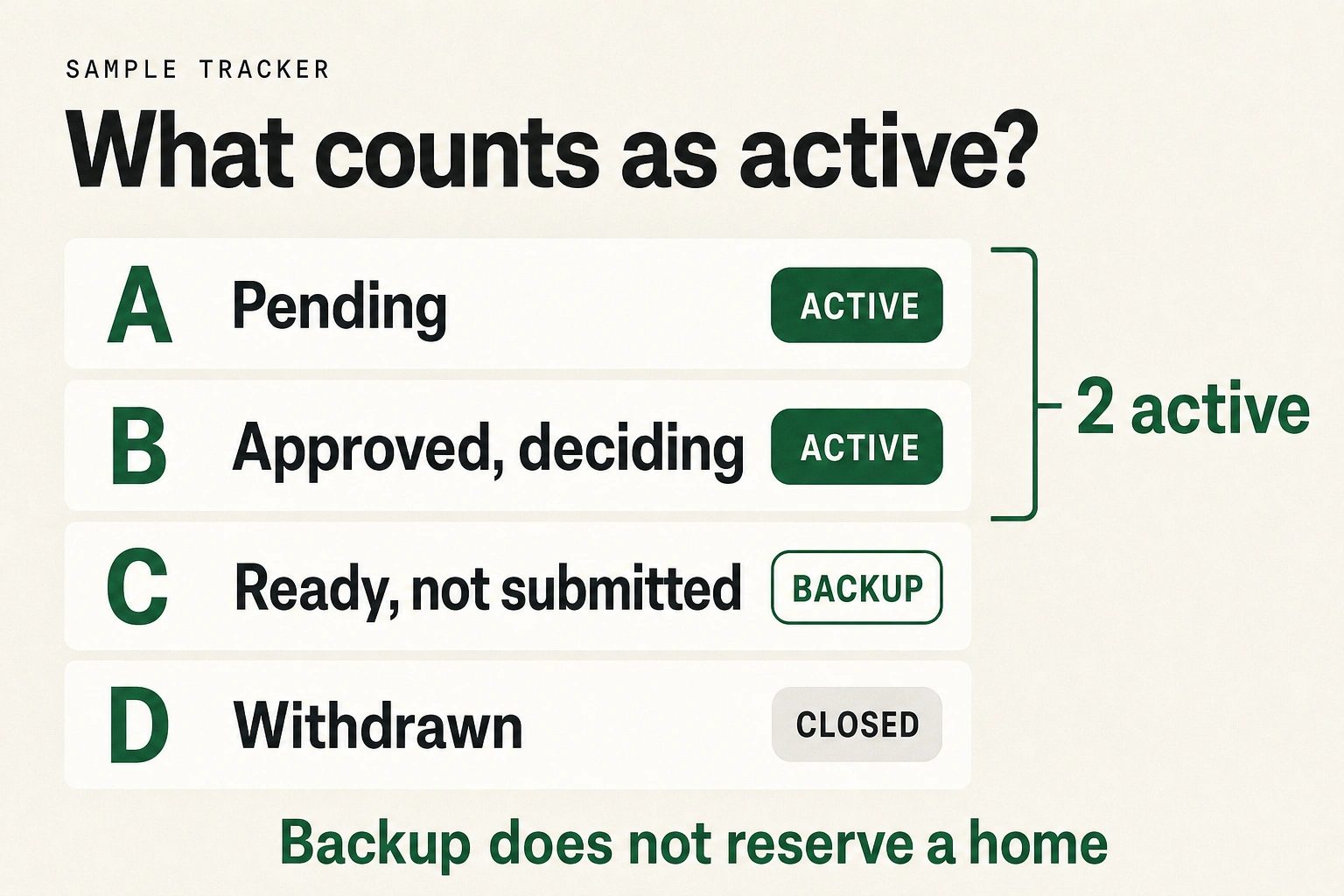
For planning, an active application is a submitted application still under consideration, or an approval you have not accepted or declined. Include a file waiting on your roommate or guarantor. It still needs attention, even if screening has not started.
A ready backup is an apartment you would take, with its price, criteria, application route, and timing already understood, but no application submitted. It is an option, not a reservation. Someone else can still rent it.
Denied and withdrawn applications leave your active count. Keep their charges in your spending tracker, plus any refund requests or payments received. Treat a refund as expected only when written terms or applicable law support it. A denial or withdrawal alone does not establish that a refund is owed.
If you applied to five apartments over a month but only one remains pending, you have one active application, not five.
Make each application worth paying for
More applications help when they give you additional realistic options. They do little for you when every property has the same requirement you cannot meet.
For example, if three properties require income documentation you do not have, three incomplete files will not solve that problem. A property that accepts your available proof may be a better backup than another apartment with the same mismatch. Fannie Mae notes that rental approval criteria vary by property, including credit requirements and acceptable income documentation.
Before paying, get the written screening criteria and the terms for the exact unit. A useful shortlist has answers to these questions:
- Would you lease it? The full monthly cost, move-in date, lease length, pet policy, and must-haves work for your household. Ideally, you have toured the exact unit.
- Can your household submit a complete file? Required adults and any guarantor have their documents and authorizations ready. Our apartment rental requirements can help you prepare.
- Is this a real opening? The application is for an available unit with a workable move-in date, rather than a general interest list.
- How does selection work? The office reviews completed applications in order, compares several applicants, or uses another stated process. Ask whether someone is already ahead of you and whether the unit remains available during review.
- What commitments and deadlines apply? You know the approval-response deadline, required payments, and terms of any holding agreement or lease, including anything requested before approval.
You can put the timing questions in one message:
I'm interested in Unit [number] for [move-in date]. What makes the household application complete, how are applications reviewed, and when could I expect a decision? What payments or agreements are required to apply or hold the unit? If approved, how long would I have to respond, and what would be due then?
An online listing or an open application button does not tell you where you stand in the process. The office's answer is more useful than a city's reputation for being competitive.
Budget for the household, including money tied up in holds
Set a total application-spending limit before choosing the next apartment. Keep it separate from the deposit, rent, and moving money you need for the home you actually choose.
Record each charge's purpose, who pays it, when it is due, and its written refund conditions. A screening fee, administrative charge, holding deposit, and security deposit can have different terms. Our application fee guide covers that distinction and location-specific fee rules.
Here is an illustrative budget, using hypothetical charges rather than typical prices:
| Item | Calculation | Cash paid |
|---|---|---|
| Two adults apply to Apartment A | 2 × $40 | $80 |
| The same household applies to Apartment B | 2 × $40 | $80 |
| The household adds Apartment C | 2 × $40 | $80 |
| A separate holding payment at Apartment B | $300 | $300 |
| Total | Screening charges plus holding payment | $540 |
The application spending is $240. Another $300 is tied up in the hold, with any refund or credit depending on the agreement and applicable law. Even money eventually returned is unavailable for another payment in the meantime.
For a conservative budget, count fees you may lose at full value. Track a possible refund separately, with its basis in written terms or applicable law and any stated return date. An expected refund cannot fund a deposit due today.
Ask about reusing an application or screening report
Before paying again, ask whether the property will accept an application or screening report you already have. Ask how recent it must be, how it must be shared, whether additional screening or fees apply, and whether each adult needs a separate report.
If two units share a leasing office, ask whether your existing application can transfer between them before opening another paid file. Use the office's stated charges in your budget. Even if it agrees to reuse, each property's decision and response deadline still needs attention.
Understand the credit inquiry before authorizing screening
A rental application does not have one universal effect on your credit. The Consumer Financial Protection Bureau distinguishes soft inquiries, which do not affect credit scores, from hard inquiries, which can.
Ask the leasing office or screening provider whether its process uses a soft or hard inquiry before authorizing it. “Background check” alone does not answer that question.
Do not assume submitting apartment applications close together makes hard inquiries count as one. FICO's rate-shopping guidance describes special treatment for qualifying mortgage, auto, and student-loan inquiries. It is not a blanket apartment-shopping exemption.
Plan around the earliest deadline, not your favorite's deadline
A second application can reduce the risk of having nowhere to go. It can also give you a decision before you are ready for one.
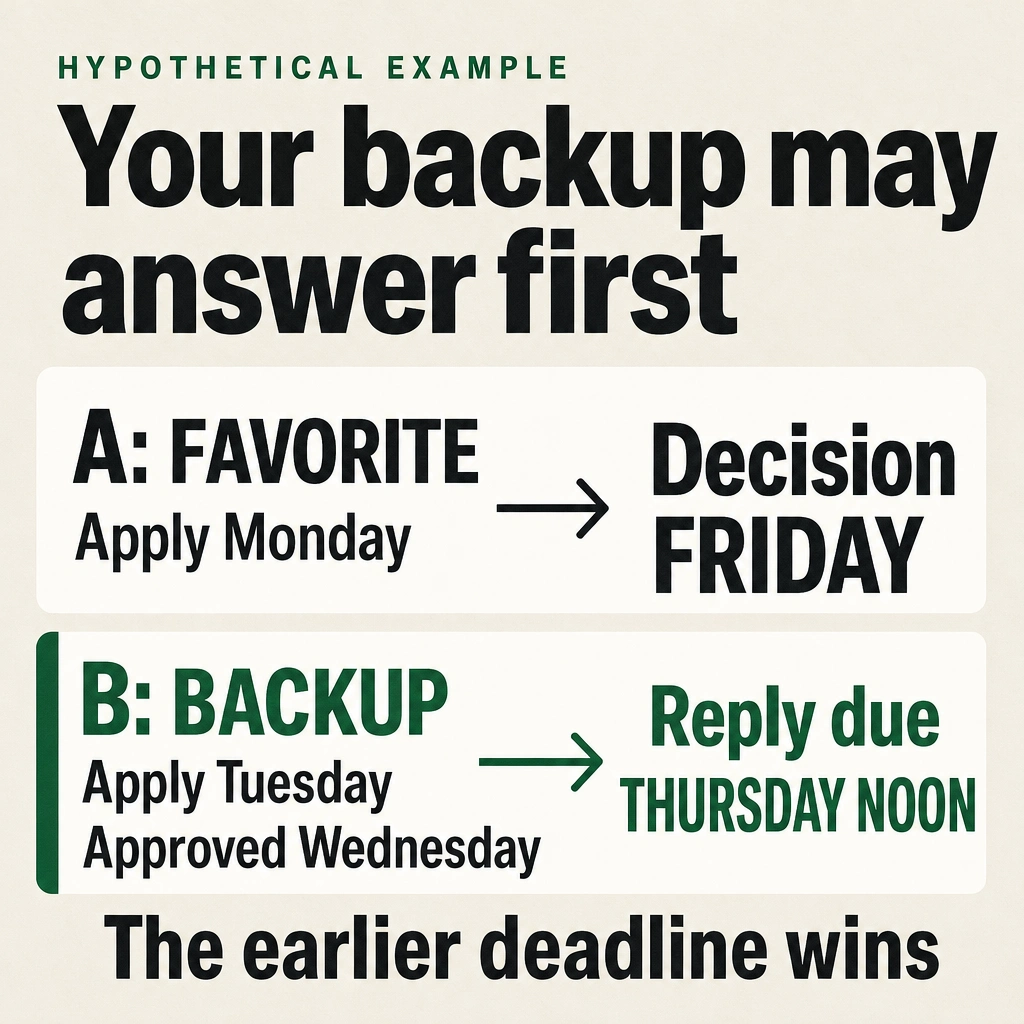
Imagine this hypothetical sequence:
- Monday: You submit a complete application for Apartment A, your favorite. Its office expects a decision Friday.
- Tuesday: You apply to Apartment B, an acceptable backup that may be rented before Friday.
- Wednesday: B approves you and gives you until Thursday at noon to respond.
You now have two active applications and one immediate decision. B's deadline controls your next move, even though A is your first choice.
You can ask A whether it can finish before Thursday noon, and ask B for an extension. Treat neither request as granted until you have an answer. Our apartment approval timeline explains what can delay a complete file.
If the timelines still do not line up, choose between securing the acceptable backup on its stated terms and letting it go while you wait for A. There may be no way to preserve both options for free. A third application may add another option, but it will not extend B's deadline or reserve A while you decide.
Set a follow-up trigger before submitting
Put the expected decision date and your own next-action time beside every active application. When that time arrives, ask what is outstanding, whether the file is complete, and when a decision is now expected.
A missing guarantor document calls for a completed file. A decision with no reliable date, close to your move deadline, may justify activating a ready backup. The useful response depends on the bottleneck.
Keep touring and saving suitable options while an application is pending. You can maintain a search without paying for every possibility.
Handle approvals and withdrawals cleanly
Rank your acceptable apartments before approvals arrive. Include the full monthly cost, move-in cash, commute, lease terms, and move date. That gives you a decision you can make under a short deadline.
An approval, a holding agreement, and a lease involve distinct commitments, with no fixed sequence. Their effect depends on the specific terms and applicable law. Read each commitment before accepting, signing, or paying. Money can be at risk before a lease is signed: California's holding deposit guidance explains that an agreement may permit retention of some or all of a holding deposit when an approved applicant does not sign. Other locations have their own rules.
Once your chosen rental is secured under the agreed terms, promptly close the applications you no longer want. Also withdraw sooner from any apartment you have ruled out. Avoid signing a second lease as a temporary backup.
For a pending application with no lease signed, a short written message works:
Hello [name], please withdraw our application for [address and unit], submitted on [date], for [applicant names]. We will not be moving forward with this rental. Please confirm receipt and whether any screening or charges remain pending. Please also confirm the disposition of any holding payment under our agreement. Thank you.
Use the portal's withdrawal option where available and send the office a written message. Save the confirmation, receipts, and any refund correspondence. Have co-applicants coordinate so one person does not continue a file the household intended to close.
Withdrawal does not guarantee a refund or reverse screening already completed. If you have signed a lease or another binding agreement, a withdrawal message alone does not cancel those obligations.
If applications keep getting denied, change the next step
Find out whether the problem is competition, a missing document, a stated eligibility requirement, or information in a screening report before buying another round of applications.
If a landlord denies you because of a tenant-screening report, federal law requires a notice identifying the reporting company and explaining your rights. You can request a free report copy within 60 days of the adverse action and dispute inaccurate information. Sending the same unresolved error to more properties can spread the problem across more applications.
Keep your backup ready without paying for everything
The right active count changes as decisions arrive. Add an application when it gives you a realistic path your current options cannot provide. Close it when that path no longer serves you.
A prepared shortlist makes that easier. If the calls, unanswered messages, and tour scheduling are slowing yours down, start with Fairway. Tell us what you need, and we'll help find matches and book tours while you keep control of where you apply.