Apartment applications
How to Get Approved for an Apartment Before You Apply
Learn how to get approved for an apartment before you apply. Check your credit, verify the property's rules, gather documents, and ask the right questions before paying a fee.
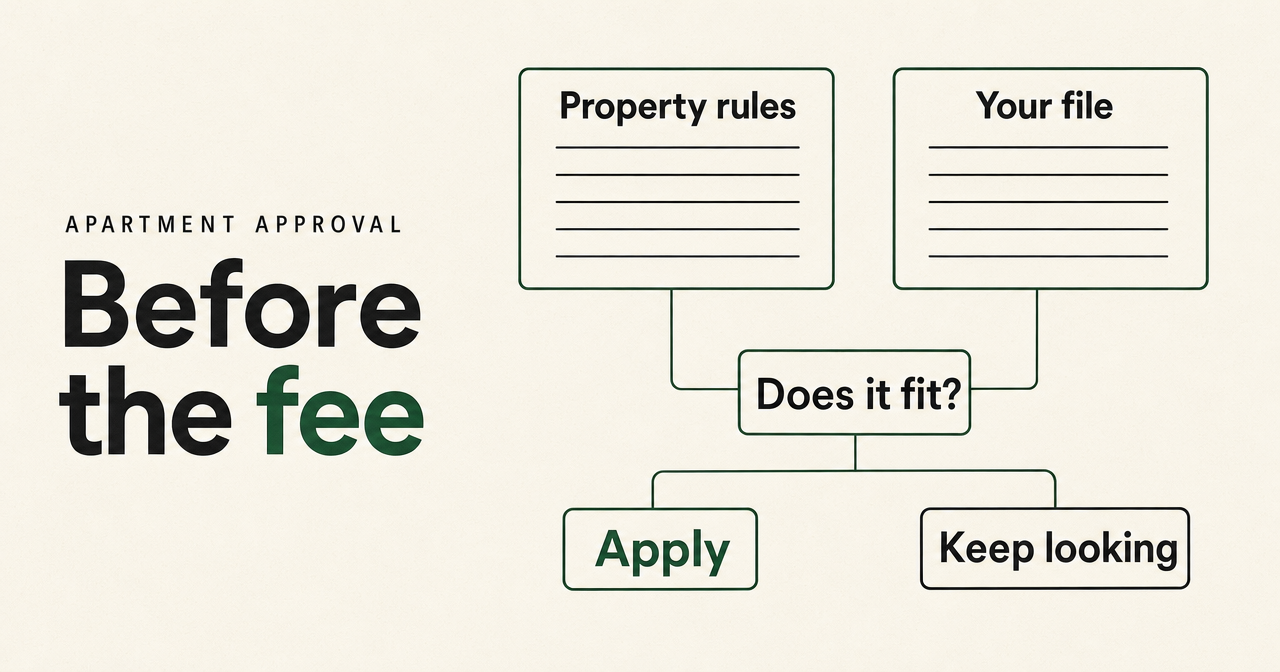
Getting approved for an apartment can feel more mysterious than it should. A lot of the stress comes from not knowing a property's real rules until after you have already paid the fee.
A more helpful way to think about it is: try to screen the listing before the listing screens you. If you can learn the property's criteria, check your credit, gather the right documents, and spot the weak part of your file early, you can avoid a lot of avoidable rejections.
The goal is not to build a perfect application. It is to avoid paying for apartments that were never a realistic fit on paper.
Start with the property's actual rules, not your best guess
Before you apply, it helps to get the property's real screening rules from the listing, leasing office, or property manager. You are trying to learn what they actually use, not what you hope they might overlook.
Approval standards can vary a lot from one property to another. That is why a good first move is not "submit and see what happens." It is ask a few direct questions before you spend the fee.
A helpful question set before you pay the fee
Use these questions in an email, chat, or quick call:
-
What income standard do you use? If you use an income multiple, what is it, and do you look at gross income or take-home pay?
If you cannot document the amount they require, that is useful to know before you pay the fee. -
Do you share a minimum credit standard, or at least the credit issues that would stop an approval?
If you already know your report has one of those issues, you can save yourself an avoidable application. -
What documents do you need for someone in my situation?
Ask this especially if you are self-employed, starting a new job, using roommates' income, living on commissions or tips, or applying as a student. -
Do you accept a cosigner or guarantor, and what does that person need to qualify with?
If you will need backup and the property does not allow it, that is worth knowing right away. -
Which screening company do you use, and what happens if a report comes back with an error or needs clarification?
If a tenant-screening report later affects the decision, the CFPB says you must get an adverse-action notice with the screening company's contact information, and the FTC says you can dispute mistakes in that report. -
How does the review process work, and what usually slows it down?
If your move date is tight, do not guess. Ask when they count an application as complete and when you should expect either an answer or a request for more documents.
If a leasing office will not answer any basic screening questions, treat that as a warning sign. You may still decide to apply, but at least you will know you are paying for uncertainty.
What landlords usually check during apartment approval
Apartment approval is not one single pass-or-fail box. It is usually a stack of checks that answer one question: Does this renter look likely to pay on time and handle the lease responsibly?
The main areas are:
- Income and employment: Can you clearly document the income the property requires?
- Credit history: Do you have unpaid debts, collections, or a pattern of missed payments?
- Rental history: Have you paid rent on time before, or do you have references that help fill the gap?
- Background or tenant-screening reports: Is there anything in the screening file that raises risk?
- Application consistency: Do your documents, income, addresses, and personal details all line up?
The exact mix varies by property, but if one of those areas is weak, that is usually the part of the application to strengthen or work around before you apply.
Make sure the rent works on paper, not just in your head
A lot of renters have a gut sense of what feels manageable. Approval usually turns on what you can document, not just what feels doable month to month.
Some properties use a stated income formula. Others review the whole file and do not share one universal number. Either way, ask the property to explain their standard before you apply.
At minimum, try to clarify:
- whether they look at gross income or net income
- whether roommates' income is combined or reviewed separately
- which documents they accept for overtime, tips, commissions, or freelance work
- whether a new job offer letter is enough if you do not have long pay history yet
If a property tells you it requires income equal to 3x the monthly rent, the math on an $1,800 apartment would be about $5,400 a month in gross income. That example is there to show the math, not to suggest every property uses the same rule.
If the rent works only when you round up, leave out unstable income, or hope the property will bend its policy, it may be better to keep looking. A better-fit apartment usually beats a long explanation.
Pull your credit report before they do
If a landlord is going to look at your credit, you should know what they are about to see.
Use AnnualCreditReport.com to pull your reports from Equifax, Experian, and TransUnion. The site says free weekly online credit reports are available from all three bureaus.
When you check your reports, look for:
- unpaid collections
- accounts that are not yours
- balances that were already paid
- late payments you did not expect
- outdated personal information
If you find a problem, deal with it before you start sending applications. And if you have a freeze on your credit reports, lift it before you apply so screening does not get stuck waiting on access.
A lower score does not automatically mean a denial. But a surprise collection, a frozen report, or unresolved debt can slow the process down fast.
Gather your documents before you start sending applications
It helps to do this once instead of scrambling for each apartment separately.
A basic apartment-approval folder should usually include:
- government-issued photo ID
- recent pay stubs
- recent bank statements
- employer contact information
- Social Security number or tax ID information if required for screening
- rental history details and past landlord contact information
- references you are comfortable sharing
Depending on your situation, you may also need:
- tax returns if you are self-employed
- a signed offer letter if you just started a new job or have limited pay history
- client letters, profit-and-loss statements, or other proof if your income is irregular
- a university acceptance letter or similar school documentation if you are a student without traditional income records
The goal is not to drown the leasing office in paperwork. The goal is to make it easy for them to verify what matters without chasing you for missing pieces.
Strengthen the weakest part of your application before you apply
Find the part of your file most likely to trigger a follow-up question, then try to shore up that part before you spend money.
If your credit is weak
A short explanation rarely overrides a formal screening policy. What usually helps more is knowing the rule and deciding whether this property is even worth the fee.
Instead:
- check your reports for errors first
- ask whether the property shares the credit issues that would stop an approval
- confirm whether the property accepts a guarantor or other standard fallback before you apply
- bring the clearest proof of stable income you can
Do not count on a larger deposit or a personal explanation as a rescue plan unless the property clearly says that is part of its normal policy. Some properties follow fixed screening rules.
If you have no rental history
This is common for first-time renters, people moving out for the first time, and people relocating from a different housing setup.
You are not automatically out. You just want stronger substitute signals ready.
Before you apply, ask what the property accepts instead of prior landlord history. Some will consider stronger income proof, references, or a guarantor. Others will not.
The most useful substitutes are:
- personal or professional references who can speak to your reliability
- strong proof of income
- a short rental resume with work history and contact details
- a cosigner or guarantor if the property allows one
If the property requires established rental history and offers no alternative, save the fee.
If your income is hard to verify
This is where self-employed renters, freelancers, contractors, and new hires often get stuck.
Try to make your income easy for someone else to follow.
That may mean sharing:
- tax returns
- bank statements
- a signed offer letter
- client letters
- a profit-and-loss statement
Before you apply, ask which exact documents they accept. It is much better to hear "we need two tax returns and three bank statements" before you pay than after your file is already in limbo.
Use a cosigner or guarantor only when it actually solves the problem
This option can help, but only if the property actually accepts one and your backup person meets the property's rules.
At a high level:
- a cosigner agrees to share financial responsibility under the lease
- a guarantor also backs the lease financially, even though properties do not always use the terms the same way
Before you rely on this option, ask:
- Does the property accept cosigners, guarantors, or neither?
- What income or credit standard does that person have to meet?
- Does the guarantor submit a separate application or fee?
- Do you still need to qualify on any minimums yourself?
If you need a guarantor path and the property does not offer one, that is useful information before the fee, not after it.
And if someone is willing to help you, make sure they understand the lease obligation they are taking on.
Submit a complete application and stay easy to reach
Once your file is ready, try to keep the application clean.
That means:
- use the same income numbers everywhere
- make sure your addresses and dates match your documents
- upload everything the property asks for the first time
- answer follow-up questions quickly
A lot of approvals get delayed for boring reasons: missing pay stubs, mismatched addresses, no landlord phone number, or a guarantor who has not sent their paperwork yet.
Do not give the leasing office a reason to move on to the next applicant because yours is taking extra work.
Ask about turnaround time before you pay the fee
There is no single apartment-approval timeline that fits every property.
A clean file might move quickly. A file that needs employer verification, roommate documents, or guarantor paperwork can take longer. Some offices review applications as they come in. Others batch them or pause on weekends and holidays.
If timing matters, ask these questions before you apply:
- When do you consider an application complete?
- Do you review applications in the order they are submitted or the order they become complete?
- What are the most common reasons for delay?
- If I apply today, when should I expect either a decision or a request for more information?
That answer helps you compare apartments on more than rent alone. A slightly less perfect apartment with a clear process may be a better move than a perfect listing with a vague timeline.
What to do if you still get denied
If you still get denied, try to treat it like information instead of a mystery.
The CFPB says landlords must tell you when information in a tenant-screening report affected the decision. They also have to give you the name, address, and phone number of the company that created the report.
That matters because you can request a free copy of that report within 60 days. The FTC says the adverse-action notice should also explain your right to dispute mistakes.
If screening data caused the problem:
- Get the adverse-action notice.
- Request the report from the screening company within 60 days.
- Check for errors, wrong balances, or outdated information.
- Dispute anything inaccurate before you keep paying new application fees.
If the denial was not about a factual error, treat it as a clue. Ask yourself which exact rule you missed: income standard, credit history, required documents, rental history, or guarantor policy. Then narrow your next search instead of repeating the same fee gamble.
Quick checklist before you pay another application fee
Before you apply again, try to make sure you can say yes to these:
- I know this property's income standard and whether it uses gross or net income.
- I know what documents the property wants from someone in my situation.
- I checked my credit reports first.
- I know whether the property accepts a cosigner or guarantor if I need one.
- I asked how the review process works and what usually causes delays.
- My ID, income proof, and references are ready to send.
- I have a backup plan if one of the answers above is a no.
That prep can save you money, stress, and a lot of wasted applications.
FAQ
What credit score do you need to get approved for an apartment?
There is no single national cutoff.
Some properties will share a minimum. Others will only say they review the whole credit profile. Before you pay a fee, ask whether they share a credit standard or at least the issues that would stop an approval. If they will not share anything, you can decide whether the fee is worth that uncertainty.
Can a cosigner or guarantor get me approved for an apartment?
Sometimes, but only if the property accepts one and the backup person meets the property's rules. Ask about that option before you apply, not after a denial, and get clear on whether the guarantor files separate paperwork or has to meet a specific income standard.
Can a bigger deposit fix a borderline application?
Do not assume so. Some properties use fixed screening rules, and the available fallback options vary by property. Ask about the property's approved paths before you apply. If the only plan is "maybe they will make an exception," that is usually not a strong bet.
What if I have no rental history?
Ask what the property accepts instead of prior landlord references. Useful substitutes can include stronger income documentation, personal or professional references, a job offer letter, student records, or a guarantor. If the property requires established rental history and will not name any acceptable substitute, save the fee.
What if I need an answer fast?
Ask when the application becomes "complete," what delays happen most often, and when you should expect either a decision or a request for more documents. If the office cannot answer that clearly and your move date is tight, keep shopping.
Final thought
Getting approved for an apartment is rarely about sounding convincing after the fact. It is more about knowing the rules, lining up the paperwork, and choosing apartments that make sense for your file.
If you are apartment hunting in the SF Bay Area, Fairway can help you search listings in plain language, compare apartments and fees side by side, and coordinate tours. It is free for renters.