RENTAL APPLICATIONS
If You Apply for an Apartment, Are You Locked In?
Does an apartment application lock you in? Learn about deposits, withdrawal and pre-sign unit switches with Fairway, the free AI agent for renters.

You submit an application, pay a fee, and get an approval email. Then a better apartment appears. Suddenly, a screening form feels like a promise you might have to keep.
The confusing part is that one application portal can bundle several different agreements. Separating the screening request from any reservation or rental commitment makes it easier to understand what you can cancel, what money is at stake, and how to switch units before signing.
An ordinary application usually does not lock you into renting
Applying for an apartment usually does not obligate you to rent it. An ordinary application asks the landlord to evaluate you as a potential renter. Approval is a step toward a lease, rather than an automatic agreement to move in. Fannie Mae describes that application and approval process separately from signing a lease.
But “I have to rent this apartment” and “I could lose money if I withdraw” are different questions. You can have a screening fee or a separate reservation obligation without having agreed to a tenancy.
The important exception is a packet that goes beyond screening. An application agreement, accepted offer to lease, or separate rental agreement may create obligations before you sign a document titled “Lease.” Electronic signatures can count, too. And a paper lease is not the only possible rental contract: Minnesota's attorney general explains that oral leases can be valid under that state's law.
So the useful starting point is what you agreed to, rather than the name of the form or whether you have keys.
If you are still comparing homes, our AI agent for renters helps with the search legwork. Fairway is free for renters. You describe what you want, and we find matches, call landlords or leasing offices, and book tours. The property's application and reservation terms remain separate from using Fairway.
What each application-stage document can mean
A signature on a screening form can authorize background checks and confirm that your answers are accurate. That signature alone does not necessarily mean you promised to rent the apartment. The surrounding terms matter.
| What you submitted or accepted | What it generally does | What matters if you change your mind |
|---|---|---|
| Screening application and consent | Gives the landlord information and permission to evaluate you | Screening charges, authorizations, and any additional terms included in the packet |
| Application-fee terms | Describe the charge for processing or screening | Whether a refund is available under the terms and applicable law |
| Holding-deposit or reservation agreement | Reserves a particular apartment for a stated period | Cancellation conditions, deadlines, and whether money is returned, credited, or retained |
| Application agreement or offer to lease | May add promises beyond screening, including a commitment triggered by acceptance | The exact promise, how acceptance occurs, and any withdrawal or damages clause |
| Rental agreement, including one accepted electronically | Sets the terms of a tenancy | This is a different situation from withdrawing a screening application |
A reservation agreement might be a separate attachment or a few paragraphs above the submit button. Its placement does not make it less important.
Language such as “binding upon acceptance,” “agree to execute the lease,” or “deposit retained if applicant withdraws” signals that the packet includes more than permission to run a report. Those phrases describe different possible obligations. They do not all mean the same thing, and their enforceability depends on the agreement and local law.
An application fee and a holding deposit carry different risks
An application fee generally pays for processing or screening. Paying it does not, by itself, buy a reservation or establish that you owe rent. Withdrawal also does not automatically erase a charge for work already performed. Refund rights vary, including when screening never happens. Our application fee guide explains that separate cost question.
A holding deposit, sometimes called a reservation payment or application deposit, serves a different purpose. The agreement may reserve a unit while you decide or while the landlord finishes the application process. It can set conditions for keeping the money if you withdraw or miss a signing deadline.
The label on the payment screen is only a starting point. A charge called a “deposit” is not automatically refundable, and a charge marked “nonrefundable” is not automatically lawful.
Two state examples show why there is no single national refund answer:
- Washington: Holding payments cannot exceed 25% of the first month's rent. For a payment collected after the unit is offered to the renter, the landlord must immediately provide a receipt and written retention conditions. If the renter does not occupy the unit, the law allows retention up to the full payment in accordance with those conditions, subject to statutory protections. Washington's holding-deposit law treats that payment separately from screening costs.
- Wisconsin: Withdrawing before the landlord accepts or rejects the application triggers different earnest-money return rules from declining after approval. After approval, certain actual losses may be deducted, with limits. The state's landlord and tenant guide also addresses cases where the landlord significantly changes the previously disclosed rental terms.
These state-specific rules cannot be applied nationwide. The apartment's location matters alongside the written agreement.
Can you back out after apartment approval?
Usually, yes, if you submitted only a screening application and have not otherwise agreed to rent. With a reservation or application agreement, however, the approval email may trigger a deadline or change the refund conditions.
Before relying on “I haven't signed yet,” bring these details together:
- The unit: The exact address and apartment number covered by the application or reservation.
- The acceptance event: Whether the terms refer to approval, notice of approval, your acceptance, or signing.
- The cancellation cutoff: A specific date and time, or a period measured from another event.
- The notice method: The email address, portal action, or other delivery method required for withdrawal.
- The money consequence: Which payment is affected and whether the agreement claims a fixed charge or actual losses.
- The lease deadline: When the office expects a signed rental agreement and any remaining funds.
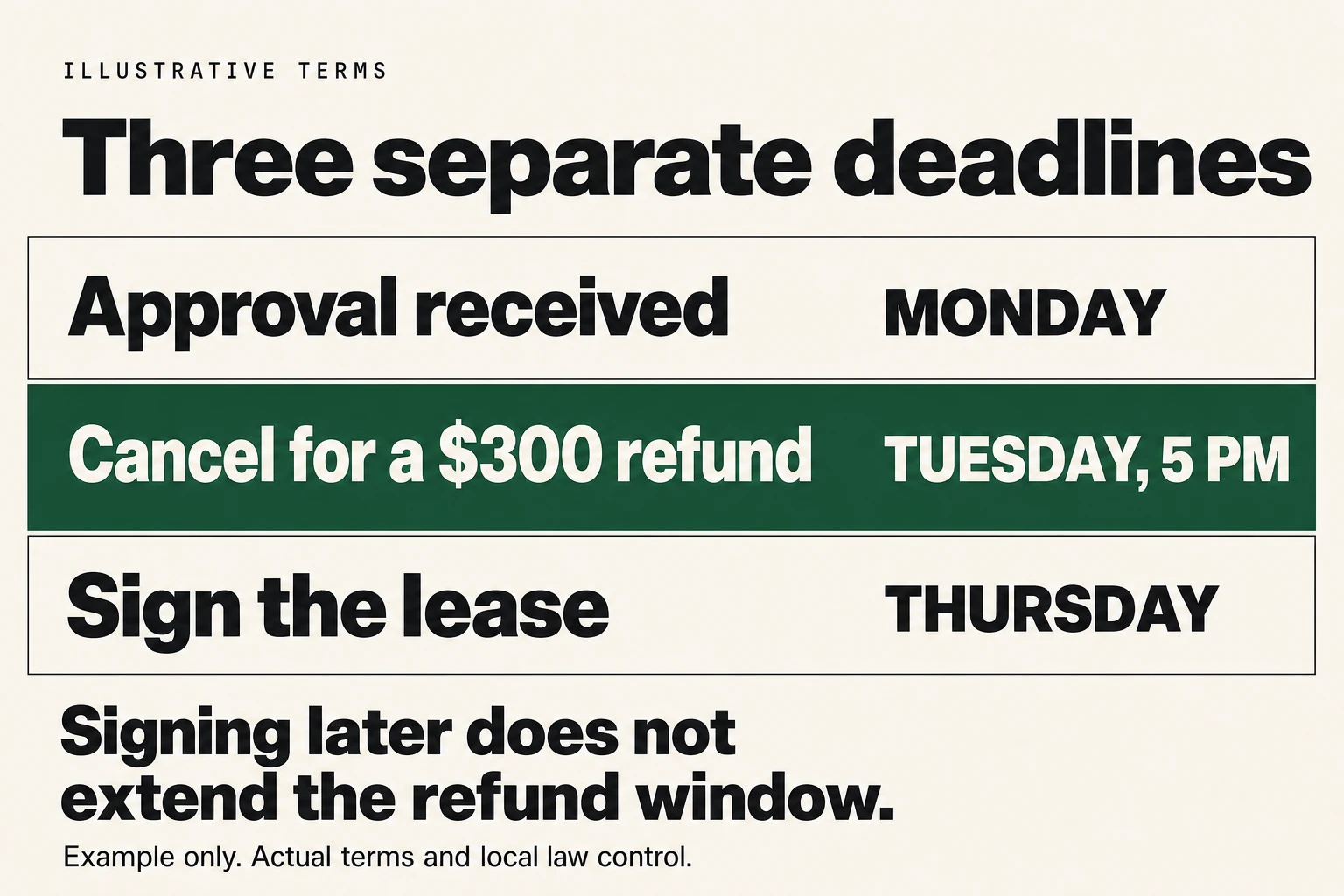
For example, imagine reservation terms that allow a $300 refund until Tuesday at 5 p.m., while giving you until Thursday to sign a lease. Under that hypothetical arrangement, waiting until Wednesday could put the $300 at risk even though the signing deadline has not passed. A later lease deadline does not extend an earlier refund window.
Our apartment approval timing guide covers the screening timeline. That timeline is separate from any cancellation window in your agreement.
How to withdraw an apartment application before a lease
Once you decide against the apartment, a clear written withdrawal is more useful than leaving the portal unfinished or ignoring an approval email. It creates a record of what you communicated and when.
Save the terms and payment record
Keep the submitted application, attachments, electronic acknowledgments, receipts, approval messages, and reservation terms. A copy showing the terms you actually accepted is more useful than a current blank form that might have changed.
For money paid together, separate the amounts in your notes. “$50 screening fee plus $300 holding deposit” is clearer than “$350 application payment.”
Send an unambiguous withdrawal
Use the notice method in the agreement. If that requires a portal submission, save its confirmation and send a matching email to the leasing office. A phone call can help reach someone quickly, but a written record makes the timing and request clearer.
For a screening application where you have not entered a rental agreement, you can adapt this message:
Subject: Withdrawal of rental application for [address and unit]
Hello [name], I am withdrawing my rental application for [address and unit], submitted on [date]. I will not be proceeding with this apartment. Please stop any application processing that can still be stopped and confirm receipt of this withdrawal.
I paid [amount and payment description] on [date]. Please confirm any refund due, any amount you propose to retain and its basis, and when the refund will be issued. Thank you.
A withdrawal message does not guarantee a refund or undo a screening report already obtained. It also does not resolve a separate agreement that the landlord says is binding.
Close the loop on each payment
Ask for written acknowledgment that the application has been withdrawn and an accounting of each payment. If you had a reservation, request confirmation that it has ended and what happens to the money.
If the office claims you owe rent or a cancellation charge, ask it to identify the specific agreement, clause, and event that created the claimed obligation. Keep that response with your records. Avoid signing a new document that admits liability or releases claims just to get a withdrawal acknowledgment.
For a disputed binding offer or retained deposit, a local renter legal-aid organization can assess the actual packet. USAGov's tenant-rights directory connects renters with state resources and legal help.
Can you switch to another unit before signing?
You can request a different unit before signing, including another apartment in the same building. The leasing office must agree to the change. An approval for Unit 204 does not establish that Unit 315 is available, costs the same, or comes with the same move-in date.
Treat the switch as two separate arrangements: ending or changing the original unit's application or reservation, and documenting the new unit's terms.
One concise request can cover both:
I'd like to change my application from Unit 204 to Unit 315 before entering a rental agreement. Please send the new rent, required fees, lease term, and available move-in date. Can you also confirm whether my application and screening can be reused, whether my holding deposit transfers, and how the original reservation will be closed?
The written response should make these points clear:
- New apartment: The exact unit, rent, required recurring charges, lease term, and move-in date.
- Application status: Whether existing screening and approval carry over or new processing is required.
- Payments: Which amounts transfer, which are refunded or retained, and whether additional charges apply.
- Original reservation: Whether it ends, when it ends, and whether any obligation remains.
- New deadlines: The cancellation cutoff and signing deadline for the replacement unit.
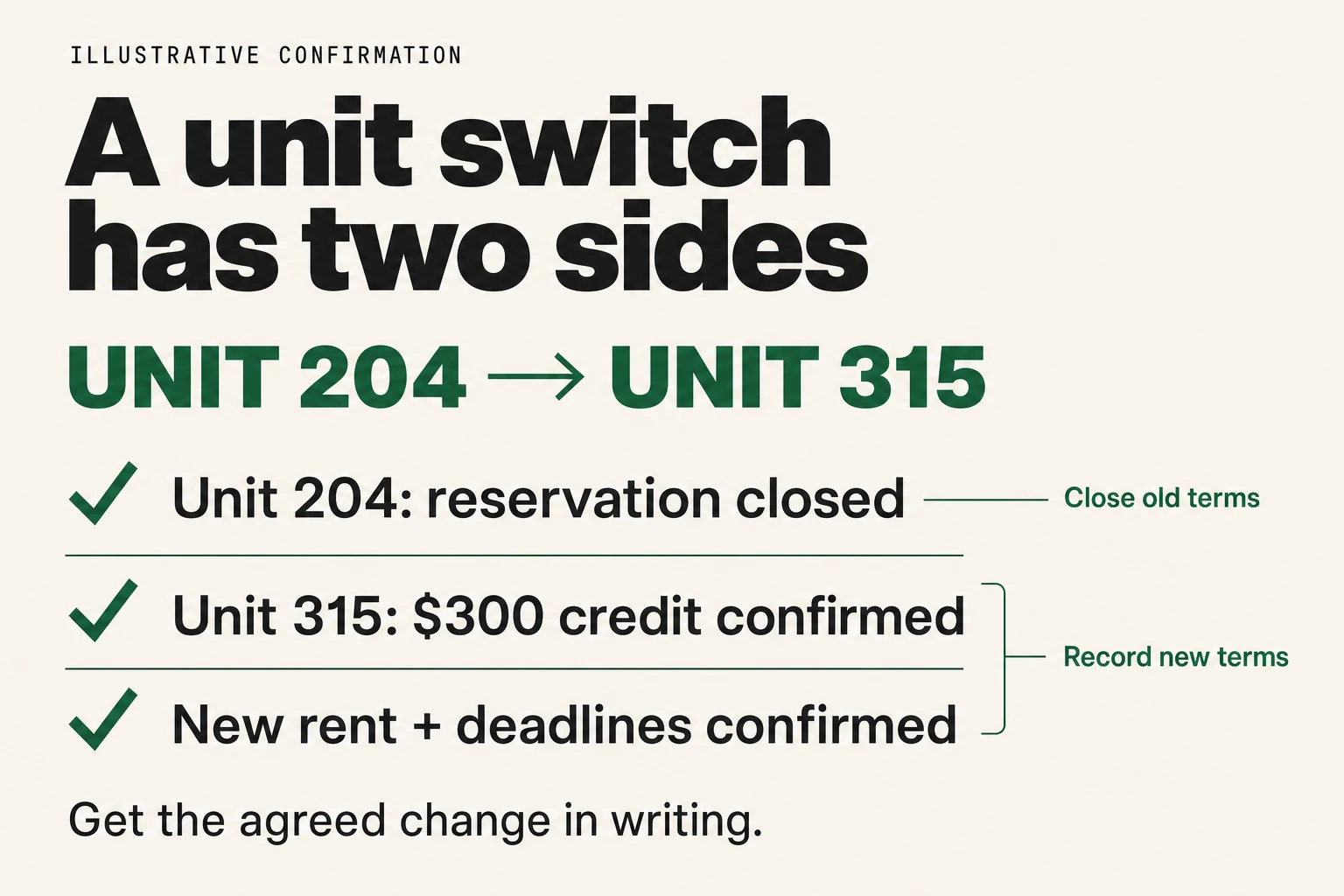
Do not assume a deposit transfers because the two units share a landlord. A written change should identify the payment and the unit it now covers. If the original agreement claims a cancellation charge, the switch confirmation should address that charge too.
When moving to a different property or management company, approval and payments do not automatically follow you. A fresh application may be necessary. Closing the first application and applying elsewhere are separate steps.
Keep the decision and the paperwork aligned
An ordinary application usually leaves you free to decline the apartment. A separate reservation or application agreement can still put money or other obligations at stake. The safest decision rests on the actual promises, payment terms, and deadlines, rather than an assumption that everything before keys is reversible.
If you are returning to the search, tell us what you want. We'll find matches, make the calls, and help line up tours so you can spend your time deciding which home fits.