Renter guide
Living Near Train Tracks: Should You Rent That Apartment?
Living near train tracks? Weigh freight, horns, vibration, night noise and station access with practical guidance from our free AI agent for renters.
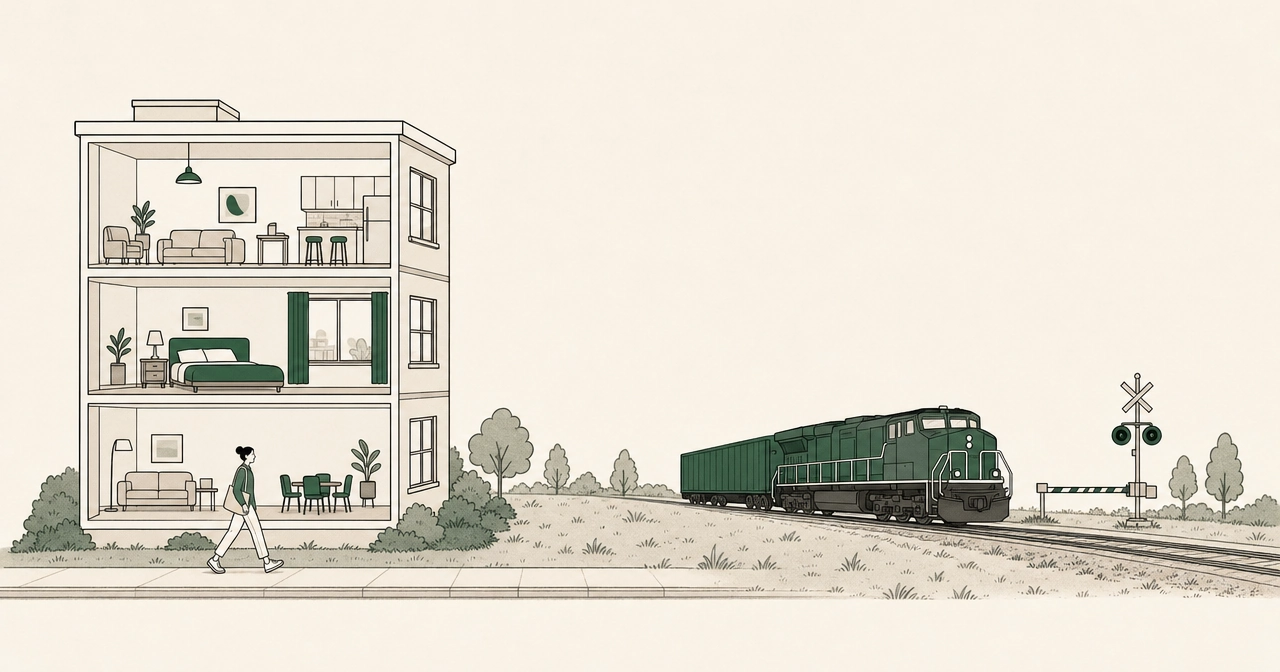
An apartment near train tracks can look like an easy win: a convenient location, a layout you like, maybe a shorter commute. The hard part is learning what it feels like when the tour ends. A quiet afternoon tells you little about overnight freight or a horn outside your bedroom.
The decision gets clearer when you separate the rail line's activity, the exact apartment's noise and vibration, and the transportation benefit you would actually use.
Is living near train tracks a good idea?
It can be, when the apartment works during your sleep and work hours and the location gives you something worthwhile in return. We would give more weight to hearing a passing train inside the actual bedroom than to a leasing agent's assurance that everyone gets used to it.
Three questions help organize the decision:
- What runs here, and when? Passenger trains, freight, switching and maintenance can have different patterns.
- What reaches this unit? Horns, rolling noise and physical vibration deserve separate attention.
- What do you gain? A usable station, shorter commute or lower total cost matters more than being close to rails on a map.
In the metros we cover, our AI agent for renters handles more of the search busywork, free for renters. Describe what you want; we find matches, call landlords and book tours. A listing match still cannot tell you how a train feels from your future bed.
Find out what uses the tracks
A line that looks like a commuter route can carry more than the trains on one timetable. Near San Jose's Tamien station, for example, Caltrain's shared-use bridge description identifies several passenger services and Union Pacific freight using the same bridges.
For your shortlist, the useful distinction is between scheduled passenger service and other rail activity:
| Rail activity | What it means for a renter | Useful information |
|---|---|---|
| Passenger service | Published trips help you understand the service day and likely passing-train times | Every passenger operator's weekday, weekend and holiday timetable |
| Freight service | Timing may be variable, including overnight movements | Railroad community information and answers about current local operations |
| Yard, side-track or maintenance activity | Passing trains may be only part of what you hear | Nearby facilities, railcars being moved between tracks and work notices |
Twin Cities & Western's community rail guidance says its trains can run daily at any time of day. “Usually around nine” is useful local context, but it is a weak basis for assuming quiet every night.
A helpful question for the railroad or city is: “Which operators use this stretch, and does it have freight, overnight switching or nearby railcar storage?” The leasing office can describe the building. It may know much less about railroad operations.
The Federal Railroad Administration's (FRA) Rail Crossing Locator provides crossing locations and inventory records submitted by railroads and states. It helps identify the corridor; it is not a live train schedule. An old inventory average cannot tell you how many trains will pass tonight.
Nearby crossings change the horn question
Train noise includes several distinct sounds: rolling rumble, wheel squeal, bells and horns. A home beside a straight stretch of track and a home beside a road crossing present different questions, even at similar distances from the rails.
In the U.S., federal rules generally require routine horn sounding as trains approach public highway-rail crossings, unless a qualifying quiet-zone restriction applies. A quiet zone limits routine crossing horns. Horns can still sound for emergencies and other operating requirements. The FRA's horn guidance explains both the requirement and its exceptions.
The public authority responsible for the crossing, often the city or county, is the right source for the current quiet-zone boundaries. “The building is in a quiet zone” leaves an important gap: which nearby crossings are covered?
Quiet-zone status also says nothing about rolling noise or vibration. Caltrain's quiet-zone explanation notes that locomotive bells still operate at crossings. A “no routine horn” claim is narrower than a promise of silence.
Listen for noise and feel for vibration separately
Airborne sound travels to the building through the air. Ground-borne vibration travels through the ground into the foundation and building. It can produce perceptible movement, rattling and a low rumble indoors. Ground conditions and the building's construction affect the result, as the Federal Transit Administration's (FTA) noise and vibration manual explains.
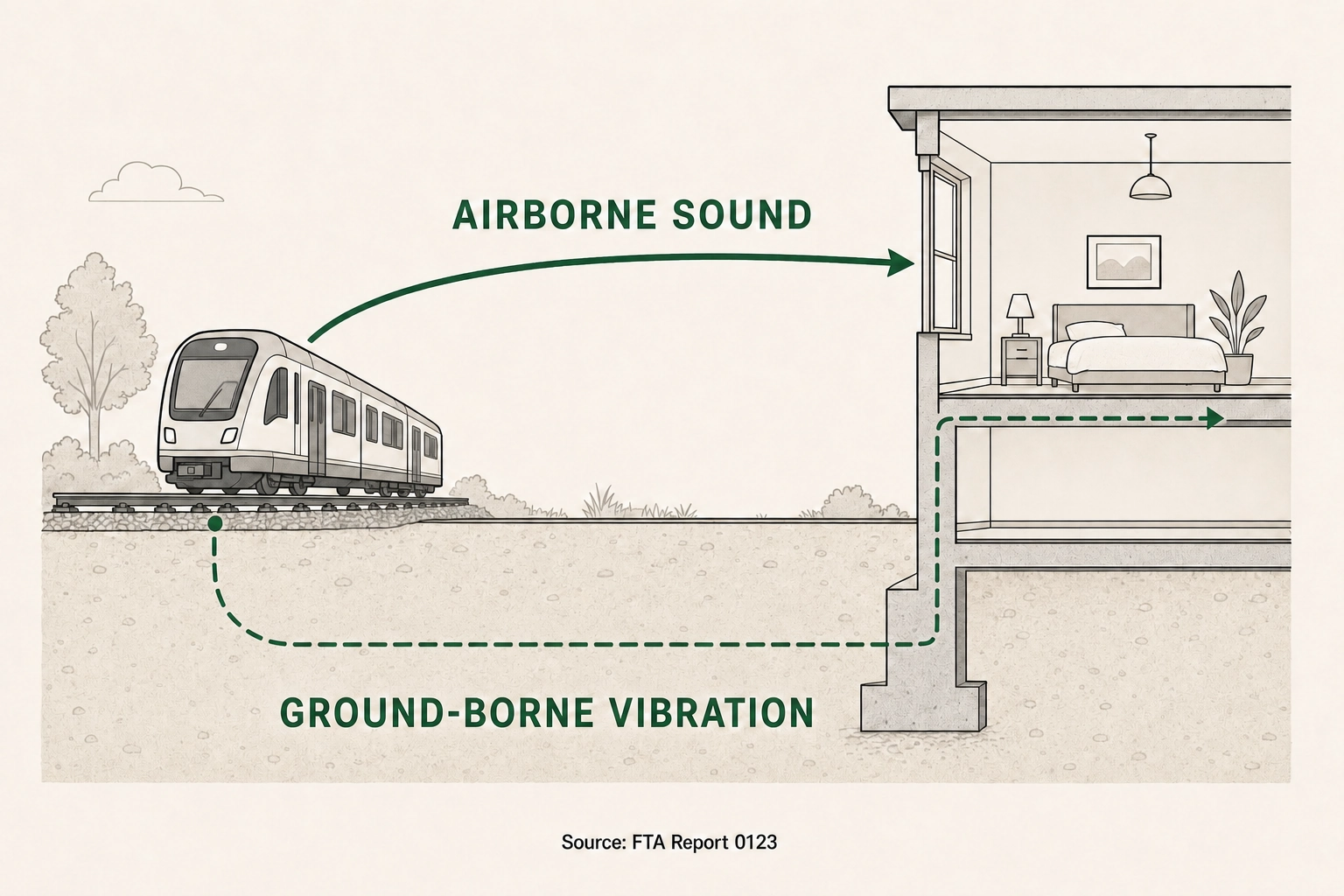
During a passing train, a useful pause inside the apartment includes:
- Listening: Does a horn interrupt conversation? Does a low rumble linger? Are bells or squealing distinct from the rolling sound?
- Feeling: Is there movement underfoot or through the chair where you are sitting?
- Noticing rattles: Do windows, doors or fixtures buzz as the train passes?
A rattle alone does not establish its cause or diagnose a building problem. For the rental decision, the immediate question is whether the experience would interfere with the way you use that room.
Treat noise and vibration as separate lines in your notes. A window that makes an outdoor horn less noticeable does not establish that the apartment will feel still.
The bedroom's windows matter more than the lobby
The exact unit deserves its own viewing. A courtyard-facing model apartment cannot represent a track-facing bedroom in another wing. Our broader apartment viewing questions help keep the unit, condition and management promises separate.
For rail noise, spend time where you would sleep and work. If a train passes, compare the track-facing room with the room on the opposite side. Notice whether your bed or desk would sit beside the most exposed window. An elevated line may also sit close to the height of a particular apartment's windows, so “higher floor” alone is an incomplete description.
Hear the rooms with windows fully closed. With permission, open them too if that is how you expect to live. A room that suits you only with closed windows may be a poor match if you rely on an open bedroom window at night.
Window condition and building construction matter, but “double-pane” is not a comfort guarantee. The FTA manual describes noise-control measures involving façade gaps and specially designed doors and windows. For the rental decision, give more weight to the apartment's existing features.
If management promises a repair, such as fixing a window that will not close properly, ask for the specific work and completion date in writing. A future upgrade, curtains or a white-noise machine should not carry the decision for a room you already find disruptive.
An afternoon tour leaves nighttime and weekend gaps
A tour with no train gives you information about the layout and windows. It gives you no firsthand evidence of a train passing.
If possible, arrange a return visit around an evening or early morning that matters to your routine, plus a weekend. Night-shift renters may care most about midday freight. Someone working from home may care more about repeated interruptions during calls than a late train.
A simple visit record keeps the observations useful:
| Record | Example |
|---|---|
| Time and place | Saturday, 9 p.m., actual bedroom |
| Rail activity observed | Passenger train passed; no freight observed |
| Window position | Closed |
| Sound and movement | Rolling sound audible; no movement noticed |
| Remaining gap | Overnight freight and maintenance not experienced |
Several quiet visits still cannot rule out an infrequent freight train or future changes.
Current residents can add useful detail. Specific questions tend to produce better answers than “Is it noisy?” Try “What do you hear after passenger service ends?” or “Does your bedroom face the tracks, and do you sleep with the window open?” Their answers describe their experience, which may differ from yours or from a unit on another side of the building.
Maintenance deserves its own question. Caltrain describes nighttime track maintenance using heavy equipment that can be heard by neighbors. Other operators have their own work patterns. The last passenger departure is not a reliable cutoff for all rail noise.
Count the station access you can actually use
Living beside tracks is different from living near a usable station entrance. The platform might be across the corridor, with the public crossing several blocks away. A nearby express train might pass without stopping at your station.
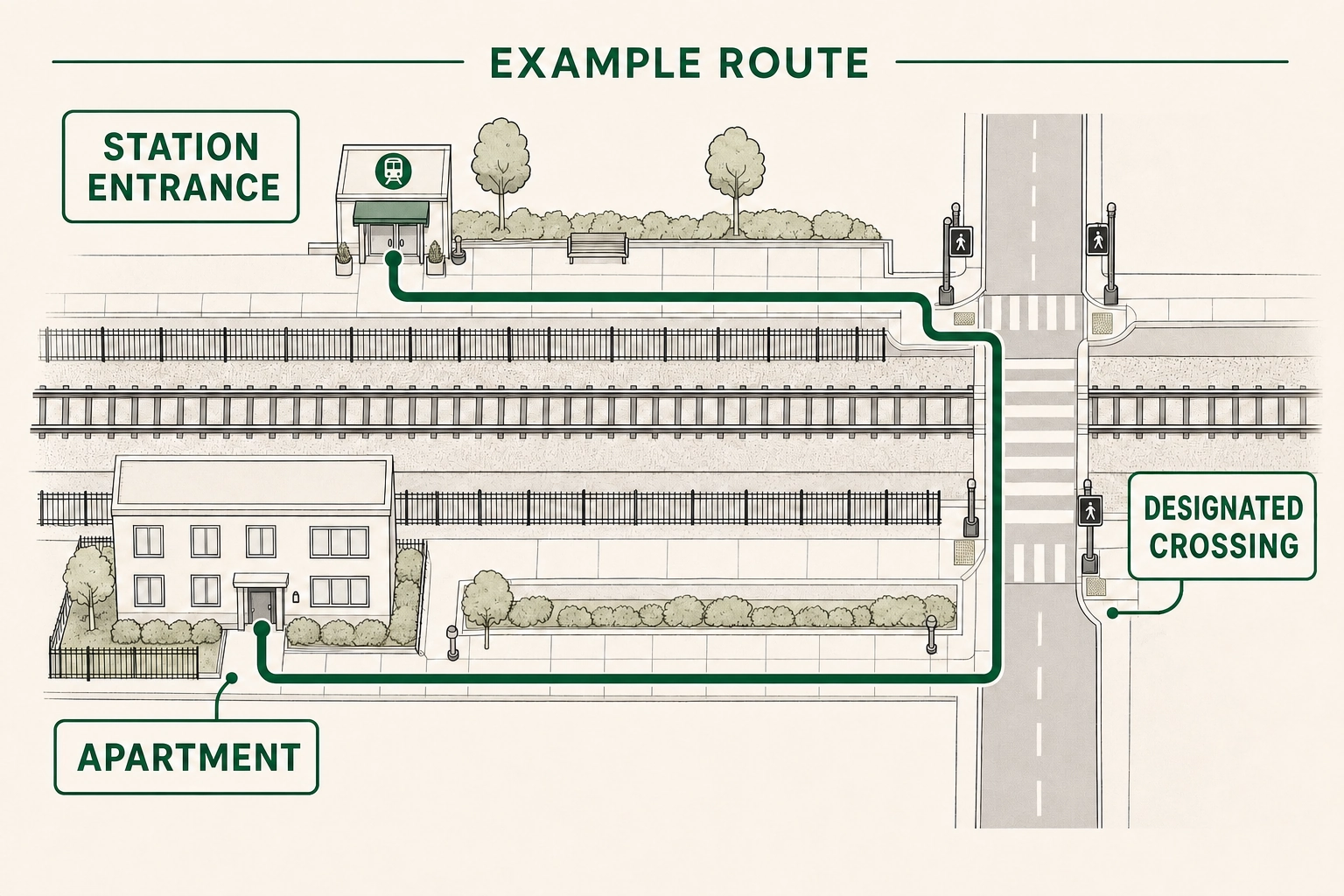
A worthwhile commute comparison includes the whole route:
- Apartment door to the correct station entrance and platform.
- Designated crossings, gate waits, stairs, ramps and elevators you would use.
- Departure times that fit your workday, including the trip home.
- Transfers and the walk from the destination station.
- Weekend or late-night service if those trips matter to you.
Use designated pedestrian or roadway crossings and obey their signs and signals. The rail right-of-way is never a station shortcut. The FRA's pedestrian crossing guidance makes that boundary clear.
For a hypothetical comparison, a 35-minute door-to-door commute instead of 50 minutes saves 30 minutes per round trip. At three commuting days a week, that is 90 minutes. Include station walks and waiting in both figures; comparing a train's ride time with a car's full trip makes the rail apartment look better than it is.
Fares, parking and backup transportation belong beside rent and required fees in the total. A freight-only line gives you no passenger commute benefit simply because it runs behind the building.
Leave room for service disruptions
A route that fits the normal timetable can become inconvenient during a closure or cancellation. Caltrain's service alert system, for example, covers service changes and elevator outages as well as train disruptions.
For each finalist, useful evidence includes planned construction notices, modified weekend schedules and accessible station routes. Consider what a replacement bus, missed connection or unavailable elevator would mean for your own trip. A backup route with a realistic fare and travel time makes the trade-off easier to price.
Proposed quieter trains, extra departures or a future quiet zone should remain outside the apartment's current benefits. A plan and an operating service are different things. Today's timetable is useful information, but it cannot promise the same service throughout your lease.
Choose based on the unit you would rent
A rail-side apartment is a stronger candidate when you have heard representative activity indoors, the bedroom and work space suit your routine, and the location saves meaningful time or money.
It deserves more caution when the decision depends on several hopeful assumptions: no overnight freight, an unconfirmed quiet zone, windows that have not been repaired, or your eventually tuning out a sound you dislike now.
Before committing, keep three categories in the same apartment record:
- Known: What you heard and felt, in which room, at what time and with which window position.
- Unresolved: Freight timing, nighttime work, an unseen bedroom or a proposed repair.
- Worthwhile benefit: Actual door-to-door commute, usable station access and the full housing-plus-transportation cost.
An unresolved rail question does not automatically make the apartment wrong. It does mean the price and location need to make sense with that uncertainty still present. If quiet sleep is a hard requirement and the bedroom experience already bothers you, another unit or building is a reasonable choice.
Frequently asked questions
How far from train tracks is far enough?
There is no single distance that establishes comfort for every apartment. The train activity, crossings, sound path, ground and building all matter. A map distance is useful for comparing locations; it cannot replace hearing and feeling a passing train inside the unit.
Will I get used to train noise?
You may, but that is a poor promise to build a lease around. Another resident's tolerance does not establish yours. Give more weight to whether the sound and movement feel acceptable now than to an assumption that they will stop bothering you later.
Can a virtual tour answer the rail-noise question?
A live virtual apartment tour can show bedroom orientation, windows and the view toward the tracks. It cannot give you firsthand experience of vibration. If an in-person visit is unavailable, that gap remains part of the decision even if the video looks reassuring.
Once you know your budget, commute needs and rail-noise deal breakers, start your apartment search with our free AI agent for renters. We'll handle more of the listing hunt and property calls while you choose the trade-offs you can live with.