Renter guide
Rent Abatement: A Renter’s Guide to Repairs and Rent Relief
Rent abatement explained: qualifying issues, loss-of-use records, and a landlord request template. Renter help from Fairway, your AI agent for renters.
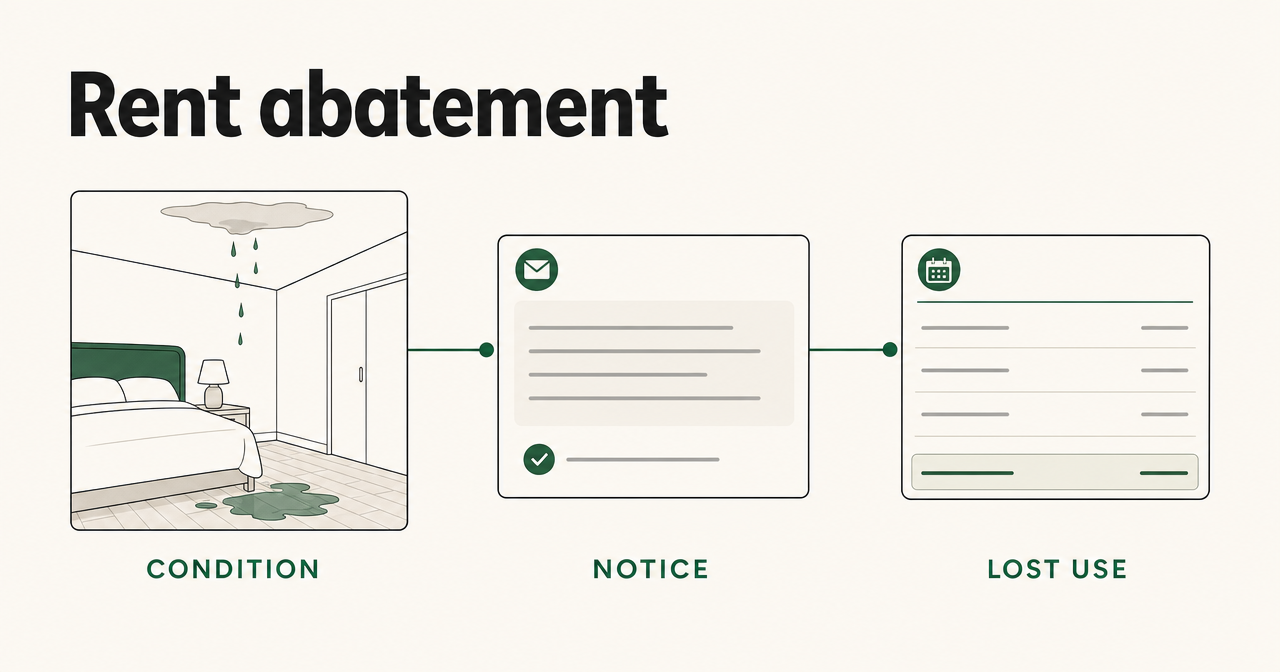
A leak that keeps a bedroom unusable leaves you paying for space you can’t use. Getting repairs and getting rent relief are separate problems, and you may be left to chase both.
Rent abatement can come into that conversation. Understanding the term, the facts that matter, and the records worth keeping gives you a better way to ask for relief without accidentally creating an unpaid-rent dispute.
What is rent abatement?
Rent abatement is a reduction or elimination of rent for a specific period. For a U.S. renter dealing with repairs, it can compensate for a home’s reduced usability or a landlord’s failure to meet a legal obligation. Relief may come through an agreement, a lease provision, or a court or housing-agency process, depending on where you live and the situation.
An abatement can cover part of the rent or all of it for the affected period. It may also apply to rent already paid. The amount, dates, and way you receive the relief need to be established through the applicable process or agreement.
For an agency example, Madison’s rent-abatement program gives eligible renters a way to apply for temporary relief after certain code violations remain unresolved past an official notice deadline. Other cities have different procedures.
The term also appears in promotional leases. A rent-free move-in month is a different situation from losing access to a bedroom during repairs. Our guide to rent concessions explains that promotional use.
If unresolved conditions also have you considering another home, our AI agent for renters can help with the next-home search in metros where we’re live. It is free for renters. Rent relief for your current home follows a separate local process.
Abatement, withholding, and repair-and-deduct mean different things
The distinction matters before rent is due:
| Term | What it means |
|---|---|
| Rent abatement | A reduction in the rent owed for an affected period |
| Rent withholding | Holding back some or all of a rent payment because of a dispute |
| Repair-and-deduct | Arranging a repair and subtracting its cost from rent under an authorized procedure |
| Rent deferral | Postponing a payment that remains due later |
Requesting an abatement does not, by itself, authorize a smaller rent payment. In Texas, for example, renters cannot withhold rent simply because the landlord has not made repairs. The state has a separate repair-and-deduct remedy with strict requirements, as the Texas State Law Library explains.
California also has a repair-and-deduct law, with its own conditions, notice requirements, and limits. A deduction based on a repair bill is different from compensation for being unable to use your home.
Keep the required rent payments current unless an applicable legal procedure, court order, or clear agreement permits a change. Local legal aid or a housing lawyer can help establish that path before you withhold money, deduct costs, or end the lease.
When might a renter qualify for rent abatement?
There is no single nationwide qualification rule. Serious repair problems, lost essential services, or damage that makes a home partly or wholly unusable can support a claim in some locations. The legal standard and route to relief vary.
The useful starting point is the effect on daily life. Can you safely sleep in the bedroom? Use the plumbing? Cook? Stay in the home? Describe those losses plainly rather than relying only on the word “uninhabitable.”
A New York City court decision, for example, awarded relief for documented sewage flooding and a vermin infestation. It rejected a separate mold claim because the evidence did not establish its effect on health, safety, or use of the home. That New York City decision illustrates why a problem’s name alone does not establish the claim.
Four facts that shape the request
These questions help you organize the facts for a landlord conversation or local housing adviser. They are not a national eligibility checklist.
- Who is responsible for the condition? Record how it began and include relevant lease terms, move-in photos, and repair history. Responsibility for renter-caused damage can differ from responsibility for normal wear or a building-system failure.
- What use or service did you lose? Name the affected room, fixture, or service and what you could no longer do. A bedroom with a wet ceiling and standing water tells a clearer story than “the apartment is terrible.”
- When and how did the landlord receive notice? Save the request, recipient, delivery record, and any acknowledgment. Formal notice rules may require more than a maintenance ticket or text.
- What happened after notice? Record repair attempts, access offered, missed visits, continuing problems, and restoration. Local law determines the time allowed and the effect of the landlord’s response.
Texas shows how specific a legal route can be. Its repair-remedy provisions require, among other things, a condition materially affecting an ordinary renter’s physical health or safety, the required notices, reasonable repair time, a lack of diligent repair effort, and rent current when notices are given. If the requirements are met, a court can order reduced rent under the Texas repair-remedy statute. Those requirements are Texas-specific.
For an immediate danger, get to safety and contact emergency services. Use emergency maintenance for urgent building problems. A rent-relief request should never delay a safety response. If the problem is a loss of hot water, our no-hot-water guide covers reporting and escalation in more detail.
Document the condition, notice, and loss of use
A repair request tells the landlord what needs fixing. An abatement request also needs a clear account of what you lost and for how long.
We suggest keeping one folder and one running timeline. Save copies somewhere you can still access if a maintenance portal closes the ticket or you move out.
Capture what happened, without guessing at the cause
Take dated photos or video when it is safe. Include a wide view showing the location and a closer view showing the problem. Preserve original files and add new records when conditions change.
Describe what you can observe: “Water drips from the bedroom ceiling when it rains,” rather than “the roof was installed incorrectly.” A contractor or inspector can assess the cause. You can document the impact.
Useful records include:
- Your lease and relevant addenda.
- Repair requests, emails, texts, ticket numbers, and delivery receipts.
- Notes of calls, including the date, person, and promised action.
- Photos, videos, inspection reports, and complaint numbers.
- Dates and times when you offered access and when workers arrived or missed a visit.
- Receipts for related expenses, kept separately from the requested rent reduction.
Receipts establish what you spent. They do not automatically make the landlord responsible for reimbursing it.
Track usable space separately from repair activity
A maintenance visit is an event in the timeline. It may not be the end of the problem.
For example, suppose a leak starts on September 3 and you report it that day. A contractor stops the leak on September 5, but the bedroom remains wet and unavailable for sleeping until September 8. Your record should preserve both the repair date and the date the room became usable again. Neither date, by itself, establishes the legally compensable period.
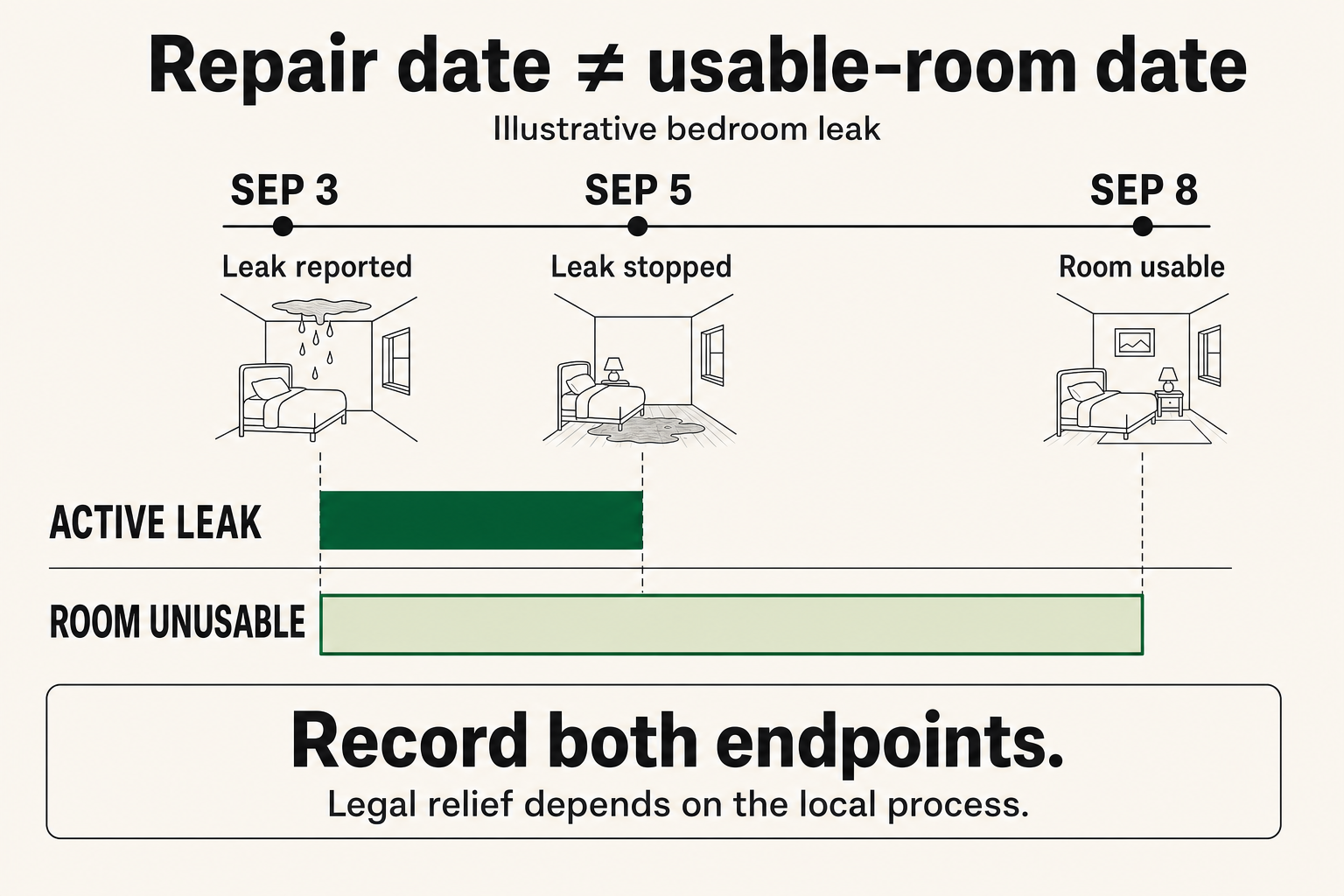
For each change, note what remained unusable, whether the problem returned, and what restored normal use. Avoid filling a month-long gap with a blanket statement that conditions “continued.” Short, dated entries make the history easier to understand.
Proof of duration can matter as much as the first photo. In the New York City case, the court declined to award relief for a gap between documented flooding episodes because the renters had not established an ongoing problem during that period. That is a practical reason to keep recording changes, including when a condition improves.
Ask for a repair plan and rent relief in writing
You can ask for repairs immediately and raise compensation for the lost use separately. The landlord does not need to receive a long legal argument to understand either request.
Use the repair contact and notice recipient specified in your lease. A local housing adviser can identify any additional notice format or delivery method required for a legal remedy. A portal message can be useful evidence without satisfying every formal notice rule.
A clear message includes the condition, start date, earlier reports, effect on your use of the home, and access availability. Ask for the repair schedule and a written response to the rent-relief request.
A rent abatement request you can adapt
Subject: Repair follow-up and rent relief request, [address and unit]
Hello [name],
I reported [condition] on [date] through [method or ticket number]. The problem began on [date] and [is continuing / was resolved on date].
From [date] to [date or “the present”], I have been unable to [sleep in the bedroom, use the bathroom, or describe the specific impact]. I have attached [photos, earlier requests, or other relevant records].
Please provide the repair plan, the next appointment, and any temporary arrangement available while the problem continues. I can provide access at [times], with the required entry notice.
I am also requesting rent relief for the affected period. Please respond with the proposed amount, dates covered, and whether it would be issued as a refund or rent-account credit. Please state the remaining payment due and how any continuing loss of use will be addressed.
Thank you, [Name and contact information]
This is a starting point for communication, not a substitute for a legally required notice. Keep the facts that apply to your home and remove the alternatives.
After a phone conversation, send a short recap in the same thread: what was agreed, who will act, and when. If a promised visit is missed, record that and ask for the revised plan.
How much rent abatement can you receive?
There is no national percentage or room-by-room calculator. The governing law, facts, proof, and any agreement determine the amount.
Under the Texas judicial repair remedy, a court can reduce rent in proportion to reduced rental value from the first repair notice until the condition is remedied. The New York City decision considered severity, duration, and the effectiveness of the landlord’s response. These are examples of local approaches, not formulas you can apply everywhere.
For a negotiated request, tie the proposed credit to a specific period and concrete loss of use. You can propose a dollar amount, explain the basis, and invite a written counteroffer without presenting your estimate as a legal entitlement.
Before relying on an agreement, get these terms in writing:
- Amount: The exact rent reduction or credit.
- Period: The start and end dates it covers.
- Delivery: A refund, a named month’s credit, or another defined method.
- Payment: The remaining rent due and the due date.
- Continuing problems: What happens if the condition remains or returns.
- Repayment: Whether any amount is only deferred and owed later.
Any release of claims deserves local legal advice before signing. A credit agreement may also contain terms about other losses or disputes. The repair obligation and the money agreement should each be clear.
If the landlord says no or stops responding
A refusal does not resolve whether you have a legal claim. It does mean the next step needs a local route rather than another guess at what to subtract from rent.
Share the timeline and records with your city or county housing, building-code, or health-enforcement office. Ask which office handles the condition and how to request an inspection. USAGov’s tenant resources also connect renters with state agencies and legal-help options.
In New York City, renters can report unresolved apartment maintenance problems through 311. Housing Preservation and Development investigates complaints and can issue violations. Its apartment complaint process also explains the Housing Court route for unresolved repairs. Reporting a condition does not automatically produce a rent award.
For the money dispute, contact a local housing lawyer, legal aid office, or court help center. The Legal Services Corporation’s legal aid directory locates funded organizations by address or city. Give them the lease, notice records, rent-payment history, timeline, and any notice you received from the landlord or court.
Ask which remedy fits, whether additional notice is needed, and what payments remain due while you pursue it. If you receive an eviction notice, court papers, or a threat after reporting the problem, seek help promptly and preserve that communication too.
Rent abatement FAQs
Can I request relief after the repair is finished?
Yes, you can request a credit for a past period. Whether you can compel payment depends on the local remedy, filing deadlines, and evidence. The New York City case included credits for rent paid during qualifying periods. Keep the records even after the maintenance ticket closes.
Is a broken pool or gym grounds for rent abatement?
An unavailable amenity raises different questions from lost heat, unsafe plumbing, or an unusable bedroom. The lease promise, separate amenity charges, length of the closure, and local law matter. Ask for a credit tied to the unavailable service without assuming it meets a habitability standard.
Does rent abatement end my lease?
An abatement reduces rent for a period. It does not automatically cancel the lease. Ending the tenancy is a separate decision with its own legal requirements and possible costs. Get local legal help before treating a serious repair problem as permission to move out without further rent responsibility.
Keep the repair record and the next-home search separate
Your record should make three things easy to follow: what was wrong, when the landlord knew, and what use you lost. Written terms should make the money just as clear.
If you decide to look for another home in a metro where we’re live, start your rental search with us. Tell our AI agent for renters what you want, and we’ll find matches, call landlords or leasing offices, and book tours. It is free for renters.