Renter guide
Rental Application Approved but Landlord Changed Their Mind?
Rental approval withdrawn before signing? Understand promises, fees, deposits, and written next steps with Fairway, the free AI agent for renters.
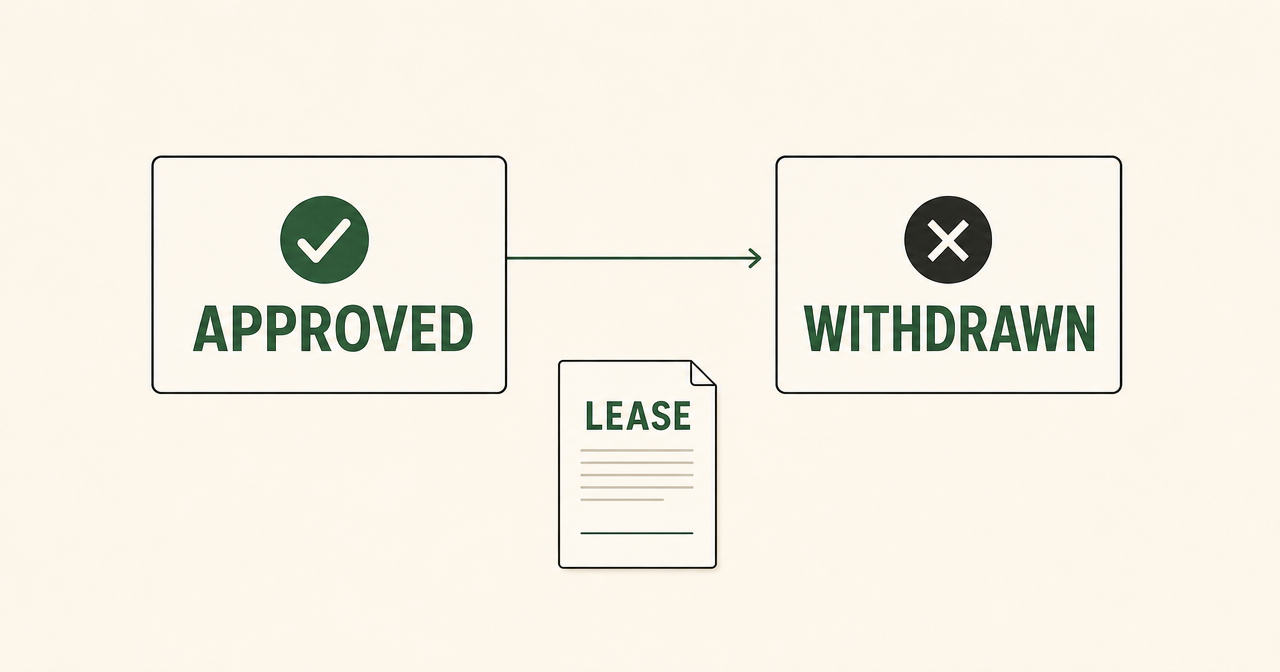
You have not signed a lease yet, but an approval email has already set your move in motion. You stop touring, arrange movers, and start counting down to a new address. Then the landlord says they are no longer renting to you.
That reversal leaves two urgent problems: finding somewhere to live and understanding what happens to the promises and payments already made. Before writing off the approval or accepting a cancellation charge, it helps to separate the agreement, the money, and the reason the landlord gave.
Can a landlord change their mind after approving your application?
Sometimes, yes. Approval can be conditional or preliminary. Having no signed lease does not automatically erase the landlord's obligations. The approval's wording, any conditions, a separate holding agreement, applicable state and local law, and the reason for the reversal all matter.
There is an important difference between “you passed screening, subject to owner approval” and an agreement to rent a specific home on settled terms. California, for example, recognizes oral rental agreements, although a tenancy term longer than one year must be in writing. Its rental-agreement guidance shows why “no signatures means no rights” is too broad.
A holding agreement can also create obligations before the lease is signed. And fair housing protections can apply during the application process itself.
If restarting the search means more listings and phone tag, we can take that work off your plate. Fairway is an AI agent for renters, free for renters in the metros we cover. Tell us what you want. We find matches, call landlords or leasing offices, and book tours. We cannot reverse the property's decision or settle a refund dispute.
Pin down what the approval actually promised
Pull together the application, approval email, texts, portal notices, any draft lease, and every payment agreement. Read them as a sequence. A celebratory subject line may have conditions in the next paragraph.
These details help distinguish a preliminary approval from a more definite commitment:
| Detail | What matters after a reversal |
|---|---|
| Remaining conditions | Was approval still subject to references, income documentation, a guarantor, or a separate owner's decision? |
| Rental terms | Did both sides agree on the address and unit, rent, start date, and rental term? Were important terms still unresolved? |
| Acceptance | What did you say or do in response, and did the paperwork require a signed lease before either side was committed? |
| Timing | Was there a signing or payment deadline? Did you meet it, and do you have the submission receipt? |
| Holding agreement | What did the landlord promise to reserve, for how long, and what did the agreement say about the landlord backing out? |
A condition being completed later than expected is different from an owner withdrawing after all stated conditions were satisfied. If the landlord says something was missing, ask them to identify the condition and the notice that imposed it. A timestamped upload or email may resolve a disagreement without a legal dispute.
An email approval is useful evidence. It is not, by itself, proof that every requirement for an enforceable rental agreement has been met. A local housing lawyer can assess that question from the complete exchange rather than one sentence pulled from it.
Get the landlord's reversal into one written record
Save the records you already have before the portal closes or the listing changes. Download documents and receipts rather than relying only on links to an account the property controls.
A useful file contains:
- The approval and all stated conditions, including attachments.
- The application and any terms you accepted electronically.
- The holding agreement and itemized payment receipts.
- Your responses, document uploads, and payment timestamps.
- The reversal message, voicemails, and dated notes of calls.
- Any specific assurance about signing, move-in, or when you could give notice at your current home.
If the reversal came by phone, send a short email summarizing it. Ask whether the decision is final, what changed, and who can authorize a correction or refund. A leasing employee's explanation and an owner's decision may be different things.
A message you can adapt
Subject: Approval withdrawn for [address and unit]
Hi [name], I received approval for [address and unit] on [date]. On [date], [name] told me the property would no longer proceed with renting to me.
Please confirm whether that decision is final, the reason, and any approval condition you believe remained unmet. I paid [amount and purpose] on [date]. Please confirm the amount being returned, the payment method, and the expected return date. For any amount being withheld, please identify the charge and the agreement term or legal basis for retaining it.
Please reply by [date]. Thank you.
Choose a response date that reflects your move deadline. That requested date is a communication deadline, not a substitute for a refund deadline set by law or an agreement.
If you were ready to proceed and the landlord ended the arrangement, keep that sequence clear. You do not need to describe the decision as your cancellation just to request your money back.
Separate each payment before asking for a refund
A portal may collect several charges in one transaction. They can have different purposes and refund rules. Ask for an itemized account instead of debating whether “the deposit” is refundable.
| What you paid | What to request after the landlord backs out |
|---|---|
| Application or screening fee | An itemized explanation of work performed and any refund due under the policy or local law. A reversal does not automatically make completed screening free. |
| Holding deposit or reservation payment | Return of the payment, with the landlord's withdrawal documented. If the property refuses, ask for the specific retention term and its legal basis. |
| Security deposit or prepaid rent | Return of the payment and an explanation of any claimed deduction. Keep these amounts separate from screening charges. |
| Administrative or lease-preparation fee | The stated purpose, refund terms, and basis for keeping it when the landlord chose not to proceed. The label alone does not settle the issue. |
For example, suppose you paid a $50 screening fee, a $500 holding deposit, and $1,800 in advance rent. Your request should list all three amounts. A dispute over the $50 screening charge should not blur the separate request for the $2,300 paid to hold and occupy the home.
Local rules can change the result. Washington's holding-deposit law requires a receipt and a written statement of the conditions for retaining a holding payment when it is collected after the dwelling unit has been offered to the prospective tenant. In California, the state's holding-deposit guidance says that when a landlord rents to someone else during the agreed hold period and the applicant remains willing and able to move in, the landlord should at least return the entire holding deposit.
Those are location-specific protections, not a nationwide refund schedule. Our application-fee guide explains the separate screening-fee rules and why unused fees can receive different treatment from deposits.
Keep the refund conversation specific: amount, reason for any deduction, payment method, and expected date. If the property offers money only in exchange for a release of claims, get legal help with the release before accepting that settlement.
The reason for withdrawing approval can create separate rights
A landlord's explanation helps identify which issue needs attention. A screening-report problem, suspected discrimination, and a disagreement about a promise call for different responses. They should not all be filed under “the owner changed their mind.”
If a screening report influenced the reversal
Under the Fair Credit Reporting Act, a landlord must provide an adverse-action notice when a consumer report contributed to an unfavorable decision. That includes withdrawing approval because of a tenant-screening report. The federal requirement applies when the report was part of the reason, even if it was not the only reason.
The notice must include the reporting company's name, address, and telephone number, including a toll-free number for a nationwide reporting company. It must state that the company did not make the decision and cannot explain the specific reasons for it. It must also explain your rights to dispute inaccurate or incomplete information and obtain a free report from that company within 60 days.
The federal notice requirements allow oral, written, or electronic notice. If a credit score influenced the decision, additional score disclosures must be provided in writing or electronically.
Request the report named in the notice. Dispute errors with the reporting company and send supporting records. Tell the property about the dispute and ask whether it will reconsider with corrected information.
This notice right is tied to use of a consumer report. It does not arise automatically from every approval reversal. A landlord's direct conversation with a reference, for example, is not necessarily a consumer report.
If the decision followed a protected disclosure
Fair housing law reaches rental decisions before a lease is signed. In covered housing, the federal Fair Housing Act prohibits discrimination based on race, color, national origin, religion, sex, familial status, or disability. State and local laws can add protections.
A reversal immediately after the landlord learns you have children or receives a disability-related accommodation request deserves attention. Timing alone does not prove discrimination. Preserve the exact statements, the original approval, and any change in the stated reason or terms.
The U.S. Department of Housing and Urban Development's housing-discrimination reporting page accepts reports and explains what information to provide. Fair housing complaints have filing limits, so early contact matters. A local fair housing organization can also help assess the facts and applicable protections.
Keep expenses caused by the reversal separate from your deposit
A refund returns money you paid the property. Moving losses are a different question.
If you booked movers, gave notice at your current home, or paid for temporary housing after a specific promise, save both the promise and the dated expense records. The order matters: what the landlord said, what you reasonably did because of it, and what the reversal then cost.
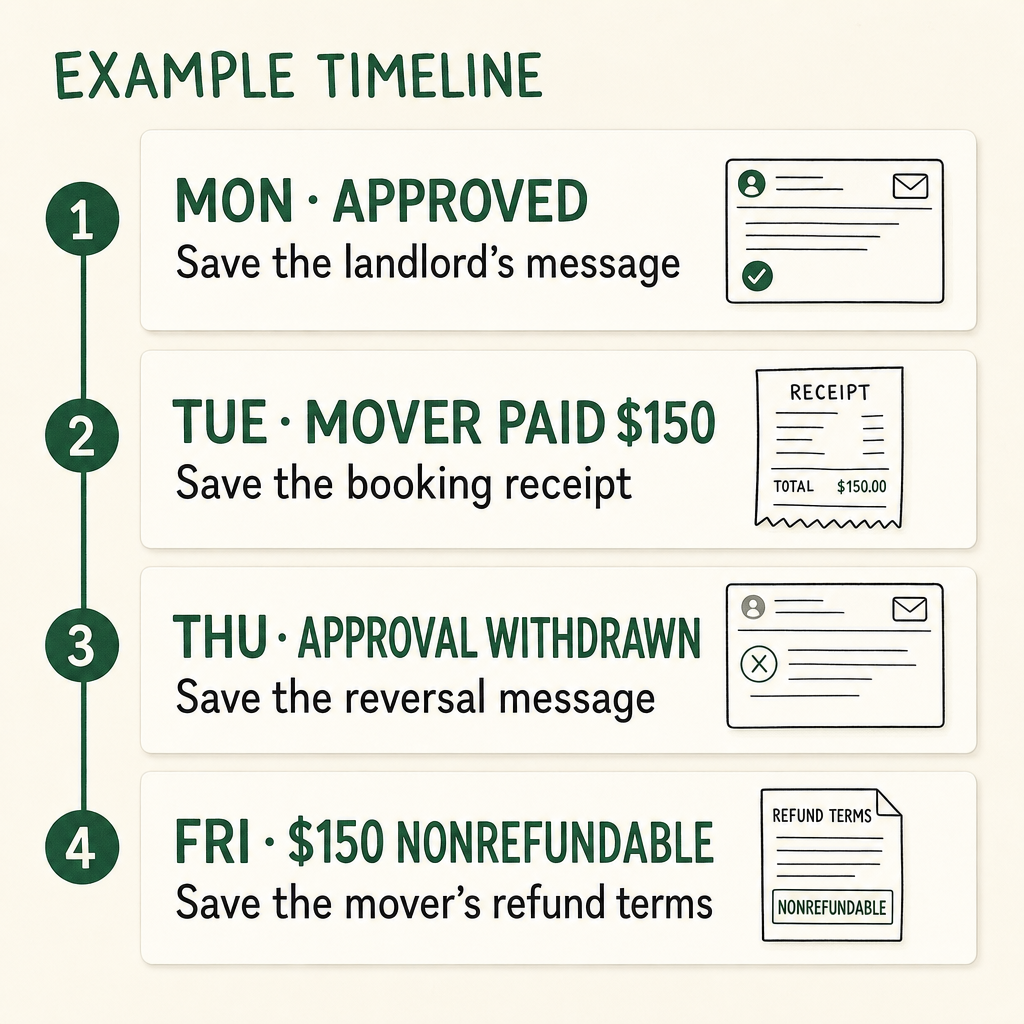
This sequence gives a housing lawyer concrete facts to evaluate. It does not guarantee reimbursement. Whether there was an enforceable agreement or another basis for recovering losses depends on the promises, documents, and local law.
Match the next step to the problem
If the property does not resolve the issue, bring your short timeline and supporting documents to the right kind of help:
- Money withheld: A local tenant counseling service or legal aid office can identify the applicable refund rules. Small claims court may be an option for a money claim within that court's limits.
- A definite promise or urgent housing loss: A local housing lawyer can assess enforceability and possible remedies, especially if you want more than a refund.
- A report-based reversal: The screening company handles errors in its report. A dispute with the property alone does not correct that record.
- Possible discrimination: A fair housing organization, state or local civil rights agency, or HUD can address that issue separately from the refund request.
The LawHelp legal-aid directory provides state-by-state routes to nonprofit legal assistance. Include the apartment's location when requesting help, even if you currently live in another state.
Protect your move while the dispute is open
A refund request or complaint does not put a roof over moving boxes. If your current move-out date is close, ask your present landlord about an extension and get any agreement in writing. Ask movers about rescheduling and refundable arrangements before adding new costs.
Keep alternatives active while the original property answers. For the next approval, ask for the remaining conditions, signing deadline, payment terms, and expected key date together. Our apartment-approval timeline guide explains the steps that can remain between screening and a final decision.
You can preserve the record of this reversal while looking for another home. To take the listing hunt and leasing-office calls off your plate, start your search with Fairway.