Renters insurance
Renters Insurance Liability Coverage: Limits, Leases, and Claims
Learn when renters insurance liability coverage may apply, what it excludes, how limits and deductibles work, and what to do after a possible claim.

Your lease asks for $100,000 of liability coverage. The quote shows personal property, medical payments, loss of use, and a deductible. Suddenly, a simple move-in requirement looks like four different products.
The boundaries matter when a guest gets hurt, your dog knocks someone over, or a kitchen mistake damages the building. Here is how to identify a possible liability claim, spot the common gaps, choose a limit, and respond when something happens.
What renters insurance liability coverage is
Personal liability is the part of a renters policy that responds when someone claims you are legally responsible for accidental bodily injury or property damage. For a covered claim, it can pay damages and provide a legal defense, subject to the policy's terms and limits.
It is one section of the policy. Calling the whole thing “$100,000 of renters insurance” creates confusion because that number usually describes the liability limit, not the value of your belongings.
| Policy section | Whose loss it addresses | Simple example |
|---|---|---|
| Personal liability | Another person's injury or property damage for which you are legally responsible | A guest claims your wet floor caused a broken wrist |
| Medical payments to others | Limited medical costs for an injured guest, often without a finding that you were at fault | A visitor needs an X-ray after a minor fall |
| Personal property | Your covered belongings | A covered fire destroys your clothes and laptop |
| Loss of use | Your extra living costs after a covered loss makes the rental unlivable | You need a hotel while covered fire damage is repaired |
The Kansas Insurance Department's consumer guide says renters policies are commonly written with $100,000 of personal liability per claim and $1,000 per person for medical payments, with higher limits available. Those are common starting points. Your declarations page shows the limits you actually bought.
The Maine Bureau of Insurance also publishes a sample ISO HO-4 form. Its Coverage E pays covered damages for which an insured is legally liable and provides a defense. That 2011 specimen is a useful map of standard policy language. Your issued form, state amendments, and endorsements can change the result.
The real coverage test is bigger than “Did it happen in my apartment?”
An address does not decide a liability claim by itself. Three questions matter:
- Are you alleged to be legally responsible? A guest's injury in your apartment is not automatically your fault. A broken stair owned and neglected by the landlord presents a different issue from a spill you left on the floor.
- Was another person injured or was someone else's property damaged? Liability does not replace your own couch or pay your own medical bill.
- Does the event fit the policy? Accidental personal activity may fit. Intentional harm, driving, paid work, and liability involving an excluded animal often do not.
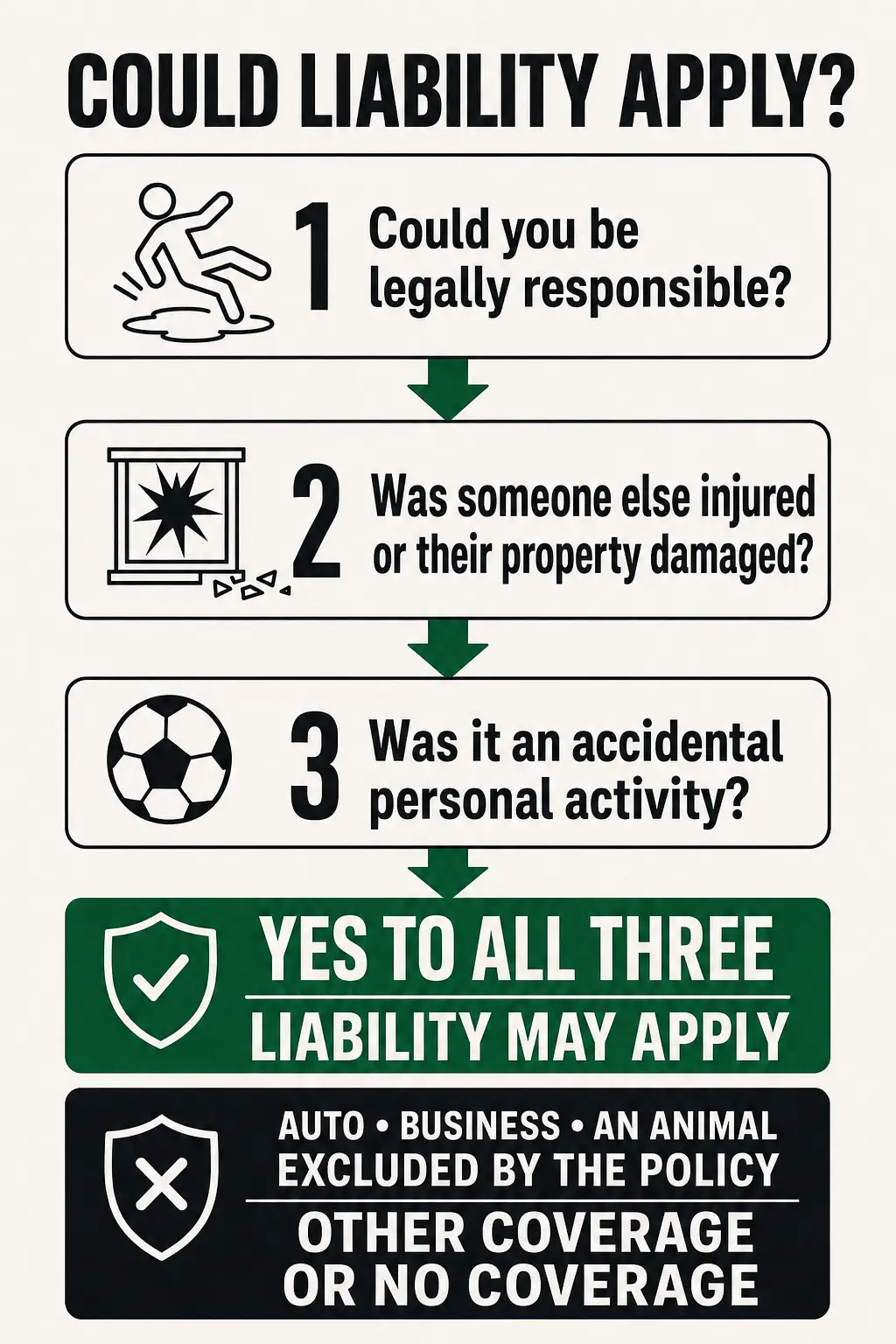
Personal liability can follow an insured person away from the rental for many personal activities. The NAIC describes comprehensive personal liability as coverage that generally follows you wherever you go, apart from exclusions such as auto and some boating accidents. The policy territory, definition of insured, and exclusions still control.
Here is how common renter situations sort out:
| What happened | Coverage most likely to matter | The detail that decides it |
|---|---|---|
| A guest slips on a spill and blames you | Personal liability; medical payments may handle a small bill | Legal responsibility, exclusions, and the amount claimed |
| Your child breaks a neighbor's window | Personal liability | Whether the child is an insured household member and the act was accidental |
| Your dog bites or knocks down a visitor | Personal liability | Whether animal liability is covered, excluded, or capped |
| An unattended pan starts a fire that damages the unit | Personal liability may apply; personal property covers your belongings separately | Negligence, rented-premises language, and any endorsement or sublimit |
| An overflowing tub damages the apartment below | Personal liability may apply | Cause of the overflow, legal responsibility, and water-damage wording |
| Your own laptop is stolen | Personal property | Covered cause, property limit, valuation method, and deductible |
| You hit a parked car | Auto insurance | Motor-vehicle exclusions in the renters policy |
| A client is injured during paid work in your apartment | Business coverage or an endorsement | Business and professional-services exclusions |
Every example depends on the issued policy and the facts of the event. A familiar scenario can still fall outside coverage.
What personal liability can pay
For a covered occurrence, personal liability can address several costs.
Bodily injury damages
This can include another person's medical costs, lost income, and other damages you are legally obligated to pay after an accidental injury. The claim might start with a demand from the injured person or their insurer. It can also become a lawsuit.
Property damage to others
This can include repair or replacement costs when you accidentally damage someone else's property. A landlord's building insurance protects the owner's interest in the structure. It does not provide your personal liability protection, as the Washington insurance regulator explains.
If you negligently cause a kitchen fire, the owner's insurer may pay to repair the building first. That may leave a demand against you. Whether the owner or insurer can seek recovery from you depends on the facts, lease, policy, and state law. Your liability insurer needs notice of that demand.
A defense against a covered lawsuit
Defense wording deserves a close read. In the sample ISO form, the insurer provides a defense at its expense and lists certain claim expenses as coverage in addition to the liability limit. Its duty to defend ends after the occurrence limit has been exhausted by payment of a judgment or settlement. Other forms and endorsements can treat defense expenses or the end of the defense duty differently.
Medical payments without a liability fight
Medical payments to others is separate from personal liability. It can cover limited, necessary medical expenses without waiting for a finding that you were negligent. It has its own lower per-person limit. In the sample ISO form, it does not cover you or regular household residents other than a residence employee, and payment is not an admission of liability.
What renters liability insurance usually leaves out
The sample ISO form helps show why the exclusions page matters. Common boundaries include:
- Your injuries and belongings. Health insurance and personal property coverage serve those losses.
- Injury to an insured. Coverage E in the sample form excludes bodily injury to you or another person treated as an insured under Definition 5.a. or b., including a resident relative and certain people under 21 in your care or a resident relative's care.
- Expected or intentional harm. The form excludes injury or damage expected or intended by an insured, with a limited exception for reasonable force to protect people or property.
- Motor-vehicle liability. Most car, truck, and motorcycle incidents belong under auto coverage, including an accident in the apartment parking lot.
- Business and professional activity. Paid work can trigger business or professional-services exclusions, although forms may contain narrow exceptions.
- Regular home-sharing. Frequent rentals to paying guests can create both lease trouble and a coverage gap. Some forms allow limited rental activity; a standard policy is not a substitute for host coverage.
- An excluded animal. Pets are not automatically excluded. An animal-liability endorsement may exclude a category or an individual animal, or impose a separate limit.
- Contract-only liability. A promise in a lease does not automatically expand the insurance contract. The sample form has specific exceptions within its contractual-liability exclusion.
- Property owned by an insured, or rented to, occupied or used by, or in the care of an insured. The sample form excludes damage to property an insured owns. It also excludes damage to property rented to, occupied or used by, or in the care of an insured, but makes an exception in that second category for fire, smoke, or explosion. Water damage to the unit you rent is not part of that specimen's exception. Another carrier form or endorsement may treat it differently.
Pet owners should take the liability limit seriously. Home insurers paid an average of $65,450 per dog-related injury claim in 2025, across 28,450 claims, according to Triple-I's claims data. The dataset includes homeowners claims and dog-related injuries beyond bites, and it is not limited to renters. It still shows why “my dog is friendly” is not a coverage limit.
For a lease that specifically requires negligent fire, smoke, or water-damage protection, the policy documents need to show that protection. A generic proof page with one total liability number may not answer the requirement.
Does renters liability coverage have a deductible?
Personal liability coverage typically has no deductible. The New Jersey insurance regulator says the property deductible applies to the home or its contents, while personal liability has no deductible for claims brought by others. The sample ISO HO-4 form follows that structure: its general deductible appears under Section I property conditions, and Coverage E in Section II does not state a general liability deductible.
That answer is policy-specific. An endorsement can add a deductible or separate retention for a particular exposure, and an umbrella policy may have its own self-insured retention. For your policy, the relevant places are the deductible entries on the declarations page, Section II Coverage E, Section II conditions, and every liability endorsement. A $500 personal-property deductible on the declarations page does not automatically mean you owe $500 on a liability claim.
How much liability coverage do you need?
There is no universal correct limit. Many insurers offer $100,000, $300,000, and $500,000 choices. Use this order instead of picking the cheapest default.
1. Treat the lease minimum as the floor
If the lease requires $100,000, a $50,000 policy does not meet that term. The lease threshold also says nothing about whether $100,000 fits your finances or risks.
2. Price credible worst cases
Consider events that could produce a serious third-party claim: a fire spreading beyond your unit, a major guest injury, a dog-related injury, or an accident caused by a household member. Then consider the savings, investments, property, and income that a judgment above the policy limit could put at risk. What a creditor can reach varies by state.
3. Compare higher limits on otherwise identical quotes
Hold the address, personal property limit, property deductible, valuation method, endorsements, and discounts steady. Then compare the annual price for each liability option. Our guide to renters insurance cost explains why two quotes with the same headline price can still buy different coverage.
4. Look above the renters-policy maximum when needed
A personal umbrella policy can add liability protection after an underlying renters or auto limit is reached. The Oregon insurance regulator's guide describes this relationship. The umbrella declarations and contract set the required underlying insurance, covered exposures, exclusions, and any retention, so the renters and umbrella limits need to fit together.
A liability-specific lease check
Lease compliance is a separate question from claim coverage. Match the lease requirement against the declarations and endorsements for the named insured, rental address, policy dates, Coverage E liability limit, and any specifically required fire, smoke, or water-damage coverage.
The definition of insured matters for roommates. In the sample ISO form, it includes the named insured, a resident spouse, resident relatives, and certain people under 21 in their care. An unrelated roommate does not automatically fit those categories. Each roommate needs to appear in a role the issued policy recognizes or have a separate policy.
Landlord designations also depend on the actual form or endorsement. A label such as “additional interest” or “additional insured” does not, by itself, explain what notice or coverage the landlord receives. The declarations and endorsement wording do.
The Maryland Insurance Administration says a property damage liability waiver is not renters insurance, typically does not cover a renter's belongings, and generally covers only building damage from certain events such as fire, smoke, explosion, or leaking water. That is the extent of the regulator's general description. The waiver document sets its actual terms.
Whether renters insurance is required is the broader lease question. This liability-specific check answers the narrower one: whether the policy documents match what your lease demands.
What to do when an accident could become a claim
Do not wait for a lawsuit to take the event seriously.
- Handle the emergency. Call emergency services when needed and take reasonable steps to prevent more harm.
- Document the scene. Save photos, video, witness names, messages, repair notices, and the timeline. Keep damaged items unless health or safety requires disposal.
- Notify the insurer promptly. Report the facts even if nobody has demanded money yet. The sample ISO form requires notice as soon as practical and asks for available details about the time, place, circumstances, claimants, and witnesses.
- Send every demand or legal paper. Forward letters, bills, summonses, and complaints as soon as they arrive. The policy can make this one of your duties after an occurrence.
- Do not negotiate the claim alone. The sample form bars an insured from voluntarily making a payment, assuming an obligation, or incurring an expense other than first aid, except at the insured's own cost. Cooperate with the insurer's investigation and defense.
Keep the declarations page, full policy, endorsements, lease, incident record, claim number, adjuster contact, and every coverage decision together. If an insurer denies coverage, the written decision should identify the policy language it relies on. State insurance departments accept complaints about unfair delays, denials, and policy handling.
Buy protection along with proof for the landlord
The useful policy names the right people, meets the lease, covers your real personal risks, and carries a liability limit you could live with after a bad accident. The declarations page is the summary. The policy and endorsements are the contract.
If you are still looking for the apartment that started all this paperwork, our AI agent for renters can help. We watch every listing, Craigslist included, call landlords, surface every fee, and book tours. It is free for renters. Start your search with Fairway.