San Francisco renter guide
San Francisco Tenant Buyout Offers: A Renter's Decision Guide
San Francisco tenant buyout guide with city timelines, a net-impact worksheet, local help, and our free AI agent for renters to compare replacement homes.
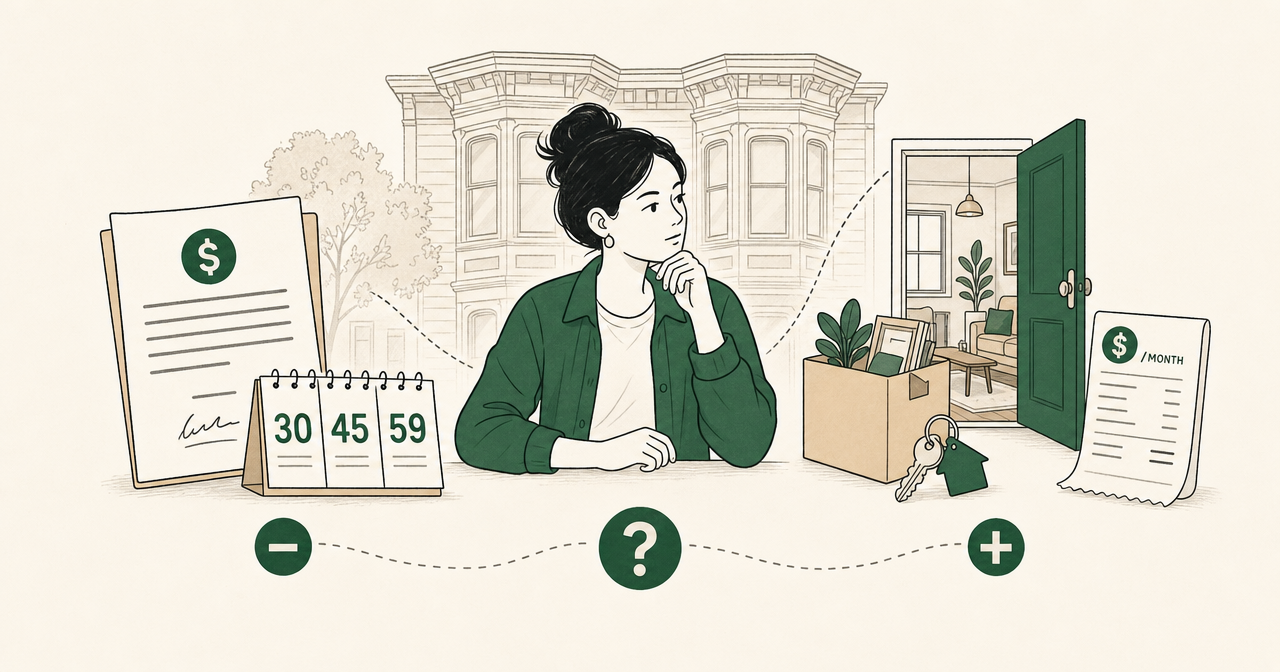
A landlord buyout offer can turn one number into a very big housing decision. The payment may feel substantial, while your next rent, move-out deadline, and the rights released in the agreement can last much longer. San Francisco gives renters a defined process, including disclosures, time before signing, and a cancellation window. A clear timeline and a net-impact worksheet help you compare the full deal with the cost of staying or moving.
General information only: This Guide does not provide legal, tax, benefits, or financial advice.
Start with what the landlord wants you to give up
A tenant buyout, sometimes called cash for keys, is an agreement in which a landlord gives a renter money or other consideration to leave a rental unit. It is voluntary. San Francisco law says you have the right to decline both the agreement and the negotiations.
The city's buyout rules apply to landlords and renters of rental units as defined in the Rent Ordinance. They are broader than locally price-controlled apartments. A condo, newer apartment, or other home outside San Francisco's local rent cap can still be covered by the buyout process. A settlement of a pending unlawful-detainer case is not a Buyout Agreement for Section 37.9E purposes.
Your tenancy rights help determine what you are surrendering. Use our San Francisco rent control guide for coverage, just-cause rules, eviction notices, owner move-in, Ellis Act, and statutory relocation payments. Those general rules stay there. A voluntary buyout is a separate path with its own agreement and timeline.
Slow the conversation down and build a clean record
The first oral or written discussion about a possible buyout can count as the start of negotiations. Treat an informal call, hallway conversation, or text as part of the timeline.
Save these items together:
- Your lease, amendments, rent ledger, deposit records, and notices
- The pre-buyout disclosure and its delivery date
- Every written offer, counteroffer, email, and text
- Notes of spoken conversations, including the date and who participated
- The first date money or move-out terms were discussed
- Any proposed agreement and every later draft
- The date each party signs, if an agreement is eventually executed
Do not let the headline amount become the only fact in the file. Record why the landlord wants the unit, what move-out date is proposed, who must leave, what claims would be released, and when the money would arrive.
Price a realistic replacement home at the same time. Fairway is free for renters. Our AI agent for renters finds current matches, calls landlords or leasing offices, and books tours, which gives you real alternatives instead of a guessed market rent.
The San Francisco buyout timeline has three separate clocks
The negotiation date, the fully signed date, and the Rent Board filing period serve different purposes. Put all three on one calendar.
| Stage | What the city requires |
|---|---|
| Before negotiations | The landlord gives each renter the Rent Board-authorized disclosure, then files a declaration with the Rent Board before starting buyout discussions. |
| At least 30 days after negotiations start | The agreement can be executed only after this waiting period. It must be in writing, and each renter receives a copy when signing. |
| Through day 45 after all parties sign | The renter may rescind by hand delivery, email, or placing in the mail a statement that the agreement is rescinded. For a clear record, use a signed, dated notice and keep delivery proof. |
| Days 46 through 59 after all parties sign | The landlord files the agreement with the Rent Board. A cancelled agreement does not have to be filed. |
| After day 59 if the landlord did not file | Either party may file. The missed deadline has specific consequences for waivers and releases. It does not mean you should assume the whole agreement vanished. |
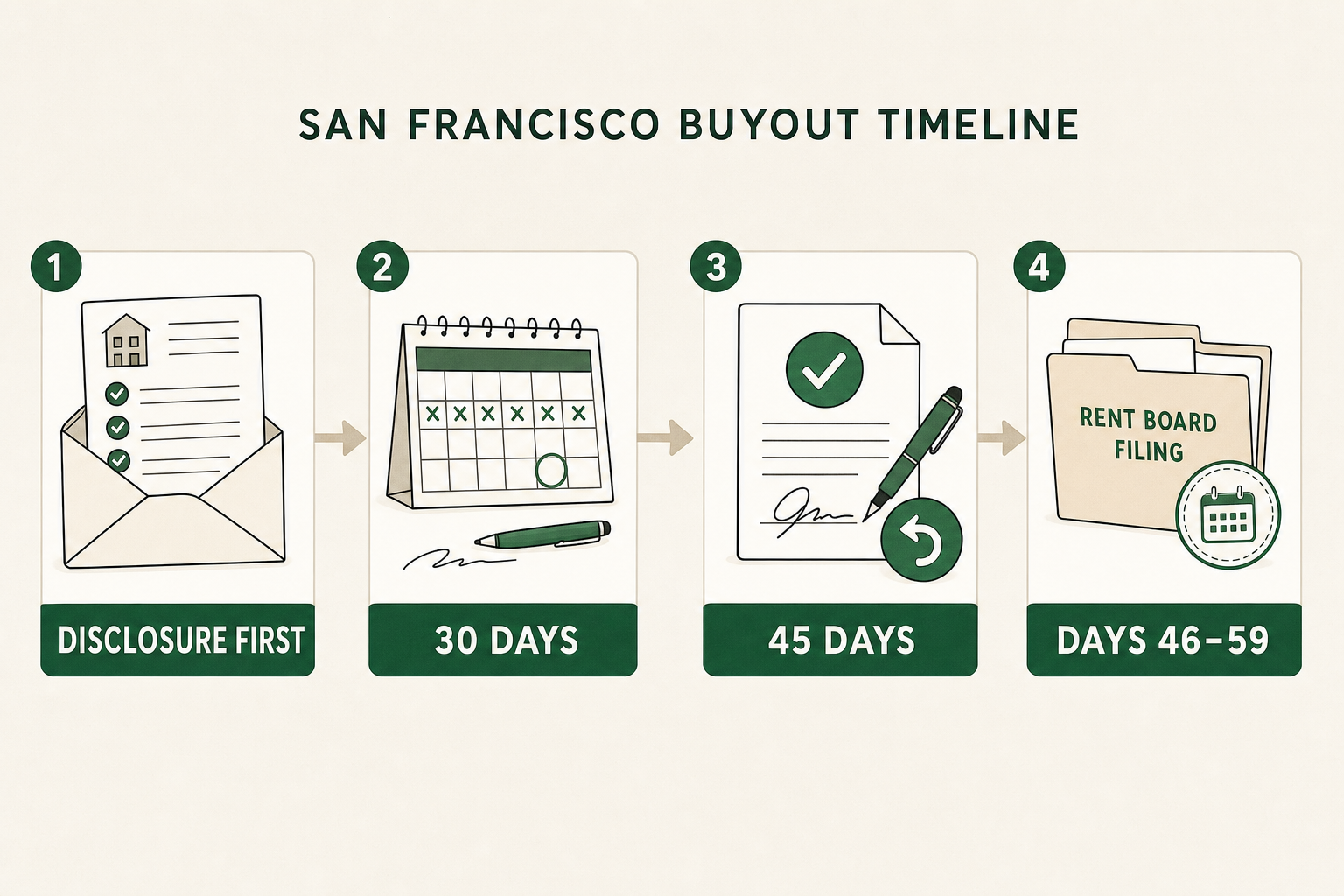
The fully signed date starts the 45-day cancellation window and the later filing period. If signatures happened on different dates, the last signature matters. A Rent Board counselor or attorney can help map the dates when the record is unclear.
The pre-negotiation disclosure already included information about how a buyout may affect eligibility for city affordable housing programs. The February 2026 amendment added an additional required item within the same pre-negotiation disclosure: Planning Department information about how a buyout may affect eligibility for relocation assistance and other benefits if the property is redeveloped.
The amendment also requires a warning in buyout agreements entered into on or after its effective date that a renter displaced by demolition may be giving up relocation assistance or other benefits.
Step 1 on the Rent Board's city buyout page links to the disclosure dated February 9, 2026. Step 2 links a separate landlord declaration with a March 2025 date in its filename. That declaration is a different document from the historical March 2025 disclosure, which already contained affordable-housing-program information and predates the 2026 redevelopment additions.
Paragraph 6 of the February 2026 disclosure describes rights and benefits that may apply when a building is demolished and replaced. It warns that moving voluntarily under a buyout may mean giving up relocation assistance and other benefits. Before negotiations begin, confirm the required disclosure materials with the Rent Board or a tenant counselor.
Read the whole agreement, not just the payment line
A compliant agreement has visible renter protections. It is written, identifies the rental address and Assessor's Parcel Number, and includes required 14-point statements about the right to refuse, access to an attorney or tenant organization, the public buyout database, and the 45-day cancellation period.
It also includes the required condominium-conversion statements and questions. For buyout agreements entered into on or after the February 2026 amendment's effective date, it must include the demolition-related relocation-benefits warning. Each renter who is party to the agreement initials the required statements.
Missing language, missing initials, an incomplete address, or pressure to sign before the 30-day waiting period is a serious red flag. Bring that document to a tenant counselor or lawyer promptly.
The rest of the contract determines how the deal works in real life. Put these terms into plain language before signing:
- Total consideration: Cash, rent waiver, deposit treatment, and any other promised value
- Payment timing: Exact amounts and dates, including what is paid before, at, or after move-out
- Move-out mechanics: Date, time, key return, unit condition, belongings, cleaning, and final access
- Current rent: What remains due through move-out and what happens if the date changes
- Every household member: Who signs, who must leave, and whether any subtenant or occupant is addressed
- Release language: Claims and rights being waived, including unknown claims
- Confidentiality terms: What you may say, to whom, and the consequence of a claimed breach
- Default terms: What happens if the landlord pays late or you cannot deliver possession as described
- Disputes and fees: Mediation, arbitration, court venue, and attorney-fee clauses
- Tax documents: Who receives the payment and what reporting document the landlord expects to issue
Crossed-out language, side promises, and blank spaces create avoidable ambiguity. The final signed copy should contain the complete deal.
Public records show stated amounts, not total deal value
San Francisco does not set a standard tenant buyout amount. As of the October 6, 2026 snapshot, the city's public file includes declaration-only records with no associated agreement filed, buyout-agreement records with different numbers of renters, and deals that may resolve very different issues. A declaration-only record can later have an agreement filed.
The public buyout data contains 353 buyout-agreement records filed in 2025. Of those, 346 have a stated Buyout Amount. The median stated amount across those 346 records is $36,958.60. However, 104 of the 346 amount-bearing records also flag Other Consideration. The dataset therefore does not support calling $36,958.60 a median total consideration.
One agreement may cover one renter, another may cover several, and the stated amount may capture only part of the deal.
Use a nearby recorded agreement as context only. Address, neighborhood, date, number of renters, tenancy length, unit protections, release scope, move-out timing, and the landlord's goal can all differ. The most useful comparison is between the offer and your own documented cost of leaving.
Use a net-impact worksheet instead of a buyout calculator
A calculator that uses one citywide average creates false precision. This worksheet keeps the unknowns visible.
A. Add the value promised in writing
| Promised value | Amount |
|---|---|
| Cash payment | $_____ |
| Rent waived or debt cancelled | $_____ |
| Deposit amount expressly returned or credited | $_____ |
| Other specific consideration | $_____ |
| A. Total promised value | $_____ |
B. Subtract one-time costs of leaving
| One-time cost | Estimate |
|---|---|
| Movers, packing, and supplies | $_____ |
| Storage, parking, or temporary lodging | $_____ |
| New deposit and move-in charges | $_____ |
| Overlapping rent | $_____ |
| Applications and screening | $_____ |
| Utility and internet setup | $_____ |
| Accessibility, pet, or household-specific move costs | $_____ |
| Lost work time, childcare, or travel | $_____ |
| Legal, tax, or benefits review | $_____ |
| B. Total one-time costs | $_____ |
C. Measure the ongoing housing gap
Use all required monthly charges for both homes, not rent alone.
| Monthly comparison | Amount |
|---|---|
| Replacement rent, required fees, and expected utilities | $_____ |
| Current rent, required fees, and expected utilities | $_____ |
| Monthly housing gap | $_____ |
Multiply the gap by 12, 24, and 36 months. The three views show how quickly a finite payment can be absorbed.
| Planning horizon | Housing-gap cost |
|---|---|
| 12 months | $_____ |
| 24 months | $_____ |
| 36 months | $_____ |
D. Keep individualized effects visible
Do not enter zero when an item is unknown. Write unresolved until the appropriate person supplies an answer.
| Individualized item | Confirmed effect |
|---|---|
| Federal and state tax treatment from a tax professional | $_____ / unresolved |
| Affordable housing or public-benefit effect from the program administrator | $_____ / unresolved |
| Treatment of attorney fees or another payment recipient | $_____ / unresolved |
The IRS explains that the tax treatment of settlement payments depends on the facts and what the payment replaces. A buyout's tax result cannot be determined from the amount alone. Use an individualized answer for this row rather than a rule of thumb. IRS settlement guidance explains the general distinction.
E. Calculate the planning margin
Net planning impact = A − B − chosen housing-gap cost − confirmed D items
This result is a planning estimate. It does not say whether the offer is fair or whether you should accept it. It makes the trade-offs visible.
For a hypothetical example, assume the written deal promises $45,000 in cash and a $3,000 rent waiver. One-time moving and move-in costs total $9,000. A comparable replacement costs $1,300 more per month, or $31,200 over 24 months.
| Hypothetical line | Amount |
|---|---|
| Promised value | $48,000 |
| One-time costs | −$9,000 |
| 24-month housing gap | −$31,200 |
| Planning margin before unresolved tax or program effects | $7,800 |
The same $45,000 headline can produce a very different result when the rent gap, time horizon, or household needs change.
Get the right local help for the question
Different helpers do different jobs.
- Rent Ordinance process: A Rent Board counselor provides free information by phone or in person, with multilingual support. The Rent Board cannot give legal advice. Bring your dates and documents. The counseling line is 415-252-4600.
- Tenant counseling and community support: The official March 2025 referral PDF lists local tenant-help organizations.
- Contract and rights review: A tenant lawyer can assess releases, payment protections, household status, missed deadlines, and cancellation questions. The lawyer referral service connects San Francisco renters with landlord-tenant counsel.
- Tax or program effects: A tax professional can address the payment's tax treatment. An affordable housing, voucher, or benefits program administrator can address that program's treatment of the payment.
If a buyout conversation is paired with threats, harassment, a termination notice, or court papers, treat that as a separate urgent issue. Our San Francisco guide explains the difference between a landlord notice and an eviction case and lists the local response paths.
Frequently asked questions
Can a San Francisco landlord force me to take a buyout?
No. The required disclosure states that a renter has the right to decline buyout negotiations and a buyout agreement. A landlord's other legal options are separate from the voluntary buyout process.
Do buyout rules apply only to rent-controlled apartments?
No. Section 37.9E applies to landlords and renters of rental units as defined by the Rent Ordinance, even when the local price cap does not apply to the home.
Does a spoken offer start the process?
It can. The ordinance defines buyout negotiations as any oral or written discussion or bargaining about a possible agreement. The landlord must provide the authorized disclosure and file the declaration before that conversation begins.
Can I cancel after signing?
San Francisco gives a renter through the 45th day after all parties execute the agreement to rescind by hand delivery, email, or placing a statement in the mail. A signed, dated notice with delivery proof is the clearest record. A lawyer can address a missed deadline or an agreement that lacks required terms.
Is there a minimum tenant buyout amount in San Francisco?
The buyout ordinance does not set a minimum payment. Statutory relocation payments tied to certain formal no-fault evictions are a different system. The existing San Francisco rent control guide covers those schedules and eligibility rules.
If moving is one of the outcomes you are weighing, start a Fairway search. Tell us what you need, and our free AI agent for renters will find matches, call landlords or leasing offices, and book tours so you can compare the offer with real homes.