Apartment co-signer
What Is a Co-Signer for an Apartment? Read the Liability Clause
See how an apartment co-signer becomes directly liable, when joint and several terms can expose the full rent, and how release or renewal works.
Being asked for a co-signer can feel like one more approval step. For the person signing, it can mean direct responsibility for the whole household's unpaid lease balance, even when they only intended to back one renter. The safest path starts with the actual paperwork: who signs, where they sign, whether liability is joint and several, which later changes keep it alive, and what ends it.
What is a co-signer for an apartment?
An apartment co-signer is an additional person who signs the lease or a co-signer addendum and becomes directly responsible for the lease duties stated in that agreement. If a covered amount goes unpaid, the landlord may be able to require the co-signer to pay without first taking the renter to court or trying every collection step against them.
That direct obligation is the defining feature. A co-signer is more than a reference or emergency contact. They put their own finances behind the agreement when they sign.
Landlords usually request a co-signer when an applicant does not meet the property's income, credit, or rental-history rules alone. Adding another accepted signer gives the landlord another person responsible for the payment and lease duties named in the agreement. The co-signer can be any adult the property accepts under its lawful screening rules. They do not have to be a parent or relative. A friend, partner, or other adult may qualify if they meet the property's requirements and agree to sign.
Leasing offices use the words “co-signer” and “guarantor” loosely, so the label at the top of a form is only a clue. The lease definitions, any addendum made part of the lease, the liability clause, and the signature block show the person's real status. The agreement and applicable law define their potential responsibility.
Co-applicant, co-tenant, co-signer, and guarantor are separate roles
Applying and signing are different events. A co-applicant has no liability for future rent merely because they filled out an application. Application fees, holding deposits, or statements on the application can create separate obligations, but lease liability begins only if that person signs a lease or another agreement that creates it.
| Role | Occupancy | What creates lease liability? | Usual position |
|---|---|---|---|
| Co-applicant | Plans to live in the apartment | No lease liability until they sign an agreement that creates it | An applicant under review |
| Co-tenant or co-lessee | Lives in the apartment | Signs the lease as a renter | Directly responsible for lease duties, often jointly and severally with other renters |
| Co-signer | May or may not occupy, depending on the documents and approval | Signs the lease or a co-signer addendum | Directly responsible for the obligations the agreement assigns |
| Guarantor | Usually does not occupy | Signs a guaranty, addendum, or sometimes the lease in a defined guarantor capacity | Usually becomes responsible after a defined renter default |
| Approved occupant | Lives in the apartment | Occupant status alone does not create payment liability | Allowed to live there without necessarily being a leaseholder |
A person signing in a “resident” or “tenant” block may be a co-tenant with occupancy rights and full renter duties. A person signing only a co-signer addendum may have financial duties without any right to enter or live in the unit. A guaranty may also be written broadly enough to waive notice or let the landlord demand payment soon after default. Our apartment guarantor guide covers that backup role, professional guarantor services, and guarantor qualifications.
What can an apartment co-signer be responsible for?
A co-signer's possible exposure starts with the covered obligations in the signed lease and addendum. Those may include:
- unpaid base rent
- utilities or recurring charges assigned to renters
- late, returned-payment, parking, pet, or other lease fees
- repair costs for damage beyond ordinary wear
- lawful early-termination charges or rent loss after a lease break
- charges for staying after the lease ends
- court, collection, and legal costs
None of those categories is an automatic blank check. State or local law may prohibit a fee or limit its amount. If a renter leaves early, the landlord may have to make a reasonable effort to find a new renter instead of charging the entire remaining balance. Damage claims still depend on ordinary-wear rules, proof of who caused the damage, and security-deposit law. Legal or collection costs can be charged only when the agreement and applicable law allow them. The signed terms, legal limits, available proof, and the landlord's efforts to reduce the loss can all limit a claim.
State rules illustrate why the location matters. Washington law, for example, requires a landlord to make a reasonable effort to limit the loss after a renter leaves. California limits certain rent claims after termination to losses that could not reasonably have been avoided under Civil Code section 1951.2. A co-signer agreement cannot erase renter protections that the law does not allow people to sign away.
Joint and several liability can reach the whole household balance
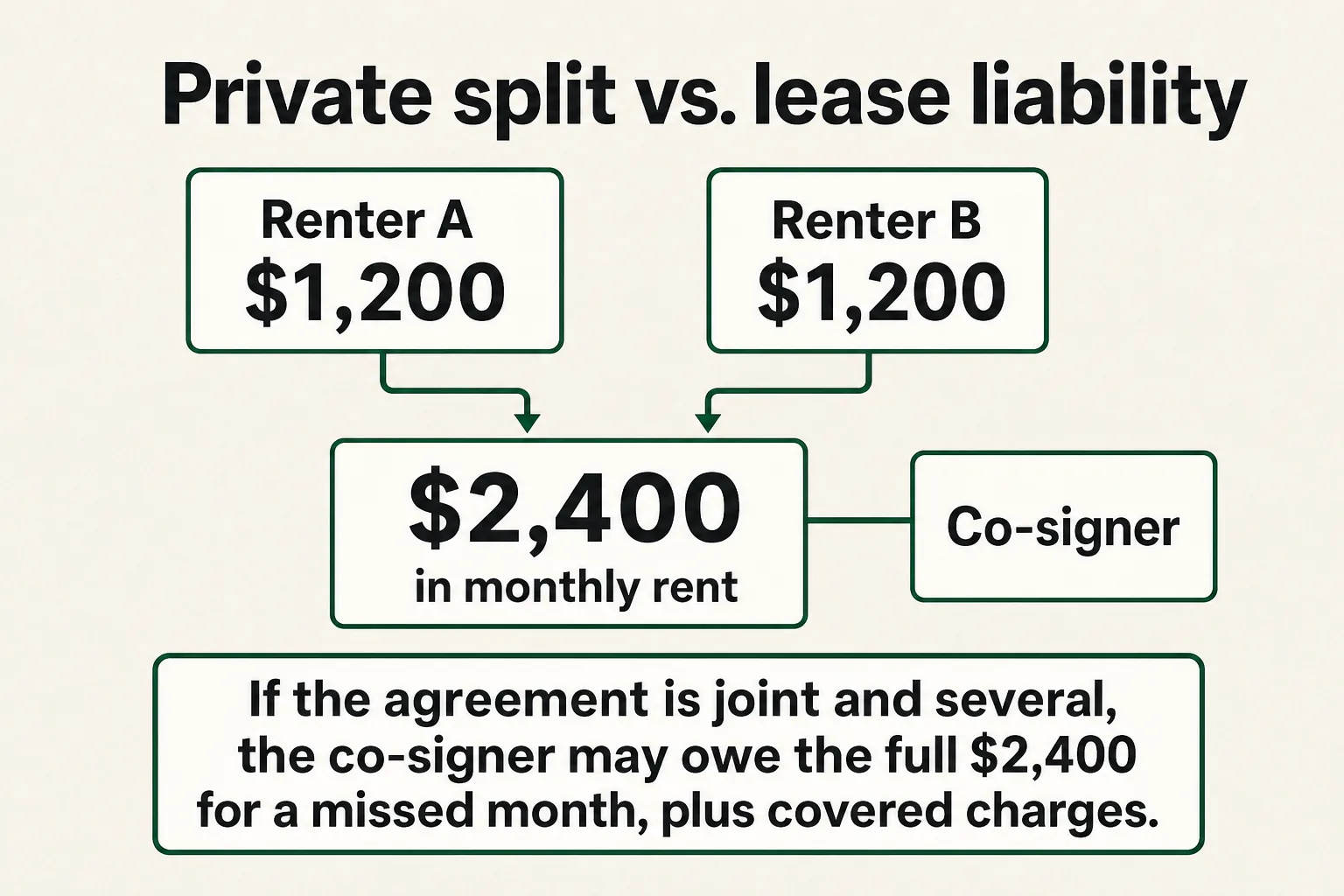
“Joint and several” is the phrase that can turn one person's share into the whole bill. When a lease makes the co-signer jointly and severally liable for all renter obligations, the landlord may pursue that co-signer for the full covered household balance. A private roommate split does not change the landlord's contract. An official Fairfax County FAQ explains the same rule for a joint lease: each signer can be responsible for the entire rent, regardless of the roommates' own split.
Consider two roommates who privately split $2,400 in monthly rent into $1,200 each. One roommate's parent signs a co-signer addendum that binds the parent to the lease obligations. If that agreement is joint and several, the co-signer may owe the full $2,400 for a missed month, plus covered charges. The result would be different if the signed addendum capped liability at one named renter's $1,200 share.
The co-signer's due-diligence checklist
Good intentions do not set a legal limit. These are the terms both people should pin down before anyone signs.
1. Identify every document that creates the obligation
Read the proposed lease, co-signer addendum, rules, fee schedules, and every outside document the lease says is part of the deal as one package. The unit, renters, landlord, monthly rent, term, and addendum date should match. An e-signature screen that shows only a signature box is not a useful substitute for the full text.
The co-signer should receive the complete copies signed by everyone. A blank form or an early draft cannot show the final deal.
2. Find the co-signer's exact signing status
Look for the name in the lease's definitions, party list, and signature block. Then trace any sentence saying the co-signer is bound “as if a tenant,” is “jointly and severally liable” for the whole covered balance, guarantees “all obligations,” or has no occupancy rights. The effect comes from those words together.
Also find out when the co-signer can be billed. Direct liability may let the landlord demand an unpaid covered amount from the co-signer as soon as it is due. Another form may require the renter to miss a payment, notice to the co-signer, time to fix the missed payment, or other collection steps first.
3. Put a number around the risk
Calculate the base rent over the full term, then add mandatory recurring charges and the agreement's other covered categories. Search for a dollar cap, a one-renter limit, a fixed end date, and any exclusion for roommate-caused charges.
For a $2,400 monthly apartment, 12 months of base rent is $28,800 before utilities, fees, damage, or collection costs allowed by the agreement and law. That number does not mean the co-signer will owe $28,800. It shows why “I am only helping with approval” is too vague to describe the commitment.
4. Plan for information before a payment fails
The renter and co-signer can arrange access to payment confirmations, the rent ledger, late notices, renewal offers, and amendments. The agreement should say whether the landlord must send the co-signer a default notice and whether that notice is a condition of payment liability.
The renter can also sign a separate repayment and communication agreement with the co-signer. It can set notice deadlines, repayment terms, and what happens after a roommate leaves. It does not reduce the landlord's rights under the lease.
5. Find the exit before signing the entrance
Read the release, replacement, expiration, renewal, month-to-month, and holdover language together. A fixed end date is clearer than a promise that continues until every balance is paid and the landlord issues a release. If the co-signer expects to back only the original year, the signed terms need to support that limit.
Renewals and amendments can change the risk
A lease can change without the household thinking of it as a new financial deal. A rent increase, added roommate, removed roommate, pet, parking space, unit transfer, concession repayment, extension, or month-to-month conversion can alter the amount or people the co-signer is backing.
Some co-signer forms say the signer consents in advance to renewals, extensions, or changes without another signature. That language may support continuing liability. It does not settle every case because state rules for people legally treated as guarantors or sureties can limit responsibility for later renewals or changes.
California shows two ways those state rules can matter. Civil Code section 2815 can let a guarantor stop a continuing guaranty from covering some future obligations in defined circumstances. Civil Code section 2819 can release a surety when the creditor changes the original obligation without the surety's consent, subject to the section's limits. These sections apply when the signer is legally a guarantor or surety. They do not automatically govern every direct co-signer or joint obligor, meaning someone who accepted direct responsibility alongside the renter under the lease. The exact signed wording, whether another clause can lawfully waive those protections, and the facts still affect the result.
The cleanest process is a written amendment that states the new rent, term, residents, covered charges, and whether the co-signer consents. Silence is a poor release. A renewal without the co-signer's fresh signature may still be covered by broad continuing language, while state law or narrower contract terms may end the obligation.
Can you remove a co-signer from an apartment lease?
Unless the agreement or applicable law gives the signer a release or a right to end future responsibility, removal generally requires the landlord's consent. The renter cannot end the co-signer's obligation with a private promise, and the co-signer cannot assume that the original term's end date or a renter's move-out erased continuing language.
A complete written release should identify:
- the lease, unit, renter, and co-signer
- the effective date
- whether the release applies only to future charges or also resolves existing balances
- whether a replacement signer or replacement lease takes over
- which parties must sign
The landlord may require the renter to qualify alone or may screen a replacement before consenting. If the co-signer signed the lease as a tenant, the change may also affect occupancy rights and requires careful treatment in the lease amendment. A name disappearing from an online portal is not the same as a signed release.
Co-signer requirements and credit reporting
Properties set their own lawful screening criteria. A proposed co-signer may need to submit identification, income records, an application, and authorization for credit or tenant screening. There is no universal national co-signer score or income multiple. Our apartment rental requirements guide covers application reasons, proof of income, credit, rental history, and document security in detail.
If a landlord requires a co-signer based in whole or in part on information in a consumer report, the Fair Credit Reporting Act treats that as an adverse action. The notice must identify the reporting company, state that the reporting company did not make or explain the decision, and explain the consumer's rights to dispute information and request a free report directly from that company within 60 days. The FTC's landlord guidance explains the notice. If the landlord used a numerical credit score in that adverse action, it must also provide the score and the additional score information required by 15 U.S.C. § 1681m in writing or electronically.
A proposed co-signer whose report was used and whose participation was rejected gets their own notice. The FTC reached that conclusion in its co-signer advisory opinion, although the opinion itself notes that it is informal and nonbinding.
The screening pull may be a hard inquiry that affects the co-signer's score, or a soft inquiry that does not. The CFPB explains the difference between hard and soft inquiries. Later, accurate rent or collection reporting about each legally liable person's own obligation can affect that person's consumer reports. A family relationship alone does not create that obligation. If information is inaccurate or assigned to the wrong person, the FCRA provides a dispute process.
Make the signature match the help being offered
A co-signer may help a renter get approved, but the safe version has boundaries: named renters, a defined amount, covered charges, a fixed term, notice rights, and a written exit. The broader the joint-and-several, renewal, and amendment language, the further the risk can travel from the promise everyone discussed.
When you are still comparing apartments, start your search with Fairway. Our AI agent for renters watches listings, calls leasing offices, surfaces fees, and books tours. Fairway is free for renters. Eligible renters may receive $100 after move-in for a home found through us. To qualify, sign the lease and send us the signed copy. The offer is limited to one payment per lease and is subject to our current eligibility and terms.