Pet-friendly renting
What Is Pet Screening? What Renters Actually Need to Know
Learn what pet screening checks, how PetScreening.com works, what it can cost, how long approval takes, and which records renters should prepare.
A listing marked “pet friendly” can still lead to another application, another fee, and a request for your dog’s vaccination record. That extra layer is pet screening. The confusing part is that the term can mean a landlord’s own checklist or PetScreening.com, a third-party service. Here is what you may be asked for, what it can cost, how decisions are made, and where ordinary pet rules stop applying.
What pet screening means
Pet screening is a review of an animal and its owner before a landlord approves the animal for a rental. Think of it as a pet profile checked against the property’s rules. It is separate from the credit, income, rental history, and background checks used to screen you.
The landlord may collect the information on a paper form, inside the rental application, or through a third-party website. Screening can happen when you apply, renew a lease, or ask to bring a new animal into your current home.
Two similar names cause a lot of confusion:
| Term | What it means |
|---|---|
| Pet screening | The general process a landlord uses to review an ordinary household pet |
| PetScreening.com | A specific third-party service that creates animal profiles and shares them with housing providers |
A “pet-friendly” label does not tell you the screening rules or total cost. Our free AI agent for renters can search for pet-friendly apartments, call landlords, and ask about restrictions and fees before you spend money on an application.
What happens during pet screening
The process usually follows five steps.
- The property gives you its pet policy. This should cover allowed species, maximum number of animals, breed or weight restrictions, required records, and every pet-related charge.
- You complete one profile for each animal. You enter identifying, health, behavior, and care information, then upload the requested records.
- The landlord or screening service reviews the profile. It compares your answers with the property’s rules. A third-party service may also assign a score or flag a policy conflict.
- The reviewer asks for anything missing. Some landlords also request a pet reference or an in-person meeting, especially when the application raises a behavior question.
- The property makes the decision. Approval is usually documented in a pet addendum that identifies the animal, fees, rules, and consequences for damage or nuisance behavior.
Timing depends on who runs the screening and whether anything is missing. A completed form may move quickly, while a reference, record request, or meet-and-greet adds another round. The leasing office still has to make the final call.
What landlords usually ask for
Expect questions that help the property identify the animal, apply its policy, and assess possible damage or disruption.
| Category | Common requests |
|---|---|
| Identity | Name, species, breed or mix, age, sex, color, weight, and clear photos |
| Health | Rabies and other vaccination records, veterinarian, spay or neuter status, microchip, and local license |
| Behavior | House-training, barking or noise, chewing or scratching, aggression, bite incidents, and obedience training |
| Daily care | Time left alone, exercise routine, waste plan, enclosure details, and pet sitter information |
| Housing history | How long you have owned the animal, prior addresses, past damage or complaints, and a former landlord reference |
Cats, birds, reptiles, rabbits, and other animals may get species-specific questions. A bird profile may focus on noise. A reptile profile may ask about its enclosure. “Pet” does not automatically mean “dog form with the name changed.”
Build a small pet file before you apply
Keep these items together so the profile does not stall:
- one recent, full-body photo
- current vaccination and rabies records
- license, microchip, and spay or neuter records when applicable
- veterinarian contact details
- training certificates or canine good-citizen records, if you have them
- one former landlord, trainer, sitter, or veterinarian reference
- a short, factual note about house-training, time alone, noise, and care
Accuracy matters more than cuteness. A bow tie is optional. Matching dates, weights, records, and answers are useful.
How PetScreening.com works for renters
If your invitation points to PetScreening.com, the property has outsourced the profile step. PetScreening’s resident FAQ lists three profile types and their prices:
| Profile type | Profile price | What happens |
|---|---|---|
| Household pet | $30 by card or $25 by ACH, per profile | You enter animal information and receive an active profile that lasts one year |
| No pet or animal | $0 | You acknowledge the property’s no-animal and pet-visiting rules |
| Assistance animal | $0 | You submit a separate accommodation profile for review |
The household-pet price applies to each profile. Profiles stay active for one year, then must be renewed and reactivated. Early household-pet renewal reduces the price by $5. Submitted household profiles are nonrefundable, although an active profile can be transferred to another housing provider.
The service creates a FIDO Score from 0 to 5 paws. Its factors include breed, sex, age, weight, reported behavior, and owner-care information. Five paws indicates potentially lower risk, one paw indicates potentially higher risk, and zero signals a limiting factor based on the property’s rules, including weight, breed, age, spay or neuter status, or a reported bite. PetScreening lays out those factors in its onboarding guide.
PetScreening.com does not approve or deny ordinary household pets. It sends the profile, score, and factors to the housing provider. The property decides how to use them. Ask whether the score affects eligibility, the deposit, or monthly pet rent, rather than assuming that an active profile equals a yes.
PetScreening’s help center says household-pet and no-pet profiles are usually processed right away. Its onboarding guide lists a standard review window of two to five business days for an assistance-animal accommodation request. A returned profile or slow response from a healthcare provider can extend that window. Property approval is a separate step.
If an invitation arrives unexpectedly, contact the leasing office through the phone number or email you already use. A real PetScreening.com email can still reflect a mistake, an old application, or a new policy that is not part of your current lease.
Calculate the full first-year pet cost
A pet-screening charge is only one line in the cost stack. Keep these four charges separate:
| Charge | How it usually works |
|---|---|
| Screening or profile fee | Paid to review or maintain the pet profile, often per animal |
| Pet deposit | Usually refundable after lawful deductions for damage, subject to the lease and local law |
| One-time pet fee | Usually nonrefundable |
| Monthly pet rent | Added to the rent every month, often per animal |
Use this calculation:
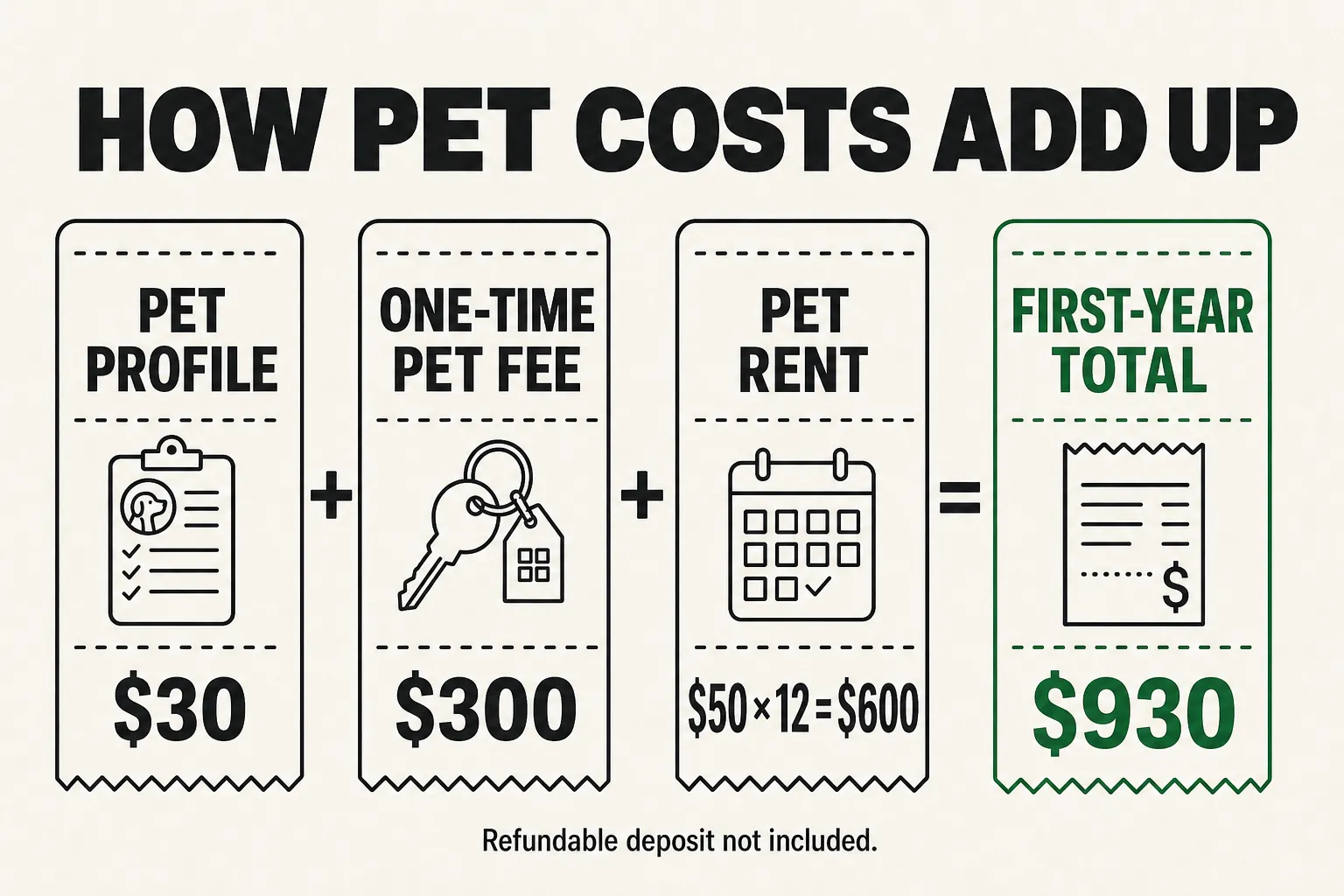
First-year nonrefundable pet cost = screening fee + one-time pet fee + (monthly pet rent × 12)
For example, a $30 profile, $300 one-time fee, and $50 monthly pet rent create a $930 first-year cost. Add a $400 refundable pet deposit and the first-year cash outlay becomes $1,330, even though the deposit may eventually come back.
Get the amounts, payees, due dates, annual renewals, and refund rules before paying. Our guide to apartment application fees explains how to separate screening, admin, holding, and move-in charges across the rest of the application.
What can cause a pet to be rejected?
There is no universal passing score. Common reasons include:
- the species, breed, weight, age, or number of animals conflicts with a written policy
- required vaccination, license, or health records are missing or expired
- the application reports a bite, aggression, repeated noise complaint, or major property damage
- a required spay, neuter, enclosure, or insurance condition is not met
- the profile contains conflicting or incomplete information
- a meet-and-greet raises a specific behavior concern
Some issues are fixable with a current record or clearer reference. A hard species, weight, or insurance restriction may leave no approval path at that property.
Breed rules deserve a direct question. A large study published in Science found that breed explained just 9% of individual behavioral variation, so breed alone is a weak predictor of one dog’s behavior. The dog genetics study does not stop a property or its insurer from using a breed list where local law permits it. Ask whether individual review is available, then support it with training records and a landlord reference. Do not guess at a mixed breed or hide a bite history to get past the form.
Assistance animals follow a different path
An animal connected to a disability belongs in a reasonable-accommodation request before an ordinary pet profile. HUD’s current assistance-animal page says an assistance animal is not a pet and gives an exception to a no-pet rule or pet charge as an example of a reasonable accommodation. On PetScreening.com, the assistance-animal profile costs $0.
The federal treatment of untrained emotional support animals is less settled. HUD withdrew its 2013 and 2020 assistance-animal guidance effective September 17, 2025, according to the official Federal Register notice. A May 2026 HUD memo then directed its fair-housing office to find reasonable cause only in cases involving animals individually trained to provide disability-related assistance.
That memo changed HUD’s enforcement position. It did not amend the Fair Housing Act or eliminate private claims and broader state or local protections. An August 2026 legal analysis explains why a housing provider still cannot assume every untrained emotional support animal request may be denied.
Send a disability-related request to the housing provider in writing and use its separate accommodation route. Ask the provider to pause ordinary pet charges until it decides the request. If you believe the provider discriminated, HUD’s current housing discrimination report accepts allegations online, by phone, or by mail. State and local civil-rights agencies or housing legal aid may offer broader routes for an untrained emotional support animal than HUD’s present enforcement standard.
Seven questions to ask before you submit a pet profile
- Does this exact unit accept my animal’s species, breed or mix, weight, age, and size?
- Is screening required, and is the property using its own form or a third-party service?
- What is every one-time, monthly, per-pet, and annual charge?
- Which charges are refundable, and what happens to them if the animal is rejected?
- What records, references, insurance, or meet-and-greet are required?
- Who makes the final decision, and how long does that decision usually take?
- If I already live here, which lease clause or signed addendum makes the new process and fee applicable now?
These questions belong beside the property’s other rental requirements. Get both sets of rules before paying the general application fee. A pet profile is frustrating. A pet profile for a unit that never accepted your animal is worse.
Pet screening FAQs
How long does pet screening take?
A complete household-pet or no-pet profile on PetScreening.com is usually processed right away. Final approval from the property may take longer. PetScreening lists two to five business days as its standard review time for assistance-animal accommodation requests, and missing information or healthcare-provider verification can extend that timeline.
Can a landlord make me complete pet screening if I do not have a pet?
Some properties using PetScreening.com require every applicant or resident to choose a profile type, including a free no-pet profile. That profile records that you have no animal and acknowledges rules about pet sitting or visiting animals. For a current resident, whether a new requirement can be added mid-lease depends on the signed lease and local law.
Is PetScreening.com legitimate?
Yes. It is a real third-party service used by housing providers. That does not make every unexpected invitation or fee correct. Confirm an unexplained request with the property through contact information you already trust, then get the requirement and charge in writing.
Does pet screening affect my credit score?
Ordinary pet screening does not involve a personal credit inquiry. A FIDO Score is a pet-related risk indicator, not a consumer credit score. Your separate rental application may still include a credit and tenant-screening report.
How do I pass pet screening?
Start with a property whose written policy fits your animal. Submit complete, accurate records and answer behavior questions directly. There is no document that can override every breed, weight, species, bite-history, or maximum-pet rule.
Pet screening is easier when the rules are known before the application link arrives. Start your search with Fairway, tell us about your animal and budget, and let our free AI agent for renters find matches, call landlords, surface fees, and book tours.