Apartment Admin Fee
Apartment Admin Fee: Costs, Timing, and Refund Questions
Understand apartment admin fees, when payment is due, what happens after a denial or cancellation, and how the charges differ from deposits and screening fees.
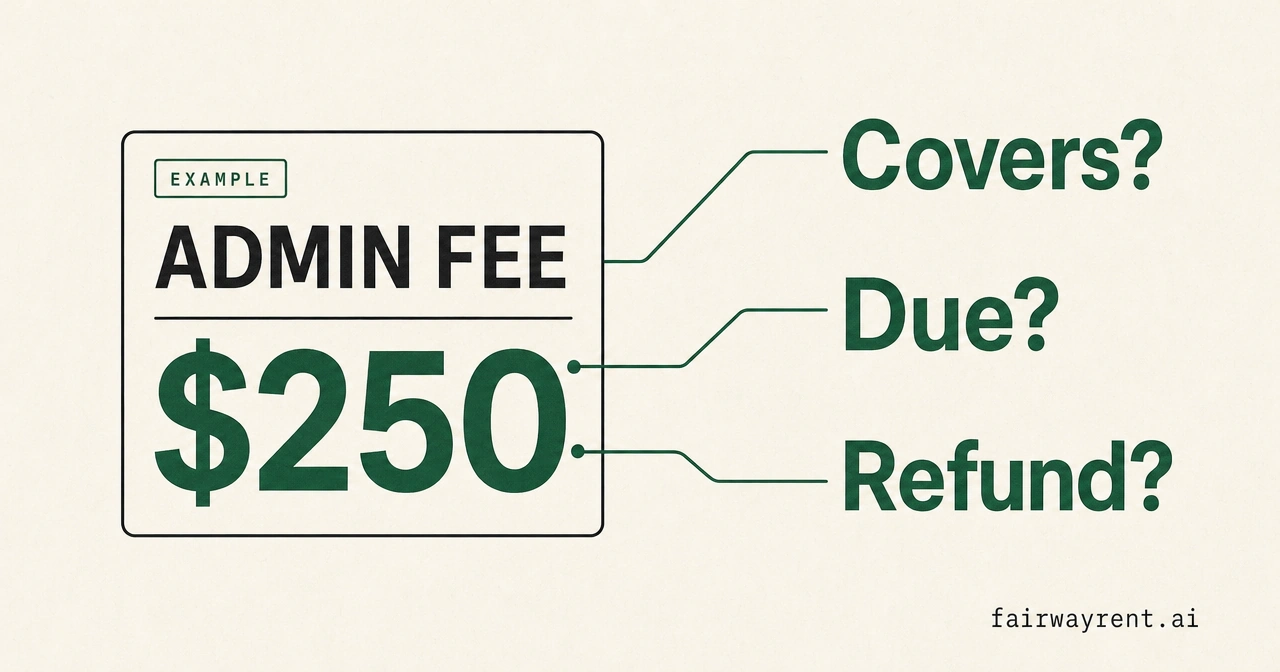
Suppose a property adds a $250 admin fee to your apartment application costs. That extra charge can change your moving budget fast. It gets more frustrating when the line item just says “admin fee,” with no clear explanation of what happens if you never get the keys. Understanding the charge means separating its purpose, payment deadline, and refund terms from the other money a property wants upfront.
What is an apartment admin fee?
An apartment admin fee is a charge a property labels as payment for administrative work connected with a rental application or new tenancy. That label alone does not tell you exactly what work it covers, whether it reserves an apartment, or whether you can get the money back.
A property might describe it as lease preparation or new-renter processing. Another might list an admin fee beside a separate application fee and security deposit. Those separate line items deserve separate explanations. “It's part of applying” leaves too much unanswered.
We built Fairway as an AI agent for renters, free for renters. We surface fees and ask leasing offices your questions before you commit. For an admin fee, the useful answer is the amount, what it buys, when it is due, and the written conditions for keeping or returning it.
When do you pay the admin fee?
Property fee schedules vary. An admin fee can be due with the application or at move-in. Its name does not establish the deadline, and an application fee or deposit may have a different due date.
It helps to separate two questions:
- When is payment due? This tells you when the money must leave your account.
- When does the property say it becomes nonrefundable? This identifies the event that could affect a refund, subject to applicable law.
For example, a policy saying the charge becomes nonrefundable upon approval creates a different decision from one that says payment is due at lease signing. You want to know whether approval could happen before you receive the lease.
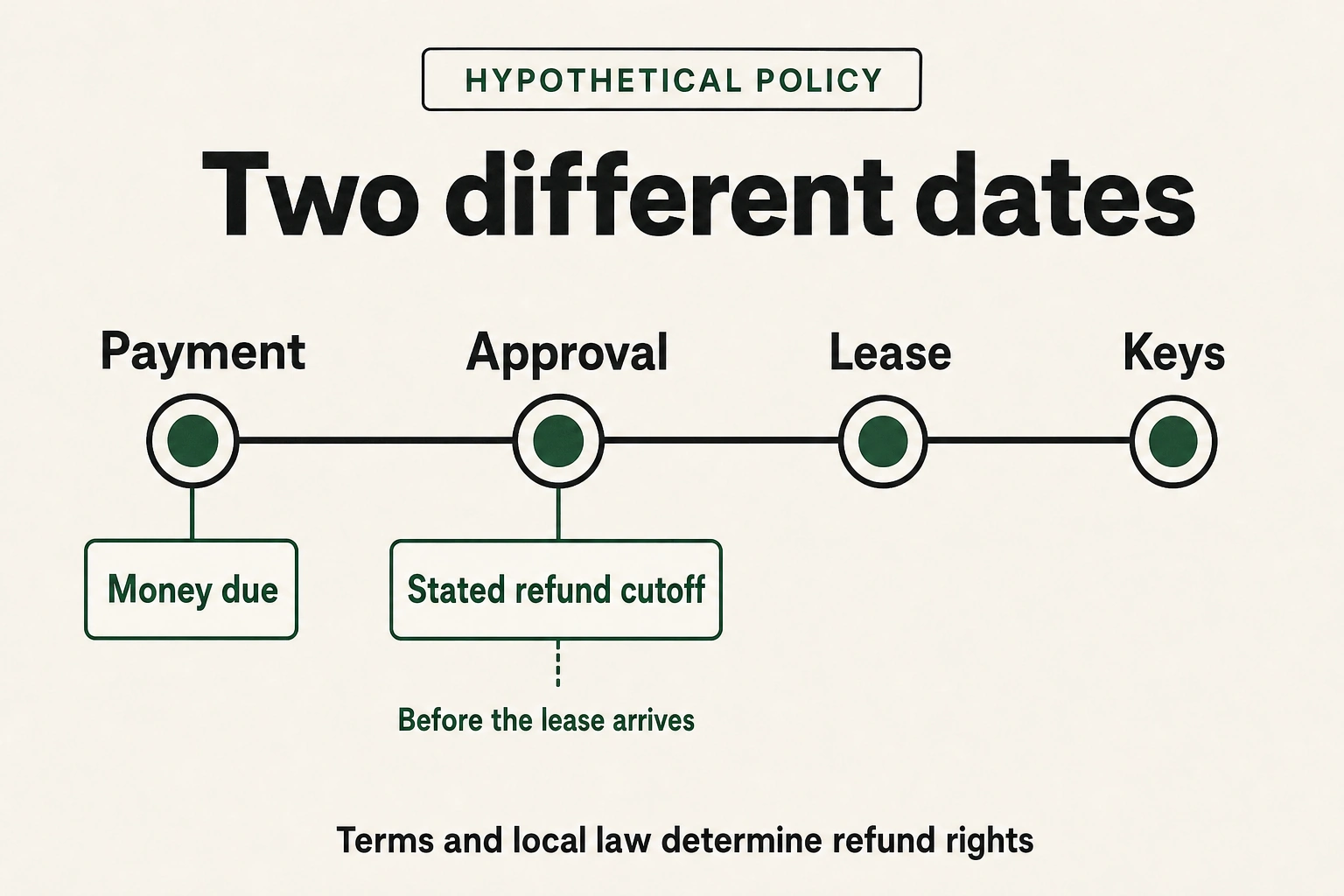
A useful question is: “Can you send the fee agreement and a sample lease before I pay? At what point would I lose the ability to get this payment back?”
If a property will not explain the charge or share its terms, pausing the application is a reasonable choice. A deadline does not make an unclear fee easier to afford.
Admin fee vs. application fee, deposits, and move-in fee
The most useful distinction is what each payment does. Several charges can appear on the same bill, and a property's label may not match how local law treats the money.
| Payment | What it means | What you need in writing |
|---|---|---|
| Admin fee | A property-labeled charge for administrative work associated with applying or starting a tenancy | The specific work, due date, and refund conditions |
| Application or screening fee | Payment for obtaining or reviewing applicant information, such as credit history or references | What screening it covers, whether it is per applicant, and any refund terms |
| Security deposit | Money held as security for lawful deductions, such as unpaid rent or damage | Deposit amount, permitted deductions, and return terms under local law |
| Holding deposit | Money paid to reserve a particular apartment for a stated period | The unit, holding period, refund conditions, and any credit toward rent or a deposit |
| Move-in fee | A separately listed charge associated with moving in; its purpose depends on the property's terms | What it covers and whether it overlaps with another charge |
An admin fee does not automatically reserve the apartment. If the property says it does, the written terms should identify the unit and how long it will be held. Likewise, paying an admin fee does not establish that you have been approved or have a signed lease.
Application charges also need their own treatment. If two adults apply, a per-applicant screening charge can multiply while a per-apartment admin fee stays the same. Our application fee guide explains screening charges and their refund rules in more detail.
A security deposit is different from a payment for a completed service. A smaller fee labeled nonrefundable can leave you with less money later than a larger deposit returned after lawful deductions. Comparing only the amount due today misses that trade-off.
Is an apartment admin fee refundable?
There is no reliable nationwide yes-or-no answer based only on the words “admin fee.” Refundability depends on the payment's actual purpose, the applicable state or local rules, the agreement, and what happened to the rental.
A property calling a fee nonrefundable does not settle whether that treatment is lawful. In California, for example, a landlord's charge at the beginning of a tenancy for processing a new renter counts as part of the security deposit, apart from the separately regulated screening fee. A security deposit cannot be made nonrefundable under the state's tenant rights guide.
Screening has different limits. In New York, a landlord's pre-lease credit and background check charge is capped at $20, with a copy of the report and an invoice required, according to the Attorney General's guidance. That is a screening rule, not a blanket answer about every charge named an admin fee.
These distinctions are why a refund question needs more than “Do you refund admin fees?” Ask what happens in each specific situation.
If your application is denied
Denial does not, by itself, tell you what happens to every payment. Ask for an itemized decision covering the admin fee, screening fee, and any deposit separately. A refund policy for one does not establish the outcome for the others.
California illustrates the difference: its guide says a holding deposit submitted with an application must be returned if the applicant is not accepted. An application screening fee need not be refunded solely because the applicant failed established screening criteria, although unused amounts must be returned. These are distinct California payment rules, not a nationwide admin-fee refund promise.
If your application was never considered
A completed screening followed by denial is different from a property taking your money and selecting someone else before reaching your application. Your refund request should say which happened.
Ask whether the property considered your application and what work it performed. Include any message saying the unit was already rented or that your application was never processed. Rules tied to screening or unused charges may matter even when the receipt uses a broad label.
If you are approved but do not sign
This includes finding another apartment, losing income, being unable to meet approval conditions, or declining the lease terms. It is a separate situation from the landlord rejecting your application.
The application or holding agreement may contain a withdrawal deadline or a provision allowing the property to retain money after approval. Whether that provision applies and is enforceable depends on the payment and local law. “I never signed the lease” is not enough information to decide the refund question.
If approval requires a guarantor or a larger deposit you cannot provide, ask the property to state the outcome accurately in writing. The distinction between a denied application and your withdrawal can matter to the fee terms.
If the property cancels or cannot provide the apartment
A property withdrawing the unit is different from you changing your mind. Save its cancellation message and identify the exact apartment, promised move-in date, and payments made.
Request an itemized refund response. If the office offers a different unit or a credit toward a future application, ask whether you can receive money back instead and what terms it relies on. An offer of credit is not the same as a refund.
What to do when a refund is refused
A clear written request is more useful than arguing over the label on the receipt. Gather the fee schedule, application and addenda, holding agreement, receipt, and messages about approval or cancellation. Keep the version you received before paying.
A short request can say:
I paid $250 labeled “administrative fee” for apartment 204 on [date]. On [date], your office told me [what happened]. Please return the payment and explain separately how each fee or deposit is being handled. If you are retaining any amount, please identify the agreement provision and legal basis, the work or loss it covers, and the amount retained.
If the office agrees to a refund, ask for the amount, payment method, and expected date. Keep that reply with the original receipt.
If the dispute remains unresolved, a local legal-aid organization, housing counselor, or consumer-protection office can help identify the rules and complaint process for the apartment's location. A broad statement that “admin fees are never refundable” does not explain how those rules apply to your payment.
How much does an admin fee add to your move-in budget?
Use the property's actual dollar amount rather than treating an online range as a fair-price rule. The same $250 can be a separate cost, a credited payment, or a charge waived under a written offer. Those produce different budgets.
Here is a hypothetical quote for two adults, with a holding deposit credited toward the security deposit:
| Payment | Due with application | Due before keys |
|---|---|---|
| Application fees, $50 per adult | $100 | $0 |
| Separate admin fee | $250 | $0 |
| Holding deposit | $500 | $0 |
| $1,000 security deposit, less $500 holding credit | $0 | $500 |
| First month's rent | $0 | $1,800 |
| Total cash due | $850 | $2,300 |
The cash needed across both stages is $3,150. Counting the $500 holding deposit again as an additional charge would overstate it by $500. The admin fee remains a separate $250 because this example gives it no credit.
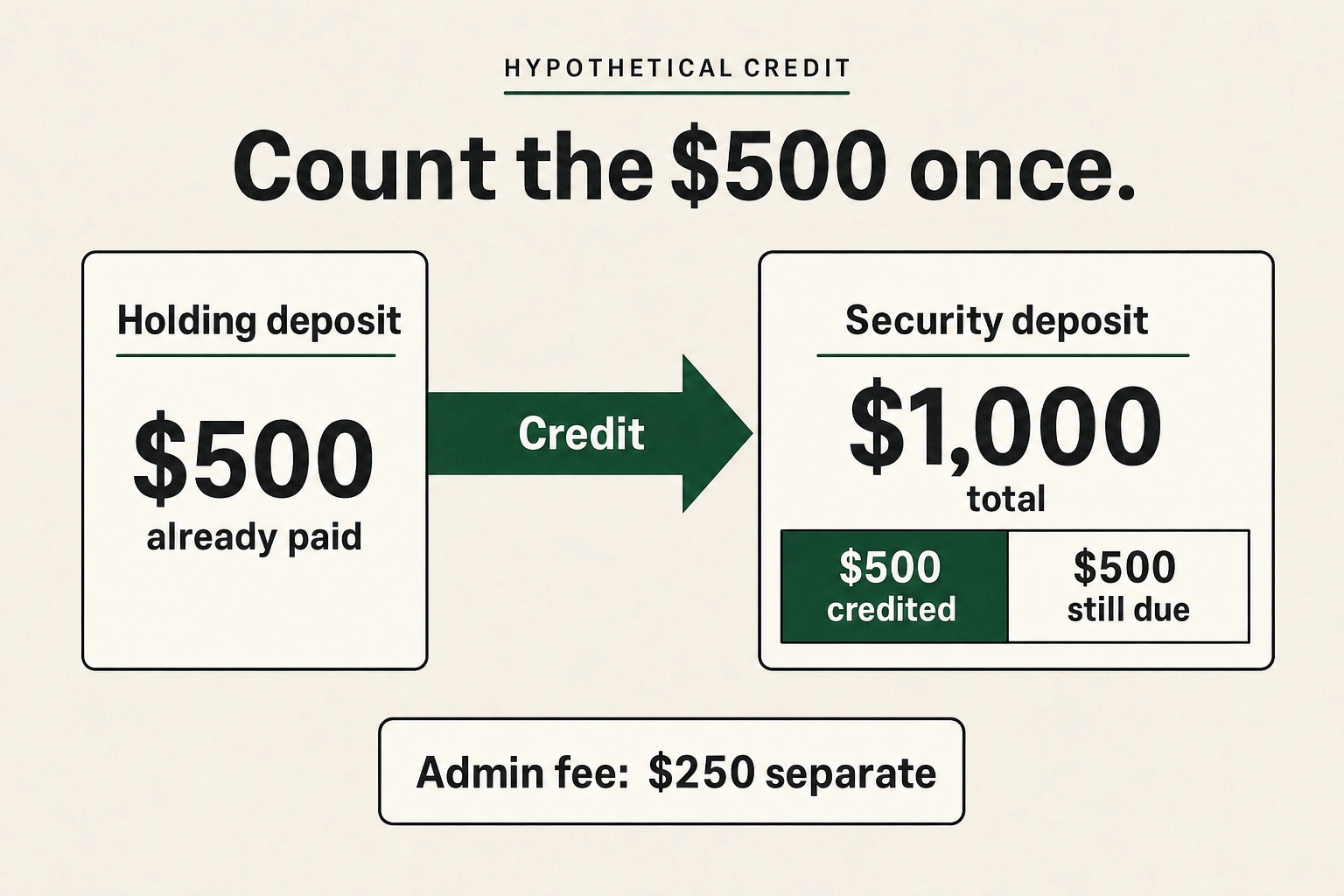
A credit reduces a later balance. A refund returns money to you. Neither should be assumed from the word “deposit” or from a verbal promise that the money “goes toward move-in.”
For the rest of your apartment move-in budget, keep recurring costs separate from these upfront payments. A future deposit return cannot fund the money due before you get the keys.
Get the fee terms before the payment deadline
Before sending money, ask the leasing office for one written breakdown that answers:
- What does the admin fee cover, and is it mandatory?
- Is the amount charged per person or per apartment?
- When is it due, and what event changes its refundability?
- What happens after denial, non-selection, renter withdrawal, or property cancellation?
- Does any payment reserve a specific unit, and for how long?
- Is any amount credited toward rent or a deposit, and where will that credit appear?
- Can you receive the fee terms and a sample lease before paying?
An answer such as “$250 per apartment, due at signing, separate from the deposit” is much more useful than “standard admin fee.” It gives you something concrete to budget and a clearer basis for deciding whether to proceed.
If you want help getting those answers while finding your next apartment, start with Fairway. Tell us what you want. We find matches, call leasing offices, surface fees, and book tours, free for renters.