Apartment budgeting
How to Budget for an Apartment: Monthly and Move-In Costs
Build a realistic apartment budget from take-home pay, recurring costs, move-in cash, and a real-life pressure test before you sign a lease.

The rent in a listing is the easiest number to see and usually the least complete. Phoenix renters can anchor the first pass to current city and neighborhood rent benchmarks. Your real apartment budget also has to cover utilities, required fees, insurance, parking or pet costs, and the cash you will need before anyone hands you the keys.
Calculate three numbers before you get attached to a listing:
- Your all-in monthly housing ceiling: what your cash flow can support after non-housing expenses, savings, and a cushion.
- Your maximum base rent: the ceiling minus every monthly cost that will sit beside rent.
- Your cash-to-keys target: application, signing, setup, and moving costs, plus a buffer you choose.
The familiar 30% rule can give you a starting benchmark. Your actual income and spending decide whether that number works in your life.
1. Start with the month you actually live
A clean budget made from an unusually cheap month will not help much. Review several ordinary months of checking and credit card activity so you catch groceries, transportation, health care, child care, subscriptions, flexible spending, irregular expenses, debt payments, and savings.
The Consumer Financial Protection Bureau recommends reviewing several months and comparing the result with the money that actually remains in your account. That keeps an annual bill or a burst of car repairs from disappearing from the plan.
Use this first formula:
Repeatable monthly take-home pay
- planned non-housing spending, including debt and irregular costs
- savings goals and a personal buffer
= all-in monthly housing ceiling
Include debt payments, less-frequent bills, and a miscellaneous allowance in planned non-housing spending. Keep savings goals and the buffer you want to protect on their own line.
Take-home pay is the amount that reaches your account after taxes, insurance premiums, retirement contributions, and other payroll deductions. If your income varies, use several representative months and choose a conservative amount that repeats. Overtime, bonuses, commissions, or your best month of tips belong in the calculation only if you can reasonably depend on them.
Choose the cushion based on your own risks and responsibilities. The CFPB notes that even a small emergency reserve can help and that the right amount depends on your situation. There is no useful national number that fits every renter. The monthly cushion leaves room in ongoing cash flow. The starting buffer in section 5 is cash you plan to keep available after moving.
2. Use the 30% rule as a benchmark
The quick version of the 30% rule is:
Gross monthly income x 0.30 = starting monthly housing benchmark
Gross income is your pay before taxes and other deductions. If you make $6,000 per month before deductions, the benchmark is $1,800.
Treat that $1,800 as a comparison point, not an instruction. The Department of Housing and Urban Development's measure classifies a household as cost-burdened when monthly housing costs, including utilities, exceed 30% of monthly income. That means the benchmark is broader than base rent alone.
It also cannot see your student loan payment, medical bills, child care, savings goals, or unstable hours. A renter with few other obligations may have more room. Someone with high transportation or care costs may need a lower ceiling. Keeping housing at or below 30% may not be realistic in an expensive market. The cash-flow calculation gives you a more honest decision number.
A landlord's income requirement answers a different question. Earning three times the rent, for example, may help you pass that property's screening rule. It does not account for your take-home pay, fees, utilities, or other bills, so it does not prove the apartment will feel comfortable month after month.
3. Turn your housing ceiling into a maximum base rent
Once you know the most you want to spend on housing each month, subtract the costs that will arrive beside rent:
All-in monthly housing ceiling
- required recurring property fees
- renter-paid utilities
- renters insurance
- parking, pet rent, storage, laundry, and internet as applicable
= maximum base rent
The Census Bureau defines gross rent as contract rent plus the estimated average cost of utilities and fuels paid by or for the renter. Your working total should go a little further by adding every other recurring cost attached to the apartment.
| Monthly apartment expense | What to use in your budget |
|---|---|
| Base rent | The rent in the lease rather than a promotional headline |
| Required property fees | Package, trash, technology, pest, amenity, billing, or other mandatory charges |
| Utilities | The services you pay, based on unit-specific information when available |
| Renters insurance | An actual quote that meets the property's requirements |
| Parking or storage | The option you will really use, including mandatory charges |
| Pet costs | Monthly pet rent or other recurring pet charges |
| Internet and laundry | A realistic plan for your household and building |
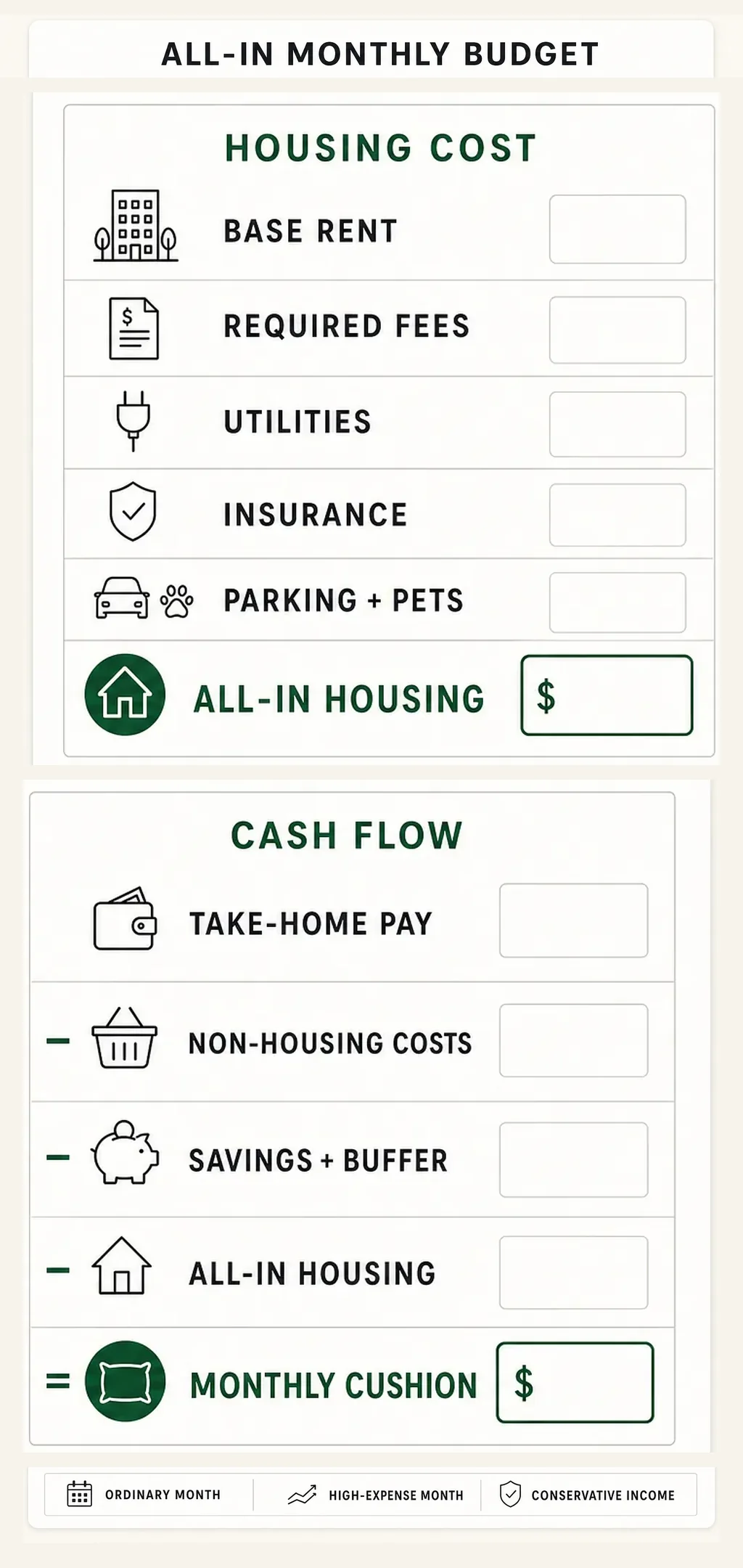
On the worksheet, put any recurring apartment add-on without its own row, such as storage, laundry, or internet, in Parking + Pets. The cash-flow side treats debt and irregular costs as non-housing costs. Monthly cushion is what remains after the savings and buffer you already protected; it reaches zero when the apartment uses your full ceiling.
Ask the property for a written list of every mandatory recurring charge and every one-time charge before you apply. In a 2026 rental-fee rulemaking notice, the Federal Trade Commission cited enforcement cases involving required fees omitted from advertised rent. A $50 package fee is still part of the price when you cannot decline it. Do not add a utility or service twice when it is already included in the rent.
If the listing advertises a free month or another rent concession, write out the actual payment for every month of the lease. Keep the undiscounted rent visible too. A short-term discount can make the first lease cheaper without changing the number a future renewal may start from.
National utility averages are rarely useful for a specific apartment. Climate, rates, unit size, building efficiency, and your habits all change the bill. Ask which utilities are included, how the others are billed, whether charges are split across the building, and whether the property or provider can share unit-specific history or an estimate.
Do the same for insurance. A landlord's policy generally does not cover your possessions, according to the National Association of Insurance Commissioners. Renters policies can include personal property and liability coverage, but prices, limits, deductibles, and exclusions vary. Use the quote you would actually buy.
Finally, revisit transportation. If an apartment adds a paid parking spot, a transit pass, tolls, or a much longer drive, update the non-housing expenses in your first formula. A lower rent can still make the rest of the month more expensive.
4. Work through one apartment budget example
Say a renter earns $6,500 per month before deductions and brings home $5,000.
The 30% benchmark produces an all-in housing comparison point of $1,950. Their real monthly cash flow produces a lower number:
| Cash-flow step | Amount |
|---|---|
| Repeatable take-home pay | $5,000 |
| Planned non-housing spending, debt, and irregular costs | -$2,550 |
| Savings goals and personal buffer | -$750 |
| All-in monthly housing ceiling | $1,700 |
Now subtract the apartment costs beyond base rent:
| Housing step | Amount |
|---|---|
| All-in monthly housing ceiling | $1,700 |
| Estimated utilities and required add-ons | -$250 |
| Maximum base rent | $1,450 |
The renter may qualify for a higher asking rent. Their budget says $1,450 is the more comfortable listing ceiling if the add-ons total $250. When the actual costs for a unit change, the rent ceiling changes too.
The point is the method, not these exact dollar amounts. Use your statements, your obligations, and real quotes from each property.
5. Build a separate cash-to-keys target
Monthly affordability does not tell you how much cash you need to move. Application charges may come first, a holding payment may follow, and the rest may be due at signing or key pickup. Moving and household setup draw from the same account.
Use this formula:
Application and screening costs
+ holding, administrative, and move-in payments
+ required prepaid rent
- holding or other credits applied to later charges
+ potentially refundable deposits
+ utility setup and deposits
+ moving, storage, and supplies
+ immediate household basics
+ your starting buffer
= cash-to-keys target
Required payments vary by property. Legal limits and refund rules vary by state and sometimes by city. Do not assume you will always owe first month's rent, last month's rent, and one month's security deposit. Get the actual amounts and terms.
Make a simple payment schedule:
| Payment | Amount | Due date | Refundable, credited, or spent? |
|---|---|---|---|
| Application or screening | |||
| Holding payment | |||
| Security or pet deposit | |||
| Prepaid rent | |||
| Administrative or move-in fee | |||
| Utility setup or deposit | |||
| Movers, truck, storage, and supplies | |||
| Immediate household basics | |||
| Starting buffer | Available after move-in |
Keep potentially refundable deposits separate from nonrefundable fees and prepaid rent. You need the cash either way, but each payment has a different purpose. For every charge, confirm what it covers, when it is due, whether it is mandatory, and which conditions control a refund or credit. If a term is unclear or unusually expensive, USAGov's tenant-rights directory can point you to the relevant state agency or local legal help.
Here is one hypothetical cash-to-keys calculation for the renter in the earlier example. These are sample inputs, not national averages or a prediction of what a property will charge:
| Cash-to-keys item | Amount | Treatment |
|---|---|---|
| Application charge | $50 | Spent |
| Holding payment | $300 | Credited toward first month's rent |
| Remaining first month's rent | $1,150 | Prepaid housing cost |
| Security deposit | $1,000 | Potentially refundable |
| Utility setup | $100 | Spent or deposited, depending on provider terms |
| Moving and supplies | $400 | Spent |
| Immediate household basics | $200 | Spent |
| Protected starting reserve | $800 | Kept after move-in |
| Cash-to-keys target | $4,000 |
First apartment? Budget for a usable first night, not a fully furnished home on day one. Fairway's first apartment checklist separates immediate basics from the things that can wait until you measure and live in the space.
Before sending an application fee, holding payment, or deposit, independently confirm the exact unit, property manager, official application route, payee, and written refund terms. The FTC warns renters to verify the listing and manager and be wary of demands for money before a showing. Use the fuller checklist to verify the rental before you pay.
6. Pressure-test the budget before you sign
A spreadsheet can leave $200 at the end of the month even when your bank account never does. Compare the planned leftover with what remains after several real months. If the two numbers disagree, find the missing or underestimated expense before taking on a lease.
When timing allows, simulate the new payment for one or two months. Pay your current housing costs, then transfer the difference between your current total and the proposed total to savings. This gives you a small move-in reserve and shows how the higher cost affects the rest of your life.
Test at least these versions of the budget:
- An ordinary month: regular income and expected bills.
- A higher-expense month: an irregular bill, seasonal utility change, health cost, or other expense that predictably appears.
- A conservative-income month: especially important when hours, tips, bonuses, or commissions vary.
- A renewal view: the recurring cost without a one-time concession, plus room for an increase you could absorb. You do not need to predict the exact future rent to know whether the current deal leaves any flexibility.
Also check timing. Rent due on the first, a car payment on the third, and a paycheck on the fifth can create a cash squeeze even when the monthly total works on paper.
If the result is too tight, change one variable and run it again. A roommate, smaller unit, older building, different neighborhood, later move, or fewer paid amenities may help. Check the entire tradeoff. Moving farther out can lower rent while raising transportation costs and taking back hours of your week.
7. Compare apartments on the same all-in basis
Now use the same inputs for every finalist. Suppose your all-in housing ceiling is $1,700:
| Monthly cost | Apartment A | Apartment B |
|---|---|---|
| Advertised rent | $1,425 | $1,350 |
| Mandatory recurring fees | $45 | $120 |
| Estimated renter-paid utilities | $150 | $175 |
| Parking | $0 | $75 |
| Renters insurance | $20 | $20 |
| All-in monthly housing cost | $1,640 | $1,740 |
| Amount left below your ceiling | $60 | -$40 |
Apartment B advertises for $75 less. Its required costs make it $100 more per month in this example, and it crosses the renter's ceiling. That is the number the listing card will not calculate for you.
Confirm the rent, lease term, concessions, required fees, utilities, parking, pet charges, and move-in cash in writing. If commute or child-care costs change with the location, rerun your cash-flow ceiling too. Fairway's apartment hunting guide goes deeper on how to compare total apartment costs and keep the details for your finalists in one place.
Fairway is a free AI agent for renters. Tell it what you want and it can watch listings, surface fees, call landlords, and book tours. You choose the ceiling and the apartment; Fairway takes on more of the refreshing and phone tag.
8. Budgeting for an apartment with roommates
Start with the household's complete monthly cost, then decide how each line will be split. Dividing the advertised rent by the number of people misses shared fees and personal add-ons.
Write down:
- each person's share of rent, including whether different room sizes change it
- how required fees and shared utilities will be divided
- who pays individual costs such as parking, storage, or pet rent
- how utility deposits, furniture, and other upfront purchases will be handled
- what cushion each person needs after paying their share
- what happens to shared bills if someone moves out
Each roommate should run their own cash-flow test using their share. A private roommate agreement can make the arrangement clearer, but it does not change the lease. Read the lease's rules on responsibility, replacement roommates, subletting, and early departure before anyone counts on a backup plan.
Leave the listing tabs closed until you have three numbers
Write down your all-in monthly housing ceiling, maximum base rent, and cash-to-keys target. Use those numbers for every apartment, and update them when a property gives you a real fee sheet or utility information.
Then you can compare listings, tour the real finalists, and review the full lease without renegotiating your budget every time a bright kitchen appears. The kitchen can have its moment after the math works.