Renter guide
Average Cost of Utilities in Arizona for Apartment Renters
Arizona apartment utilities explained by provider, season, unit size, and lease charges. A practical budget guide from our free AI agent for renters.
Summer cooling and a lease's shared utility charges can change the price of an Arizona apartment long after the advertised rent catches your eye. A one-bedroom in Phoenix, a master-metered building in Tucson, and an all-electric unit in Flagstaff need different budgets. The useful details are the local rates, the cooling equipment, and which bills actually reach you.
What can you budget for Arizona apartment utilities?
A statewide household average is a weak estimate for a particular apartment. It cannot tell you whether cooling is on your electric meter, water is included, or the property adds a share of the building's bills.
For a concrete electricity reference, 600 hypothetical kilowatt-hours (kWh) produces about $88 to $102 in selected service and energy charges under the Arizona Public Service (APS), Salt River Project (SRP), and Tucson Electric Power (TEP) examples below. These are partial tariff calculations, not typical apartment bills or a total utility budget. Usage, season, plan, adjustments, and taxes change the result.
Keep seven lines in your apartment estimate:
| Utility or charge | Useful input for an Arizona rental |
|---|---|
| Electricity | Unit-level monthly usage, serving provider, plan, and summer history |
| Water | Property's recent charge and whether it measures or allocates use |
| Sewer | Separate wastewater charge and its calculation |
| Trash | Lease amount, including any separate collection service |
| Natural gas | Only the gas systems you pay for, plus their seasonal usage |
| Internet | Address-specific service price or required building package |
| Community allocations and administration | Shared costs and fees, identified separately from your unit's usage |
Our AI agent for renters is free for renters. We find matches, call leasing offices, and surface property fees, so those charges can join your utility estimate before you commit. For the broader national budgeting framework, our apartment utility guide covers the full monthly calculation.
Electricity starts with the service address
Arizona does not work like a statewide electricity shopping market. The Arizona Corporation Commission says residential customers do not currently have a practical choice of competing providers. The address determines the serving utility; available plans are a separate question. Arizona electric service rules explain that distinction.
A Phoenix-area listing's city name alone is insufficient to identify APS or SRP service. A Tucson-area apartment may have a different provider from another nearby address. Ask the leasing office for the serving utility and whether you open an individual account or pay through the property.
Hypothetical electricity calculations at 600 kWh
These examples hold usage at 600 kWh to show what the listed rates do. The APS example assumes a 30-day bill. SRP and TEP use their listed monthly service charges. None assigns 600 kWh to a studio, one-bedroom, or two-bedroom apartment.
| Provider and plan | Selected charges and period | Hypothetical calculation |
|---|---|---|
| Arizona Public Service (APS), Fixed Energy Charge, small Tier 1 | Tariff effective March 8, 2024: $0.12925/kWh plus $0.362/day | 600 × $0.12925 + 30 × $0.362 = $88.41 |
| Salt River Project (SRP), Basic E-23, apartment Tier 1 | Temporary May–October 2026 schedule: $20/month plus $0.1166/kWh in May, June, September, and October cycles | $20 + 600 × $0.1166 = $89.96 |
| SRP, same apartment plan, summer peak | July and August 2026 cycles: $20/month plus $0.1360/kWh | $20 + 600 × $0.1360 = $101.60 |
| Tucson Electric Power (TEP), Basic, single-phase | Tariff effective September 1, 2023. Summer, May–September: first 500 kWh at $0.130431, next 100 at $0.150095 | $15 + 500 × $0.130431 + 100 × $0.150095 = $95.23 |
| TEP, same plan, winter | October–April: first 500 kWh at $0.126352, next 100 at $0.146016 | $15 + 500 × $0.126352 + 100 × $0.146016 = $92.78 |
Calculated totals are rounded to the nearest cent.
APS limits: The calculation includes basic service and energy only. It excludes tariff adjustments, taxes, and other fees. The small tier requires annual average monthly usage of 600 kWh or less; one 600-kWh bill does not establish eligibility. These terms come from the APS fixed-energy tariff.
SRP limits: Apartment Tier 1 applies to service of 0–225 amps. The rates include the listed temporary fuel-and-purchased-power adjustment but exclude taxes and account-specific charges. The SRP temporary rate book ends that temporary adjustment after October 2026 billing cycles. These figures do not price November bills. E-23 excludes resale and submetering, so it is not a landlord allocation rate.
SRP prices the entire billing cycle using the season in effect on the meter-read date. A cycle crossing a seasonal boundary can therefore have one seasonal rate for all its usage. SRP seasonal billing describes this rule.
TEP limits: Rates combine the bundled energy charge and base power-supply charge in the TEP Basic tariff, using unrounded values. Totals exclude the Purchased Power and Fuel Adjustment Clause, taxes, and other charges. Three-phase service has a $20 monthly service charge rather than $15.
These examples show price mechanics. They do not rank providers or establish a ceiling for an Arizona summer bill. Time-of-use plans also depend on when you use electricity; demand plans add a charge based on a measured peak. Total monthly kWh alone cannot fully price either arrangement.
Season and cooling equipment change the estimate
Arizona has very different cooling climates. The 1991–2020 July average-high normals are 106.5°F in Phoenix, 100.2°F in Tucson, and 82.0°F at Flagstaff Pulliam Airport. These are weather benchmarks, not electricity-use estimates. Phoenix climate normals, Tucson climate normals, and Flagstaff station normals show why one statewide summer assumption falls short.
For Phoenix and Tucson finalists, summer bill history deserves particular attention. For Flagstaff, winter heating deserves its own line of questioning. An October move-in bill tells you little about the cost of staying comfortable through the rest of the lease.
The cooling setup also tells you where costs land:
- Your own central air conditioner, heat pump, or room air conditioner: Electricity for that equipment is part of your electric use when it runs through your meter.
- Evaporative cooler, often called a swamp cooler: It uses electricity and water. Its cooling performance declines as humidity rises, an important monsoon-season distinction. University of Arizona evaporative cooling guidance explains the energy, water, and humidity trade-off.
- Shared building cooling: The lease and metering arrangement determine whether costs are included, allocated, or partly reflected in your own electricity. “Central cooling” alone does not answer who pays.
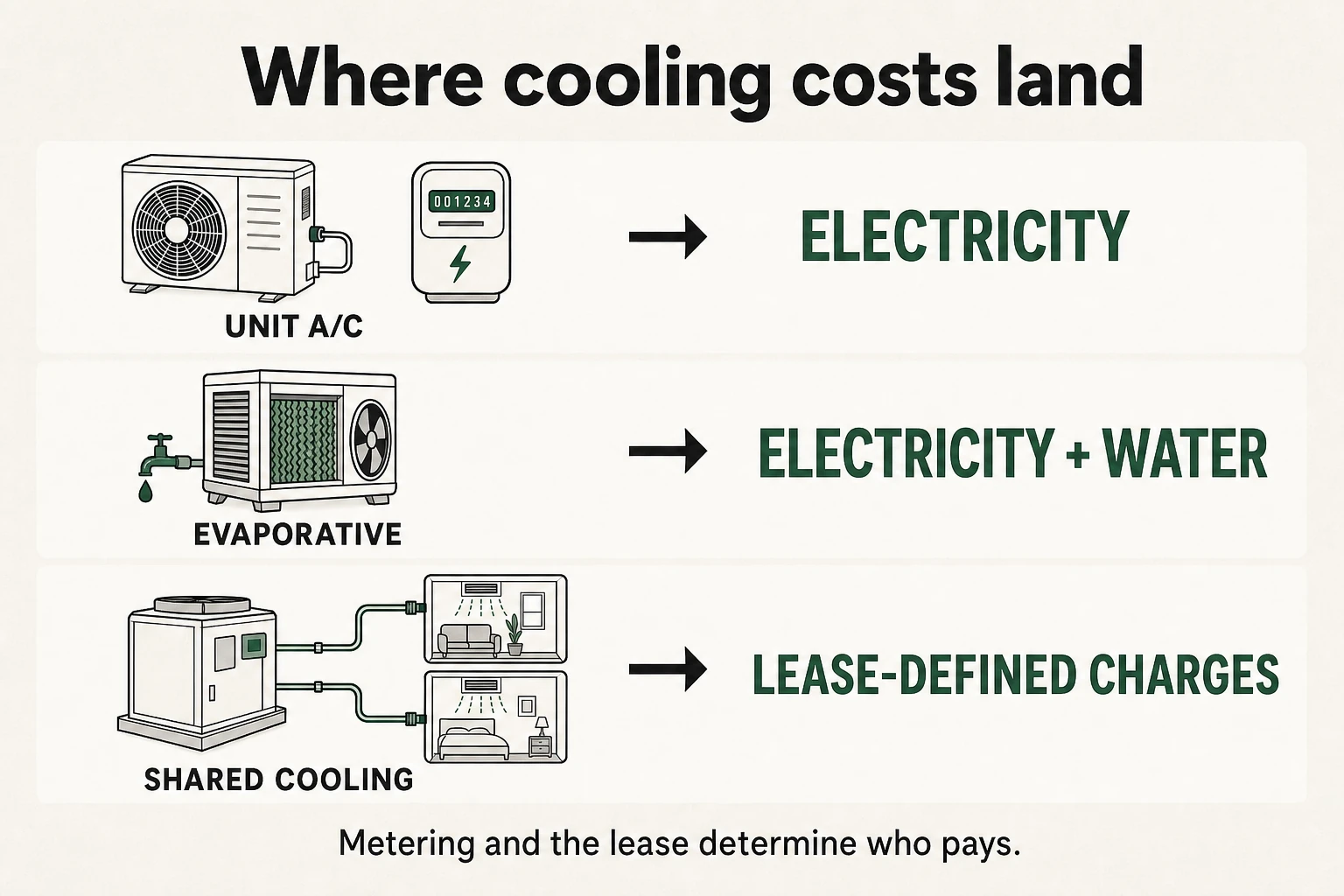
Ask about the actual equipment, whether you control it year-round, who maintains it, and what summer residents pay for that floor plan. A lower electric bill is less informative if the property bills cooling elsewhere.
Apartment size is an input, not a dollar formula
More space can mean more space to cool. The number of bedrooms still leaves out ceiling height, sun exposure, windows, insulation, and equipment efficiency. The Department of Energy's window performance guidance explains how glazing and air leakage affect energy use.
We would compare these details alongside size:
| Unit size | More useful evidence than a statewide size-based average |
|---|---|
| Studio | Actual square footage, cooling type, exposed windows, and summer usage for that unit |
| One bedroom | Same floor plan with similar floor and sun exposure, plus heating and water-heating fuel |
| Two bedrooms or larger | Larger conditioned area, household size, hot-water and laundry use, and any occupancy-based allocation |
A second bedroom does not double the service charge or internet subscription. It can change cooling needs, and another resident can change water use or an occupancy-based utility share.
Square footage can also affect a shared bill even when nobody measures your unit's consumption. That is a separate cost mechanism from running the air conditioner.
Water, sewer, and trash need separate local numbers
A city's utility schedule prices the provider's account. Your apartment charge depends on whether that account serves your unit or an entire building.
Water: Phoenix and Tucson use different schedules
Phoenix lists a $4.64 monthly service charge for a 5/8-inch inside-city meter, effective October 1, 2023. The service charge includes 3,740 gallons during October–May or 5,984 gallons during June–September. The excess-use volume schedule took effect March 1, 2025. Environmental charges still apply to all use; excess-use charges, taxes, and other fees can add to the bill. This is a direct city-account example, not an apartment water-budget recommendation. Phoenix water rates also vary by meter size and inside/outside-city service.
Tucson's water rates effective July 6, 2026 classify more than three residential units on one master meter as multifamily. Listed volumetric rates are $3.82 per CCF for incorporated service and $4.55 for unincorporated service, before additional supply, conservation, applicable stormwater, service, and tax charges. One CCF is 748 gallons. The Tucson water schedule prices the master account; it does not state each apartment's share.
For a master-metered building, recent allocated charges for the same floor plan and household size are more useful than inserting a city's single-family water example into your budget.
Sewer: “water included” leaves a question open
Sewer or wastewater can appear separately from water. Phoenix calculates monthly sewer charges using a percentage of average water usage from the January–March billing cycle, with the percentage depending on customer category. That makes the sewer line different from simply paying for this month's water use.
For an apartment allocation, the property may be dividing the building's sewer charge. Ask whether wastewater is included, separately metered or allocated, and whether its formula differs from water. A combined portal payment can still contain two distinct costs.
Trash: municipal service and apartment fees differ
Phoenix's residential solid-waste rate became $42.32 per month on July 1, 2026, under its approved waste schedule. That municipal service figure should not be added to every Phoenix apartment's estimate.
The property may include trash, allocate a hauler's bill, or list a separate collection service. A doorstep or valet collection charge may be additional to trash removal. The useful number is the property's written arrangement and recent charge, separated from any other service fee.
Gas and internet depend on the building
Gas: identify the appliances before adding a bill
An all-electric unit with no separately billed shared gas charge has no natural-gas line to add. A gas stove, furnace, water heater, or shared boiler changes that picture. Cooking-only usage is a different budget from gas heating through a Flagstaff winter.
Where Southwest Gas serves the address, the bill includes applicable service and usage charges and adjustments. Its Arizona gas-rate information reinforces why old bills need their usage and tariff context. Unit-level therm usage and the systems covered are the useful starting inputs.
Internet: price the address and any required package
Internet availability and price depend on the address and building. The Federal Communications Commission's FCC broadband map shows reported providers, technologies, and speeds. It does not give your lease's internet price.
A useful quote names the recurring service price, equipment cost, installation charge, and price after any introductory offer. The leasing office can also identify a required bulk internet or technology package. Keep a mandatory package in the property-charge column, and avoid counting the same internet service twice.
Shared utility allocations can change what you owe
For utilities included in rent or a fixed package, the useful terms are the services covered, the amount, and any cap or overage rule.
With an individual utility account, the provider bills measured unit usage. A submeter measures the unit within the property's system. A ratio utility billing system (RUBS) divides a building bill using a stated formula instead of measuring only your consumption.
Arizona law permits separate charges for gas, water, wastewater, solid-waste removal, and electricity through submetering or RUBS. It requires the rental agreement to list separately charged utilities and specify any associated administrative fee. A RUBS allocation method must be specifically described in the agreement. Arizona utility-billing law allows methods including per resident, livable square footage, unit type, and water fixtures.
Here is a hypothetical square-footage allocation, not an Arizona average: a 600-square-foot unit represents 5% of 12,000 square feet of participating livable space. If the water amount being allocated is $900, that share is $45. An administrative fee would be a separate line.
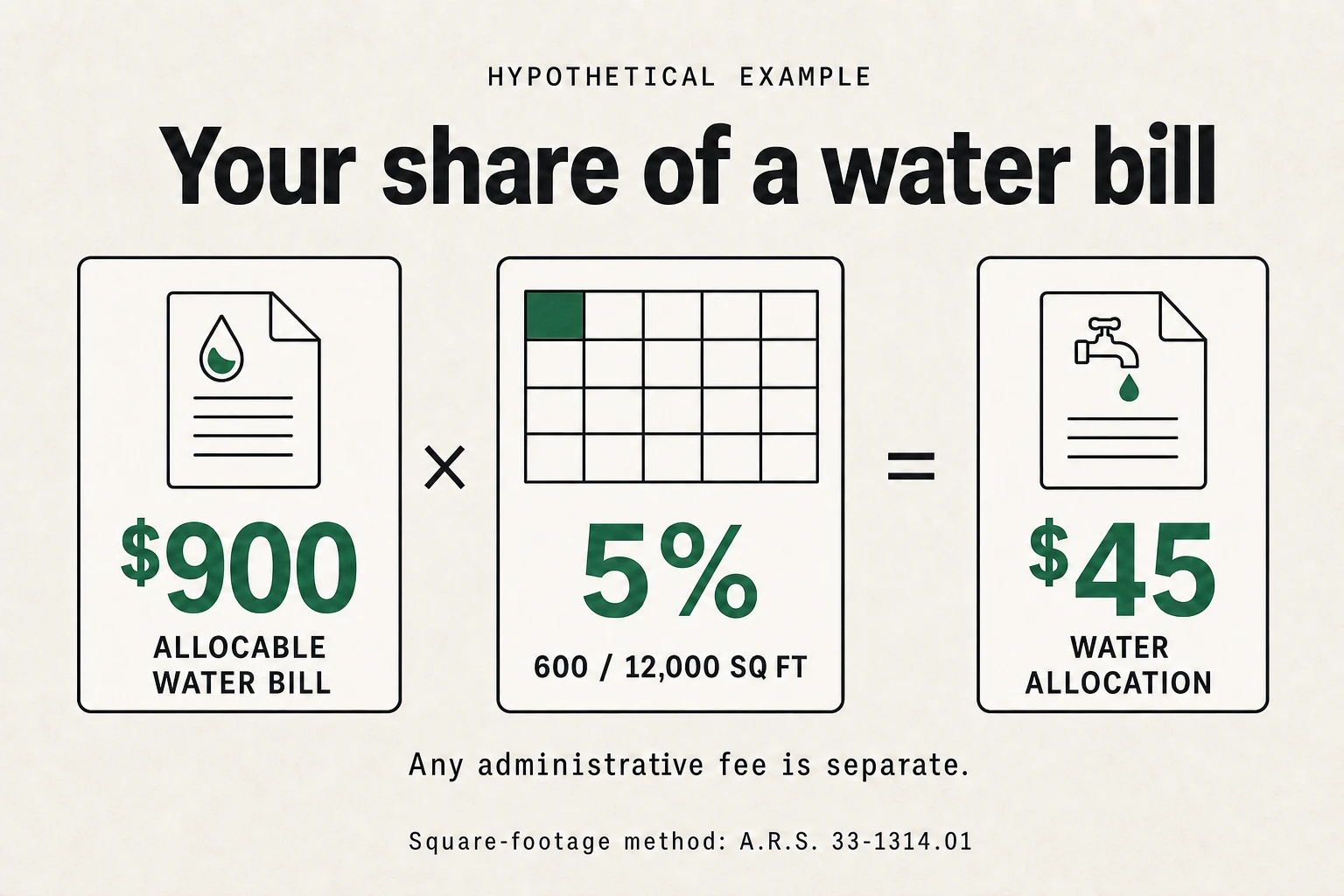
For community charges, ask which costs enter the allocation, including any shared cooling, pool, irrigation, or common-area electricity, and how any common-area adjustment works. Record that explanation alongside the formula. Do not add a second community estimate if it is already part of the water or electricity allocation.
The statute limits an associated administrative fee to actual administrative costs and prohibits additional charges under this separate-billing provision. A fee's appearance in a lease does not, by itself, settle whether it is permitted.
Before you choose an apartment, ask for two seasonal totals
An annual average helps spread expenses across the year. A peak-season total tells you whether a difficult month fits your cash flow. For Phoenix or Tucson, we would want a summer view; for a Flagstaff rental, we would also want the winter heating view.
A useful message to the leasing office is:
For this unit, could you send the utility responsibility list and recent summer and winter charges or usage? Please name the electricity provider and cooling/heating systems, identify every included or separately billed service, and send the allocation formula and administrative fee for any shared bill. Please also include any required internet, trash-collection, or community package.
Twelve months for the exact unit is the strongest starting point. If those records are unavailable, a matching floor plan with similar exposure, equipment, and household size is a useful substitute. A leasing-office estimate without those details is less dependable.
Add the resulting utility lines to rent and other mandatory monthly charges. Keep deposits, connection fees, and installation costs in the separate move-in budget. Our apartment budget guide helps turn that all-in amount into an affordable rent limit.
For a Phoenix-area move, start your apartment search with Fairway. Tell us what you want and what you can spend. We'll find matches, call leasing offices with your questions, and book tours while you compare the complete monthly cost.