Renter guide
Family-Friendly Apartments: Find a Home That Fits Your Week
Find family-friendly apartments with space for daily life, safer layouts and workable school routes. Get touring tips from Fairway's AI agent for renters.
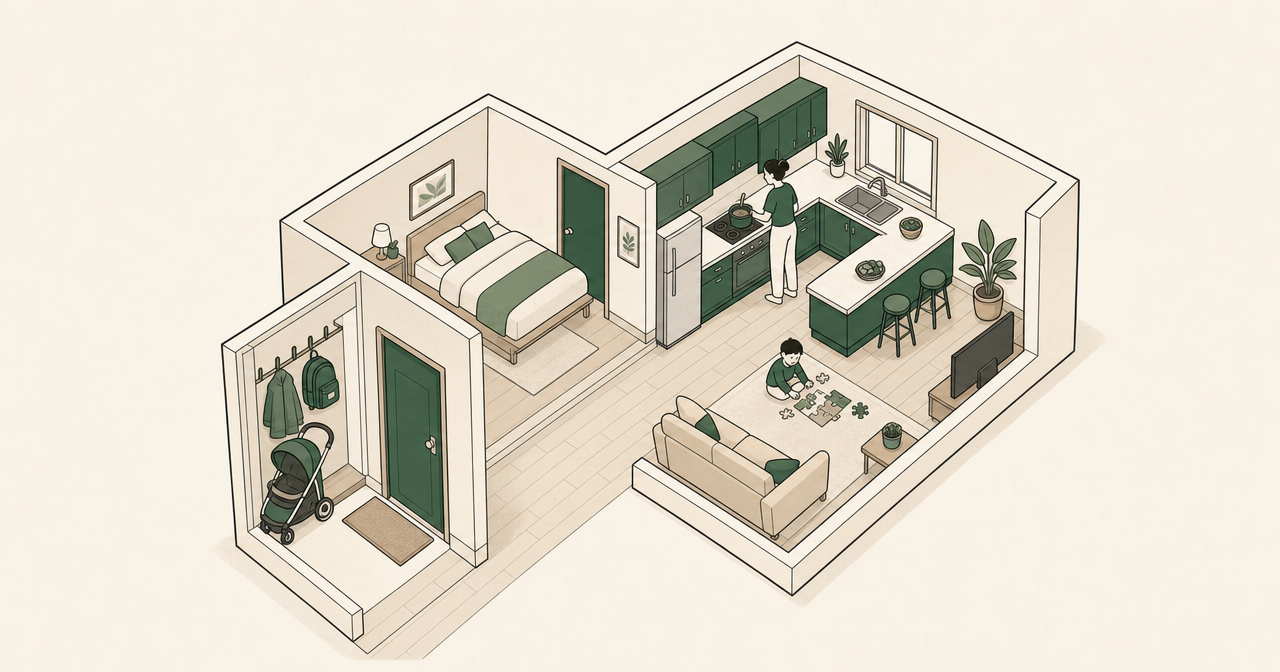
Apartment hunting with children adds a second schedule to every decision. A promising listing can unravel when the stroller meets the stairs, bedtime meets the living-room television, or school pickup collides with your commute. You deserve a home that makes an ordinary Tuesday easier. A focused shortlist helps you spend your touring time on the details that shape your family's week, without paying extra for amenities you will rarely use.
What makes an apartment family-friendly?
Family-friendly apartments combine usable living space, manageable access, maintained safety features, and a location that supports your household's routines. The label alone tells you little. A modest apartment near childcare may work better for you than a larger home with a pool and a difficult school run.
Start with three requirements you cannot comfortably give up. Then separate them from preferences you can trade. Your children's ages, sleep schedules, mobility needs, and caregiving arrangements should shape that list.
| Your household's stage | Features worth prioritizing | Details easy to miss |
|---|---|---|
| Baby or toddler | Room for an appropriate sleep setup, visible play space, convenient laundry | Window hazards, stroller storage, the full route from parking or sidewalk to your door |
| Elementary-school children | Workable school and childcare routes, everyday outdoor play, gear storage | Pickup hours, street crossings, space for homework while someone cooks |
| Older children or mixed ages | Privacy, separate quiet areas, reliable internet, access to activities | Different bedtimes, shared-bedroom furniture fit, transportation beyond the school day |
Turning those needs into listings takes time, especially when availability and tour scheduling mean another round of phone calls. We're Fairway, an AI agent for renters, and we're free for renters. You describe what you want, we find matches, call landlords or leasing offices, and book tours. That leaves more of your attention for whether the home actually fits your family.
Choose a layout that works from breakfast to bedtime
Square footage is a starting point. Room shape, door placement, storage, and separation decide how much of it you can use.
Give sleeping and active spaces some separation
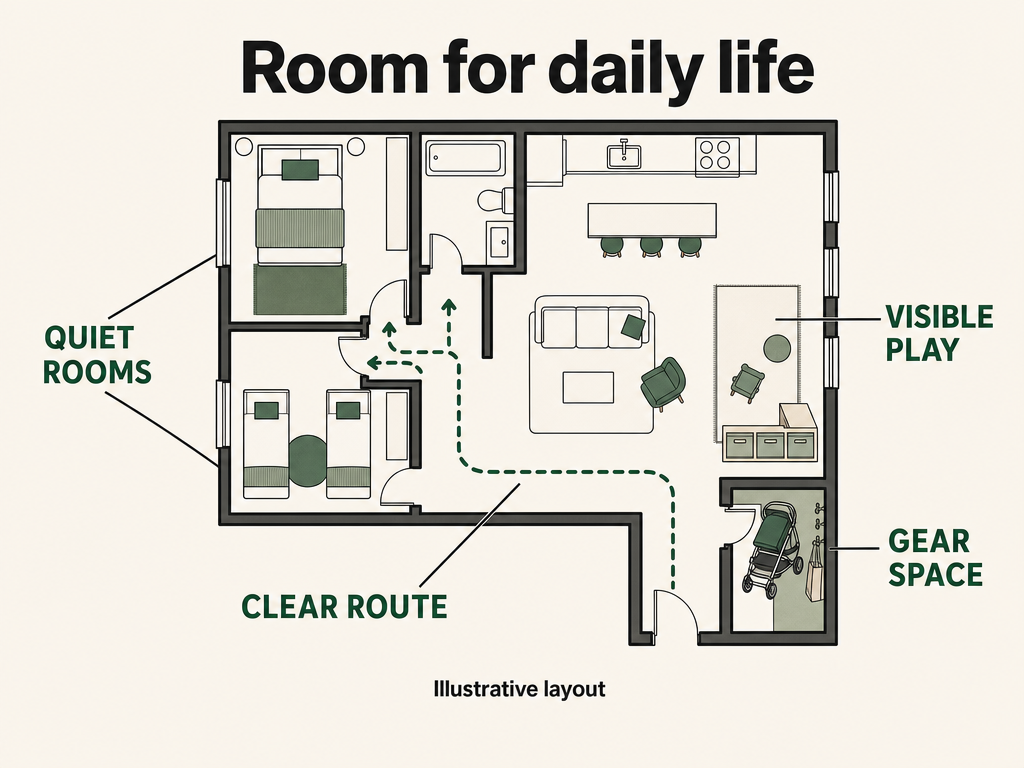
An open kitchen can make it easier to see children playing while you prepare dinner. It can also carry cooking and television noise toward bedrooms. A bedroom door, short hallway, or separate living area may be more useful than another stretch of open floor.
For each candidate, picture one child asleep while another person eats, works, or plays. Notice whether reaching the bathroom requires walking through a sleeping area. Bedrooms beside the elevator, garage entrance, or shared courtyard deserve extra attention to sound during the viewing.
A den or flex space can be useful for toys, homework, or a desk. Its marketing name does not establish that it is a legal bedroom. Ask the leasing office which rooms are approved for sleeping and for the exact unit's written occupancy policy. Keep hallways and exits clear of beds, furniture, and stored gear.
Plan for your furniture and the things that follow you home
Bring the dimensions of your beds, crib, dining table, and stroller. Two beds may fit in a room while leaving no usable path to the closet. A large living room may have only one wall available for furniture.
Useful storage has a job: coats and backpacks near the entrance, cleaning products in secured storage, and space for bikes or seasonal gear. An entry alcove that holds a stroller without blocking the door can be worth more than a larger closet at the far end of the apartment.
Think one lease ahead, too. A nursery corner may become a shared bedroom. A homework spot may have to coexist with remote work. Flexible space earns its rent when those changes fit without another move.
Separate child-safety needs from building security
Controlled entry and good lighting matter. They do not resolve hazards inside the home. A useful tour covers both the route into the building and the places children can reach once inside.
Windows, balconies, stairs, and furniture
The U.S. Consumer Product Safety Commission's childproofing guidance recommends cordless window coverings, furniture anchors, and window guards or opening limits. Window screens do not prevent children from falling. Window protections must also preserve emergency escape.
Ask who installs and maintains suitable window protections and whether management permits the anchors or gates your household needs. Get any installation agreement in writing. A lease restriction on drilling needs a workable answer before your furniture arrives.
A balcony adds fall and climbing concerns. Treat it as supervised outdoor space, with furniture kept away from railings. It is a poor storage solution if a bike, box, or chair becomes a climbing aid. Ground-floor patios have their own questions, including whether a child can reach a driveway or pool through the gate.
For apartments with internal stairs, the landing shape and wall surfaces affect where appropriate safety gates can go. A staircase that looks attractive in photos may complicate everyday supervision.
Fire safety and the condition of the home
The U.S. Fire Administration recommends smoke alarm placement inside every bedroom, outside separate sleeping areas, and on every level. Ask management about working smoke and carbon monoxide alarms, maintenance responsibilities, and the building's evacuation instructions. Clear exits matter more than a tidy lobby.
Also notice peeling paint, water stains, damp smells, damaged flooring, and pest traces. Ask what caused an issue and what repair is planned. A fresh coat of paint does not explain a recurring leak.
For most homes built before 1978, landlords must provide known lead-paint information, available reports, a warning statement, and a lead-safety pamphlet before lease signing. The EPA disclosure rules do not require the landlord to commission a new lead inspection. A disclosure saying the owner has no knowledge of lead is different from a report finding the home lead-free.
Unresolved safety defects belong in the decision about whether to proceed. They should not become a weekend childproofing project after move-in.
Follow the whole route from the apartment to the street
Ground-floor units can reduce stair trips and the footstep noise reaching a downstairs neighbor. Higher floors can offer more separation from street activity. Neither choice solves every household's needs.
The practical question is how you get a child, stroller, groceries, and yourself through the building. During a viewing, follow the route you would use every day, including parking if you need it. A building with an elevator may still have steps at its entrance or a heavy door between the garage and lobby.
Useful questions include:
- Is there a step-free route all the way to this unit?
- Can the elevator and entry doors accommodate our stroller?
- Where may we store a stroller or children's bikes without obstructing shared passages?
- What happens when an elevator is out of service?
- Is the parking space assigned, and does the route cross moving vehicles?
For shared laundry, location and hours matter alongside machine count. Consider how you would move the laundry while supervising children. For in-unit machines, ask whether both stay with the apartment and who handles repairs.
Outdoor amenities deserve the same practical view. A play area needs maintained equipment, usable hours, and a manageable route. A pool needs access controls and close adult supervision; the presence of a fence does not make it a substitute for either. Ask about guest rules if relatives help with childcare or join you outside.
Tie school plans to the address and enrollment rules
A nearby school on a rental listing does not establish where your child will enroll. School assignment can involve attendance boundaries, applications, capacity, grade level, and program-specific rules.
San Francisco provides a useful example: its school district explicitly says an attendance-area school is not a guaranteed placement. Paying more to live beside a particular campus can therefore buy proximity without buying admission.
Before committing to an apartment for a school, ask the district's enrollment office about the exact address, your child's grade, and intended start date. The useful answer includes:
- The applicable school or assignment process.
- Required residence documents and enrollment timing.
- How transfers, waitlists, or boundary changes affect the plan.
- Transportation eligibility and the actual bus-stop arrangement, if relevant.
School fit also goes beyond a headline rating. Ask about the supports your child uses, language programs, after-school care, start and dismissal times, and communication with families. Childcare opening hours and available places matter just as much when your workday begins before school.
A school route is only one leg of the day. Include the trip from drop-off to work and from work to pickup. A shorter home-to-school journey can still create a longer overall commute.
Judge the neighborhood by the routes you will use
A park half a mile away may be convenient, or it may sit beyond a road you would rather avoid with a stroller. Distance tells only part of the story.
For your finalists, walk the likely route to school, childcare, transit, or a park at a relevant time of day. Notice continuous sidewalks, crossings, curb ramps, lighting, traffic, shade, and places to pause. A slightly longer route with a signalized crossing may suit your household better than the shortest line on a map.
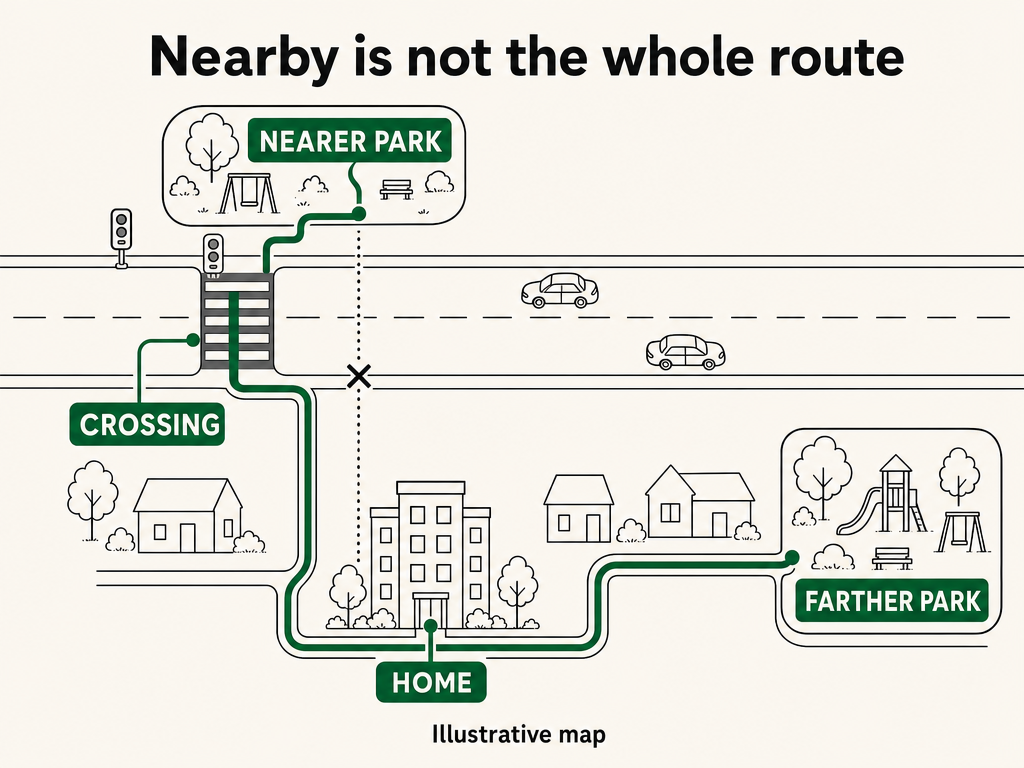
Think about outdoor space you could use on a normal weekday. That might be a public playground, library, recreation center, or courtyard. A destination requiring a drive and parking every time offers a different kind of convenience.
Avoid broad assumptions about which neighborhoods or residents are family-friendly. Describe the conditions that matter to you: a lit walk from the bus stop, a maintained play area, or fewer driveway crossings. Security features and neighborhood labels cannot guarantee safety.
If you meet current residents naturally, ask about elevator outages, recurring noise, laundry access, and maintenance response. Their experience adds detail that a leasing-office tour may miss. Your children's impressions can help too, especially whether they can picture their ordinary activities there.
Compare the family's monthly cost, then the lease
The cheaper advertised rent can produce the more expensive week. Alongside rent, include required fees, utilities, insurance, parking, storage, and laundry. Then account for changes to transportation and childcare costs caused by the location.
Here's an illustrative comparison, not a market-price estimate:
| Monthly cost affected by the move | Apartment A | Apartment B |
|---|---|---|
| Base rent | $2,050 | $2,200 |
| Fees, utilities, and insurance | $260 | $240 |
| Parking and laundry | $140 | $40 |
| Transportation | $180 | $90 |
| Additional after-school care needed | $220 | $80 |
| Total of these costs | $2,850 | $2,650 |
Apartment B has $150 more in base rent and $200 less in the illustrated monthly total. The point is to price the routine each apartment creates. Our apartment budgeting guide also separates recurring costs from deposits, moving expenses, and the cash needed before you get the keys.
Request a sample lease and community rules early. Pay attention to quiet hours, play-area access, guests and visiting caregivers, smoking, maintenance, childproofing installations, renewal timing, and notice to move out. Ask how ordinary noise complaints are handled. A promise that children are welcome tells you less than a clear, consistent policy.
If school stability matters, consider the lease end date and renewal process alongside the school calendar. A 12-month lease does not establish what a second year's rent or terms will be.
Know the difference between occupancy rules and excluding children
In U.S. housing covered by the Fair Housing Act, familial-status protections generally prohibit discrimination against households with children under 18. Qualifying housing for older people has an exemption. The Justice Department's familial-status guidance explains that distinction.
Reasonable occupancy limits are a separate issue. There is no single nationwide rule that every family must have one bedroom per child. HUD's occupancy policy treats two people per bedroom as generally reasonable while considering room and unit size, children's ages, configuration, and other circumstances. State and local requirements also matter.
If you encounter an adults-only statement, a restriction aimed specifically at children, or different terms because you have children, keep the listing, messages, and written rules. A local fair-housing organization or HUD can help assess the situation. You do not need to limit your search to properties advertising a family-friendly label.
Leave each tour with the same five answers
Keep a short record for each exact unit:
- Space: Where will everyone sleep, play, work, and store gear?
- Safety: Which concerns are resolved, and which repairs or installations remain open?
- Access: How will your household get in, out, and through daily chores?
- Location: What are the school arrangements and complete daily routes?
- Cost and terms: What is the monthly total, move-in cash, and lease commitment?
Mark an unanswered requirement as unresolved. A repair promise needs a written scope and completion date. A school plan needs an answer from the district. A model apartment cannot settle the noise or access conditions of a different unit. Our broader apartment tour questions cover the leasing details worth bringing along.
A home that fits your family is easier to recognize when the requirements are concrete. Start your search with us and describe the space, budget, access, and location you need. We'll handle finding matches and arranging tours, so you can focus on choosing a home that works for your week.