Apartment living
How Do Packages Get Delivered to Apartments? A Renter's Guide
Learn where apartment packages go, how lockers and signatures work, and what to ask before moving. A guide from Fairway, your AI agent for renters.
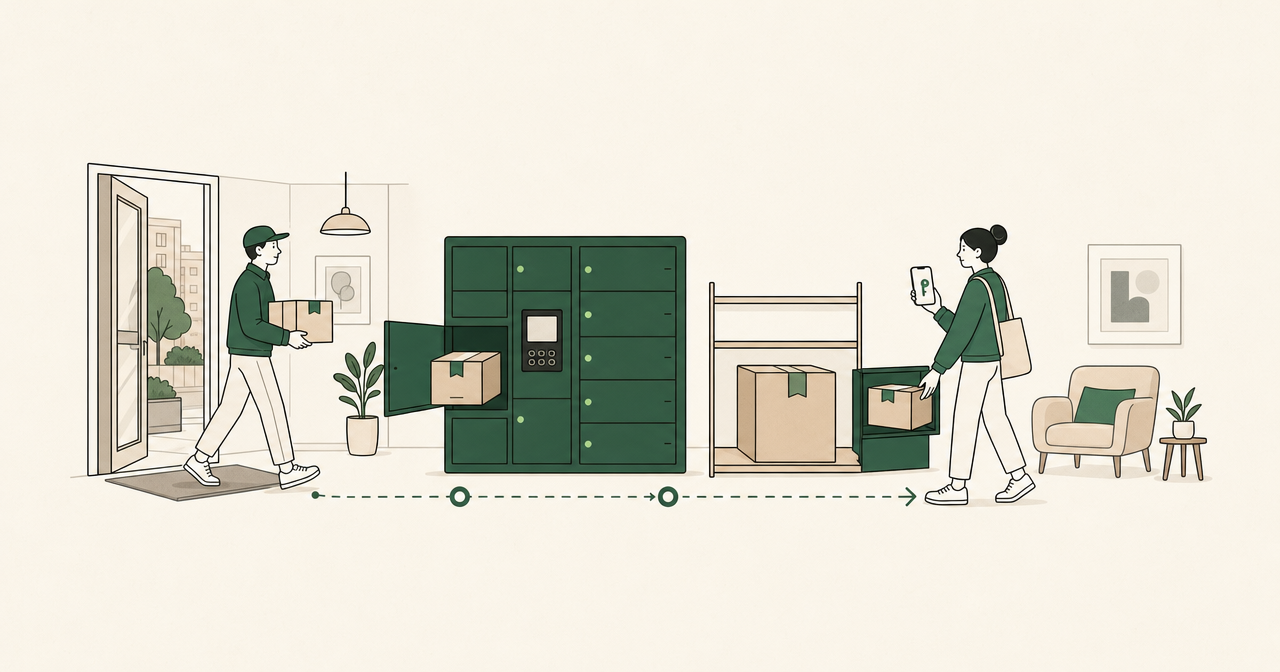
A “delivered” alert can still leave you wondering where your box actually went. At an apartment, the carrier's drop-off and your pickup can be two separate events, with a building policy in between.
That is why a package locker in a listing tells you only part of the story. The useful details are where each delivery goes, how you get it, and what happens when the normal plan fails. Those details matter just as much before a move as after your first missing notification.
Where do packages go in an apartment building?
In U.S. apartment buildings, packages can go to your apartment door, a mailbox or parcel locker, a shared package room, or a staffed leasing office or front desk. The destination depends on the building's delivery arrangement, the carrier, the package's size, and any signature requirement. An apartment number on the label identifies you; it does not guarantee delivery to your unit door.
| Delivery location | How you receive the package | The detail that matters |
|---|---|---|
| Apartment door | The driver hands it over or leaves it where permitted | Whether unit-door delivery is allowed and possible |
| U.S. Postal Service (USPS) mailbox or parcel locker | You use your mailbox key, sometimes followed by a separate locker key | Postal lockers are different from the building's electronic lockers |
| Electronic package locker | You receive a code, app notification, or other pickup credential | Registration, pickup access, and the plan for full lockers |
| Package room | You enter the designated room and find your labeled package | Whether access is shared, logged, or staff-assisted |
| Leasing office or front desk | Staff accept the delivery and release it to you later | Acceptance rules, identification, and opening hours |
If you are apartment hunting, treat package pickup as part of the apartment's daily fit. Our AI agent for renters is free for renters: you describe what you want, we find matches, call landlords or leasing offices, and book tours. Delivery arrangements belong on the same question list as laundry and parking.
Delivery to your apartment door
Some buildings allow drivers to leave packages outside individual apartments. Others direct deliveries to a central location. A locked entrance, a building restriction, or a signature requirement can change the outcome.
Even “front door” can be ambiguous. It might mean the building entrance rather than your apartment door. A delivery photo and location description are more useful than that phrase alone.
Mailboxes and USPS parcel lockers
Small USPS packages may fit in your own mailbox. With a traditional postal parcel locker, the carrier puts the package in a larger compartment and leaves its key in your mailbox. The key's tag identifies the compartment. After you unlock it, the key stays in the locker. USPS explains the key system.
These postal compartments are separate from electronic lockers used by other carriers. A code from a building's package app will not open a traditional postal locker.
USPS delivery is not universally limited to mailboxes. For example, UW–Madison's apartment guidance describes USPS packages going to mailboxes, postal parcel lockers, or apartment doors depending on size. It also explains that other couriers cannot use those postal lockers. The arrangement at your building determines which route applies.
Electronic lockers and package rooms
With electronic lockers, the delivery is assigned to a resident and stored in a compartment. You receive pickup instructions, usually by email, text, or app. The compartment is used for a delivery rather than permanently assigned to your apartment.
A package room works differently. Your credential may open a shared room with shelves instead of one private compartment. You then locate the box bearing your name and unit number. Access control does not mean every package is individually locked away.
For systems that identify residents electronically, enrollment matters. Each person receiving packages needs to appear in the resident directory or be added through the system's household-account process. Your name, unit, email, and phone number connect the box to its pickup notification.
Leasing offices and front desks
A staffed office can accept packages only under its own acceptance policy. Some accept ordinary parcels, some handle only exceptions, and some do not accept resident packages at all.
Office delivery also creates a second schedule. A package can arrive at 2 p.m. while you are at work and remain unavailable after the office closes. An office in the building is not the same as round-the-clock pickup.
How to address a package to an apartment
Use your full recipient name, street address, apartment or unit designation, city, state, and ZIP code. Include any building identifier that is part of your assigned address. The apartment community's marketing name cannot replace the street address or unit number.
A simple example looks like this:
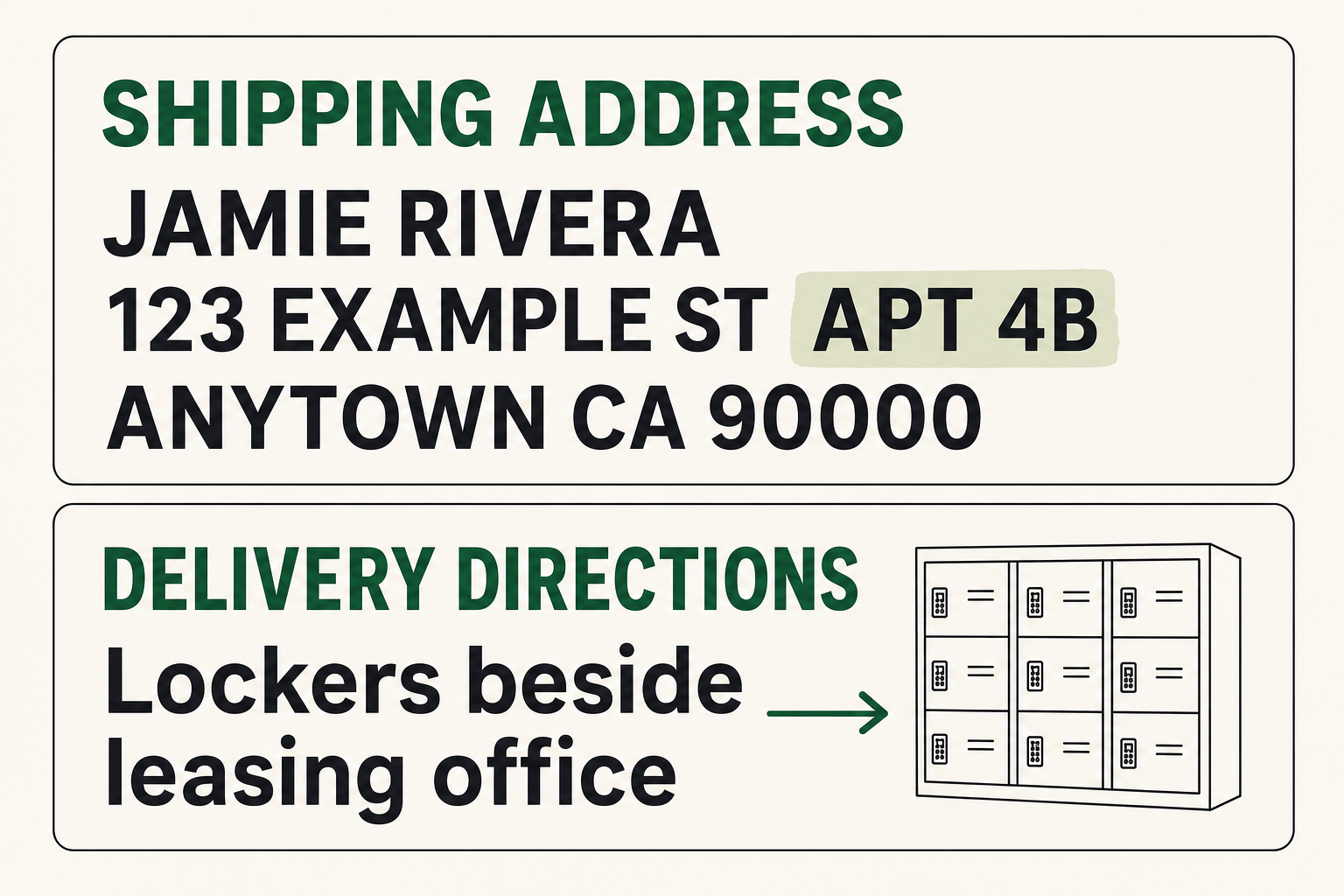
JAMIE RIVERA
123 EXAMPLE ST APT 4B
ANYTOWN CA 90000
This is an illustrative address. In an online checkout, you can use the apartment or unit field when provided. Confirm that the resulting shipping label includes APT 4B. USPS prefers the unit designation at the end of the delivery-address line, as shown above. Its addressing standards recognize abbreviations such as APT, BLDG, and UNIT and discourage a bare number sign when the correct designation is known.
Use your assigned shipping address even when pickup happens elsewhere on the property. Do not substitute the leasing office's address just because the lockers are beside it, unless the building explicitly uses that address for resident deliveries.
An off-site package service is a separate arrangement. If your building uses one, it may provide a service-specific address and resident identifier, followed by a separate delivery to your apartment. That adds another handoff and potentially another delivery window.
For move-in orders, the earliest useful delivery date is the date the property can accept your packages and you can retrieve them. A signed lease alone does not establish that date. Get the start date and enrollment instructions before sending furniture or essentials to the new address. Our first apartment checklist helps organize the rest of that setup.
Delivery instructions should name one clear destination
Keep the address and the directions separate. Your unit belongs in the shipping address. Directions explain how to find the approved drop-off point.
A useful note might say:
Package lockers are beside the leasing office, facing Oak Street. Please use the resident locker directory for Jamie Rivera, apartment 4B.
For a building that accepts desk deliveries:
Please leave with the staffed front desk in the main lobby during its posted acceptance hours. Recipient: Jamie Rivera, apartment 4B.
Avoid conflicting notes such as “leave at my door” followed by “all deliveries must go to the lockers.” Give one current destination that matches the building's arrangement. Put sensitive access information only in the property-approved delivery channel, never on a public sign or review.
Saved retailer instructions and carrier preferences are separate systems. Add directions through the service actually handling the delivery when that option is available. Instructions do not remove signature requirements or guarantee a particular delivery time. Building entry is only one part of the process; the pickup location and resident notification still need to work after the driver gets inside.
What happens when a package needs a signature?
A signature requirement changes who can accept the package. It does not automatically mean you personally must stand at your apartment door, and it does not mean any leasing-office employee can sign.
FedEx, for example, distinguishes three signature requirements:
- Indirect signature: Someone at or near the address, including a neighbor or building manager, may sign. Eligible shipments can also allow an electronic release.
- Direct signature: Someone at the delivery address must sign. Electronic release is unavailable.
- Adult signature: Someone at the delivery address who is at least 21 must sign and provide accepted identification. Electronic release is unavailable.
The shipper selects the service. A delivery note saying “leave in locker” does not override the signature requirement.
There are two questions for an office delivery: does the carrier permit that person to sign, and does the property agree to accept that kind of package? Both need a yes.
When nobody eligible is available, the outcome can be another attempt or a hold for pickup. Some shipments allow redirection to a staffed pickup location; others restrict changes. UPS does not allow adult-signature shipments to be released digitally. Plan around the specific shipment rather than assuming every carrier will make the same number of attempts.
Pickup has its own rules, deadlines, and exceptions
The carrier's “delivered” scan records its delivery event. A separate building or locker notice, when used, gives you the next step for collection. Those messages may arrive at different times.
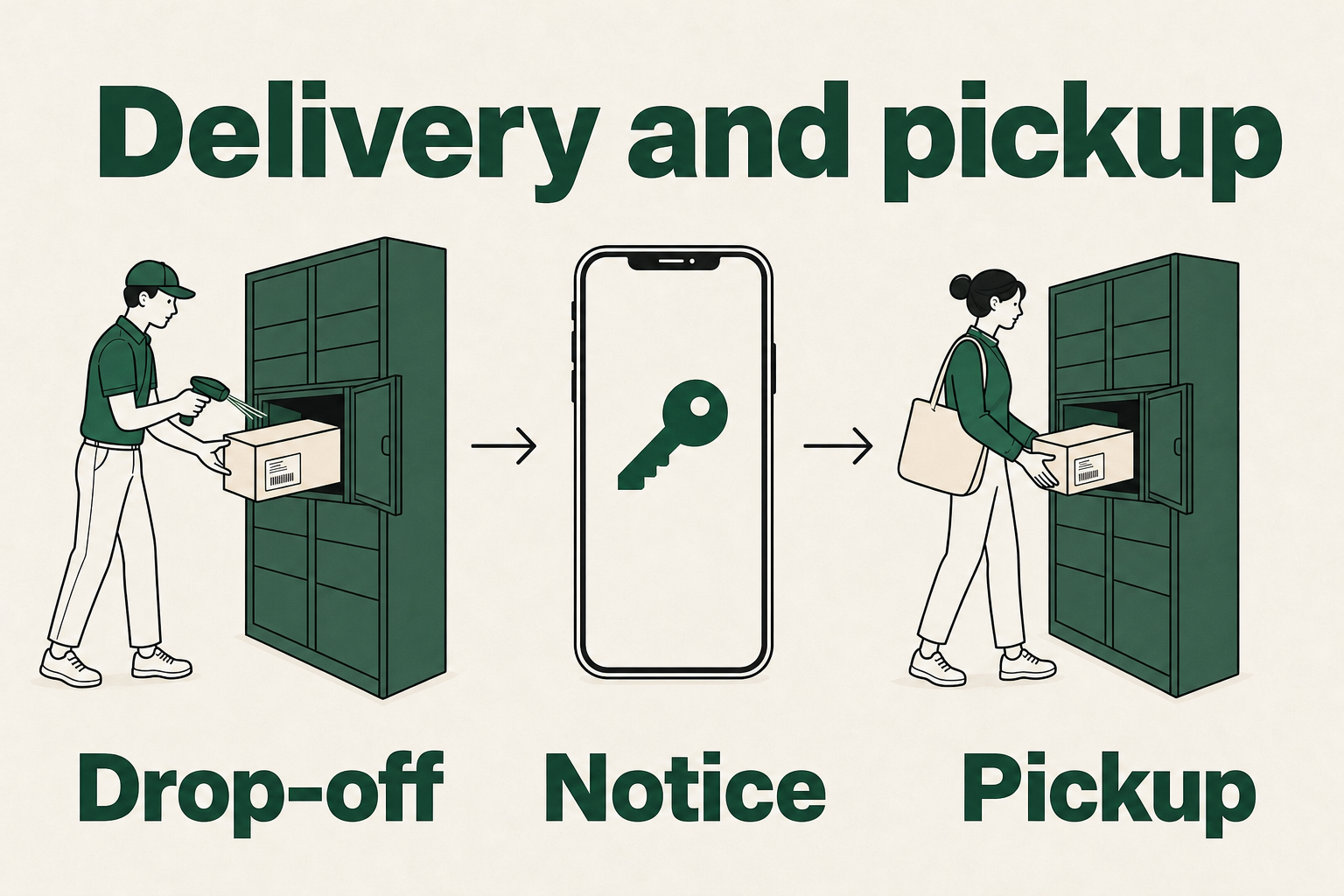
With a locker, you need the credential for the correct delivery. At a desk, you may need photo identification and authorization for someone else to collect it. With a shared room, match the name and unit on the label before taking a box. A shelf number is not a substitute for the recipient's name.
Learn the pickup clock before you need it
Package systems can have registration charges, recurring fees, storage fees, or pickup deadlines. These are different costs. A monthly package charge does not necessarily buy unlimited storage.
The grace period is program-specific. A locker brand name does not tell you how long you have before storage charges begin.
Get these terms in writing:
- When does the pickup deadline begin, and do weekends count?
- What charge applies after the deadline?
- Can unclaimed packages be moved or returned?
- Can an authorized person collect while you are away?
- Does a vacation setting pause fees, reminders, or deliveries, and for how long?
Full lockers and oversized boxes need a fallback
A locker system cannot accept a box that does not fit an available compartment. The fallback might be an overflow room, the office, your door, or a later delivery attempt. A large package is not automatically the leasing office's responsibility.
Perishables need a separate plan too. Unless refrigerated storage is explicitly provided, treat the package area as ordinary storage. Furniture or freight deliveries may also have appointment, elevator, loading, and carry-in arrangements outside the parcel system. “Delivered to the building” does not promise a sofa carried upstairs.
“Delivered,” but no code or package?
Start with the delivery record: carrier, tracking number, location wording, photo, and any signature or recipient name. Then follow the relevant route:
- Postal parcel locker, no key: Contact USPS with the tracking number and locker issue.
- Electronic locker, no notification: Open the resident account for the delivery record, then contact the locker support team or office for help locating the assigned compartment.
- Package room, no code: Request help through the room's official access process. A package can be physically inside without a matching scan or notification.
- Office delivery, no package: Give staff the delivery time and recipient or signature information, and ask about overflow storage.
- Photo of another location: Send the image and correct address to the carrier and retailer as a misdelivery report.
Save the tracking record and your report. An unexplained scan alone does not establish theft. If the package remains missing, report the nonreceipt to the carrier and seller through their support channels. USPS provides a missing-package service request for eligible delivered items still missing after more than one postal business day.
What to ask before moving into the building
“Do you have lockers?” is a starting point. The better question is: “How would I receive an ordinary box, a signature-required shipment, and something too big for a locker?”
Ask to see the actual pickup area during your tour, including the route from your apartment. A room that is technically open late can still be inconvenient if it sits across the property or requires stairs you cannot use. On a live virtual tour, include that route in the walkthrough.
| Ask about | Get a concrete answer |
|---|---|
| Normal delivery | Where do USPS and other carriers leave packages for this unit? |
| Resident setup | When is the account active, and how are roommates or other recipient names added? |
| Pickup access | What are the actual hours, including weekends and holidays? |
| Exceptions | Where do oversized boxes, full-locker deliveries, and signature shipments go? |
| Costs and deadlines | Which fees are mandatory, when do storage charges start, and when are packages returned? |
| Accessibility | Is there a usable route, reachable locker option, and help moving a heavy package? |
| Problems and travel | Who handles a missing code, system outage, misdelivery, or authorized pickup while you are away? |
Put the answers beside each apartment's rent and other fees. If you regularly get home after the office closes, a desk-only pickup system can become a weekly errand. If you order large items, the overflow arrangement may matter more than the locker brand.
The apartment should work for the way you live, including the unglamorous part where you just want to bring a box home. Start your apartment search with Fairway and give us the daily-life requirements that belong on your shortlist.