Lease decisions
How to Fight Non-Renewal of a Lease: A Renter's Options
How to fight lease non-renewal: grounds, evidence, and response options. Our AI agent for renters can help with a separate backup apartment search.
A non-renewal notice can turn a settled home into a moving deadline overnight. Getting a reason from the leasing office may be its own project. Before you accept that deadline or send an angry reply, it helps to separate three possibilities: a decision you can legally challenge, a notice problem that may give you more time, and a decision you may need to negotiate. Each calls for a different response.
Can you fight a landlord's decision not to renew?
Yes, when the decision violates your lease, a right to continued tenancy, notice requirements, or laws against retaliation or discrimination. You can also ask a landlord to reconsider a lawful non-renewal, though a request alone does not create a right to another lease.
Paying on time and taking care of your home support that conversation. They do not, by themselves, guarantee renewal everywhere. For U.S. renters, your address, lease terms, length of occupancy, and any housing assistance determine which protections apply.
If you have received a court summons or eviction complaint, contact tenant legal aid immediately. An email to management is separate from a court response. The eviction response process can require a written answer and attendance at a hearing.
You can pursue staying while preparing a backup. Where Fairway is available, our AI agent for renters is free for renters. Describe what you want, and we find matches, call landlords or leasing offices, and book tours. A tenant lawyer handles the non-renewal dispute.
1. Separate the notice from an eviction case
A non-renewal notice tells you the landlord does not intend to continue your tenancy. It is different from a court order authorizing an eviction. The wording varies: “notice to vacate” or “notice of termination” may be a pre-court notice, rather than a document issued by a court.
Read every page, including attachments. Make a short record of:
- Your lease end date. Include any automatic-renewal or month-to-month provision.
- The notice's dates. Record the date printed on it, when and how it reached you, and the requested move-out date. Keep the envelope, email, or delivery record.
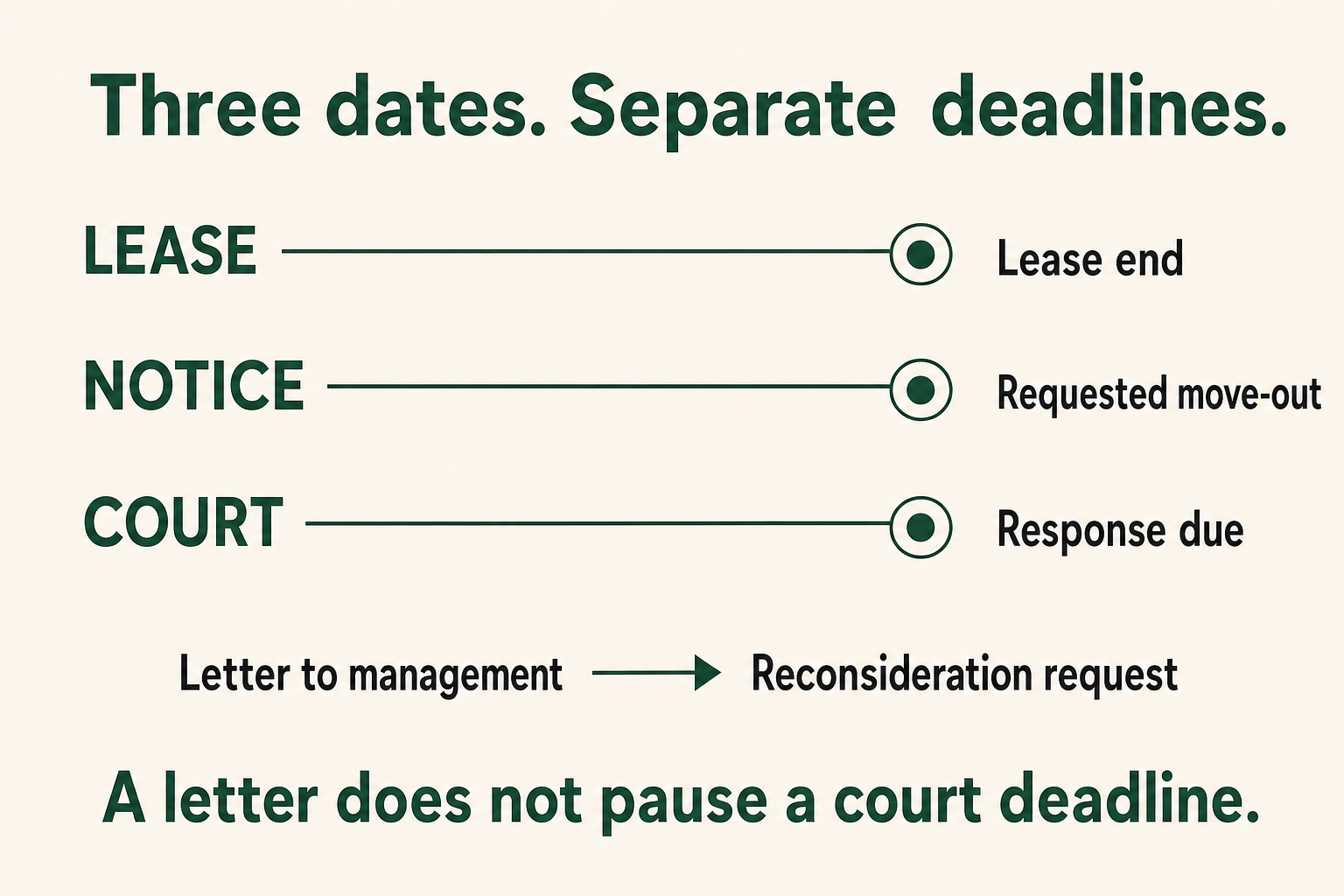
- Any court deadline. Save the summons, case number, response instructions, and hearing date separately.
These dates can differ. The lease ending does not tell you whether notice was sufficient. A later hearing date does not give you permission to ignore an earlier answer deadline.
Avoid assuming that remaining after the lease ends is risk-free. Depending on local law and your circumstances, it can lead to an eviction case and additional charges. A local tenant lawyer can explain your options before the requested departure date.
If management threatens a lockout or utility shutoff, seek urgent local legal help rather than treating it as a routine renewal negotiation.
2. Identify a specific basis for challenging the non-renewal
“This is unfair” describes the impact. A useful challenge also identifies the lease term, legal protection, or documented event that makes the decision improper.
The landlord did not follow the lease or notice rules
Look for renewal options, required advance notice, delivery instructions, and what happens at the end of the term. Save any renewal offer you accepted and any signed extension. A dispute over an existing renewal agreement is different from asking for a new one.
There is no single nationwide 30-day rule. Notice can depend on the tenancy type, lease, state, and city. In New York, for example, the statutory notice period depends on occupancy or lease length, whichever is longer. A lease term of at least one year but less than two years triggers at least 60 days' notice under the state's non-renewal notice law.
Under that New York law, late notice continues the tenancy on its existing terms until the required notice period expires. That illustrates an important distinction: a notice defect can mean more time without guaranteeing a new year-long lease. The remedy elsewhere depends on the applicable rule.
Your home has renewal or just-cause protections
Some laws require a legally recognized reason to end a tenancy. These are often called “just cause” or “good cause” protections. A landlord's label of “non-renewal” does not settle whether those rules apply.
California's Tenant Protection Act generally requires just cause for covered tenancies after 12 months. Adding an adult before any renter has lived there for 24 months can delay protection until all renters reach 12 months or one reaches 24 months, under the state's tenure and coverage rules.
Local protections can go further. Permitted grounds can include both lease violations and certain owner-related reasons, so just cause does not mean a tenancy can never end. The California Attorney General explains those eviction protections and exceptions.
Rent stabilization can create a separate renewal right. In New York, rent-stabilized renters generally have a right to renewal, with limited grounds for an owner to refuse.
Give a legal aid office or local rent board your full address, move-in date, lease, and any exemption notice. Those details help establish coverage. For a local example of how protections overlap, our San Francisco renter protections guide separates rent limits from eviction rules.
The decision may be retaliation
A non-renewal after a repair complaint deserves attention. So does a notice following a report to code enforcement or participation in a tenant organization. Which activities are protected, and what evidence is needed, depend on the law where you live.
New York, for example, protects qualifying renters against retaliatory non-renewal after good-faith complaints. Its law includes a one-year presumption in specified circumstances, with an exception for owner-occupied buildings with fewer than four units. The state's retaliation protections explain that framework.
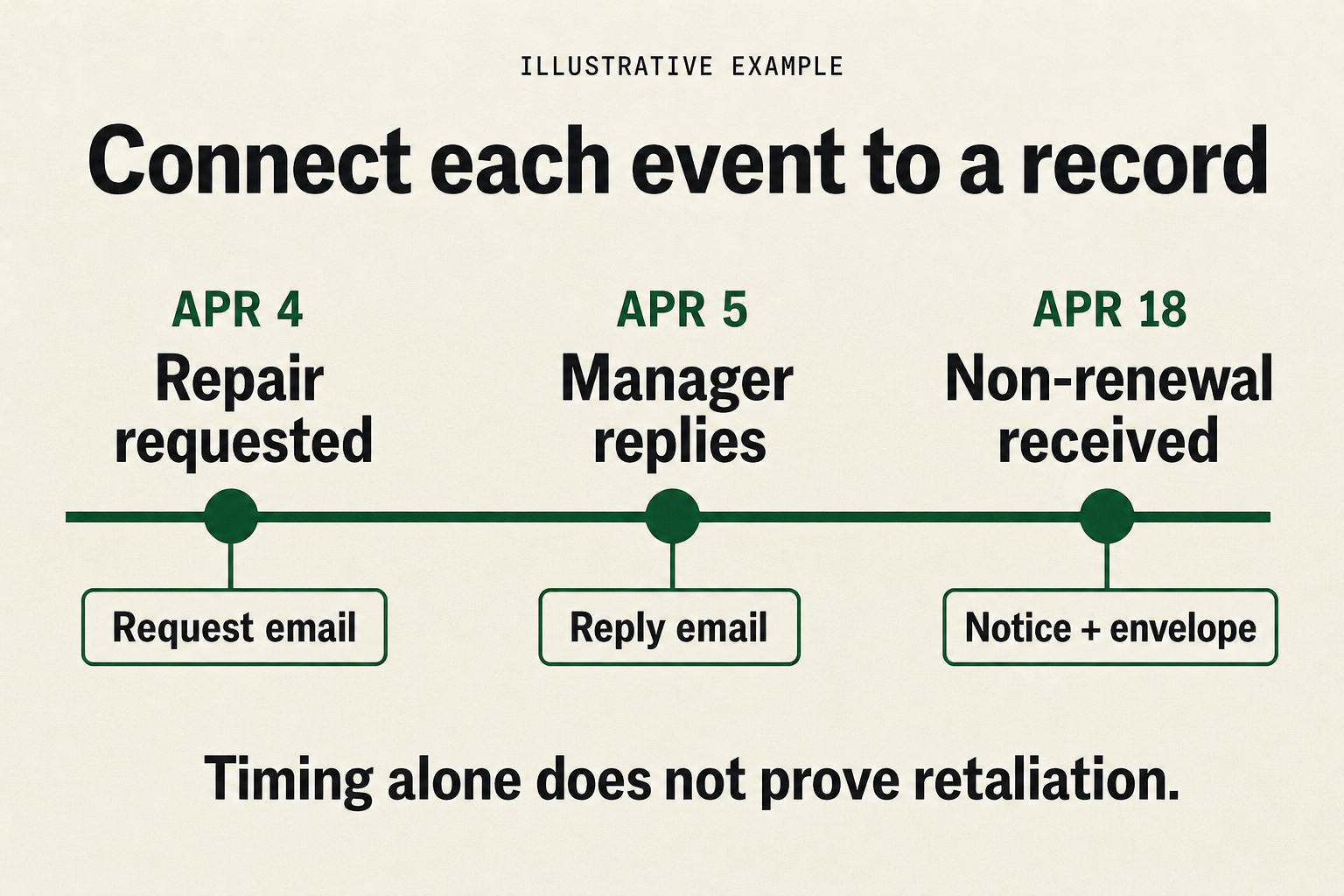
Timing is useful evidence. It does not automatically prove retaliation. Preserve the original complaint, evidence that management received it, the response, and the later notice. Include any earlier warnings too, even if they complicate your account.
The decision may be discriminatory
In covered housing, the federal Fair Housing Act prohibits housing discrimination based on race, color, national origin, religion, sex, disability, or familial status. The Act has coverage exemptions, while state and local laws may cover additional housing and characteristics.
Statements about children, disability, or another protected characteristic can matter, as can different treatment of comparable households. The U.S. Department of Housing and Urban Development (HUD) accepts housing discrimination reports.
If the stated problem is connected to a disability, a reasonable accommodation may be relevant. That means a disability-related change to a rule, policy, practice, or service. It is not an automatic exemption from every lease obligation. The joint HUD and Justice Department reasonable accommodation guidance explains the requirements and limits.
Keep the request focused on the change you need and its connection to the disability. A fair housing organization or lawyer can help frame it without unnecessary disclosure of private medical details.
Your housing program adds protections
Public housing, project-based assistance, and a Housing Choice Voucher are different arrangements. They do not all have the same termination rules or review procedures.
For example, federal rules for Section 8 new-construction housing under Part 880 prohibit an owner from ending a tenancy solely because the initial or renewal term expired. They require a permitted ground under the program's tenancy termination rules.
Send the notice to your housing authority or program contact promptly. Ask which program governs your home and whether there is a meeting, grievance, or hearing deadline. Include every program notice when contacting legal aid. Do not assume that a landlord's non-renewal and a housing authority's decision about assistance are the same proceeding.
3. Build a small evidence file that answers the dispute
A useful file connects each concern to a record. Hundreds of screenshots without dates make that harder.
| Concern | Records to gather | What the records help establish |
|---|---|---|
| Late or defective notice | Lease, complete notice, envelope, email headers, delivery record | Required terms, notice contents, and delivery timeline |
| A renewal already exists | Renewal offer, acceptance, signed agreement, payment receipts | What each party agreed to and when |
| Retaliation | Repair requests, agency complaint numbers, management replies, earlier warnings | Protected activity, management's knowledge, and sequence of events |
| Discrimination or accommodation | Exact messages, accommodation request and response, witness names | Statements, requested changes, and how management responded |
| Disputed lease violation | Rent ledger, receipts, inspection reports, dated photos, correspondence | Whether the stated reason matches the records |
Write a one-page timeline alongside the documents. Use dates and observable facts: “April 4: emailed about the leak. April 5: manager replied. April 18: received non-renewal.” Keep your interpretation separate from the events.
Save copies somewhere you can access outside the resident portal. Keep originals intact. After a phone conversation, a short follow-up email can record your understanding: “You said the decision concerned repeated noise complaints. Please send the dates and notices you referred to.”
4. Send a calm request for reconsideration
A written response gives management something concrete to address. It can request an explanation, correct a factual error, identify a potential protection, or propose another term. Keep it short enough that the main request is obvious.
Use only facts that fit your situation. If a lawyer is already helping, let them guide the response.
Subject: Request to reconsider non-renewal for [address and unit]
Hello [name],
I received the non-renewal notice on [date], requesting that I leave by [date]. I would like to renew my tenancy.
Please provide the reason for the decision in writing and reconsider the notice. My concern is [brief factual explanation, such as a notice-period issue, an existing renewal agreement, or the timing after a repair complaint].
The attached [documents] show [specific fact]. Please confirm whether you will withdraw the notice and offer a renewal, or discuss an extension through [date].
Please respond in writing by [date]. This request is not an agreement to move out or surrender my tenancy.
Thank you, [name and contact details]
Send it through the notice channel required by your lease or applicable law, and retain proof of delivery. Email can provide an additional record; it does not automatically replace a required delivery method.
This letter is a request to management. It is not a court answer, a program appeal, or an automatic extension of any deadline. The response date you propose does not bind the landlord to pause the process.
5. Choose the outcome you are trying to secure
Your strongest next step depends on what you want and what the evidence supports.
- Keep the tenancy: Ask for withdrawal of the notice and a renewal or continuation on lawful terms.
- Correct the timing: Ask for the notice period and effective date required by the lease or applicable law.
- Negotiate breathing room: Propose a specific extension, such as six more weeks, with an agreed rent and end date.
- Arrange a workable departure: Discuss moving costs, any available relocation assistance, deposit handling, and the final account.
Get agreed terms in writing. “We'll work with you” leaves the most important details unresolved. A short extension should state the rent, dates, and whether the original notice is withdrawn or replaced. Our guide to month-to-month rentals explains how a rolling tenancy differs from a short fixed extension.
For legal help, the Legal Services Corporation's local legal aid directory connects eligible renters with organizations by location. A rent board or housing agency may handle certain local violations. A fair housing organization can help with discrimination concerns. Give each office the notice and your nearest deadline first.
If a court case has started, follow the court's response and appearance requirements while seeking help. Do not assume negotiations, an agency complaint, or an accommodation request pause that case. A lawyer can advise whether you need a separate request for emergency relief.
Keep meeting your rent and lease obligations while the dispute is being addressed. Withholding rent as leverage can introduce a separate nonpayment issue. If payment is refused or you are considering a legally permitted withholding remedy, get local legal advice and preserve the payment records.
Have a tenant lawyer review any surrender agreement, release of claims, or court settlement before you sign. Extra time can come with conditions that affect your defenses or commit you to leaving on a particular date.
Keep a backup search separate from giving up your home
Researching another apartment does not require you to accept the landlord's position. It gives you options while the renewal question is unresolved. Budget for the deposit, moving costs, and any overlap between homes before committing to a new lease.
You deserve a clear answer about your current home and a workable next step if you need one. If a backup search would take some pressure off, tell Fairway what you need. We can handle the matching, calls, and tour scheduling while you focus on resolving the notice.