Flexible rentals
Month-to-Month Rentals: Find a Flexible Lease Without Overpaying
Find month-to-month rentals, compare furnished and unfurnished options, calculate the full cost, and confirm notice terms before you sign or pay.
Most rental searches assume you want a 12-month lease. Search for a monthly option and the results get messy fast: rolling leases, furnished stays, sublets, hotels, and apartments that merely offer a shorter fixed term. Each comes with different costs and exit rules. The right search starts with your actual timeline. From there, you can find the right type of flexibility, compare the full stay cost, and get the notice terms in writing before you pay.
What a month-to-month rental actually promises
A month-to-month rental is a periodic tenancy with no fixed end date. The agreement renews for another month until you or the landlord ends it under the lease and applicable law. You usually sign once. You do not sign a fresh lease every month.
That is different from renting a place for exactly one month. A landlord may require an initial minimum stay, advance notice, or both. If you move in on June 1 and the agreement requires 30 days' notice before the end of a rental period, giving notice on June 2 may leave you responsible through July. The advertised “monthly” rate tells you how often the price is quoted. It does not tell you the earliest day you can leave without owing more rent.
| Rental type | How it ends | Common fit | Main tradeoff |
|---|---|---|---|
| True month-to-month lease | Renews until proper notice ends it | Your departure date is uncertain | Rent and other terms may change with lawful notice |
| Short fixed-term lease | Ends on a stated date, subject to the agreement and local law | You know you need two, three, or six months | Leaving earlier can trigger lease-break costs |
| Furnished monthly stay | Fixed booking or rental agreement, sometimes extendable | You need furniture, utilities, and a fast move-in | Higher quoted rate and possible booking or cleaning fees |
| Sublet or lease takeover | Ends under the sublease or original lease | You can match another renter's remaining term | You need clear authority from the landlord and original renter |
| Extended-stay hotel | Ends under the reservation terms | You need a few weeks or maximum arrival flexibility | Less space and pricing that may remain tied to nightly or weekly rates |
The label can be loose. Read the proposed agreement to see whether you are getting an open-ended periodic tenancy, a 30-night booking, or a fixed term that later converts to month-to-month.
How to find month-to-month rentals
Flexible rentals are scattered across several kinds of inventory. Running one generic search tends to produce duplicate listings and plenty of apartments whose “short-term” option is still six months.
1. Define the flexibility you need
Write down these seven details before opening more tabs:
- earliest move-in date
- earliest acceptable move-out date
- whether the departure date is firm or uncertain
- furnished or unfurnished
- whole home, apartment, or room
- maximum all-in monthly cost
- cash available before move-in
If your home renovation should finish sometime between October and December, a true month-to-month lease may be worth a premium. If your work assignment ends on November 30, a three-month fixed lease can give you the same practical flexibility with a stable rate.
2. Search in the right places
Use more than one inventory lane, since each surfaces a different kind of offer.
| Where to search | Best use | What to confirm |
|---|---|---|
| Fairway | Broad apartment search in the SF Bay Area, including listings outside the major portals | Whether the landlord will accept your exact term and what that term costs |
| Large rental marketplaces, such as Zillow, Apartments.com, and Trulia | Standard apartments with short-term, furnished, or keyword filters | The exact unit's lease options, since a building-level filter can cover only some units |
| Local property managers and private landlords | Unadvertised flexibility and smaller properties | Who owns or manages the home and whether the lease is direct |
| Furnished monthly marketplaces and providers, such as Furnished Finder, Airbnb, Blueground, and HouseStay | Move-in-ready stays of one month or longer | Utilities, furniture, fees, cancellation rules, and payment protections |
| Sublet and lease-takeover boards, including local housing groups and Leasebreak in New York | A fixed gap that matches another renter's dates | Written landlord consent, the original lease, and who holds the deposit |
| Extended-stay hotels | A short bridge while you tour longer-term options | Taxes, parking, pet charges, cancellation, and what the room includes |
For Bay Area renters, our free AI agent for renters is the first place we would start. Tell us the neighborhoods, budget, move date, and flexible term you need. We watch every listing, Craigslist included, then call landlords to confirm the details and book tours. That last step matters because many standard listings never publish their shortest available term.
If you prefer to contact smaller owners directly, our guide to finding private landlords shows how to search for owner-listed homes and establish who is behind the listing.
3. Use terms that uncover different inventory
Run several searches with your city or neighborhood:
"month-to-month" apartment"short-term lease" apartment"flexible lease" apartment"furnished" apartment monthly"lease takeover"orsubletcorporate housingorextended stay
Quotation marks help when a search tool supports them. On a marketplace, also use the lease-length, furnished, move-in date, and keyword filters. Search the same terms on local property-manager sites because a portal may show the building while missing its current term options.
4. Ask a question that gets a usable quote
“Do you offer month-to-month?” invites a one-word answer. Send the dates and ask for the complete deal:
Hi, I'm interested in [unit/address]. I can move in [date], expect to stay at least [number] months, and need an open-ended option after [date]. Do you offer a true month-to-month agreement or a short fixed term that later rolls monthly? Please send the base rent for that term, all required monthly and one-time fees, deposit, application requirements and fee, included utilities and furnishings, minimum stay, notice period, and earliest move-out date. Is this exact unit available on those terms?
For a large building, ask for the quote or lease-term grid for the exact unit. Prices can differ by apartment, start date, and lease length inside the same property.
5. Confirm the offer before paying
Flexible housing often moves the whole process online, which makes a copied listing easier to dress up. Search the address, compare contact details across independent sources, tour the exact unit in person or by live video, and match the payee to the confirmed owner or property manager.
The FTC received nearly 65,000 rental-scam reports and about $65 million in reported losses from January 2020 through June 2025. A self-guided tour code is not proof that the person collecting your deposit has authority to rent the home. Our rental scam checklist covers the property, person, paperwork, and payment process to finish before you share sensitive information or send money.
Compare the full cost for your actual stay
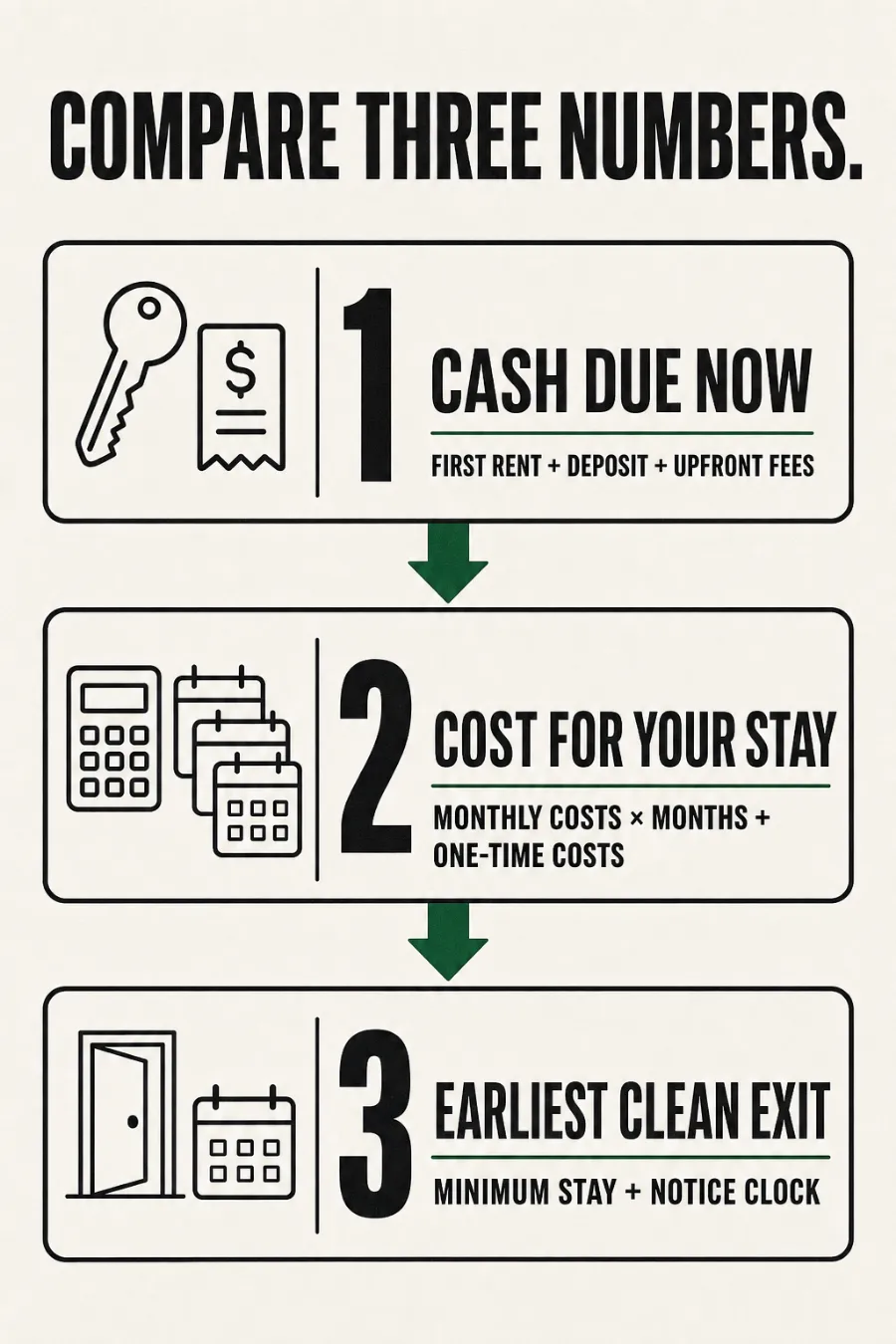
The monthly rent is only one part of a flexible rental. Compare every option over the number of months you realistically expect to stay.
Total stay cost = (rent + required monthly fees + utilities) × months + one-time nonrefundable fees + setup, furniture, moving, and storage costs
Keep refundable deposits out of the total if you expect a full return. Track them separately as cash tied up before and during the stay.
Consider a three-month example:
- An unfurnished apartment costs $2,150 in rent, plus $150 a month in required fees and utilities. Furniture, setup, and extra moving cost $1,400. The three-month cost is $8,300, or about $2,767 per month.
- A furnished monthly apartment costs $2,650 with utilities included, plus a $300 nonrefundable cleaning and administration charge. The three-month cost is $8,250, or $2,750 per month.
The furnished rent looks $500 higher. Over this short stay, it costs $50 less overall. These are sample figures, but the method prevents a cheap base rent from winning a comparison it should lose.
Also calculate cash due before move-in. First month's rent, security deposit, last month's rent where lawful, booking charges, pet charges, and furniture costs can make two similar offers very different on day one. Our apartment budget guide has a fuller move-in and monthly cost worksheet.
Negotiate the term before you negotiate the rent
The best flexible offer may use a different structure from the one you searched for.
Ask for a short fixed extension when you know the end date
If your current lease ends June 30 and you need the apartment through August 31, ask for a two-month extension at a stated rate. A property may quote a steep month-to-month premium to discourage open-ended summer holdovers while accepting a defined extension. You get a known move-out date and known price. The landlord gets the apartment back on a date it can plan around.
Give the landlord a useful end date
A landlord may be more open to a four- or ten-month term that returns the unit during a busier leasing season. Ask for prices at several nearby end dates. One extra week or month can change the quote more than expected.
Put a boundary around the premium
If you truly need an open-ended lease, ask for:
- a fixed rate for the first two or three months
- the required notice for any rent or fee change
- a cap on the month-to-month premium, if the landlord will agree
- the right to convert to a longer fixed term without another application fee
A complete application and flexible move-in date can help. Paying an unusually large deposit is a weak substitute. Deposit limits vary by location, and extra cash at risk does not repair vague exit terms.
Read these lines before signing
A month-to-month agreement should be written clearly enough that you can put every deadline and dollar on a calendar.
| Lease term | What you need in writing |
|---|---|
| Start and renewal | Start date, rental period, minimum stay, and whether renewal is automatic |
| Earliest exit | First termination date available without an early-exit charge |
| Notice | Number of days, whether the date must align with the end of a rental period, acceptable delivery methods, and when notice counts as received |
| Rent changes | Current rent, premium, required notice, frequency limits, and any applicable cap or exemption |
| Recurring charges | Utilities, parking, pets, furniture, internet, trash, service, and other mandatory fees |
| Move-in cash | Deposit, first or last month's rent, and every nonrefundable charge |
| Furnishings | Itemized inventory, existing damage, replacement charges, linens, kitchenware, and cleaning standard |
| Extension and conversion | How to extend, what price applies, and whether a fixed-term option is available later |
| Move-out | Inspection process, key return, cleaning rules, deposit deductions, and refund address |
Do not rely on “30 days' notice” in a text message when the lease says notice must arrive by certified mail before the first of the month. The delivery rule and the calendar rule matter as much as the number.
A 30-day notice is not a national rule
Notice, rent-increase, and termination rules are largely state and local. A lease can add requirements where the law permits, while rent control and just-cause rules can restrict what a landlord may change or why a tenancy may end.
The state examples show why a generic calculator can fail:
- In California, a renter in a residential month-to-month tenancy generally gives at least 30 days' notice under the renter-notice law. A residential landlord generally gives 60 days, reduced to 30 days when the renter has occupied the home for less than a year, with other exceptions and local protections potentially applying under the landlord-notice law.
- In Washington, a renter generally gives written notice at least 20 days before the end of the rental period. State law separately limits the reasons a landlord may end many periodic tenancies. Washington's periodic-tenancy law and just-cause section work together.
Those are examples, not a rule for another state. The practical move is to identify four things from the agreement and current law: how many days, counted from which event, ending on which date, delivered by which method. Save the signed agreement and proof of delivery.
Month-to-month status also does not erase basic renter protections. Housing, habitability, privacy, deposit, anti-discrimination, retaliation, rent-increase, and eviction rules can still apply. The exact protection depends on the home and location.
Choose flexibility that matches the uncertainty
A true month-to-month rental fits when you cannot name the final month and can absorb a possible premium or move on the lawful timeline. It can work well while buying a home, waiting for construction, relocating, or getting to know a neighborhood.
A short fixed-term lease is usually cleaner when you know the departure date. A furnished monthly stay earns its higher rent when it removes enough setup, utility, and moving cost. A lease takeover can cover an exact gap when the landlord authorizes it. An extended-stay hotel can buy you time to tour in person instead of signing an apartment sight unseen.
Start with the uncertainty you actually need to buy. Then compare the complete stay, not the loudest monthly price.
If you are looking in the SF Bay Area, tell us the term, budget, dates, and neighborhoods once. We will search across every listing, call landlords about the terms, surface the fees, and help get tours on your calendar. Start your rental search with Fairway.