Renter guide
Landlord Recommendation Letter: A Renter’s Guide and Template
Landlord recommendation letter help: request wording, a factual template, and options for missing references. From Fairway, the AI agent for renters.
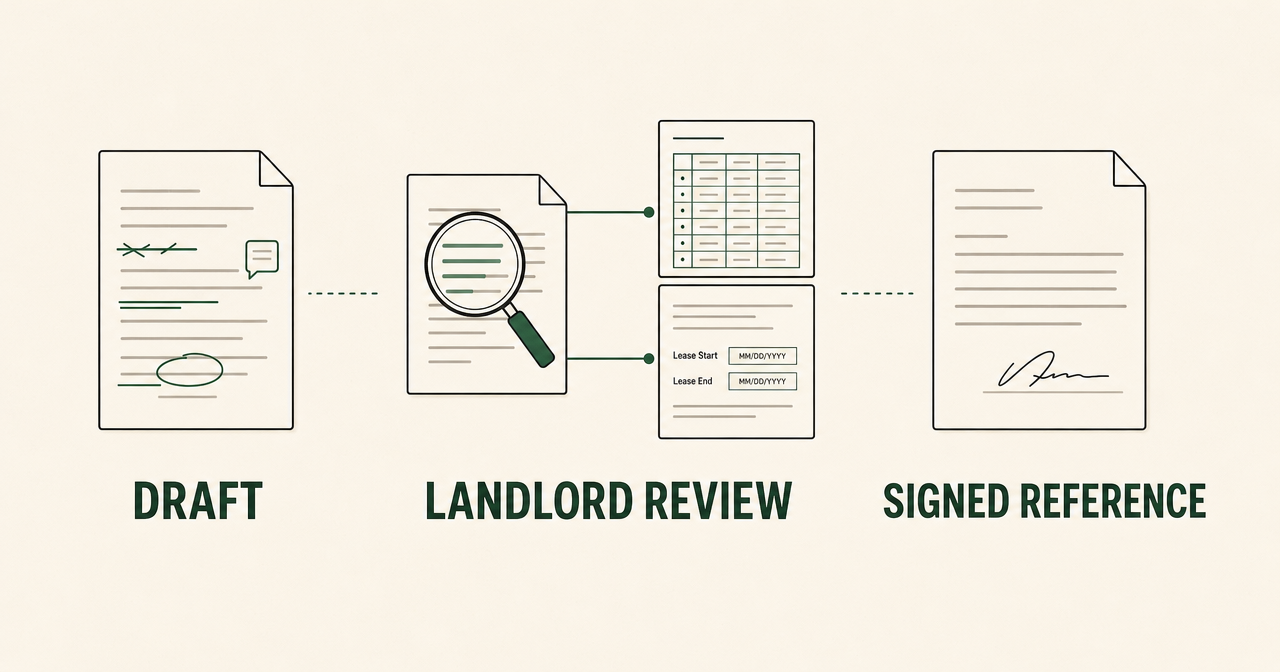
A rental application asks for a landlord recommendation letter, and suddenly your next move depends on another person finding time to write. It can feel awkward to ask, especially if you have already moved out or the relationship was strained.
Here’s how to understand the request, make it easy for your landlord to respond, and keep the letter factual. There’s also a short template you can forward for them to review, correct, and sign, plus options to discuss when a reference is missing.
What is a landlord recommendation letter?
A landlord recommendation letter is a written reference from a current or previous landlord about your rental history. An authorized property manager can also write one. You may see it called a landlord reference letter or rental reference letter.
Its useful job is to document a real tenancy: who rented the home, where, when, and what the writer can say from their records or direct experience. A short account of rent payments is more concrete than a page of praise.
The letter is one part of the paperwork. Our AI agent for renters helps with the other legwork: you describe what you want, we find matches, call landlords or leasing offices, and book tours. Fairway is free for renters. Your rental reference still needs to come from the person who knows that history.
When might a property request a landlord reference?
A prospective landlord or leasing office may request a letter as part of its rental-history review. Another property may ask for contact details, send its own verification form, or call your former landlord instead. “Landlord reference” does not always mean a letter you upload yourself.
Before paying an application fee, ask:
Do you need a signed letter from my previous landlord, your own reference form, or permission to contact them? Which rental period should it cover, and how should it be submitted?
If the contact is unavailable, add:
If I cannot obtain that reference, which other records or references does this property accept?
The Federal Trade Commission recommends asking what information a landlord uses before paying an application or background-check fee. Getting the requested format and deadline in writing helps you avoid chasing a document the property does not need.
For the rest of the application packet, our apartment requirements guide covers identity, income, screening, and move-in documents.
What a useful landlord recommendation letter contains
Aim for a brief letter, often one page. The following is a practical starting point; the receiving property may request different information.
| Detail | What the writer can include |
|---|---|
| Renter’s name | Your name as it appears on the rental records |
| Writer’s identity | Their name and actual role, such as landlord or property manager |
| Rental address | The address and unit you rented |
| Dates | The rental period, or a start date and “present” for an ongoing tenancy |
| Relevant facts | A records-backed payment summary and any other rental facts the writer can accurately describe |
| Follow-up and sign-off | Contact information they agree to share, the letter’s date, and their signature |
Match each statement to what the writer knows
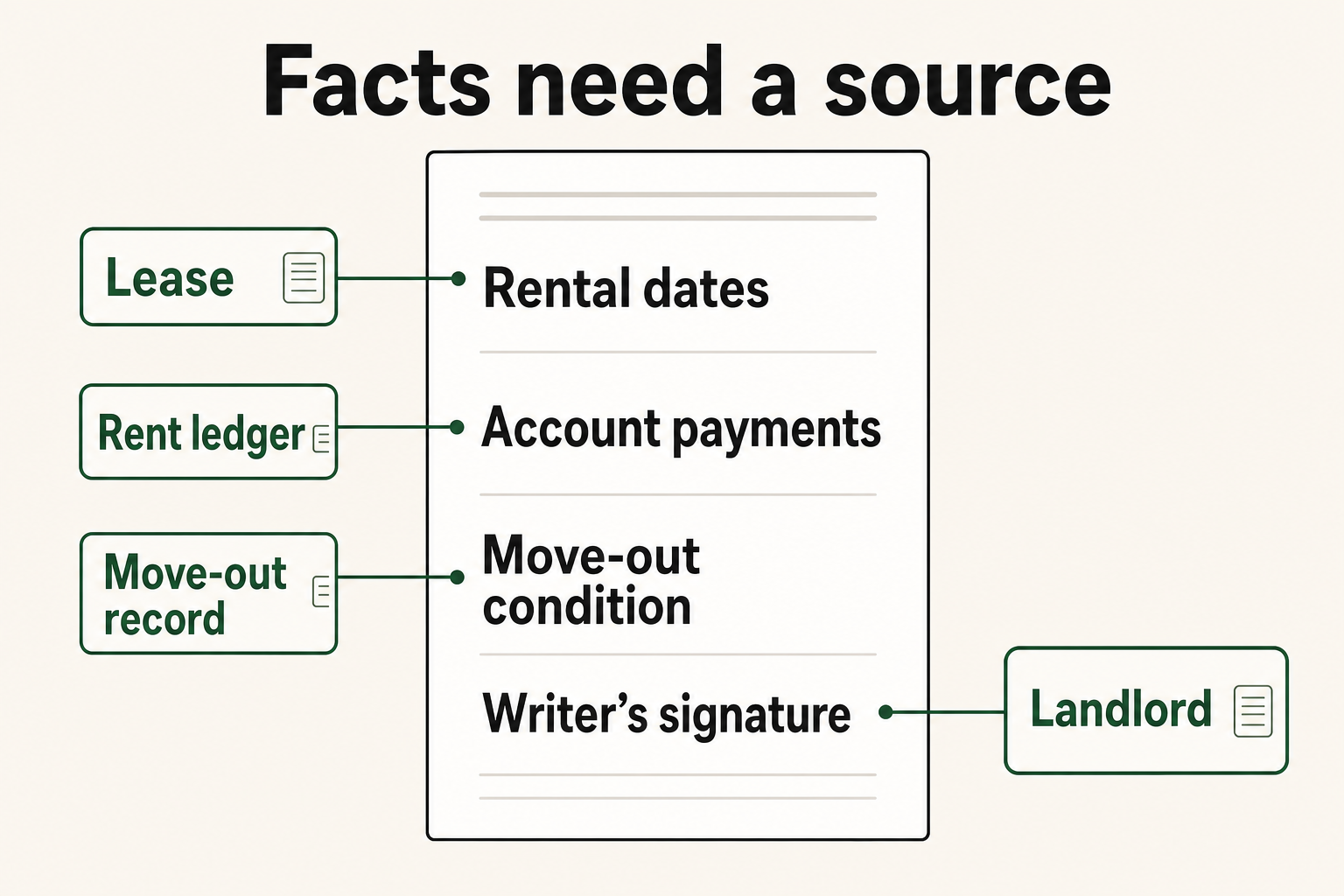
Specific facts make the letter easier to understand. For example, “The rental ledger shows all monthly rent payments were received by the due date from September 2024 through August 2026” identifies both the evidence and the period covered.
“Always paid on time” is too broad if the writer only has records for the last six months. A payment summary should accurately include any late payments within the period it describes. If a balance was later paid, the letter can give the payment date and the balance remaining as of a stated date.
Condition claims need the same care. A landlord who has completed a move-out inspection can describe its findings. A landlord writing while you still live there should not certify how you left the apartment.
On a shared lease, the landlord’s records may show payments to the household’s rental account. They may not show who contributed each dollar or whether you reimbursed a roommate on time. The letter should describe the account record without claiming knowledge of private roommate payments.
Keep personal information out of the letter
A rental reference does not need your Social Security number, bank account details, medical information, or explanations about your family. Keep it focused on the tenancy.
Ask before sharing the writer’s name and contact details with a prospective property. Let them choose a work email or office phone if they prefer. Also get their agreement before forwarding a letter to additional properties.
How to ask your current or previous landlord
Start with the person or office that actually managed your tenancy. If your building changed management, explain the dates you rented and ask which office holds the relevant records. A new manager should only speak to the records or experience available to them.
Ask early enough to leave room for a response and corrections. A requested deadline is helpful; a demand for a same-day signature usually is not. If the property has supplied a form, send that rather than asking for an extra letter.
A useful request includes:
- Your name, rental address, unit, and rental dates.
- The receiving property’s name and the format it requests.
- The requested deadline and submission route.
- A question about whether the writer is comfortable providing a factual reference.
- An offer to send a short draft for them to edit, if they would find that helpful.
A request message you can copy
Subject: Rental reference request for [your name], [previous address/unit]
Hi [name],
I rented [address/unit] from [start date] to [end date, or present]. I’m applying for another rental, and [property name] has requested [a signed reference letter/the attached form] by [date].
Would you be comfortable providing a brief factual reference about my tenancy? Please let me know which details you can confirm and which contact information you are comfortable sharing with that property.
If useful, I can send a short draft for you to review and correct. The final wording and signature would be yours. The requested submission route is [email/portal/direct reply to the property].
Thank you,
[Your name]
If you hear nothing, a brief follow-up can repeat the deadline and ask whether a dates-only confirmation or the property’s form would be easier. Meanwhile, tell the prospective property that you are waiting and ask about its alternatives. You do not have to turn every unanswered email into a second job.
Landlord recommendation letter template
This optional template is a starting point for your landlord, not a completed reference. Ask whether they want a draft first. They should review every statement, correct the facts, remove anything they cannot support, and sign only the final version they agree with. Never send a renter-prepared draft as though the landlord has already written or approved it.
[Date]
Re: Rental reference for [renter’s full name]
Dear [recipient name or leasing office],
I am [writer’s name], the [landlord/authorized property manager] for [rental address and unit]. [Renter’s name] rented this home from [start date] to [end date, or “present”].
According to [the rental ledger/other relevant records], [accurate payment summary for a stated period, including any late payments within that period].
[Optional: One or two additional facts I can support from records or direct experience, such as documented move-out condition or the date notice was received.]
[Optional: My recommendation, in my own words, if I wish to give one.]
I can be contacted about this reference at [email or phone I agree to share].
Sincerely,
[Writer’s signature]
[Writer’s printed name and role]
The optional recommendation is the landlord’s choice. A neutral confirmation should not be rewritten into an enthusiastic endorsement. For an ongoing tenancy, the letter can describe history through a stated date without pretending a move-out has happened.
If the reference is weak or unavailable
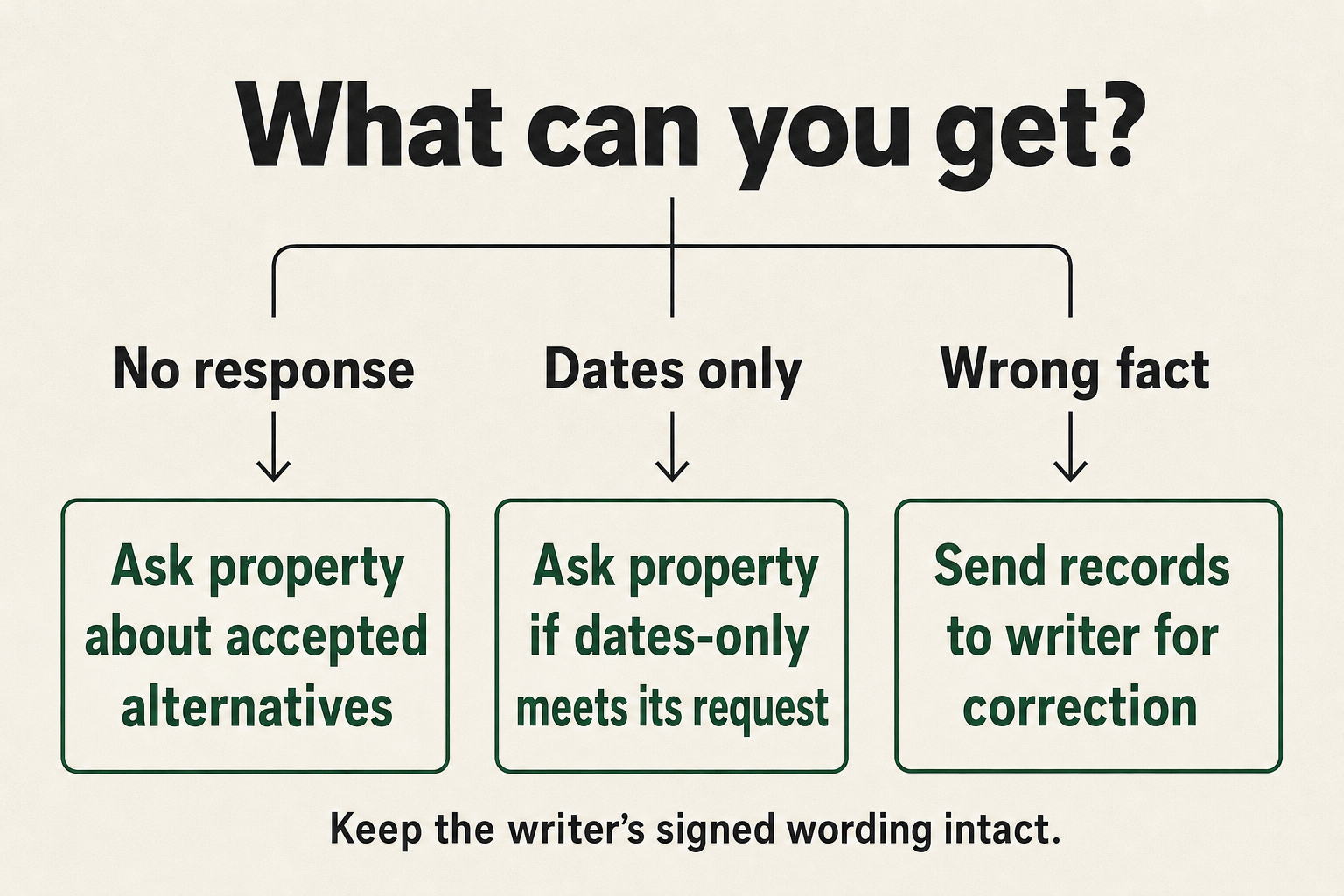
First separate three situations: the writer cannot respond, the writer can confirm only limited facts, or there is a real disagreement about the history. Each calls for a different conversation.
Your landlord does not respond or declines
Tell the prospective property plainly that the reference is unavailable. Ask whether it accepts a lease and payment records, a rent ledger, a different former landlord, or another genuine reference.
Match the proposed document to the missing information. A lease documents the rental agreement and its dates. A ledger records charges, payments, and balances. Receipts or bank-transfer records show particular payments, though they may not identify the rent period or due date. None of those, by itself, describes how you cared for the apartment.
An employer or personal reference serves a different purpose too. It should identify the writer’s true relationship to you and stay within what they know. It is not a previous-landlord reference just because someone changes the heading.
If you have never rented, have lived with family, or have owned your home, explain the actual arrangement. Our no-rental-history guide covers that broader situation. Any alternative depends on what this particular property accepts.
Your landlord offers only dates or a form
A limited response is not automatically a negative reference. Ask the receiving property whether a tenancy-date confirmation or a directly completed form meets its request.
For example:
My former management office provides rental dates only. Would you accept that confirmation with [the lease/rent ledger], or would you like to send the office your own form?
Keep the limitation visible. Do not add payment or condition claims under the writer’s signature.
The reference contains an error or a genuine past issue
For an incorrect date, payment, or balance, send the writer the relevant record and ask for a corrected letter. The writer should issue and sign the replacement. Do not edit their signed document yourself.
If a late payment or other issue really happened, keep your own explanation short: what occurred, when, how it was resolved, and which records document the resolution. Avoid asking the writer to describe an imperfect record as spotless.
If the disagreement involves disputed charges, retaliation, or potentially discriminatory treatment, local tenant legal aid can help with the specific facts and laws. A letter template cannot settle that dispute.
A landlord letter is different from a screening report
A direct reference letter and a third-party tenant-screening report are different documents. However, a report from a reference-checking service that contacts former landlords can be a consumer report covered by the Fair Credit Reporting Act, as the FTC’s consumer-report guidance explains.
The Consumer Financial Protection Bureau explains how to dispute inaccurate rental information with the reporting company. Our guide to rental history reports walks through that process. Asking a former landlord to revise a personal letter is a different task.
Keep the reference factual and the search moving
The useful reference is the one your landlord can stand behind: clear dates, accurate facts, a real writer, and contact details shared with permission. Keep their signed version intact and use the receiving property’s requested submission route.
While you arrange that paperwork, we can handle the listing search, calls, and tour scheduling. Start your rental search with Fairway, free for renters.