Renter guide
Living Near a Highway: Is the Rental Worth the Trade-Off?
Living near a highway? Weigh noise, air pollution, rent savings, and the exact unit before signing. Renter guidance from Fairway, your AI agent for renters.
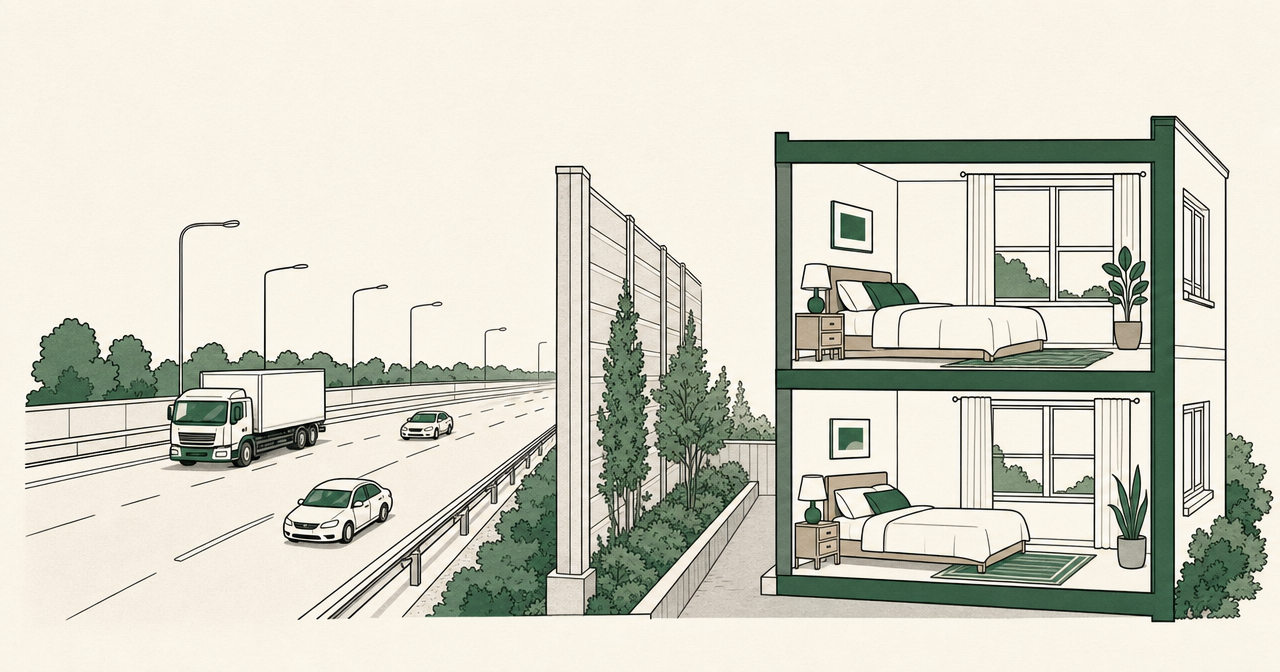
The apartment has the right price, enough space, and a highway just beyond the windows. Listing photos make the first two easy to appreciate. They tell you very little about the third.
For renters, the hard part is deciding which compromises you can live with and which ones you cannot fix after signing. A useful comparison includes the road, the exact apartment, your daily routine, and the costs hiding behind a cheaper rent.
Is living near a highway worth it?
It can be, when the apartment gives you a meaningful benefit and its drawbacks fit your limits. Easier highway access may shorten a driving commute. A lower-priced unit may leave room in your budget. Neither benefit comes automatically with a highway-facing address.
We would separate the decision into three questions: Does the location actually improve your week? Can you sleep and live comfortably in this unit? How much traffic-pollution exposure could you avoid by choosing another place?
Getting those answers often means more calls and a second viewing, work renters are usually left to handle alone. Our AI agent for renters is free for renters in the metros we cover: describe what you want, and we find matches, call landlords or leasing offices, and book tours. You still make the judgment about the home and surroundings.
| Possible benefit | The trade-off to weigh |
|---|---|
| A shorter drive to work | The nearest entrance may serve the wrong direction, and congestion can erase the advantage. |
| Lower rent or more space | Extra cooling, filtration, parking, or toll costs can shrink the savings. |
| Easy regional travel | The route to groceries, transit, or a dog-walking spot may be less convenient on foot. |
| An appealing building within budget | Your bedroom, balcony, and windows may face very different conditions from the model unit. |
You are choosing a place to live for the lease term. Resale value and investment potential do not belong at the center of that decision.
Noise and air pollution deserve separate answers
A quiet apartment can still be close to traffic pollution. Getting comfortable with the sound does not establish that the air is clean.
Noise affects more than the balcony
Steady road noise, individual trucks, motorcycles, and braking can feel very different inside a bedroom. Your work schedule matters, too. Someone sleeping during the morning commute has a different problem from someone who is away all day.
Traffic noise can affect sleep, as documented in a systematic review of sleep used for World Health Organization guidance. “You will get used to it” is too thin a basis for a year-long commitment.
During a viewing, a quiet pause in the bedroom is more useful than conversation in the kitchen. Listen with the windows closed and, with permission, briefly open. Notice individual interruptions as well as the background sound. A follow-up visit around your normal bedtime or daytime sleep hours can reveal a different version of the location.
Pollution is harder to judge on a tour
Traffic-related air pollution comes from exhaust, brake and tire wear, and road dust. Research associates living near major roads with asthma, reduced lung function, and cardiovascular disease, among other health effects. Children, older adults, and people with existing heart or lung disease can be more vulnerable, according to the U.S. Environmental Protection Agency (EPA).
A pleasant smell, clean windowsill, or quiet room cannot establish low exposure. A tour can tell you about comfort and building features. It cannot give you a personal health-risk forecast.
If your household includes someone with asthma or another condition affected by air pollution, give distance from heavy traffic more weight when comparing otherwise workable homes. A larger kitchen does not resolve that concern.
How far from a highway is far enough?
There is no universal distance that makes a rental safe. Pollution generally decreases with distance, but traffic volume, truck traffic, wind, terrain, and surrounding buildings change the pattern. Conditions also vary by time of day. The EPA's roadway guidance explains why a single distance cannot describe every location.
The often-quoted 500-foot guideline comes from California land-use guidance. The California Air Resources Board recommended avoiding new sensitive uses, including housing, within 500 feet of freeways, urban roads carrying 100,000 vehicles a day, or rural roads carrying 50,000. Its roadway exposure guidance describes this as a planning recommendation. It is not a health guarantee beyond 500 feet or a universal ban on existing rentals inside that distance.
For an apartment search, distance works best as a comparison tool:
- Record the approximate straight-line distance from the unit's part of the building to the nearest traffic lanes. A walking route to the highway entrance answers a different question.
- Include ramps, frontage roads, and other busy streets in the picture. Moving away from one road may put the bedroom beside another.
- Favor more separation when the other important parts of the rental are comparable. Avoid treating 501 feet as categorically different from 499.
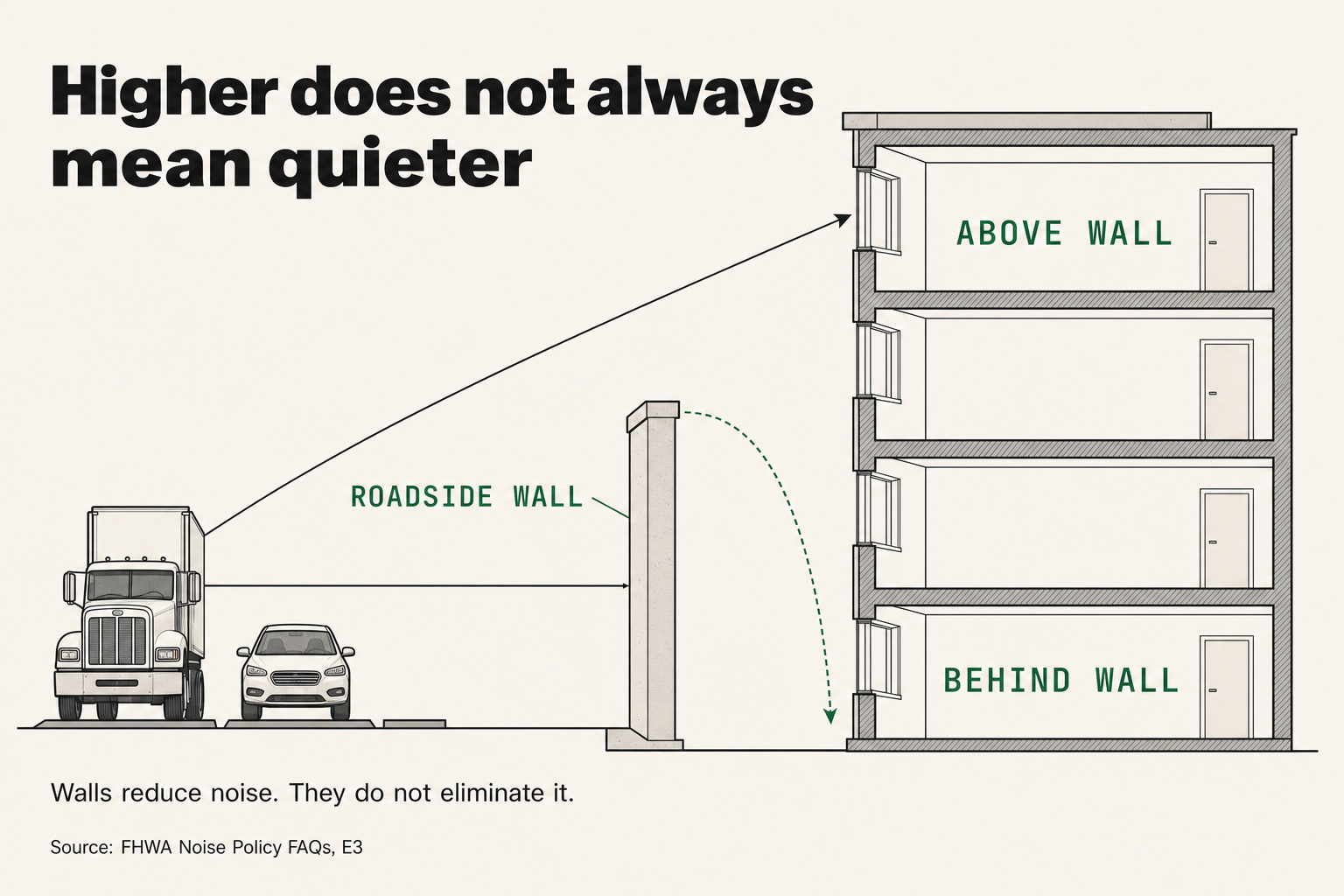
A higher floor is not automatically the better choice. For noise, an upper-floor unit can lose the shielding that a roadside wall provides below. The Federal Highway Administration (FHWA) explains that barriers often cannot provide the same protection to upper floors. Floor number alone also cannot establish indoor air quality.
The exact apartment matters more than the leasing lobby
Two apartments in the same building can put your bed on opposite sides of the property. That makes the unit number, room layout, and window direction important before you spend money applying.
A highway-adjacent viewing is worth slowing down for five details:
- Where you would sleep. Locate the bedroom relative to traffic lanes, ramps, garage entrances, and any sound wall. Include a roommate's room or a child's room in the comparison.
- How the windows close. Notice damaged seals, gaps, loose frames, and rattling. Ask which repairs will be completed before move-in.
- How cooling and ventilation work. Ask whether you control cooling year-round, how outdoor air enters, and what filtration serves the unit. Air conditioning and filtered outdoor ventilation are different functions.
- Which outdoor space you would use. Spend a little time on the actual balcony, patio, or shared courtyard. Outdoor square footage has less value to you if you would avoid sitting there.
- How you would leave home. Walk the route to your parking space, transit stop, or usual errands. Notice crossings, sidewalks, ramp traffic, and the entrance you would use after dark.
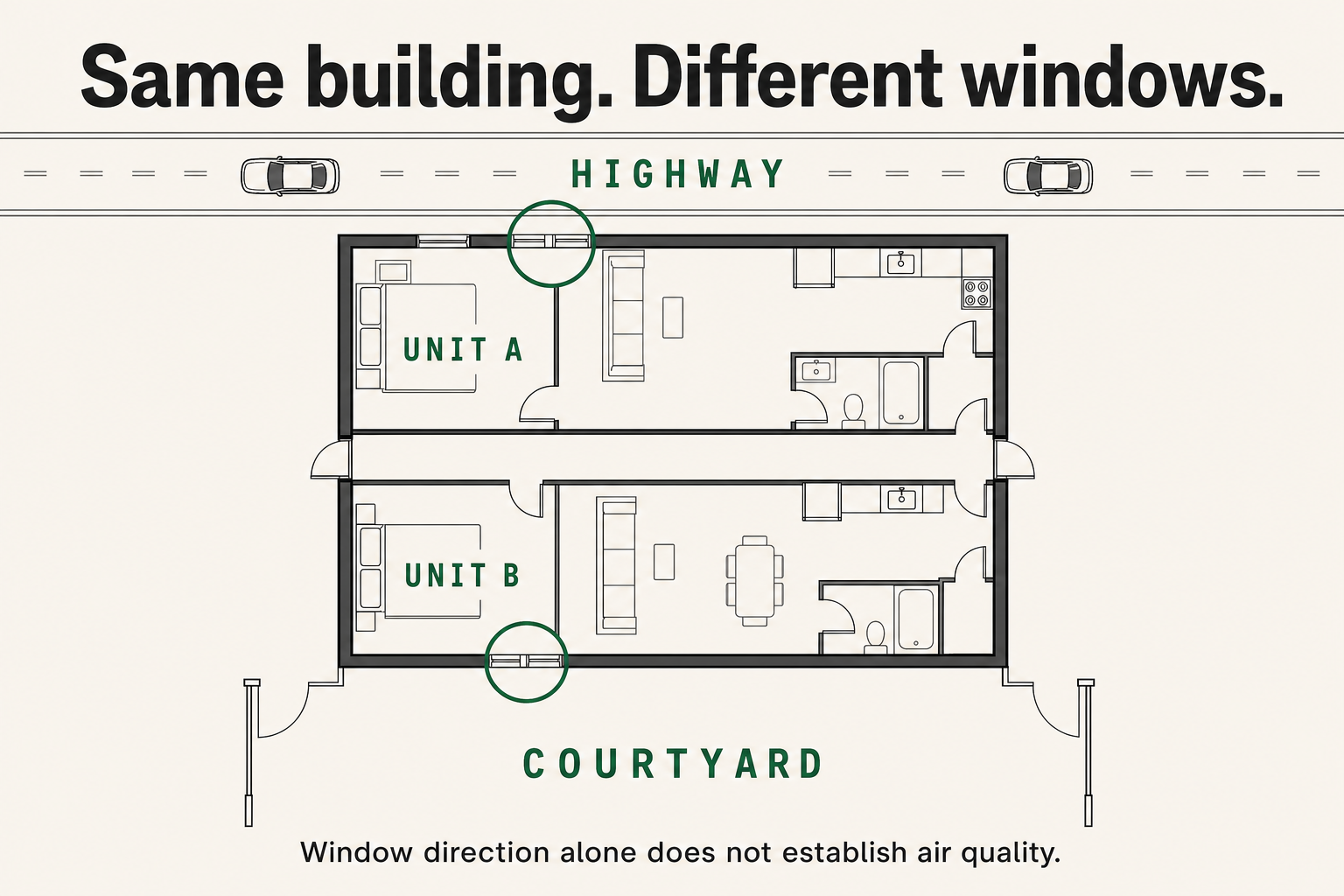
A courtyard-facing bedroom may be preferable for sound, but it is not proof of cleaner air. A wall or landscaped buffer can help under the right conditions. The EPA finds that properly designed roadside barriers can reduce downwind pollution. Their presence alone does not establish the exposure at your window.
For the rest of the viewing, our apartment viewing questions cover unit condition, maintenance, fees, and lease terms.
Questions worth sending before the tour
A specific message gives the leasing office something useful to answer:
I'm interested in Unit 312. Which direction do the bedroom windows face, and can I view that exact apartment? What cooling, outdoor-air ventilation, and filtration serve the unit? Who replaces the filters, and how often? Are any window repairs scheduled before move-in? Is a unit farther from the highway available within the same budget?
“Soundproof windows” and “premium air filtration” are descriptions. The window details, system specifications, maintenance schedule, and exact unit location are the facts you need for a comparison.
Separate renter fixes from building-level problems
Before accepting a drawback, sort it by who can change it. This keeps a manageable purchase from turning into an imaginary renovation plan.
| Who controls it? | Examples | What that means for your decision |
|---|---|---|
| You, within the lease rules | A portable air cleaner, furniture placement, washable window coverings | Include the cost and the space it needs. These measures have limits. |
| The landlord or building | Window repairs, installed ventilation, compatible central filters, major alterations | Get agreed work, responsibility, and completion dates in writing before signing. |
| Neither of you individually | Highway location, traffic volume, truck routes, prevailing wind | Treat these as existing conditions rather than promised improvements. |
Filtration can help, with limits
A portable high-efficiency particulate air (HEPA) cleaner can reduce airborne particles. Choose sufficient clean air delivery rate for the room, with a sound level you can live with at the speed you will use. Replacement filters and electricity belong in the budget.
HEPA filtration does not remove gases. Gas removal requires suitable media, such as enough activated carbon, and no household cleaner removes every pollutant. For central heating and cooling, the EPA recommends a filter with a Minimum Efficiency Reporting Value (MERV) of 13, or the highest efficiency the system can accommodate. Have the landlord arrange any system-dependent upgrade rather than assuming a denser filter will fit and work properly. Avoid devices that intentionally produce ozone. These limits are covered in the EPA's air-cleaner guide.
Filtration supplements source reduction and ventilation with clean air. It does not turn a highway-adjacent home into an exposure-free one.
Closed windows need a workable cooling plan
Closing windows can reduce road noise, but a home that relies on open windows for cooling creates a competing need. Transport noise guidance explains why mechanical ventilation and sometimes cooling are needed when windows must stay shut for acceptable indoor sound.
Ask what already works in the unit. A portable air conditioner that needs permission, an unpriced window replacement, or a future building upgrade should not count as an existing feature.
Calculate what the cheaper rent actually saves
There is no standard highway discount that makes the trade-off worthwhile. Compare actual available apartments with similar size, lease terms, condition, and required fees. A highway-facing unit may not be cheaper at all.
Here is a hypothetical comparison. The added expenses are sample budget allowances, not market averages or air-cleaner price estimates.
| Monthly comparison | Near-highway apartment | Farther-from-highway apartment |
|---|---|---|
| Rent and required property fees | $1,850 | $2,000 |
| Utilities and filtration allowance | $170 | $120 |
| Parking and commute costs | $180 | $130 |
| Total for these categories | $2,200 | $2,250 |
The advertised housing difference is $150 a month. After these expenses, it is $50 a month, or $600 over a 12-month lease. Initial equipment purchases would reduce that first-year difference further. Our apartment budgeting guide helps account for the remaining monthly and move-in costs.
Keep time separate from dollars. Saving 10 minutes each way on 20 commuting days returns about 6 hours and 40 minutes a month. That can matter. Being close to the highway only earns that credit when the actual route and schedule deliver it.
No budget calculation establishes that a health concern is acceptable. It tells you what financial benefit you would receive for taking on the location's other drawbacks.
Choose a unit that works without a rescue plan
A near-highway rental deserves consideration when its commute or cost advantage is real, the bedroom works for your sleep schedule, and the existing cooling and ventilation arrangements fit daily life. More distance deserves priority when traffic exposure is a major household concern or comparable apartments offer it without breaking your budget.
We would keep looking if the decision depends on ignoring noise, never using an outdoor space you are paying for, or assuming the landlord will make major changes later. A future sound wall is not a feature of today's apartment.
If the options are limited, the choice is not a personal failure. A different unit in the same property, a smaller apartment farther from heavy traffic, or a wider neighborhood search may offer a more workable compromise.
Tell us what you need from your next rental, including your commute, budget, and highway concerns. We can find matches, call properties with your questions, and book tours so you have concrete alternatives to compare.