Renter guide
Locked out of your apartment? A safe way back in
Locked out of your apartment? Follow a safe order for spare keys, maintenance and locksmiths, handle fees, and recognize emergencies or a landlord lockout.
The door closes, your keys are inside, and the office may already be shut. Getting home should not mean risking an injury or agreeing to an unexplained bill. The next step depends on whether someone is in danger, which door is locked, and who has authorized access. Start with safety, then work through the options that can get you inside without creating another problem.
1. Put safety ahead of the lock
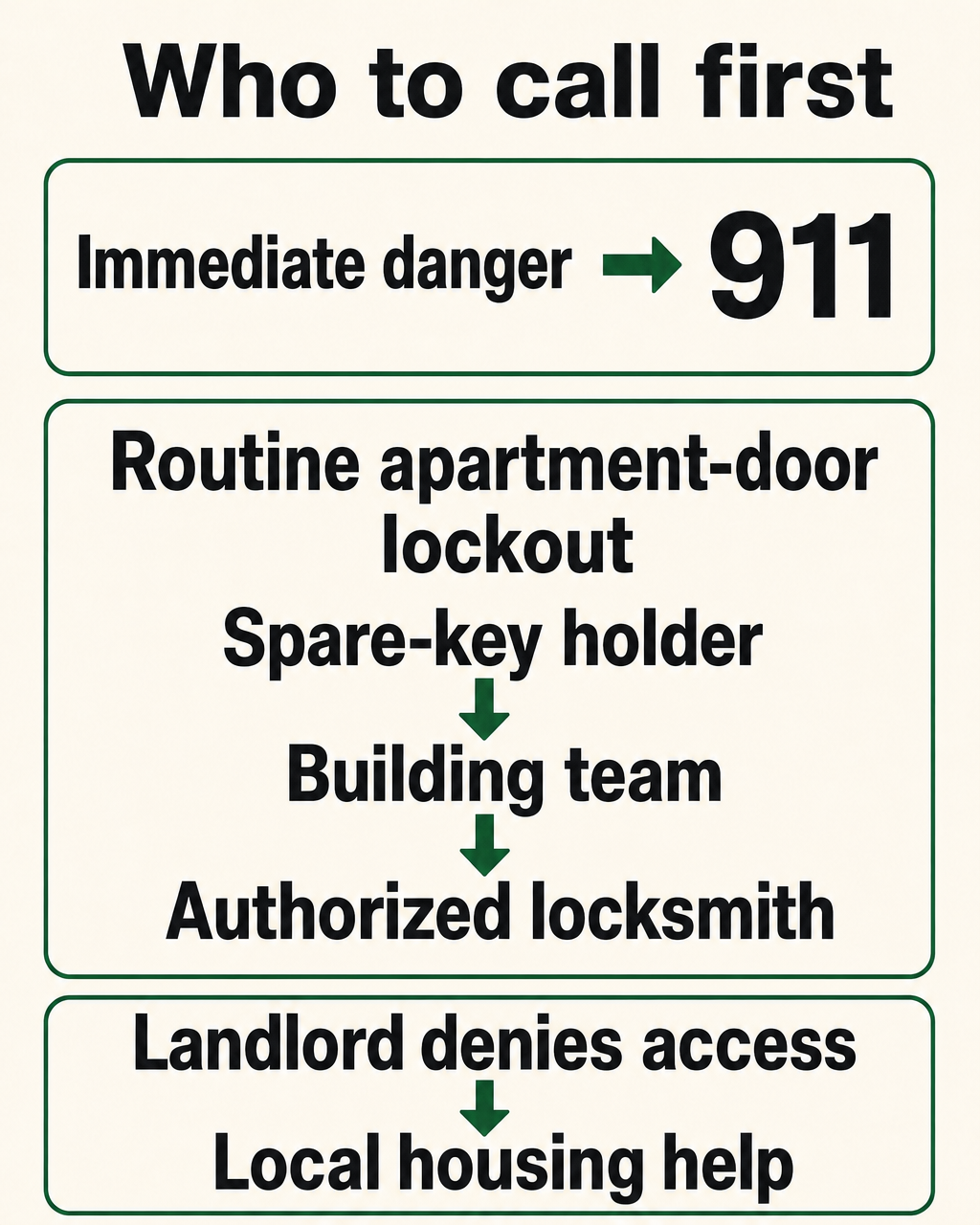
In the U.S., call 911 now if someone is in immediate danger. Do not wait for maintenance or a locksmith. That includes:
- A baby or young child locked inside alone, or a vulnerable person inside who needs immediate help and cannot open the door.
- A medical emergency, including trouble breathing, unconsciousness, or an immediate health threat because essential medication or medical equipment is inaccessible.
- Smoke, fire, or another immediate hazard inside the apartment.
Give the dispatcher your street address, building and apartment number, callback number, and the specific danger. Follow their instructions and stay on the line until told to hang up. These are the details the National 911 Program asks callers to provide.
If there is fire or smoke, move to safety. Do not enter to retrieve belongings. Tell firefighters where anyone is trapped. The Texas State Fire Marshal specifically advises against going back inside for pets; tell firefighters if a pet is trapped.
A pet waiting safely indoors does not automatically make a routine lockout a 911 emergency. If your pet is in distress or dangerous heat, seek urgent help from local animal control while arranging immediate access with management. For veterinary guidance, call your veterinarian or an emergency animal hospital, the contacts the FDA recommends for pets. Fire still means calling 911.
If medication is inside but you are not experiencing an emergency, call your pharmacist or prescribing clinician for advice while arranging access. Do not guess how long you can safely miss a dose.
If management deliberately changed the locks or disabled your access to make you leave, seek local housing help promptly. That is a different problem from forgetting your keys.
The routine call order summarized here applies to an accidental apartment-door lockout. A locked building entrance or gate, a disabled building fob, or a lockout at both doors follows the management-first route in the access-point table below. This summary does not replace those access-specific steps.
2. Try an authorized spare or normal access method
If everyone is safe, look once through your pockets, bag, and anything you are carrying. For a routine apartment-door lockout, contact a roommate, partner, or trusted person who already has an authorized spare. Ask how soon they can reach you.
Use only an ordinary access route you have permission to use. That might be your own accessible, unlocked exterior door or a working entry method already assigned to you, such as your normal smart-lock app. Skip windows, balconies, fire escapes, and any route that requires climbing or tampering. Do not force the door or attempt to bypass the lock.
Be specific about where you are stuck:
| Locked access point | Who to contact |
|---|---|
| Building entrance, gate, garage, or disabled building fob | Management or the building's concierge/security team first for authorized resident access or a replacement credential |
| Your apartment door | Roommate or spare-key holder, then management or an authorized locksmith |
| Both building and apartment doors | Management first so the person helping can reach the unit lawfully |
A locksmith opening your apartment door will not necessarily restore a disabled building fob. Do not borrow another resident's credentials or slip through a secured entrance behind someone.
3. Call the leasing office or after-hours maintenance
During office hours, call or visit the leasing office, property manager, or landlord. After hours, use the maintenance number in your resident portal, move-in information, lease, or posted building notice. The office voicemail may also give the after-hours route.
Ask whether they provide lockout assistance, how long it will take, what identification they accept, and the full charge. Some buildings provide after-hours access; others direct renters to an approved locksmith. An emergency maintenance line is separate from 911 and does not guarantee a lockout response.
A short message can cover the important details:
Hi, I'm [name], a resident at [address, building, unit]. I'm locked out of [the building/the apartment/both]. My keys are [inside/lost], and [there is no immediate danger/specific safety concern]. Can someone provide access? Please tell me the arrival time, total fee, and identification needed. If you cannot attend, which locksmith is authorized, and is any lock work permitted? My callback number is [number].
If your phone is inside, ask a staffed front desk, trusted neighbor, or nearby open business to help you make the call. Wait somewhere safe and sheltered. Tell the person responding where to meet you, and keep your phone available if you have it.
If nobody answers, leave a message and send a written request through the usual resident channel. When it is safe, a trusted friend's home or another sheltered place may be more practical than waiting outside indefinitely. Keep a record of each attempt before arranging outside help.
4. Agree on locksmith identity, access, and price before work
Use management's approved provider when one is available. Tell the locksmith this is a rental and explain whether you need building access, unit access, or both. Get management's approval in writing for work that alters or replaces the lock. A successful unlock and permission to install different hardware are separate things.
Before dispatch, ask for:
- The business's full name, address, and callback number.
- The technician's name and license or registration details where local rules require them.
- An arrival window and any cancellation or callout fee.
- A written estimate covering the service visit, labor, after-hours charges, and possible additional work.
- The identification and proof of occupancy they will accept from you.
An advertised starting price does not tell you the full bill. Connecticut's consumer protection agency describes locksmith bait-and-switch scams in which the price jumps on arrival, followed by pressure to pay. It recommends an upfront total and a written quote before work starts.
When the technician arrives, ask for identification matching the business and person you booked. Ask them to explain any price change before authorizing work. Decline work you have not agreed to, including a replacement lock that management has not authorized. Pressure, unexplained charges, or refusal to identify the business are reasons to stop.
What if your ID is locked inside?
Tell the dispatcher before anyone travels. Ask what alternative proof they accept, such as a lease in your email, access to your resident account, or direct confirmation from management. If your ID has an old address, say so too. The provider decides what documentation is sufficient; a digital lease alone is not a guaranteed substitute.
Expect to establish your right to enter. Maryland's locksmith consumer advisory explicitly tells customers to provide identification confirming that right. A legitimate access process protects your home as well as the other residents.
5. Separate the unlock charge from replacement costs
There is no single apartment lockout price. A staff unlock, a private after-hours call, a replacement key, and a new building fob are different services. Ask for the complete price for your situation before someone is sent.
A useful estimate separates these items:
| Charge | What the written estimate should say |
|---|---|
| Dispatch or travel | What you owe for attendance, even if no work happens |
| Unlocking labor | The agreed service and price, or how an estimate may change |
| Evening, weekend, or holiday service | Whether the surcharge is already included |
| Replacement key or fob | Each credential's cost, separate from opening the door |
| Lock repair or replacement | Proposed work, hardware cost, and management authorization |
| Taxes and other fees | The full expected total and accepted payment method |
For illustration, a $40 service visit, $90 unlocking charge, and $50 after-hours surcharge total $180 before tax. Those are example numbers, not a market quote. A $40 advertisement alone would not describe that bill.
Do not assume management will reimburse a locksmith you hire. Ask who is paying and get any reimbursement commitment in writing. If your working key stopped opening the door or an assigned credential failed, describe that as an access or repair problem rather than accepting that you lost your keys.
Keep the estimate, authorization, messages, payment receipt, and an itemized invoice showing the business, service address, work performed, and total. Photograph any existing damage and the finished work. Maryland's consumer advisory also calls for an itemized invoice that records the quoted and paid amounts.
For a disputed building charge, request the lease provision or written policy supporting it. For a locksmith dispute, send the company the estimate, invoice, and a concise explanation of the difference. If unresolved, contact the relevant state consumer protection agency or locksmith regulator. Do not deduct disputed costs from rent without local legal advice.
If your landlord changed the locks, take a different route
A forgotten key is an accidental lockout. A landlord deliberately changing locks, withholding a replacement key, or disabling access to make you leave raises a housing-rights issue. A nonworking key alone does not prove that happened, so ask management what changed and request restored access in writing.
The legal rules depend on location. In California, landlords cannot change locks to force a renter out; eviction requires a court process and enforcement by the sheriff or marshal. The California Department of Justice identifies these self-help evictions as unlawful.
Texas treats some temporary lock changes differently. Certain temporary lock changes for unpaid rent are allowed only under specific conditions. The landlord must provide a new key on request even if the overdue rent remains unpaid. The Texas State Law Library explains that this is not a substitute for eviction.
If you suspect a landlord lockout:
- Save photos of the door, notices, and any changed hardware or access-error message.
- Keep your lease, rent receipts, messages, and proof that you live there accessible.
- Ask the landlord in writing to explain the exclusion and restore access. Save the response or lack of response.
- Contact a local tenant attorney, housing agency, or legal aid organization promptly. Ask about emergency reentry procedures and the appropriate local law-enforcement response.
- Keep receipts for necessary lodging, transport, and other expenses. Reimbursement or damages depend on the law and facts; they are not automatic.
Do not force entry or ask a locksmith to resolve a possession dispute. If you are threatened or someone is in immediate danger, call 911. Otherwise, use the local non-emergency channel for law-enforcement assistance.
Once you are inside, make the next lockout easier to solve
Report lost or stolen keys and fobs to management promptly so they can address the access risk. Arrange approved replacements, return any temporary key, and report a sticking lock or failed credential as a maintenance issue.
For a simple backup plan:
- Save the office, after-hours maintenance, and approved locksmith numbers in your phone and somewhere accessible without it.
- Arrange a permitted spare with a trusted person nearby. Do not leave a key under a mat or attach your address to it.
- Ask management about authorized backup access for an electronic lock or dead phone. Do not change rental hardware without permission.
- Keep a secure copy of your lease and management contact details available away from the apartment.
These belong alongside the practical setup tasks in our first apartment checklist. When you next tour a building, our apartment viewing questions can help you ask about keys, replacement fees, and emergency maintenance before you need them.
For now, make the next safe call: a spare-key holder for a routine apartment-door lockout, or management first for building-access problems. If someone is in immediate danger, call 911 first.