Renter guide
Should You Pay a Security Deposit Before Signing a Lease?
Security deposit before signing a lease? Learn payment order, holding-payment terms, receipts, and scam checks with Fairway, the AI agent for renters.
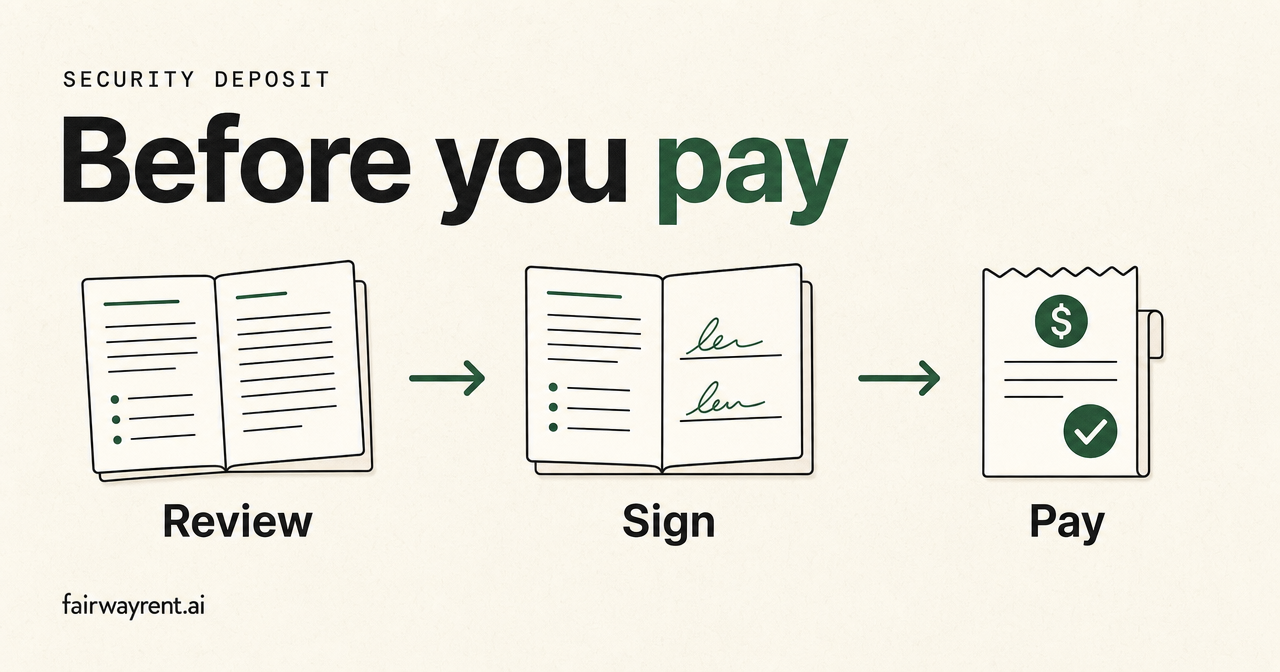
An approval email arrives, followed by a demand for a deposit. The lease is still nowhere in sight. You want the apartment, but you also want to know what happens to your money if the paperwork changes the deal.
For U.S. renters, the useful questions are what the payment covers, what you have agreed to, and who is collecting it. A clear payment sequence and written terms can keep an exciting approval from becoming an expensive guessing game.
Should you pay a security deposit before signing a lease?
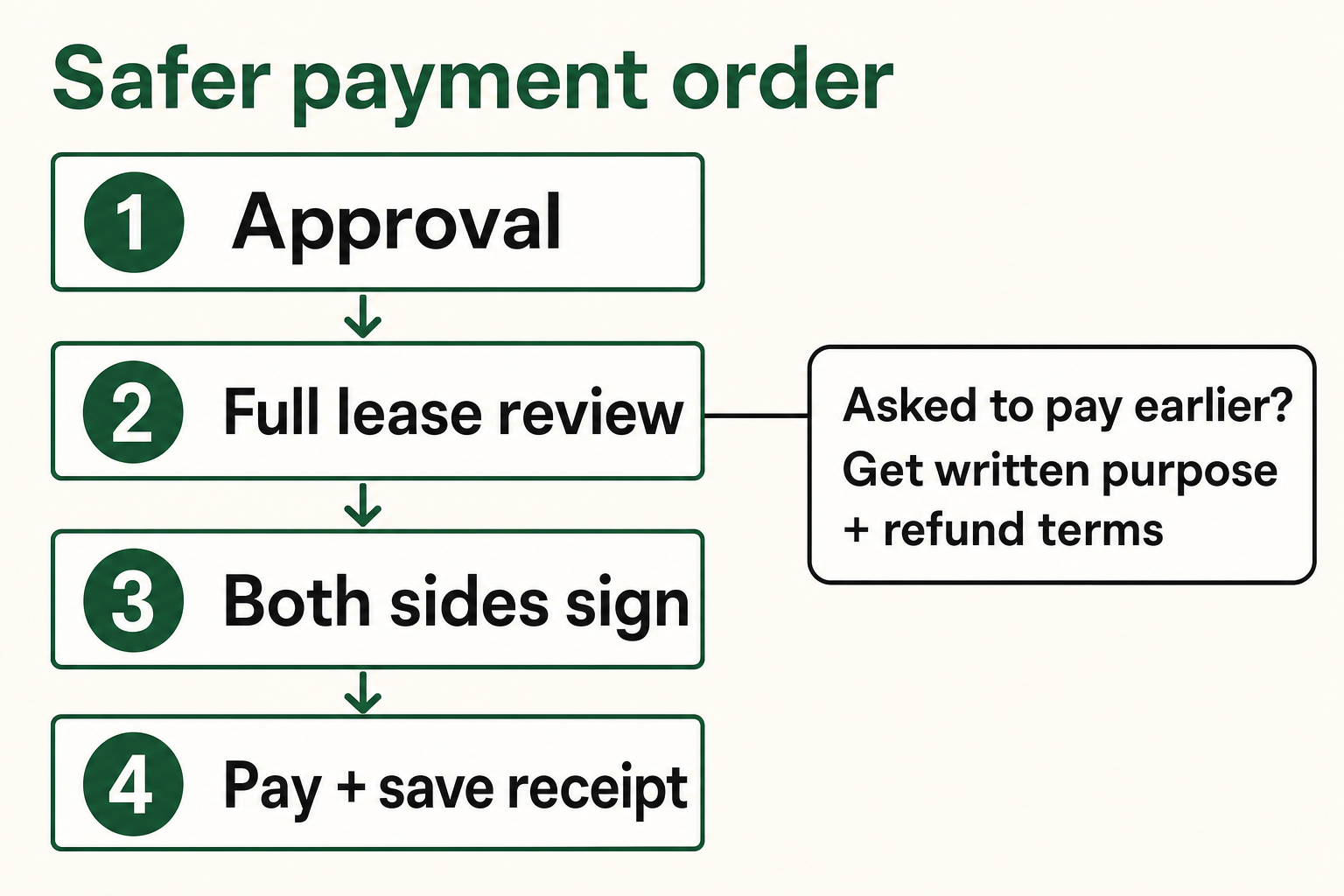
Our safer default is to get approved, review the full lease, have both sides sign, and then pay the security deposit by the agreed deadline. Signing and payment can happen in the same appointment. The goal is to know the deal before your money leaves your account.
That is a renter-safety recommendation, not a nationwide legal timing rule. Property procedures differ, and state or city law may require particular documents before collection. An early request alone does not prove a scam. A request to pay before you can read any terms deserves a pause.
If the landlord wants money earlier, ask whether it is a security deposit, a payment to hold the unit, or a separate fee. Get its purpose and refund conditions in writing. A pre-signing payment is not automatically a holding deposit just because of its timing.
If you are still searching, we can take some of the phone tag off your plate. Fairway is an AI agent for renters, free for renters. Tell us what you want; we find matches, call landlords or leasing offices, and book tours. You keep control of the lease and payment decisions.
Keep approval, signing, and payment in this order
Application approval is one milestone. It does not show you every lease term or resolve what happens if the apartment becomes unavailable.
1. Get the approval and remaining conditions in writing
Ask for the exact address and unit, proposed rent, lease term, move-in date, and any conditions still outstanding. A conditional approval that needs a guarantor or more documents leaves another step between you and the lease.
Keep the application fee separate from the security deposit. Our apartment rental requirements guide explains the documents and screening steps that may come first.
2. Read the complete lease before signing or paying
You need the lease and every addendum, not just a price quote or payment screen. Match the unit, rent, mandatory charges, lease dates, pets, occupants, concessions, and promised repairs to the deal you accepted.
For the deposit, look for the amount, due date, reasons money may be deducted, and return terms. Any earlier payment credited toward it should also appear in the move-in accounting.
If the lease changes the rent or substitutes a different unit, resolve that change before sending funds. Our apartment renting guide covers the broader lease review and move-in handoff.
3. Arrange signatures and payment together
Ask whether both sides can sign before you pay, or exchange signatures and payment in the same appointment. Save the fully signed lease, including addenda, rather than relying on continued access to an online portal.
An electronic status such as “submitted” may mean only that you signed. Ask when the landlord's signature and your completed copy will arrive. Do not assume a missing countersignature automatically means you have no obligations or can cancel without cost.
If a portal requires payment before it unlocks the lease, ask the verified leasing office for a readable copy and written payment terms outside that screen. A software workflow does not answer your refund questions.
4. Pay by the agreed deadline and save the record
The written schedule should distinguish the deadline to initiate payment from any requirement for cleared funds before keys. That matters when bank processing takes time.
Keep a receipt identifying the charge, plus the payment confirmation. Record the apartment's condition at move-in, with photos and a written condition form, so pre-existing damage has a record too.
A security deposit and a holding payment do different jobs
A security deposit secures obligations under the rental agreement, such as unpaid rent or damage covered by applicable law. A holding payment reserves an offered unit for a specified period. An application fee pays for application or screening work.
Those purposes matter more than a casual label in a text message. Ask for each charge as a separate line item.
| Requested payment | What the written terms should explain |
|---|---|
| Security deposit | Amount, due date, permissible deductions, return terms, and any required deposit-account information |
| Holding deposit or reservation payment | Exact unit, hold expiration, lease-signing deadline, refund or retention conditions, and whether it becomes rent or security |
| Application or administrative fee | What work or service it covers, when it is charged, and whether any part is refundable |
| First month's or prepaid rent | Which rental dates it pays for and when it is due |
Holding payments may be credited, returned, or retained depending on applicable law and the agreement. A promise that money is “refundable” is incomplete without the events that trigger a refund and the deadline for returning it.
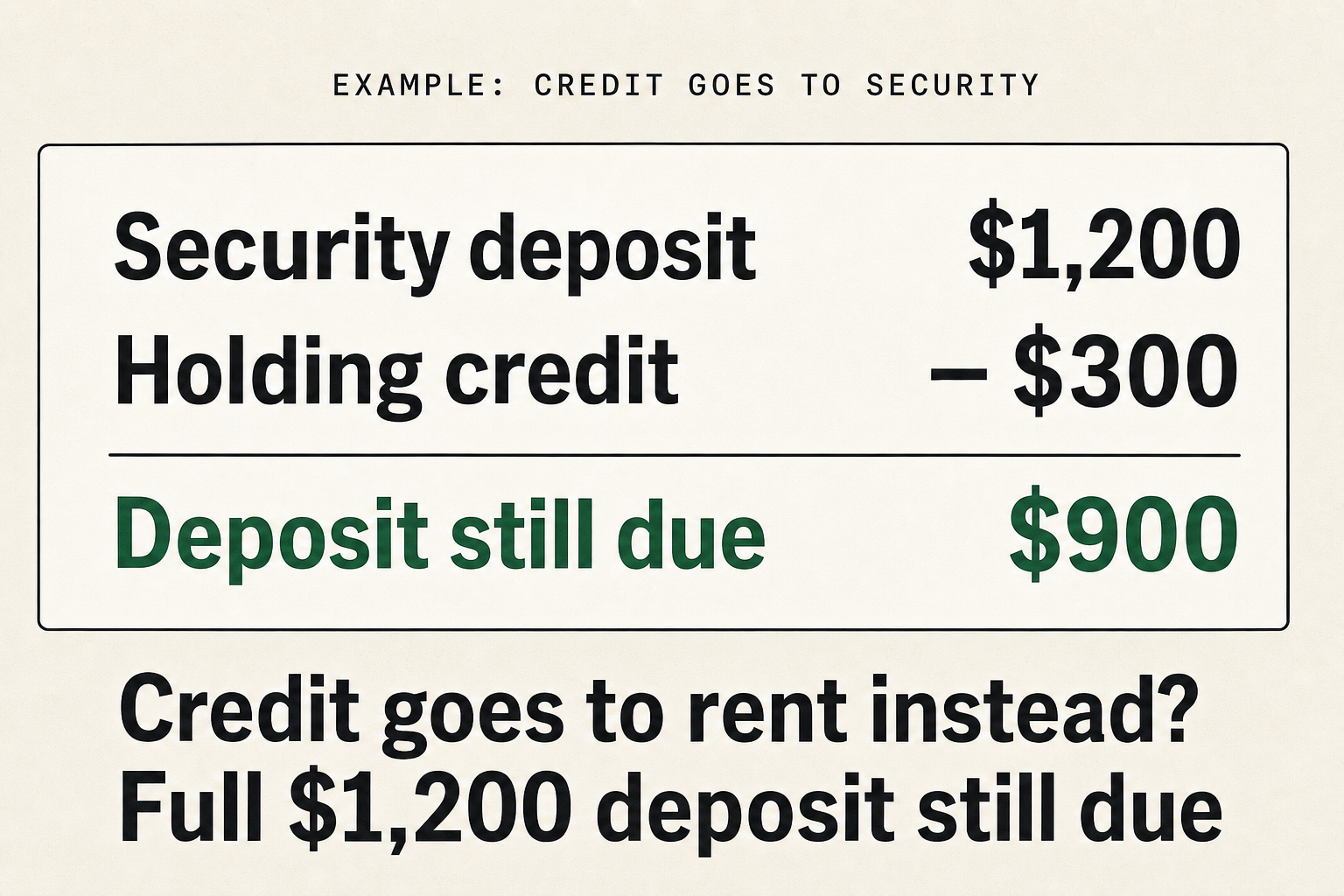
For example, suppose written terms apply a $300 holding payment to a $1,200 security deposit. The remaining deposit is $900. If the $300 goes toward rent instead, the full $1,200 deposit remains due. The move-in statement should show which balance received the credit.
Get answers for the deal that might fall through
Before an early payment, ask for a written agreement that names you, the owner or authorized management company, and the exact apartment. It should state:
- The amount and purpose of the payment.
- The payment deadline, recipient, and accepted method.
- When the full lease will be provided and signed.
- Whether the payment is credited to rent or security, and when.
- What happens if you are denied, you withdraw, or the landlord withdraws.
- What happens if the promised unit, rent, or move-in date changes.
- The refund amount, refund method, and return deadline for each applicable situation.
These are different outcomes. “You get it back if you are denied” does not answer what happens if you are approved but the lease adds a fee you cannot accept.
You can send a short message without turning the conversation into a confrontation:
I'm ready to move forward with Unit [number]. Before I send $[amount], please send the complete lease and written terms identifying this payment as security, a holding payment, or a fee. Please include when it is credited or refunded, what happens if either side does not proceed, and the refund deadline. Can we arrange signatures and payment together?
Written terms give you a record. They do not make an unlawful charge valid, and they do not make an unauthorized recipient legitimate.
Confirm the property and payee independently
Start with a phone number or website found independently of the listing or payment message. Contact the owner or management company through that channel. Ask them to confirm the exact unit, the person handling your lease, the payee, and the payment route.
For a private landlord, official city or county property records help establish ownership. A manager may collect for an owner, so a different name needs an explanation and confirmation of that authority.
See the apartment in person when possible, or have someone you trust visit. A live tour helps, but access alone is not proof: the Federal Trade Commission warns that scammers can exploit real self-guided-tour systems. Its rental scam guidance also flags conflicting listing contacts, pressure to pay, and unusually low prices.
Stop if someone refuses written terms, demands a payment before showing the home, or insists on gift cards, cryptocurrency, or a money-transfer wire. A sudden change to payment instructions deserves a fresh call through the established contact channel.
Use a payment method with a record, and understand its limits
A traceable payment helps document where money went. It does not guarantee recovery if the recipient is a scammer or a refund dispute develops.
The FTC's payment safety advice favors credit cards for rental-scam protection and warns about cash, wires, cryptocurrency, and payment apps. A landlord may not accept cards, and a card payment still does not guarantee a refund.
For a verified property's accepted methods:
- Official payment portal: Use the route confirmed by the leasing office. Save the charge breakdown, confirmation number, processing fee, and receipt.
- Check, cashier's check, or money order: Make it payable to the confirmed recipient. Keep a copy or purchase record and get an acknowledgment identifying the deposit and unit.
- Bank payment through the property's portal: Keep the authorization and transaction record. Do not assume it has the same dispute protections as a credit card.
- Cash or person-to-person payment app: Ask for another accepted method. These can leave you with fewer practical recovery options; an app username alone does not establish who is authorized to collect.
Avoid switching to an unfamiliar recipient or off-portal payment because someone says it will “speed things up.”
A useful receipt identifies more than the total
Ask for a receipt that shows your name, the recipient, payment date, exact unit, amount, and purpose. If one payment covers several charges, the receipt or accompanying statement should allocate them separately.
A bank confirmation that says “$2,400 sent” proves less than a receipt showing “$1,200 security deposit and $1,200 first month's rent for Unit 4B.” Keep both. The written agreement explains the terms; the receipt records what was paid.
Save the listing, approval, lease, early-payment agreement, receipts, and messages together. Include the move-in statement showing any holding-payment credit. That makes a later missing-credit or refund question easier to explain.
State-law differences: three examples, not a national rule
The law where the apartment sits can change the documents required, the amount allowed, and the refund deadline. These examples show why a property's policy is only part of the answer.
Washington: deposit paperwork and holding-payment limits
Washington's security deposit requirements tie collection to a written rental agreement stating retention conditions and a written condition checklist provided at the start of the tenancy. The checklist must be signed and dated by both sides, with a copy provided to the renter. A signed lease alone does not replace that condition record.
A separate payment to hold an offered unit is capped at 25% of the first month's rent. The landlord must provide an immediate receipt and written retention conditions. If the renter occupies the unit, that payment must be credited to first month's rent or security under Washington's holding payment law.
Minnesota: a prelease deposit needs its own agreement
Minnesota defines a prelease deposit as a payment before the parties enter a rental agreement, excluding a reasonable screening fee. Its prelease deposit law requires a conspicuous written agreement stating refund circumstances and the seven-day return deadline after a refund-triggering event. Mailed returns must be postmarked within that period. If the parties enter a rental agreement, the payment must be applied to rent or security.
New York: the deposit cap and return rule have separate jobs
New York's rent-stabilized deposit law covers homes subject to the New York City Rent Stabilization Law or Emergency Tenant Protection Act. It caps deposits or advances at one month's rent and requires the landlord to provide an itemized statement of deductions and return the remaining deposit within 14 days after the renter vacates.
The separate residential deposit rules also set a 14-day deadline for homes covered by subdivision 1-a. That subdivision excludes rent-controlled homes and certain other housing types. Its one-month cap also has specific exceptions.
A move-out return deadline does not tell you when an unsigned-lease payment must be refunded. Early-payment terms and the applicable law address that separate situation.
For a charge or refund dispute elsewhere, USAGov's tenant-rights resources connect renters with state agencies and legal aid.
If you already paid before signing
Paying early does not automatically mean the money is lost. It also does not automatically entitle you to a full refund because no lease was signed.
If the property is legitimate, request the full lease, the payment agreement, and a receipt now. If you want to withdraw, send a written request identifying the amount, date, unit, and refund condition that applies. Ask the property to explain any proposed retention in writing. Local legal aid can help with disputed terms or a charge that appears unlawful.
If you suspect fraud, stop sending money. Contact the bank, card issuer, or payment service immediately, explain the scam, and request a reversal or refund. The FTC's scam recovery steps explain the route for each method. Recovery is not guaranteed. Preserve the messages and payment records, and report the listing to the site where it appeared and the FTC.
Keep control of the commitment
The cleanest arrangement puts the complete deal in front of you before payment: approval, lease review, signatures, and a documented deposit. If money must move earlier, its purpose, credit, and refund conditions deserve their own written terms.
Still looking for an apartment with fewer calls and less chasing? Start your search with Fairway, and let our free AI agent handle matches, property calls, and tour booking.