Phoenix vs. Scottsdale
Phoenix vs. Scottsdale: A Renter's Guide to Choosing
Compare Phoenix vs. Scottsdale rent, neighborhoods, commutes, transit, summer apartment costs, and daily life to choose the better fit for your move.
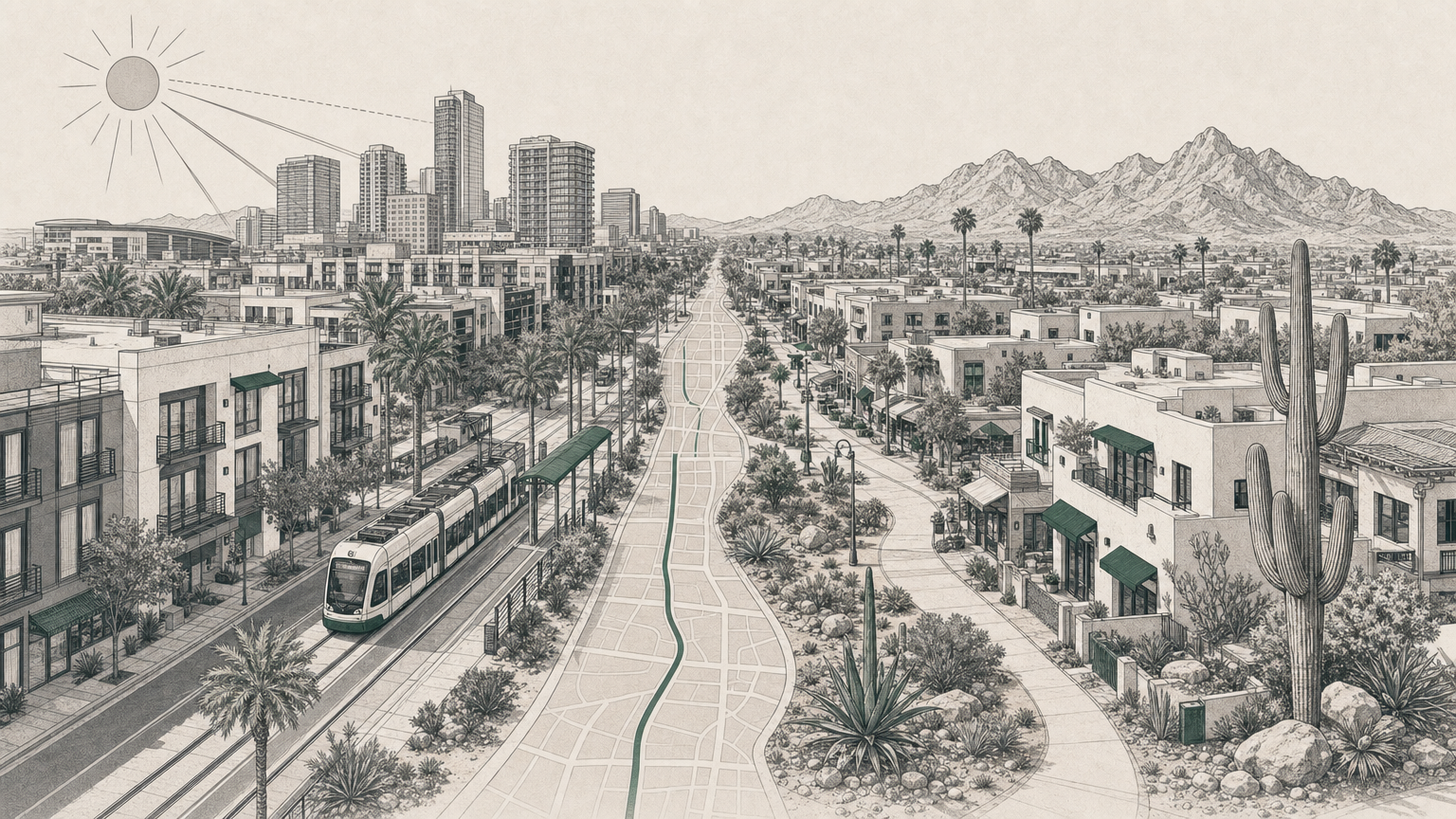
Phoenix vs. Scottsdale can look like a simple big-city-versus-resort-city choice. Renting here makes it more specific. The wrong location can add hundreds to your monthly housing cost or put your daily commute on the wrong side of the Valley. The useful comparison is rent, routine, transportation, and how the exact apartment handles summer. Here is how the two cities stack up when you are choosing a place to live.
The short answer: Phoenix gives most renters more room to choose
Phoenix is the stronger starting point if price, housing variety, or access to light rail matters. Scottsdale makes sense when its location is the point, especially for a job near the Scottsdale Airpark, a routine centered on Old Town, or regular access to North Scottsdale and the McDowell Sonoran Preserve.
| Your priority | Better starting point | Why |
|---|---|---|
| Lower typical asking rent | Phoenix | Current one-, two-, and three-bedroom asking rents are substantially lower |
| A car-light routine | Phoenix, along the rail corridor | Light rail directly serves central Phoenix; Scottsdale relies on buses and trolleys |
| Old Town dining and nightlife | Scottsdale | The busiest cluster is compact enough to build a routine around |
| Downtown Phoenix jobs, sports, or arts | Phoenix | Living nearby removes a cross-city drive |
| Scottsdale Airpark or Kierland commute | Scottsdale or northeast Phoenix | Both can keep you close to the Loop 101 employment area |
| Resort feel, golf, and North Scottsdale desert access | Scottsdale | Those amenities are a central part of the city's layout |
| The widest range of neighborhood styles | Phoenix | A much larger city produces more price points and housing patterns |
For plenty of renters, the real contest is South Scottsdale versus east or central Phoenix. Those areas sit close enough to share restaurants, parks, and commute routes without sharing the same rent profile.
Fairway is live across Greater Phoenix. Our AI agent for renters can search Phoenix and Scottsdale in one brief, call leasing offices, surface fees, and book tours. It is free for renters, so you do not need to commit to a city before seeing what your budget actually buys.
Phoenix is much cheaper on current asking rents
Citywide rent averages can mislead when each city has a different mix of apartments, condos, and houses. A by-bedroom comparison gives an apartment hunter a cleaner starting point.
Zumper's rolling 30-day data for September 2026 shows a wide gap:
| Unit size | Phoenix | Scottsdale | Scottsdale difference |
|---|---|---|---|
| Studio | $925 | $1,378 | +$453 |
| 1 bedroom | $1,160 | $1,800 | +$640 |
| 2 bedrooms | $1,495 | $2,457 | +$962 |
| 3 bedrooms | $2,150 | $3,750 | +$1,600 |
These are asking-rent snapshots across active listings, so they are a market benchmark rather than a quote for a particular building. The same source also shows why the all-unit headline is less useful: Scottsdale houses had a $4,200 median while its apartments had a $1,995 median. See the current Phoenix rent data and Scottsdale rent data for the underlying city pages.
Phoenix does not win every head-to-head listing. A new high-rise in Downtown Phoenix can cost more than an older apartment in South Scottsdale. East Phoenix neighborhoods such as Arcadia Lite and the Biltmore area can also carry Scottsdale-like prices. The citywide gap means Phoenix gives you more ways to trade location, building age, or amenities for a lower base rent.
Use the base rent as the first line of the comparison. Then add required property fees, parking, pet rent, utilities, renters insurance, and any lease-specific service package. Subtract concessions across the full lease term:
Effective monthly housing cost = (base rent for the full term + recurring fees + required one-time fees - rent credits) / lease months
Old Arizona cost guides may add a city rental tax to long-term leases. That tax ended statewide on January 1, 2025, and property owners should no longer collect residential rental TPT for stays of 30 days or more, according to the Arizona tax guidance. A line labeled "tax" on a current long-term lease needs a clear explanation.
Our Phoenix rent guide goes deeper on cooling, pools, fees, and concessions that can move the real monthly number.
Compare the right parts of each city
Phoenix covers 518 square miles and Scottsdale covers 184. A single vibe or price label cannot describe either place. The Census Bureau's Phoenix profile and Scottsdale profile show just how much ground these boundaries contain.
| Area | What works well | Main tradeoff |
|---|---|---|
| Downtown Phoenix and Roosevelt Row | Light rail, sports venues, arts, restaurants, and newer apartments | Event traffic, nightlife noise, and premium prices in newer buildings |
| Midtown, Uptown, and the Central Avenue corridor | Rail access, a central location, and a mix of older and newer rentals | The experience changes quickly with distance from a station or commercial node |
| Biltmore and Arcadia Lite | Easy access to east Phoenix, Scottsdale, dining, and major roads | Prices can erase much of Phoenix's citywide rent advantage |
| North Phoenix and Desert Ridge | Loop 101 and State Route 51 access, newer development, and larger housing options | A car does most of the work |
| Old Town and South Scottsdale | Apartments and condos near dining, nightlife, the greenbelt, Tempe, and Papago Park | Weekend activity, special events, and aircraft or road noise in some pockets |
| Central Scottsdale and the Shea corridor | Lower-key commercial nodes, the greenbelt, and access to both north and south Scottsdale | Daily errands and commutes usually require a car |
| Scottsdale Airpark, Kierland, and North Scottsdale | Employment, golf, desert trail access, and Loop 101 connections | Higher rents and a long trip to Downtown Phoenix or central Tempe |
This is why citywide verdicts often fail. A renter who likes Scottsdale's access but dislikes Old Town noise may prefer the Shea corridor. Someone who wants Scottsdale restaurants without Scottsdale rent may find a better fit around east Phoenix or South Scottsdale's older apartment stock.
Let your commute choose the side of the map
The Valley is built around several job centers rather than one downtown. Pick the work, school, caregiving, or social trip that happens most often, then draw the housing search around that trip.
- Downtown or Midtown Phoenix: Central Phoenix usually gives you the simplest commute, especially near light rail.
- Tempe or Arizona State University: South Scottsdale and east Phoenix can both work by car. Central Phoenix adds a rail option if the home and destination sit near stations.
- Scottsdale Airpark or Kierland: North Scottsdale and northeast Phoenix keep you near Loop 101. Downtown Phoenix usually creates unnecessary distance.
- Sky Harbor: Downtown, Midtown, east Phoenix, and South Scottsdale can all be workable. The exact road or rail connection matters more than the city name.
- Remote work: Shift the priority to afternoon sun, cooling performance, interior noise, internet choices, and the errands you make during the week.
Phoenix has a meaningful transit advantage, with light rail linking central Phoenix to Tempe and Mesa. Scottsdale has regional buses plus three fare-free trolley routes. The trolleys run every 20 minutes on weekdays, according to Scottsdale's current transit system, but they are local connectors rather than a replacement for the regional rail spine. The Valley Metro rail map makes the network difference clear.
A walkable listing also deserves a door-to-door reading. Old Town and Downtown Phoenix both contain walkable pockets. A home a mile beyond the useful part of either district can still turn every errand into a drive, especially in July.
The daily-life difference is concentration versus variety
Scottsdale packages much of its identity into recognizable clusters. Old Town concentrates bars, restaurants, galleries, events, and shopping. Farther north, the pattern shifts toward golf, resorts, trail access, and destinations around Kierland and the Airpark. If those places already match your week, paying more can buy convenience.
Phoenix spreads more experiences across more neighborhoods. Downtown and Roosevelt Row cover major events and arts. Melrose and Uptown have their own restaurant and nightlife scenes. Biltmore and Arcadia connect easily to Scottsdale. South Mountain, Papago Park, and the Phoenix Mountains Preserve create different outdoor routines across the city.
That spread is Phoenix's strength and its inconvenience. You get more variety and more rental inventory, but you need to choose a part of Phoenix rather than assume the whole city will be nearby. Scottsdale feels more consistent in its core districts, though North Scottsdale and South Scottsdale lead very different lives.
Schools and safety need an address-level answer
A citywide school verdict is too blunt for a lease decision. Phoenix alone has 325 public schools across 30 school districts, and attendance boundaries do not follow a simple Phoenix-versus-Scottsdale split. Phoenix's school district maps illustrate how much the assignment can change within one city. Base the comparison on the current attendance boundary for the exact apartment and the trip from home to school.
Safety comparisons have the same problem. Citywide rates combine downtown entertainment areas, quiet residential streets, shopping districts, and huge differences in population and land area. Compare recent incidents around the address, parking area, transit stop, and routes you would actually use. Phoenix and Scottsdale both publish official tools through their crime data page and Scottsdale police portal. Those maps still need context because reporting dates, offense categories, and agency systems can differ.
Summer comfort can matter more than the city line
The stations used for the 1991 to 2020 climate normals put Scottsdale's annual average at 73.3°F and Phoenix's at 75.6°F. That 2.3-degree gap is not a summer escape. At Phoenix Sky Harbor, July's normal daily high is 106.5°F and the normal low is 84.5°F. The National Weather Service normals show why both cities require the same serious approach to cooling.
For a renter, top-floor exposure, west-facing glass, shade, insulation, and the condition of the air-conditioning system can outweigh a small difference between city averages. During a tour, run the installed system and feel the airflow in every bedroom. Ask for the equipment age, filter responsibility, recent summer electricity use for the same floor plan, and the after-hours repair process. Covered parking also has real value when a car sits outside all afternoon.
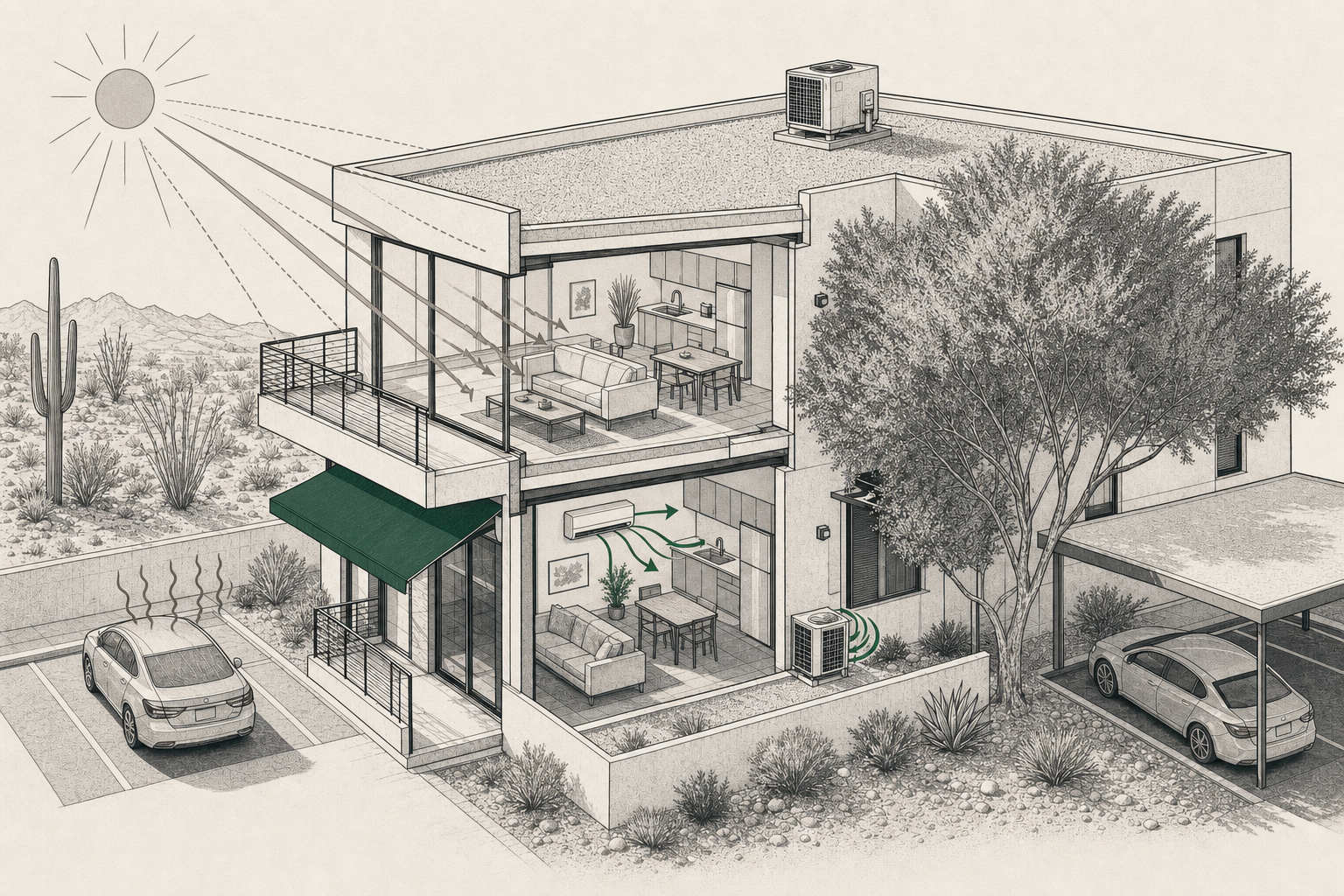
Phoenix adds a specific local protection: rental cooling systems must be capable of reaching 82°F with air conditioning or 86°F with evaporative cooling. The city's cooling ordinance applies inside Phoenix. Across both cities, Arizona law requires landlords to maintain supplied air-conditioning and cooling facilities in good working order and provide reasonable cooling when seasonal conditions require it. The state habitability rule covers that baseline.
Cooling rules are a floor, not a promise of comfort or a low electric bill. Our apartment utility guide explains how to build a unit-specific estimate instead of relying on a generic city average.
A practical way to make the final choice
- Set two numbers. Use an all-in monthly ceiling and a separate move-in cash ceiling.
- Pin your repeated trips. Put work, school, caregiving, and two weekly errands on the same map.
- Choose comparable areas. Compare Old Town with east or central Phoenix, or North Scottsdale with northeast Phoenix. Citywide averages alone are too broad.
- Price the exact units. Normalize concessions, mandatory fees, parking, pets, utilities, and lease length.
- Make heat part of the tour. Unit orientation, shade, cooling equipment, and repair response belong in the decision.
Phoenix is the practical default for renters who want lower asking rents and more ways to adjust the search. Scottsdale earns its premium when a specific Scottsdale location improves your everyday life. If the premium only buys a city name, keep the Phoenix options open.
Phoenix vs. Scottsdale FAQ
Is Scottsdale part of Phoenix?
No. Scottsdale is a separate city directly east of Phoenix. Both belong to the larger Phoenix metropolitan area, often called Greater Phoenix or the Valley.
Which city is better without a car?
Phoenix has the better path to car-light living when both home and routine sit along the light-rail corridor. Old Town Scottsdale is walkable for dining and entertainment, but trips outside that core rely on buses, trolleys, rides, or a car.
Which is better for a short visit?
Scottsdale is the easier base for a resort, golf, spa, or Old Town trip. Phoenix is the better base for downtown sports, major museums, concerts, and a broader city itinerary. South Scottsdale and east Phoenix are close enough that either can work when the plan spans both.
Ready to compare actual units instead of city stereotypes? Start your Phoenix-area search with Fairway, and tell us your budget, commute, and must-haves. We will search both cities, call the landlords, and get the tours onto your calendar.