Rental applications
Portable Tenant Screening Report: How to Get and Reuse One
Portable tenant screening report rules, costs, sharing steps, and dispute rights. Get practical renter guidance from Fairway, the AI agent for renters.
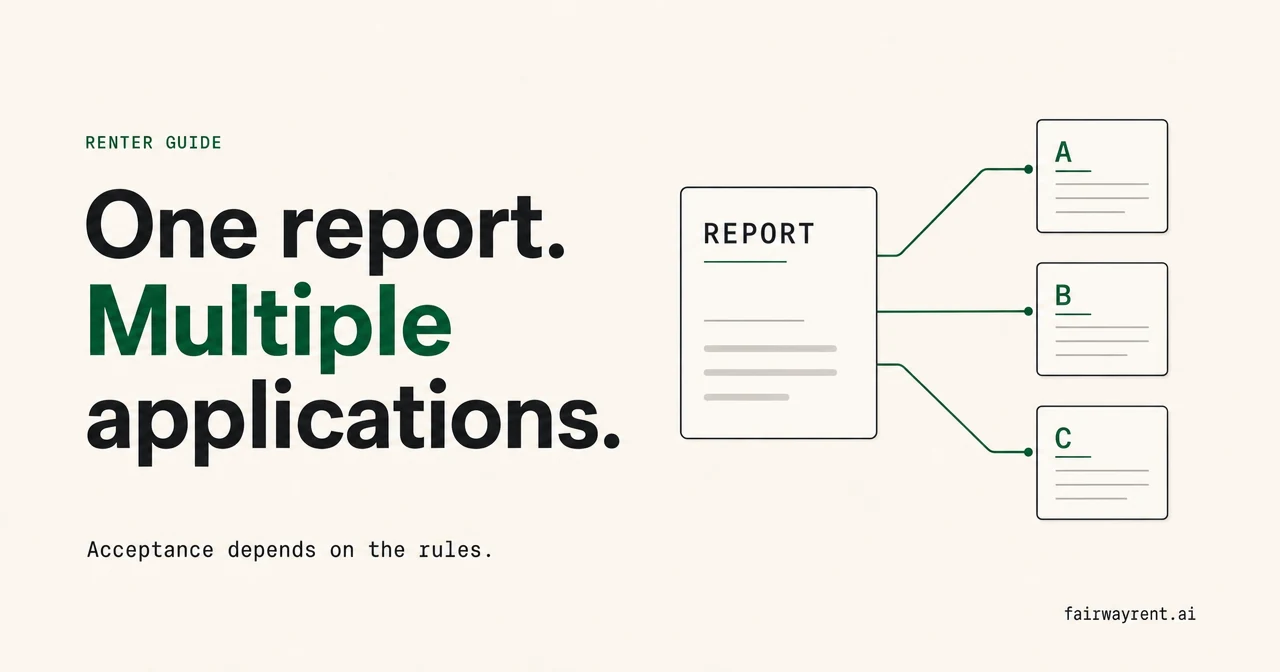
Paying for another background report gets old fast when every apartment wants its own application. A portable tenant screening report can reduce that repeat spending, but the word “portable” leaves a lot unsaid. The report's contents, age, delivery method, and the apartment's location all matter. Knowing how those pieces fit together helps you avoid buying a report that does less than you expected.
What is a portable tenant screening report?
A portable tenant screening report is a renter-requested screening report designed to be shared with more than one landlord. You may also see it called a reusable tenant screening report or PTSR. A consumer reporting agency prepares it using information about you, rather than each property ordering a separate report from scratch.
Depending on the service and state requirements, the package can include:
- Identity and contact details, including current or previous addresses.
- Credit history and sometimes a credit score.
- Rental history and housing-court or eviction records.
- Employment or other income verification.
- Criminal-history information where permitted.
There is no single national package. A credit-score screenshot, a self-written renter résumé, and a full screening report are different documents. A reusable application offered inside one rental website may also have different sharing limits from a report you can send to unrelated landlords.
We help with the work around the application, too. Our AI agent for renters is free: you describe what you want, and we find matches, call landlords or leasing offices, and book tours. The screening report itself comes from a consumer reporting agency.
Do landlords have to accept a portable report?
There is no nationwide right to use one report at every rental. State and local rules determine whether a landlord must accept a qualifying report, must waive certain fees when you provide one, or can choose whether to participate.
Those are separate protections. A fee waiver does not guarantee approval, and a landlord's willingness to accept reusable reports does not make every document qualify.
Colorado requires acceptance, with an exception
Landlords covered by Colorado's portable-report rules generally must accept a qualifying report without charging an application fee or a fee to access or use it. They may require a report completed within the previous 30 days, free access, and a no-material-change statement.
Under § 38-12-904(1.5)(f), qualifying landlords are exempt from subsections (a)-(e), including their acceptance and fee requirements. The exception requires taking only one application fee at a time for a unit, with a tenant-group rule for shared rentals, and refunding it fully within 20 calendar days after either side gives written notice declining a lease.
Separately, § 38-12-903(2)(b) bars an application fee for a report provided pursuant to § 38-12-904(1.5). These are distinct provisions in Colorado's portable-report law. Before buying, confirm whether the landlord qualifies for the exception and get the exact application and report-access costs in writing. Do not assume an exempt landlord must accept your report or waive fees.
Colorado's HB25-1236 screening changes removed the provision allowing landlords to insist on delivery directly from the reporting agency or through a qualifying third-party website. For applicants using a housing subsidy, the portable report need not include a credit history report, credit score, or adverse credit event. The signed Act took effect January 1, 2026, and applies to applications submitted on or after that date.
Illinois protects against repeat screening fees
In Illinois, a qualifying reusable report triggers a ban on report-access and application-screening fees. It must be prepared within the previous 30 days at your request and expense, be available directly or through a qualifying third-party website at no cost to the landlord, and cover all criteria the landlord consistently uses.
The written report must prominently state how current its information is and include your name, contact details, income-source verification, last known address, and a lawful eviction-history check. A landlord may request a no-material-change statement and still collect and process an additional application without charging an application-screening fee. That is the protection in Illinois's reusable-report statute, rather than a promise that the report replaces every application step.
Other states use different acceptance and fee rules
| Location | What the statewide rule does |
|---|---|
| California | Landlords may choose whether to accept qualifying reusable reports. If they accept yours, they cannot charge an application-screening fee or a report-access fee. The report must be prepared within the previous 30 days and meet the content and delivery requirements in Civil Code § 1950.1. See the state's published Civil Code. |
| Washington | Landlords must disclose whether they accept comprehensive reusable reports. If they agree to accept them, they may obtain their own screening report but cannot charge you for it. The Washington screening statute also requires advance notice of screening information and denial criteria. |
| Maryland | Landlords must notify applicants whether they accept reusable reports. If they accept a qualifying report prepared within the previous 30 days, they cannot charge an application fee or a fee to access it. Maryland's report statute specifies the required contents and allows a no-material-change certification. |
| New York | Covered landlords must waive background- and credit-check fees when you provide a copy of a check conducted within the past 30 days. Otherwise, the combined fee is capped at actual cost or $20, whichever is less. Before collecting it, the landlord must give you a copy of the check plus the provider's receipt or invoice. New York's fee statute has special rules for cooperative applications involving ownership or shares, and exceptions for specified older-adult care or retirement-community entrance fees. |
| Rhode Island | Rental application fees are prohibited. When you supply a required official state criminal background check or credit report issued within 90 days of the application, you cannot be charged for that report. Landlords may obtain independent reports at their own expense under the state's application-fee law. |
These are examples of different state models, not a nationwide acceptance list. Local rules can provide stronger protection. For example, the Berkeley Rent Board states that a landlord must use a reusable screening report if the applicant provides one, a stronger position than California's statewide opt-in rule.
How to get and share a portable tenant screening report
The useful order is: get the property's requirements, choose a matching report, review the results, then share through the approved delivery route. Buying first can leave you paying twice.
1. Get the property's criteria and fee policy in writing
Ask the leasing office for its screening criteria, reusable-report policy, required report contents, delivery instructions, and all application charges. Income standards, guarantor options, and the move-in date matter even when the screening fee disappears. Our apartment rental requirements guide covers the rest of that preparation.
A short message keeps the questions together:
I plan to provide a reusable tenant screening report for this unit. Please send your written screening criteria, required report contents, delivery instructions, and any application charges that would remain.
A property policy cannot remove a statutory right. In a place with mandatory acceptance or a required fee waiver, this message helps document how the property will handle your report.
2. Order a renter-initiated report with the right contents
You obtain a portable report from a consumer reporting agency or screening service offering reusable reports. Some services let you start the order yourself; others begin with a landlord invitation or restrict sharing to participating properties.
The package needs to fit the applicable legal definition and screening requirements. A cheaper credit-only report may leave out income verification or housing-court records. A proprietary affordability score is also different from a credit-history report when the latter is required.
Expect to provide identity information, address history, consent for screening, and the income or employment information the package requires. Keep sensitive details inside the provider's secure process instead of sending a Social Security number in an ordinary email.
3. Review the completed report before sharing
Start with identity matches, income details, rental balances, and court outcomes. Common problems include another person's record, duplicate cases, paid balances still shown as unpaid, or a dismissed case without its final outcome. The Federal Trade Commission (FTC) identifies these as recurring background-report errors.
A portable report can carry the same mistake to several properties. Starting a dispute before broad sharing gives you a chance to address that problem earlier. Our rental-history report guide explains the records that may sit behind the screening summary.
4. Share through the provider's secure route
A provider-issued invitation or authenticated link helps the landlord establish where the report came from and access the unaltered results. Direct availability is also part of several states' legal definitions.
Send access to the leasing office's official contact and identify the unit you are applying for. Complete any separate application and lawful screening authorization. Keep the report, receipt, delivery confirmation, and the property's response.
A downloaded PDF can be useful for your own records. It does not automatically satisfy every state's delivery rules. Colorado's removal of its direct-delivery condition is one reason a blanket “PDFs never count” policy is also too broad.
5. Track report age separately from link access
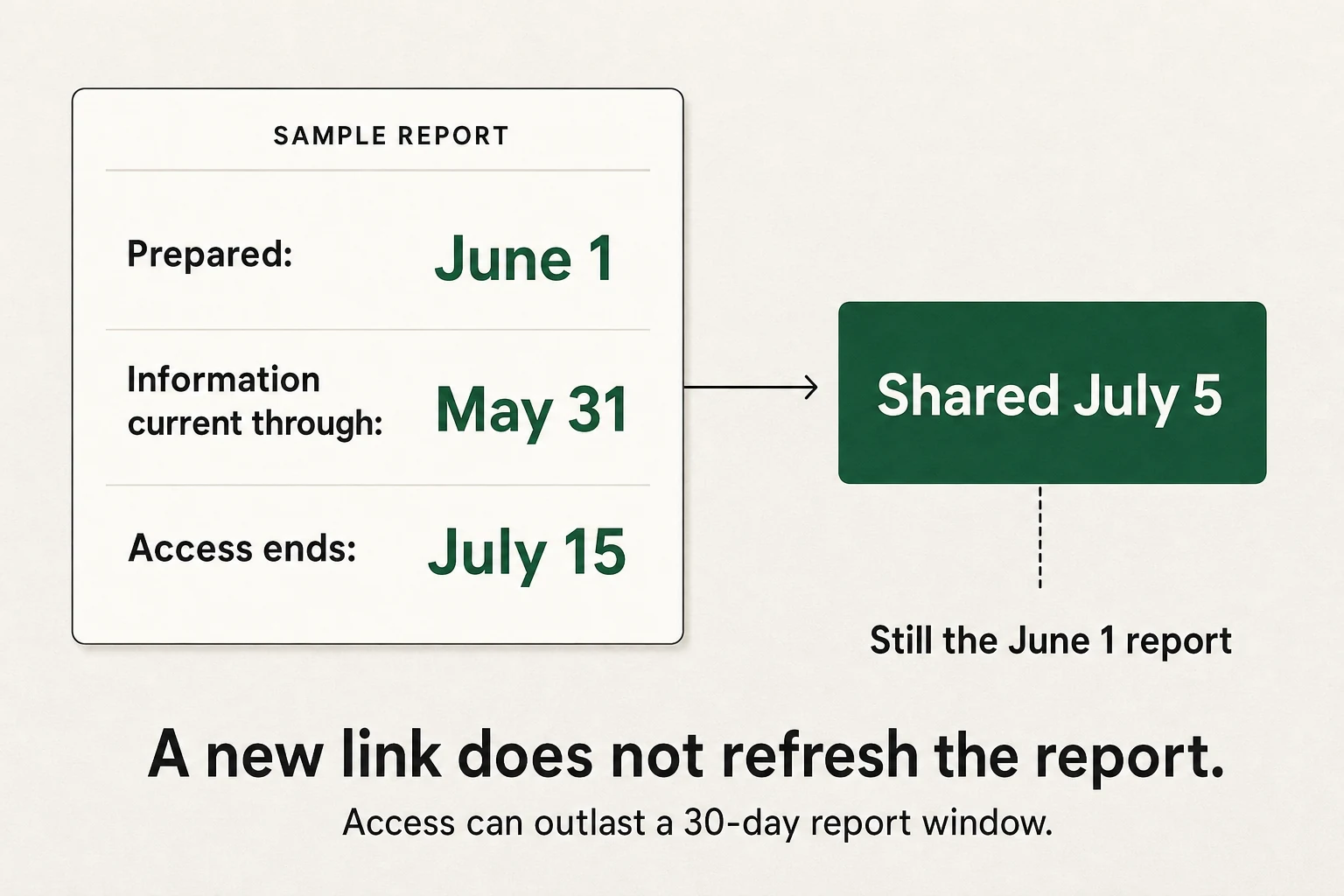
Three dates can affect reuse:
- Preparation date: when the report was created. Several state rules use a 30-day preparation window.
- Information-current-through date: how recent the underlying information is. This can differ from the date you downloaded the file.
- Sharing-access deadline: when the provider stops allowing recipients to open it.
Sending a new invitation does not, by itself, create a newly prepared report. Paying to extend access also does not necessarily refresh the underlying screening.
For example, a report prepared on June 1 is already more than 30 days old on July 5, even if its sharing link still opens. That matters where a 30-day rule applies. Rhode Island's 90-day rule concerns the specified reports in that state's law; it does not extend every provider's access period.
If your job, income, address, or other material information changes, disclose the change through the application process. Sign a no-material-change statement only when it is accurate.
Will a portable report actually save you money?
Savings depend on the fees you avoid, the purchase price, and whether another paid refresh becomes necessary before you find a home.
Use this calculation:
Net savings = application or screening fees avoided − report cost − paid refreshes
Suppose three properties would each charge you $50, and a reusable report costs $60. If it eliminates all three fees, your net savings are $90. If only one property accepts it and the other two still lawfully charge $50 each, your total is $160, compared with $150 without the portable purchase. These are illustrative numbers, not market averages.
Provider costs and landlord fees are separate. A fee-waiver law does not usually make the report you buy free. Sharing limits, extra report components, and refresh charges can also change the total.
Keep application-screening charges separate from holding deposits and other move-in costs. A portable report is no blanket exemption from every charge, and calling a screening charge an “admin fee” does not by itself make it lawful. Our application fee guide explains those distinctions.
Acceptance does not guarantee rental approval
A portable report supplies information for screening. The landlord still makes a rental decision using lawful criteria. Income, occupancy, rental history, application completeness, and unit availability can still matter.
That is why written criteria belong at the start of the process. Reusing a report saves little if you keep applying to homes whose stated requirements do not fit your situation. When accurate credit information is the obstacle, our renting with bad credit guide explains how to strengthen your application.
If a property refuses a report or demands a fee despite an applicable protection, ask for the specific reason in writing. Keep the listing, screening policy, report dates and contents, access instructions, and fee demand. A local legal-aid or fair-housing organization can help address an unlawful refusal or discriminatory screening practice.
Your rights after a denial or stricter rental terms
When a landlord takes adverse action based wholly or partly on a consumer report, the Fair Credit Reporting Act applies. Adverse action includes denying the application, requiring a co-signer, charging higher rent, or demanding a larger deposit because of report information.
The notice must give the reporting company's name, address, and phone number, explain that the company did not make the rental decision, and explain your rights to dispute inaccurate information and request a free report within 60 days. Additional disclosures apply when a credit score was used. The FTC's consumer-report requirements apply even when a report influenced only part of the decision.
Federal law allows oral, written, or electronic notice; state or local law may require more. A written copy makes it easier to preserve the reason and the reporting-company details. For follow-up timing and next steps on pending, conditional, or denied applications, our approval and decision guide lays out a practical plan.
How to dispute a screening error
Send the dispute to the company that prepared the report. Identify each wrong item, explain the correction, and include copies of supporting records, such as a payment receipt or court disposition. Keep the originals and proof of submission. Let the landlord know a dispute is pending.
The reporting company generally has 30 days to investigate, with up to 45 days in some circumstances. Inaccurate, incomplete, or unverifiable information must be corrected or deleted. The FTC dispute guidance also explains how to address errors with the source that supplied the information.
After a correction, get the updated report and send it to affected landlords. Following a deletion or dispute notation, federal recipient-notification rules let you ask the reporting company to notify specifically named landlords who received a report containing the deleted or disputed information within the previous six months.
A dispute does not guarantee that an apartment stays available while the investigation runs. Starting with an accurate report protects more than the fee you paid for it.
A portable report works best alongside a focused apartment search: suitable homes, clear criteria, and fewer applications made on a guess. Start your rental search with us, and let us handle the listing search, calls, and tours.