Rent calculations
Prorated Rent: Calculate the Right Amount Before You Pay
Calculate prorated rent for a move-in or move-out date, compare actual-day, 30-day, and 365-day methods, and see every step before rent is due.
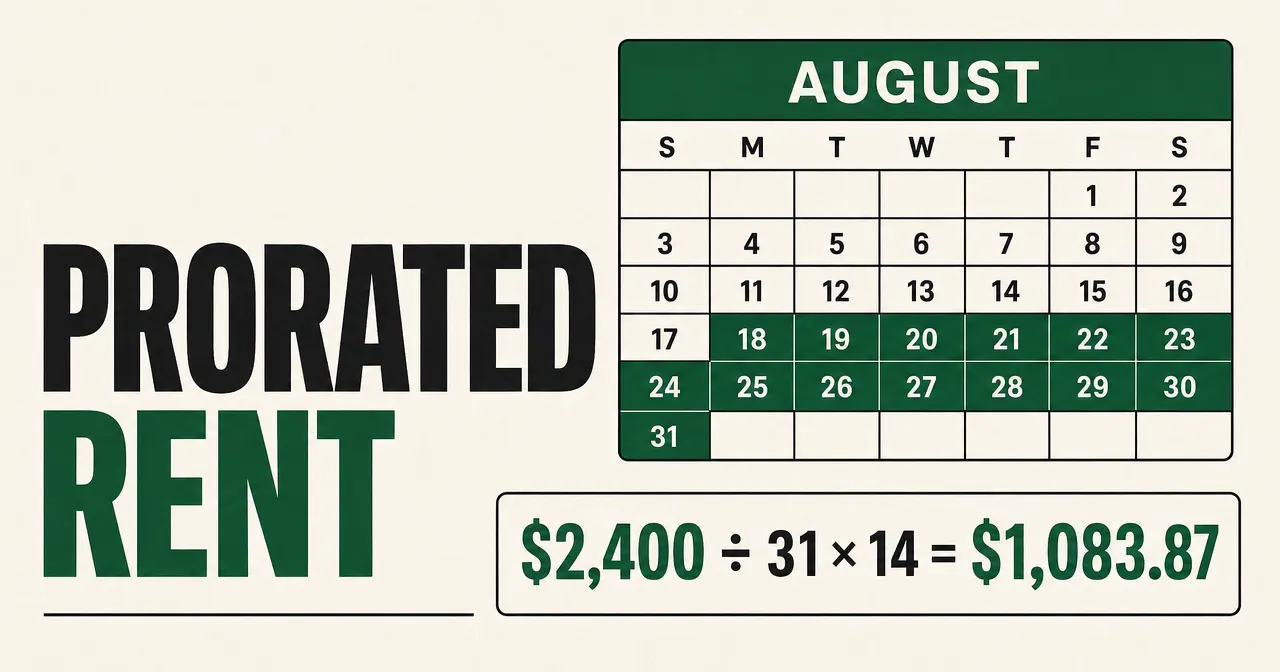
A partial month of rent should be simple. Then the lease uses one date, the keys arrive on another, and the payment portal produces a number with no math attached. Before you pay, you need to know which rent amount was used, which days count, and whether the property divides by 30, by the calendar month, or by the year. Here is how to calculate the charge and audit the full bill.
What prorated rent means
Prorated rent is the portion of monthly rent charged for part of a rental period. It commonly appears when:
- a lease starts after the first day of a month
- a lease ends before the last day of a month
- an approved early move-in adds a few days before the regular term
- a renewal or rent change takes effect partway through a month
- a law or signed agreement ends rent responsibility on a midmonth date
The basic idea is a daily rent rate multiplied by the number of chargeable days. The hard part is choosing the correct inputs.
Your payment date does not define the period your payment covers. Rent paid on August 5 may still cover August 1 through 31, with the first four days acting as a grace period under the lease. Likewise, moving your furniture in on August 18 does not create a prorated bill if the lease and right to possession started August 1.
Before signing, get the lease start date, rent start date, full move-in total, and every fee in writing. In the SF Bay Area, our free AI agent for renters can surface fees and call landlords to confirm the exact unit, availability, and move-in terms before you apply.
Prorated rent calculator
Calculate prorated rent
Change any input to see the period, inclusive day count, and full calculation.
Prorated rent $1,083.87
- Rental period
- August 18, 2026 through August 31, 2026
- Chargeable days
- 14 days, including both endpoints
- Divisor
- 31 days (Actual days in the month)
- Daily rate
- $77.419355
- Formula
- $2,400.00 ÷ 31 × 14 = $1,083.87
Prorated rent (rounded once at the end)
$1,083.87
Use the monthly rent in the lease and the exact date for the partial month. A move-in calculation charges from the selected date through the last day of that month. A move-out calculation charges from the first day of the month through the selected final date.
Enter four things:
- Monthly rent: the contractual rent that applies to the selected dates
- Date and year: the first chargeable day for a move-in or the final chargeable day for a move-out
- Move-in or move-out: this sets which side of the month the calculator counts
- Proration method: actual days in the month, a fixed 30-day month, or a 365-day annual rate
The calculator counts calendar days and includes both endpoints. For a move-in on August 18, it counts August 18 through 31. For a move-out on August 14, it counts August 1 through 14. Those assumptions only work when the selected date is also the date rent responsibility begins or ends under the lease, a signed change, or applicable law.
The year matters because February can contain 28 or 29 days. Across all three methods, the rental dates and inclusive day count stay the same; only the daily-rate denominator changes. The 365-day option always uses 365 as its denominator, including in a leap year. An agreement that expressly uses the actual number of days in the year calls for a separate 366-day calculation in a leap year.
A move-in on the first day or a move-out on the last day covers the full calendar month. In either case, the result is the monthly rent and does not need a partial-month formula.
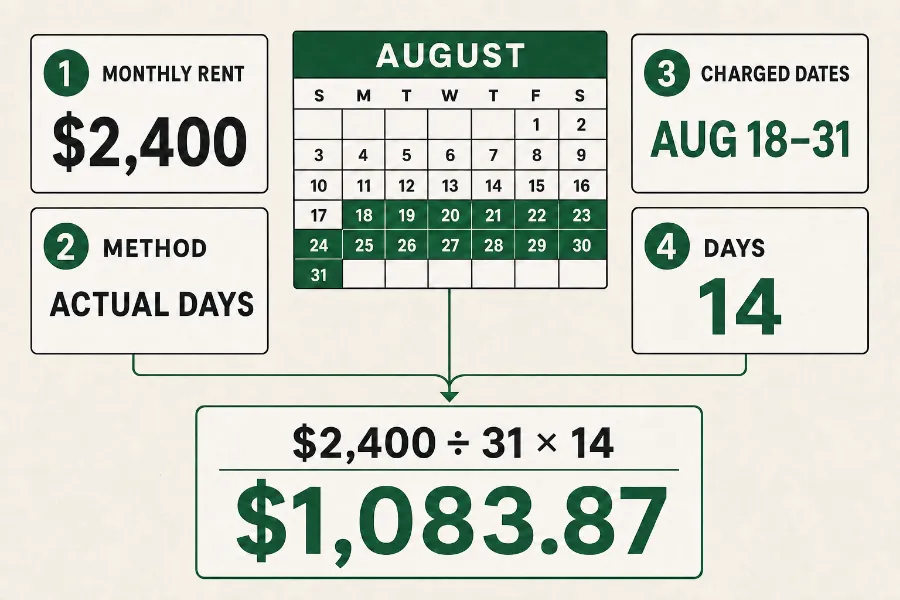
For $2,400 rent, an August 18, 2026 move-in, and the actual-days method, the result is:
- Rental period: August 18 through August 31
- Chargeable days:
31 − 18 + 1 = 14 - Daily rate:
$2,400 ÷ 31 = $77.419354... - Prorated rent:
$2,400 ÷ 31 × 14 = $1,083.87
Keep the full daily rate behind the calculation and round the final amount once. Rounding $77.419354 to $77.42 before multiplying would add one cent. A useful result always shows the rental period, day count, divisor, daily rate, formula, and final amount so an unexplained portal total does not get the last word.
Is rent prorated by 30 or 31 days?
There is no single calculation method for every U.S. rental. The lease and applicable law decide. Three methods appear often:
| Method | Daily rate formula | $2,400 rent for August 18 through 31 | What changes |
|---|---|---|---|
| Actual calendar days | $2,400 ÷ 31 | $1,083.87 | The daily rate is higher in February and lower in a 31-day month |
| Fixed 30-day month | $2,400 ÷ 30 | $1,120.00 | Every partial month uses the same denominator |
| 365-day annual rate | ($2,400 × 12) ÷ 365 | $1,104.66 | The same daily rate applies throughout the year |
The three answers differ by as much as $36.13 in this example. A calculator cannot choose the right one from your rent and move date alone. Find the proration clause in the lease, addendum, approval letter, or written quote. It should identify the method or the final partial-month amount.
Exhibit 11-EX-05, Rent Proration Examples, in the California Department of Transportation (Caltrans) Right of Way Manual defines a 30-day convention for department property management. It includes the tenancy start or vacate date in the day count and caps a partial-month charge at the full monthly rent. It does not set a statewide formula for California private leases.
If the document says “actual days,” use 28 or 29 for February, 30 for April, June, September, and November, and 31 for the other months. If it says 365 days, use 365. If it instead says actual days in the year, use 366 for a leap year.
Count the days the agreement charges
Most errors happen in the calendar before they happen in the calculator. Count the days tied to the written rent obligation or right to possession. Do not count only the nights you expect to sleep there.
Under the calculator's inclusive-day assumption:
- Move-in proration: days in month minus start-day number plus one. August 18 through 31 is
31 − 18 + 1 = 14 days. - Move-out proration: the selected final day is the count. August 1 through 14 is
14 days. - Two rates in one month: calculate each date range at its own rent, then add the two amounts.
The calculation needs these dates:
| Date in the paperwork | Why it matters |
|---|---|
| Lease commencement date | Starts the legal term, though a separate rent commencement date may control billing |
| Rent commencement date | States when rent begins if it differs from the lease term |
| Possession or key date | Shows when the apartment is available to you |
| Lease expiration or termination date | Sets the end of the term or an approved early termination |
| Notice effective date | May affect how long rent continues under the lease and local law |
If you choose to arrive late after the apartment was available, the rent clock usually does not move with you. If the landlord cannot deliver the apartment on the promised date, the lease and local law may provide a different result. Record the actual key handoff and any written change.
When do you pay prorated rent?
The amount and the payment schedule are separate questions. Properties commonly use one of these arrangements for a midmonth start:
- Partial calendar month at move-in. You pay for the move-in date through month-end before getting the keys, then pay a full calendar month's rent on the next regular due date.
- Full rolling month first, partial calendar period next. Your first full payment covers the move-in date through the day before the same date in the next month. The next payment covers the remaining days needed to reach the regular first-of-the-month schedule.
- Full payment followed by a credit or refund. The property collects a full amount and applies the unused portion later under the written agreement.
Using the $2,400 August 18 example, the second arrangement needs these exact rental periods:
| Due | Amount | Rental period covered |
|---|---|---|
| Before keys on August 18 | $2,400.00 | August 18 through September 17 |
| September 1 | $1,040.00 | September 18 through 30: $2,400 ÷ 30 × 13 |
| October 1 | $2,400.00 | October 1 through 31 |
The total rent covering August 18 through September 30 is $3,440.00. Do not use the $1,083.87 August proration in this rolling-month arrangement. That figure covers August 18 through 31 under the actual-days method. It belongs to a different ledger, such as one that explicitly credits the $2,400 collected at move-in to September 1 through 30 and applies a later $1,083.87 payment retroactively to August 18 through 31.
Payment labels are not enough. Each line needs a first date, last date, method, and amount so the same days are not charged twice and no period disappears between payments.
This is why “first month's rent” can be a confusing label. Ask for a dated ledger instead of relying on it. Also separate the security deposit, application fee, holding payment, and nonrefundable move-in charges. Our apartment budget guide shows how to turn them into one cash-to-keys total.
Four situations that need different math
A midmonth move-in
If your lease and rent both begin August 18, actual-days proration gives you 14 chargeable days and $1,083.87 in partial rent. If you receive keys August 15 and the agreement starts charging that day, use 17 days even if the moving truck comes later.
A midmonth move-out
Leaving early does not automatically shorten the lease. If you return the keys August 14 but the lease runs through August 31, a full month's rent may still be due. Use 14 days only when the lease, a signed termination agreement, or applicable law ends rent responsibility on August 14.
If you prepaid “last month's rent,” place that payment on the ledger as a credit. Then compare the credited amount with the final amount owed. The label alone does not show whether the payment covers a full calendar month, a partial final month, or a fixed amount that now needs reconciliation.
A rent increase or renewal in the middle of a month
Split the month at the effective date. Suppose old rent is $1,950 through August 14 and new rent is $1,995 beginning August 15. Under the actual-days method:
- Old rate: $1,950 ÷ 31 × 14 = $880.65
- New rate: $1,995 ÷ 31 × 17 = $1,094.03
- Total August rent: $1,974.68
Two “prorated rent” lines on a portal can be correct when one covers the old rate and the other covers the new one. Their date ranges should meet without overlapping or leaving a gap.
A lease with free rent or a concession
The advertised net effective rent may be an average, while the lease lists a higher contractual base rent and a separate credit. Proration may use that contractual rent. Read the concession addendum for the amount, dates, and any early-termination repayment term. Our rent concession guide explains how to reconcile the advertised price, base rent, and actual payment schedule.
Do landlords have to prorate rent?
A midmonth move does not create one universal right to prorated rent across the country. The answer depends on why the month is partial, what the lease says, and the law where the apartment is located.
Specific laws can require proration. Minnesota, for example, requires actual-calendar-day proration when a residential lease term ends before the last day of its final month. The rule applies even when last month's rent was paid in advance, and the statute makes a waiver unenforceable. Minnesota's proration law is much more specific than the generic advice that proration is always optional.
Federal law also creates a defined exception for qualifying lease terminations under the Servicemembers Civil Relief Act. Unpaid rent before the effective termination date must be prorated, and advance rent covering time after that date must be refunded within 30 days. The effective date and eligibility rules in 50 U.S.C. § 3955 still control.
These examples do not establish the rule in another state or city. Proration can also interact with notice, early termination, habitability, re-renting, and rent-regulation rules. The USAGov tenant-rights directory points to state agencies and legal help when a disputed charge cannot be resolved from the lease and ledger.
Audit a prorated rent bill before you pay
Run the charge through this order:
- Rent amount: Use the contractual rent that applies to the dates, before subtracting a separate credit unless the lease says otherwise.
- Proration method: Actual month, fixed 30-day month, annual rate, or a stated partial-month amount.
- Chargeable dates: Write the first and last date beside the bill.
- Day count: Count both endpoint days when the agreement charges through the final day.
- Separate line items: Calculate pet rent, parking, services, utilities, and other lawful recurring charges under their own terms. A flat fee may stay flat.
- Credits: Apply holding payments, prepaid rent, concessions, and prior overpayments only where the documents say they apply.
- Payment schedule: Match every payment to a rental period.
- Rounding: Keep the full daily rate and round the final line once, unless the lease states another rule.
If the number still does not match, send a short, specific request:
Please send an itemized ledger for my move-in amount. For each rent or recurring-charge line, include the monthly amount used, proration method, first and last date charged, number of days, credits applied, and the rental period covered by each payment due before October 1. My calculation for August 18 through 31 is $2,400 ÷ 31 × 14 = $1,083.87.
Do not quietly short-pay an unexplained bill. A portal error and a lease dispute can look identical until the property supplies the inputs. Put the discrepancy in writing, keep the original quote and signed documents, and get the corrected ledger or agreement in writing.
Prorated rent is fair only when the dates, method, and credits line up. Do the calendar first, the division second, and the full payment schedule last.
If you are still looking for an apartment in the SF Bay Area, tell us your budget, move date, and must-haves once. We watch every listing, Craigslist included, surface fees, call landlords, and help get tours on your calendar. You can start with Fairway.