Rental applications
Rental resume: a one-page summary without oversharing
Rental resume template and filled example: learn what to include, what to keep private, and when it helps. From Fairway, your AI agent for renters.
Apartment applications can reduce years of paying rent to a handful of boxes. A new job, your first lease, or freelance income may need a little context that the form never asks for.
A rental resume gives you room for that context. The trick is deciding what earns space on the page and what stays private. A useful version is short, specific to the home, and easy to reuse without sending your financial life to every listing.
What is a rental resume?
A rental resume is a renter-authored summary of your contact details, housing plans, income, rental history, and references. Think of it as a one-page introduction you can offer alongside an application when the landlord accepts extra material.
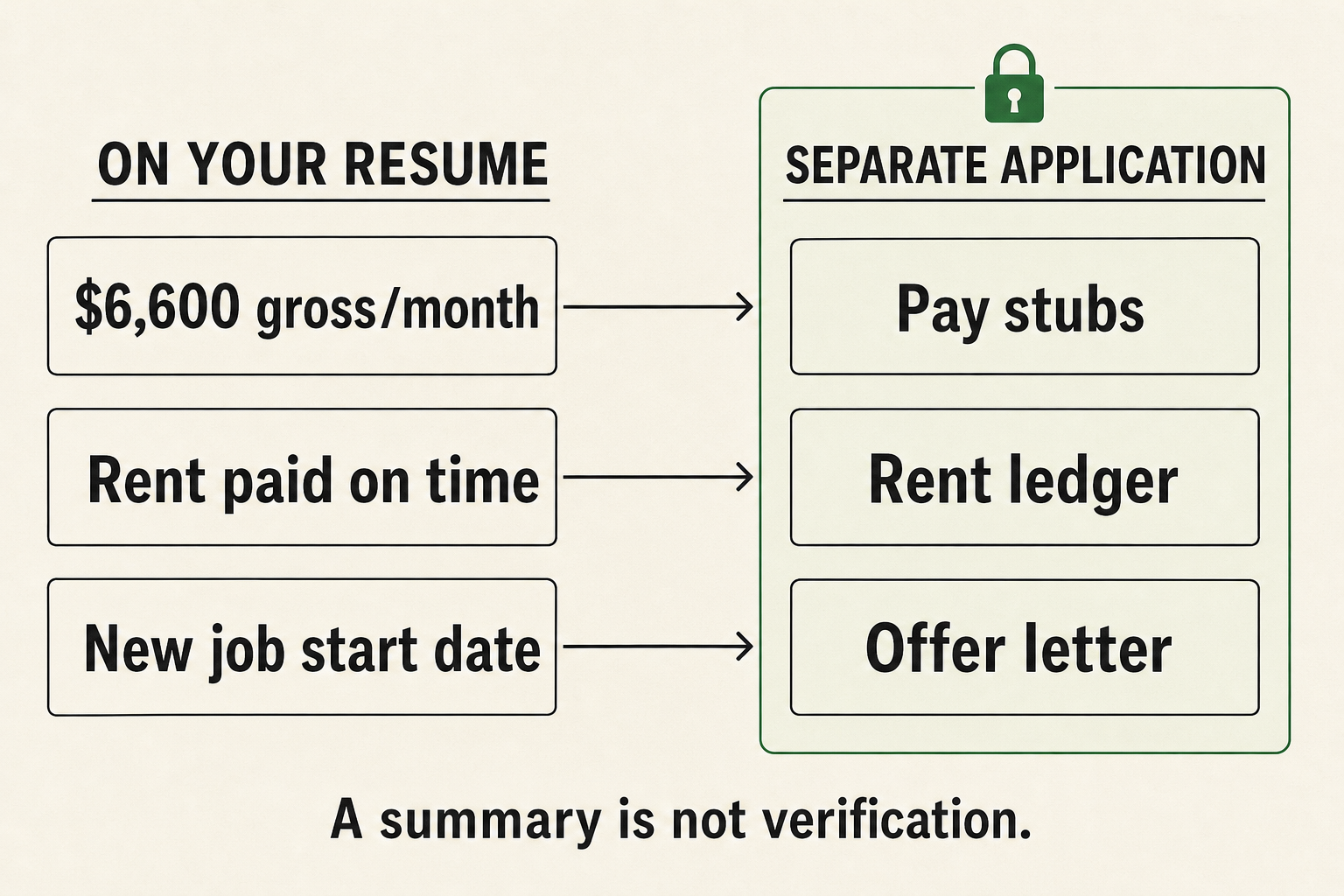
It does not replace the property's application, requested supporting documents, any forms or permissions requested as part of that application, or its screening process. A statement you write about your income or payment history is still a statement. Supporting records establish the facts separately.
The Consumer Financial Protection Bureau explains that tenant screening reports can combine credit, rental history, employment verification, and other information. Your resume is separate from those reports and cannot guarantee approval.
If finding suitable listings is still taking over your evenings, Fairway is our AI agent for renters, and it's free for renters. You describe what you want; we find matches, call landlords or leasing offices, and book tours. Each property's application and approval process remains separate.
When a rental resume can help
A resume earns its place when it answers a practical question that your application leaves open:
| Your situation | Useful context to add |
|---|---|
| You're renting for the first time | State your actual housing arrangement and offer an appropriate reference instead of inventing a landlord. |
| You're relocating or starting a job | Give the move-in window, employment start date, and the type of offer or employment letter available. |
| You freelance or have several income sources | Explain the sources and time period behind your income summary. |
| You're applying with roommates | Identify the adult co-applicants and total occupant count, with everyone's permission. |
| A landlord welcomes an introduction | Put your relevant facts in one place so they can understand your situation without a long email chain. |
The benefit is clarity. A resume alone doesn't guarantee approval or priority over other applicants. Your right to request a reasonable accommodation under applicable fair-housing law remains intact.
It's also fine to skip it. If a leasing office only accepts its standard form and specified uploads, focus on those. A complete application matters more than an extra document with nowhere to go.
What to include on a rental resume
Aim for one readable page. These six sections usually give you enough room.
1. Your name and a way to reach you
Use your full name, phone number, email, and current city and state. Your current street address can stay off this shareable summary. Supply the full address history separately when the formal application requires it.
2. The property and your moving plans
Name the property or unit, your preferred move-in date or window, and the lease length you're seeking. Add one sentence explaining the fit: a workable commute, the advertised lease term, or the amount of space you need.
For example: “I'm interested in Unit 4B for a 12-month lease beginning December 1. The location would put me near my workplace.”
There's no need for a paragraph about being the perfect renter. Dates and a clear request do more work.
3. Income and employment, briefly
For a salaried job, list your role, employer, start date, and income if you choose to share it. Label the amount clearly: “$6,600 gross per month” means something different from take-home pay.
For variable income, give the averaging period and calculation basis. For example: “Freelance design income averaged $5,200 per month after business expenses, before personal taxes, from January through September.” Business revenue and personal income are different amounts.
Other resources may include benefits, a pension, savings, financial aid available for housing, or rental assistance. Separate recurring income from savings and one-time funds. You can summarize a resource without publishing an account number or medical information.
Use the property's stated income standard rather than assuming every rental has a three-times-rent rule. Our proof-of-income guide explains common document options for different payment sources.
4. Recent rental or housing history
For one or two recent homes, include the city or property name, month-and-year dates, your actual arrangement, and a short reason for moving. A previous rent amount is optional. If you include it, distinguish your own share from the household's total rent.
Use specific, truthful statements such as “Rent paid on time throughout this tenancy; payment ledger available.” A rent ledger is a record of rent charges and payments. Only make a payment-history claim your records or landlord can support.
If you've lived with family, in a dorm, or in a home you owned, say that plainly. “First lease in my name” is enough explanation. Our guide to no rental history covers ways to document those arrangements.
5. Relevant household and pet details
A total occupant count is enough for the summary. Include adult co-applicants' names only with their permission. Children's names, ages, schools, and photos can stay off it.
For pets, a brief description can help explain fit with an advertised policy: “One indoor cat; vaccination records available.” Keep veterinary paperwork separate.
The U.S. Department of Housing and Urban Development says assistance animals are not pets. For privacy, keep any accommodation request and necessary supporting information separate from the shareable resume. Don't attach a diagnosis or medical record to the resume.
6. References and available documents
One or two relevant references are enough for a short introduction. A former landlord can discuss a tenancy; an employer or supervisor can discuss employment. Label each person's actual relationship to you.
Ask permission before sharing anyone's contact information. You can write “Landlord reference available with permission” and provide the details privately when needed. An employer or personal reference doesn't automatically satisfy a property's requirement for a landlord reference.
Finish with a short list of documents available through the secure application process, such as recent pay stubs, an offer letter, or a rent ledger. List only what you actually have. Keep those files separate from the resume.
What to leave out
A resume is easy to forward. Keep information off it that would expose you or someone else if it reached the wrong inbox:
- Identity numbers and documents: Social Security number, birth date, driver's license or passport number, ID scans, and a signature image.
- Financial access details: bank or card numbers, account logins, passwords, and security answers.
- Full financial records: pay stubs, tax returns, bank statements, credit-score screenshots, and complete credit or screening reports.
- Unnecessary personal details: a headshot, marital status, religion, medical history, children's identifying details, and personal social-media links.
- Other people's private information: reference contacts or co-applicant details shared without permission.
Some identifying information and documents may be needed for legitimate formal screening. Leaving them off your resume doesn't mean leaving required application fields unanswered. The Federal Trade Commission's background-check guidance distinguishes the identifying information used in that process.
Share sensitive identity or financial records only when a legitimate application actually requests them. The property, recipient, and secure submission route must be independently confirmed first. Use contact details obtained separately from the message requesting your records, such as the rental company's own website.
Use an independently verified secure application portal or other secure document channel, never ordinary email, for Social Security or account numbers, ID images, or financial documents. HTTPS encrypts transmission; it doesn't establish that the site operator is legitimate. The FTC warns that fake rental listings can collect Social Security numbers, ID images, and pay stubs for identity theft. A request for “a resume” is no reason to send those records.
How to tailor it to a property
Keep one private master copy. For each home, change the property name, unit, move-in window, lease term, and one sentence about the fit. Update any income figure or housing date that has changed.
Use the property's written requirements as your starting point. The FTC recommends asking what information a landlord uses before paying an application or background-check fee. A short question is enough: “Do you accept a one-page renter summary, and what are the written screening criteria and required documents?”
Then connect an actual requirement with an actual fact:
| Property detail | A useful, truthful line |
|---|---|
| Available December 1 | “Available to move December 1–7.” |
| Offers a 12-month lease | “Seeking a 12-month lease.” |
| Allows cats | “One indoor cat; vaccination records available.” |
| Uses combined applicant income | “Combined gross income: [amount], from [sources],” if that matches the applicants and the property's policy. |
Tailoring changes the emphasis, not your history. Avoid offering a higher deposit, extra rent upfront, or waived rights as a way to make the resume persuasive. Those commitments belong outside an introduction and may raise legal or financial issues.
If you want to explain a past difficulty, one factual sentence about what changed is usually enough. “A job loss interrupted my income in 2024; I've been employed full-time since March 2025.” You can give context without disclosing a diagnosis or writing a defense of your entire life.
Editable rental resume template
Copy this into Word or Google Docs, or download the editable Word template. Replace the brackets, delete sections that don't apply, and keep a private editable copy. Export a PDF for a property that accepts one.
[Full name]
Contact: [Phone] | [Email] | [Current city, state]
Property: [Property name or address and unit]
Moving plans: [Date or window] | [Requested lease length]
Introduction: [One or two sentences explaining your interest in this home and relevant circumstances.]
Income and employment
- [Role or income source, employer if relevant, start date]
- [Amount and frequency; gross/net basis; averaging period if variable]
- [Any separate resource you choose to summarize, without account details]
Rental or housing history
- [City or property name] | [Month/year to month/year or present]
- [Actual arrangement: leaseholder, roommate, lived with family, dorm resident, homeowner, etc.]
- [Relevant payment-history statement, only if accurate]
- Reason for moving: [Brief explanation]
Household and pets: [Total occupants; adult co-applicant names with permission; relevant pet details]
References: [Name and relationship, with permission, or “References available with permission.”]
Documents available through the secure application process: [Only the records you have ready, such as pay stubs, employment letter, or rent ledger.]
Prepared by the renter as a summary. Supporting documents, required applications, and screening remain separate.
Privacy: Leave out Social Security and account numbers, birth dates, ID images, and medical details. Do not attach proof documents to this summary. Submit requested sensitive records only through the property's independently verified secure application portal or other secure document channel, never ordinary email.
Filled rental resume example
Here is a fictional example for a $2,200 apartment offering a December 1 move-in, a 12-month lease, and a cat-friendly policy.
Jordan Ellis
Contact: (602) 555-0142 | [email protected] | Phoenix, AZ
Property: 100 Example Avenue, Unit 4B, Phoenix, AZ
Moving plans: December 1–7, 2026 | 12-month lease
Introduction: I'm interested in Unit 4B because the location would shorten my commute to central Phoenix. I'm looking for a 12-month lease and can move during the first week of December.
Income and employment
- Design technician, Example Design Studio, employed since January 2023.
- Gross salary: $79,200 annually, equivalent to $6,600 per month.
Rental or housing history
- Phoenix, AZ | January 2024 to present.
- Leaseholder of a one-bedroom apartment; current rent is $1,850 per month, paid entirely by me.
- Rent paid on time throughout this tenancy; rent ledger available.
- Reason for moving: a shorter commute.
Household and pets: One occupant. One indoor cat; vaccination records available.
References: Morgan Lee, current property manager. Permission received; business contact details available privately.
Documents available through the secure application process: Recent pay stubs, employment letter, current rent ledger, and landlord reference.
Prepared by the renter as a summary. Supporting documents, required applications, and screening remain separate.
Privacy: Leave out Social Security and account numbers, birth dates, ID images, and medical details. Do not attach proof documents to this summary. Submit requested sensitive records only through the property's independently verified secure application portal or other secure document channel, never ordinary email.
Send the summary without turning it into a dossier
If the property accepts a resume, send it as a separate, clearly named file such as Jordan-Ellis-Rental-Resume.pdf. A short email can carry the summary alone, without identity or financial attachments:
Hi [name], I'm interested in [unit] for a [date] move-in. I've attached a one-page renter summary for context. I'm ready to complete your required application and provide the requested documents through your secure application portal. Thank you, [name].
Keep the PDF consistent with the formal application. For a roommate household, one shared introduction can summarize the group, but it doesn't replace separate applications or screening when required.
Your resume's job is to make your situation understandable. It doesn't need to become a second apartment hunt. If you're still chasing listings and unanswered tour requests, start with Fairway and let us handle the search calls and tour scheduling.