Tandem Parking
What Is Tandem Parking? A Renter’s Pre-Lease Guide
Tandem parking explained: learn which car gets blocked and what to ask about fit, fees, and access before signing. From Fairway, the AI agent for renters.
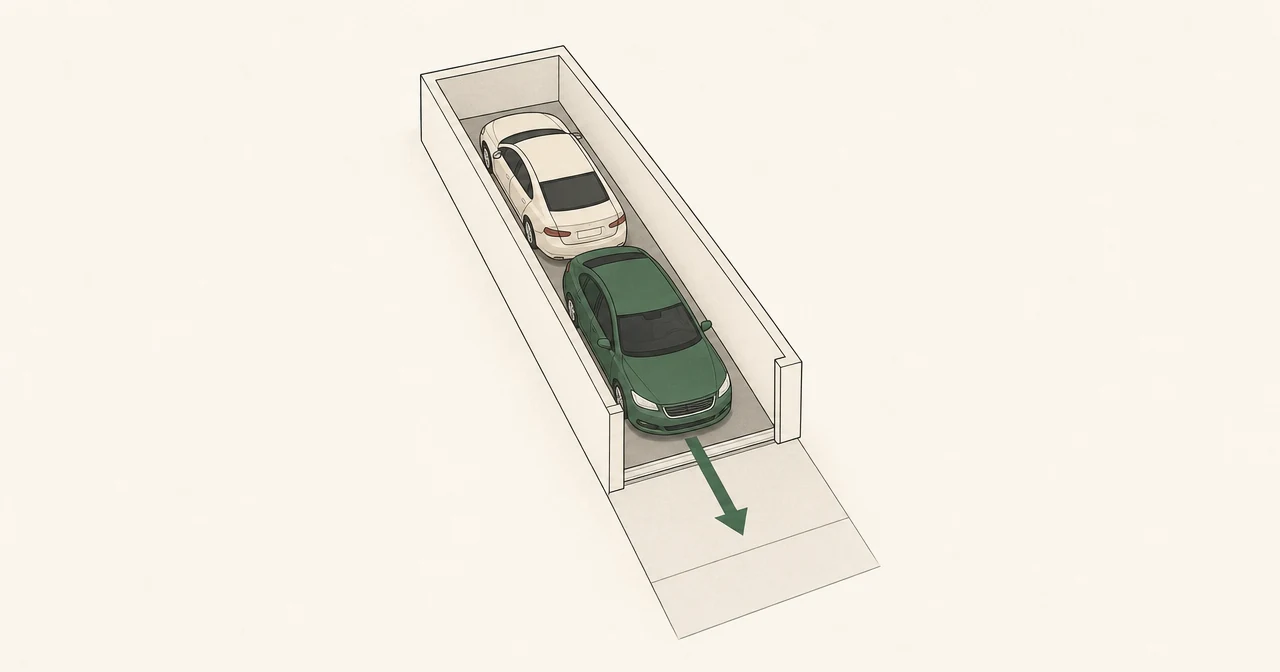
“Two parking spaces” can sound like two easy exits. A listing that adds “tandem” changes that expectation, and a quick garage photo may leave the biggest questions unanswered.
The practical issue is whether you can get your car out when you need it. Understanding the layout, the person you share with, and the parking terms helps you decide whether the apartment fits your routine before you commit.
What does tandem parking mean?
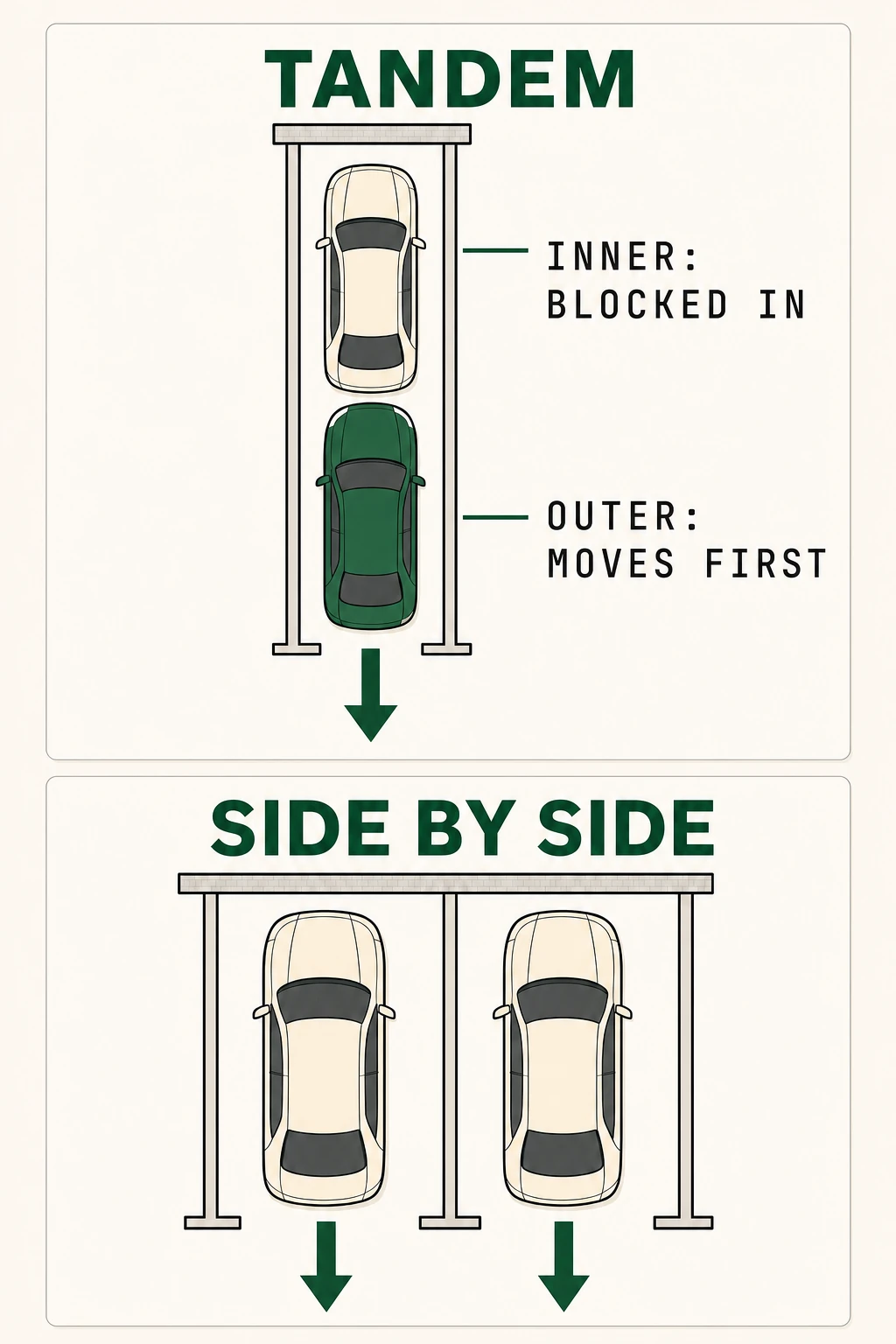
Tandem parking means vehicles park in a single-file line, one behind the other. In a two-car setup, the car nearest the exit must move before the car farther inside can leave.
You might see this arrangement in a long garage bay, a driveway, or an outdoor parking area. “Tandem garage” describes an enclosed version of the same layout. The word describes how the cars sit, not whether parking is covered or included in rent.
To avoid the confusing “front car” and “back car” labels, think of the positions this way:
- Inner position: Farther from the driveway or drive aisle. This car gets blocked in.
- Outer position: Nearest the driveway or drive aisle. This car moves first to let the inner car out.
With side-by-side spaces, each car has its own route to the aisle. With tandem parking, the cars share that route.
If independent access is a must-have, make it part of your apartment search from the start. We’re free for renters. Tell our AI agent for renters what you need, and we find matches, call landlords and leasing offices, ask your questions, and book tours.
Does the whole tandem pair belong to your apartment?
The layout alone does not answer that question. A listing’s “tandem parking” label is too vague to establish how many cars you may park or who uses the other position.
These arrangements create different daily experiences:
| Arrangement | What it means for access | Question to resolve |
|---|---|---|
| Both positions belong to your household | You coordinate with a partner or roommate, or manage both of your own cars. | Are both positions and both vehicles included in the assignment? |
| You share the pair with another apartment | Your departure may depend on someone who lives elsewhere in the building. | Who uses the other position, and how are blocked-car requests handled? |
| Staff move or retrieve the cars | Access depends on the property’s operating process. | Who can move the cars, during which hours, and what happens after hours? |
Even if you own only one car, the assignment matters. A single car in the inner position can still be blocked by another household’s vehicle. Having the entire pair reserved for your household is a different offer from renting one position within it.
Ask the leasing office to identify the exact bay and explain the assignment in writing. “Parking available” and “two cars fit” leave too much open.
How tandem parking affects an ordinary day
When the first driver pulls fully into the inner position, the second driver can use the outer one. Later, an inner-car departure requires the outer car to move far enough to clear the route. That may involve a second driver coming downstairs and then putting their car back.
UCLA Housing’s tandem guidance makes the coordination responsibility explicit: residents in its tandem spaces arrange their driving schedules with their parking partner and pull fully forward when arriving first.
The useful question is how often your arrival order conflicts with your next departure order. Consider this example:
- You arrive home at 5 p.m., park inside, and need to leave at 6:30 a.m.
- Your roommate arrives at 8 p.m., parks outside, and leaves at 9 a.m.
- Unless you rearrange the cars that evening, your early departure requires your roommate’s car to move too.
Predictable work hours do not automatically solve that conflict. Putting the early-departure car nearest the exit can help, but it may require an evening shuffle. Errands, overnight guests, and changed shifts add exceptions.
Before accepting the space, imagine a normal weekday, a late return, and a day when the other driver is away. An arrangement that works only when both people are home and answering their phones gives you limited flexibility.
What to ask before accepting tandem parking
The tour should establish the physical setup. The written parking terms should establish what you are paying for and how you may use it. These are useful additions to your broader apartment viewing questions.
1. Which exact positions and vehicles are included?
Ask for the bay number, whether you get the inner position, outer position, or both, and how many vehicles your household may register. If the pair is shared with another apartment, ask whether the pairing can change and how new drivers are introduced.
Request the lease’s parking terms or separate parking agreement before committing. The documents should describe the same arrangement the leasing office showed you.
2. Will your cars fit through the route and into the space?
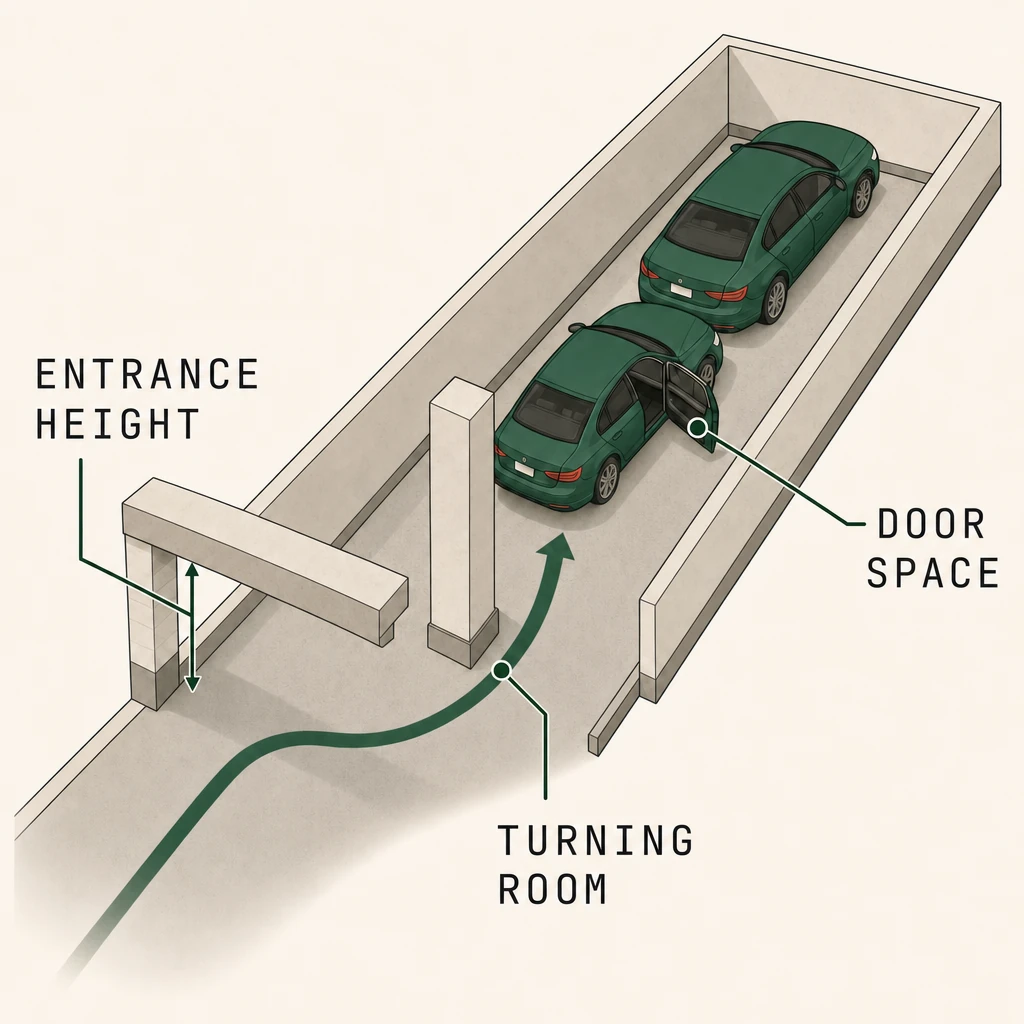
A two-car label does not establish that your two cars will fit comfortably. Ask for the marked bay’s length and width, entrance height, and any vehicle restrictions. Bring your vehicles’ dimensions, including mirrors, roof racks, or other attachments.
The approach matters as much as the rectangle on the ground. A narrow turn, column, ramp, or low garage entrance can limit access before you reach the bay. Ask the person showing the property to demonstrate the maneuver and explain where the outer car goes while the inner one leaves.
Allow for the tasks you actually do beside a parked car: opening the driver’s door, reaching a child’s car seat, unloading groceries, or opening a hatch. A space that holds two closed cars can still be awkward to use.
3. What is the full parking cost?
Ask whether the quoted amount covers one vehicle or the pair, whether it is monthly or included in rent, and whether there are separate permit, remote, or access-device charges. Keep refundable deposits separate from fees.
If an independent space is available, compare its actual price with the tandem option. Tandem parking does not automatically mean a discount. Include whichever option you would really use in your monthly apartment budget.
Also ask whether the parking assignment lasts for your lease term and what the written terms say about cancellation or reassignment. A space available during the tour is not necessarily a space reserved for your move-in.
4. What happens when you are blocked in?
A workable answer covers more than “text the other person.” Ask:
- How do drivers contact each other, and what is the backup when someone does not respond?
- Who handles repeated access problems, including evenings and weekends?
- Where may a driver temporarily move a car during a shuffle?
- What is the process if a car will not start or the garage gate will not open?
- Is there an alternative assignment if the pairing becomes unworkable?
A contact number is useful, but it does not provide independent access. If you need to leave at unpredictable times, a plan that relies on another driver replying may not meet your needs.
5. Which rules apply to guests and vehicle changes?
Ask about registration, permits or access devices, visitor parking, and the process for using a rental or loaner car. An empty position does not establish permission for a guest to use it.
Treat spare-key sharing as a separate decision. Everyone involved needs to agree on who may move a vehicle and under what circumstances. You do not have to feel comfortable handing over your keys just because the listing includes parking.
A message you can send the leasing office
Could you send the parking agreement and identify the exact tandem bay for this apartment? Please confirm whether my household gets one position or both, who uses the other position, the total charges, vehicle limits, and the blocked-car process after hours. I’d also like to see the bay, entrance clearance, and maneuvering area during the tour.
Is tandem parking worth accepting?
Tandem parking can be a reasonable trade-off when your household controls both positions, the cars fit, and the routine does not create frequent conflicts. A rarely used second car may be easy to keep inside while a daily driver stays nearest the exit.
It deserves more caution when you share with another household, both drivers make frequent trips, work hours change without warning, or your job depends on being able to leave immediately. Those are access requirements, not failures to be a cooperative neighbor.
A practical decision comes down to four things:
- Assignment: You know exactly which positions and vehicles are included.
- Fit: The bay, entrance, and maneuvering area suit your vehicles and daily tasks.
- Access: The normal routine and backup plan match how reliably you need to leave.
- Cost: The price makes sense alongside the actual alternatives available to you.
If one of those is unresolved, the parking offer is still incomplete. Two places to put cars are useful only when the arrangement also works for the people driving them.
Tell us your parking must-haves and start your apartment search with us, so the next shortlist starts with how you actually live.