Renter guide
What Is Valet Trash? A Renter’s Guide to Pickup and Fees
What is valet trash? Learn pickup timing, bag rules, missed-pickup steps, and fee tradeoffs before signing. From Fairway, your free AI agent for renters.
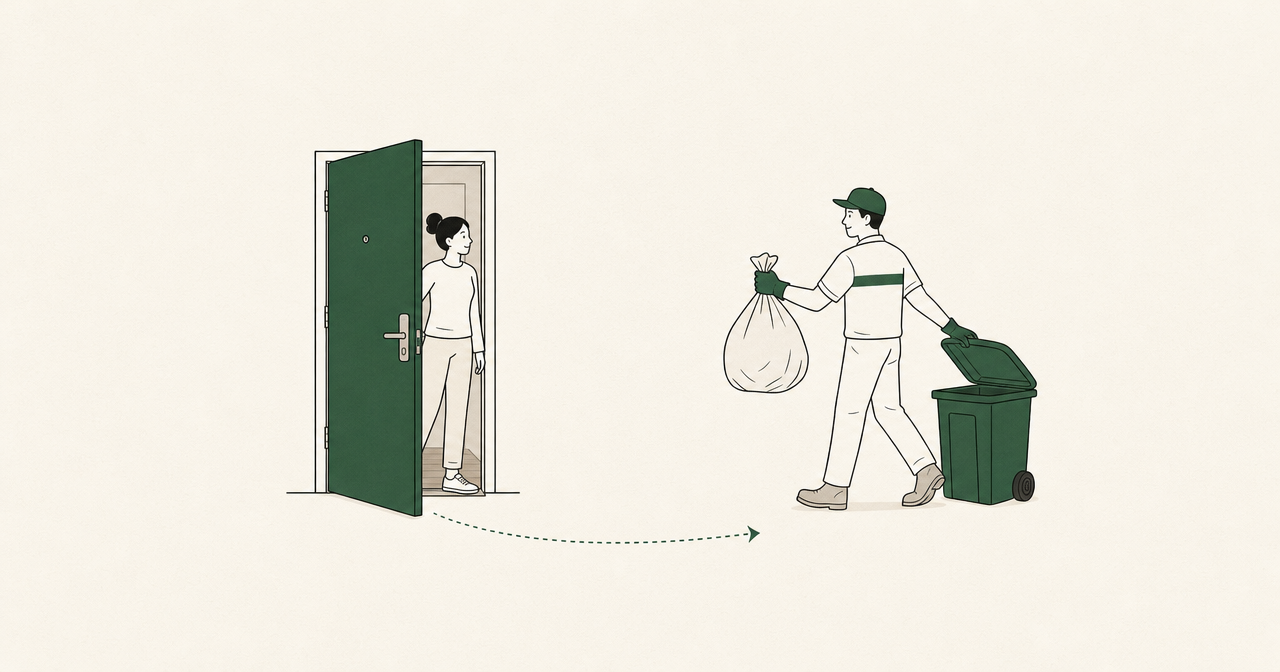
A doorstep trash service sounds simple until you find the monthly charge, the two-hour set-out window, and the rule about bringing the bin back inside. Those details decide whether it saves you a trip or adds another chore. Here’s how valet trash fits into an ordinary week, what can be collected, and which answers are worth getting before you commit to a lease.
What is valet trash in an apartment?
Valet trash is scheduled pickup of bagged household trash from outside your apartment door. You put tied bags in the community’s designated container during the allowed hours. A collector takes the bags to the property’s disposal area. You bring the empty container back inside.
You may also see it called valet waste, trash valet, or doorstep trash collection. It generally covers the trip from your door to the dumpster or compactor. It does not mean someone enters your apartment, empties your kitchen bin, or collects anything you leave in the hallway.
The apartment community usually arranges the service. Your cost may be included in rent or billed separately, and a required fee can apply even when you never set a bag out.
Unclear charges are easier to untangle while you’re still comparing apartments. At Fairway, our AI agent for renters can call leasing offices, ask about fees, and book tours. It’s free for renters and cuts down on phone tag.
Pickup has three separate time rules
Five evening pickups a week, often Sunday through Thursday, is a common arrangement. Other schedules exist, and holidays or severe weather can interrupt service. “Nightly pickup” on an amenity list is too vague to plan around.
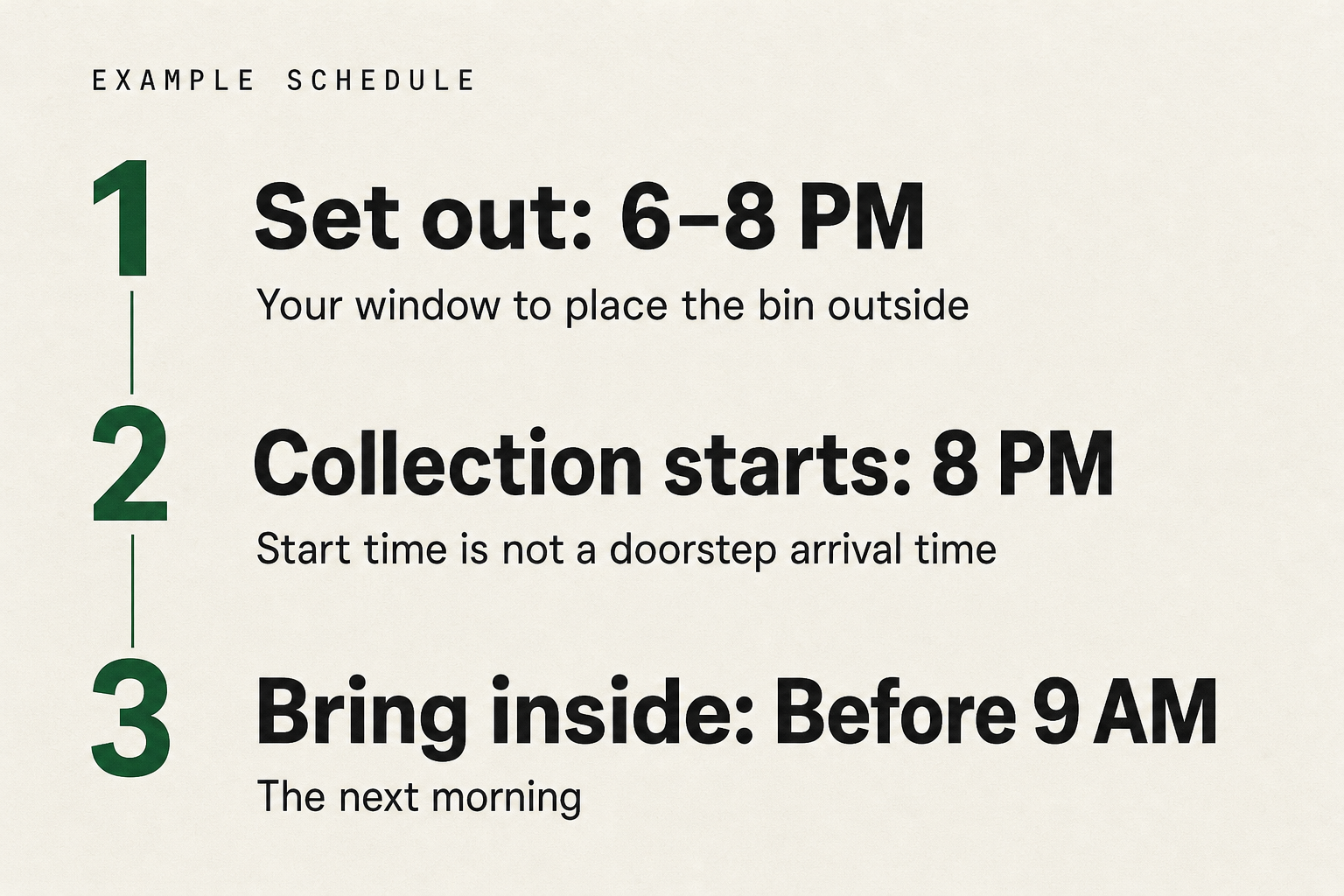
The important distinction is between when you can set trash out, when collection starts, and when the bin must come inside. Those are three different times.
For example, the Ark House resident handbook describes Sunday-through-Thursday service, a 6–8 p.m. set-out window, collection starting at 8 p.m., and a return-inside deadline before 9 a.m. the next morning. That illustrates the routine, rather than a schedule that applies to every apartment.
- Set-out window: The period when the container is allowed outside. Leaving it out before work may be too early, even on a service day.
- Collection start: When the route begins. An 8 p.m. start does not promise an 8 p.m. arrival at your door. Setting a bag out after collection begins can miss your building’s pass.
- Bring-in deadline: When the container must be back inside, even if you’re sleeping or away. This can matter as much as the evening window for someone working nights.
The off-days matter too. With Sunday-through-Thursday pickup, trash generated after Thursday’s collection may need to wait until Sunday or go to the resident disposal area. A five-night service still leaves a weekend gap.
Before choosing an apartment, picture your actual week. If you leave for work at 4 p.m. and return at midnight, a 6–8 p.m. set-out window may offer little help. Get the off-hours disposal location and access hours along with the pickup schedule.
Bag and container rules decide what gets picked up
The usual starting point is ordinary household trash in a securely tied, leak-free bag inside the approved container. Loose rubbish, an overflowing bin, or a bag on the floor can be left behind. Community policies may also attach charges to those problems.
The exact limits vary. A 13-gallon bag is common, but there is no universal bag count, weight limit, or rule for stacking extra bags.
| Part of the routine | What matters for your apartment |
|---|---|
| Bagging | A bag strong enough to lift without tearing, tied closed with no loose items or leaking liquid |
| Weight | The stated per-bag limit. Cat litter can make a small bag heavy long before it looks full |
| Container | The designated bin, its approved location, and any requirement to keep its lid fully closed |
| Extra bags | The allowed number and placement. Permission to use two bags does not automatically mean one can sit on the floor |
| Cardboard | Whether pickup includes it, how flat it must be, and where it belongs |
| Pet waste | Whether it is accepted and whether double-bagging or another preparation rule applies |
Keep enough room to tie the bag without stretching it across the rim. The collector needs to lift the bag out, so wedging it tightly into the bin can also cause trouble. Cleaning the container remains part of the renter’s routine at many communities.
Recycling and bulky items need their own answer
Recycling is included in some services, but its collection days, accepted materials, and packaging can differ from regular trash. Some programs use a separate container or specified bag. A bagging rule for valet recycling should not be carried over to another recycling system.
Furniture, mattresses, appliances, hazardous materials, and large unflattened boxes generally fall outside ordinary doorstep pickup. A monthly valet-trash charge does not automatically include move-out hauling. Get the separate disposal instructions before leaving any of those items outside.
What to do when valet trash misses your door
A bag still outside at 8:15 p.m. is not necessarily a missed pickup when collection only started at 8. A bag still there after the route is finished needs a different response.
Start with the service notice or resident app, if one is available. It may show that collection is still running, that a holiday changed the schedule, or that service was suspended. Then separate three situations:
- The bag went out after the cutoff. Use a return-request option if the service offers one. Some providers allow a “come back” request while the route is active. That does not guarantee a second pass.
- The bag was left because of a stated rule. Save the notice and photo, if provided. Rebag a leaking or overweight load, or correct the placement before the next eligible pickup.
- The bag was ready on time and was skipped. Use the reporting route in your property’s written policy or resident app. Some communities route reports through leasing first; others accept direct provider support. If the route is unclear, ask the leasing office. Include your community or building, unit, service date, set-out time, and a photo of the bag in its container.
After a missed service, keep the trash securely contained inside or use the designated resident disposal area according to the community’s instructions. Leaving it outside through a non-service day creates another problem and may violate the set-out rules.
A short written message makes follow-up easier:
My trash was set out at [time] on [date], within the stated window, in the approved container with tied bags. It remained uncollected after the route ended. I’ve attached a photo. Please confirm whether a return pickup is available and how I should handle the trash before the next service.
For repeated misses, keep the dates, photos, ticket numbers, and responses together. Ask the leasing office for a service correction and whether a credit is available. A refund or return trip is not something to assume.
Reliability deserves its own question before signing. In WSB-TV’s reporting, residents at one Georgia community said they paid $25 a month despite prolonged missed collections. The service being listed and the service working consistently are separate facts.
What does valet trash cost, and is it worth it?
Separately billed monthly fees include $25 at Alexan Gruene Crossing, $30 at Luca Apartments, and $35 at Waverly Terrace, according to those properties’ fee schedules. That puts the added cost at $300 to $420 over a 12-month lease. These are examples, not a national price limit. A Texas housing report documented a $35 monthly valet-trash charge at one Austin property.
The doorstep fee can also sit alongside a separate trash-removal charge. They can cover different parts of disposal, so “trash included” is not a clear answer about whether doorstep pickup costs extra. You want the valet amount and the total required monthly price for the exact apartment.
Judge the pickups you can actually use
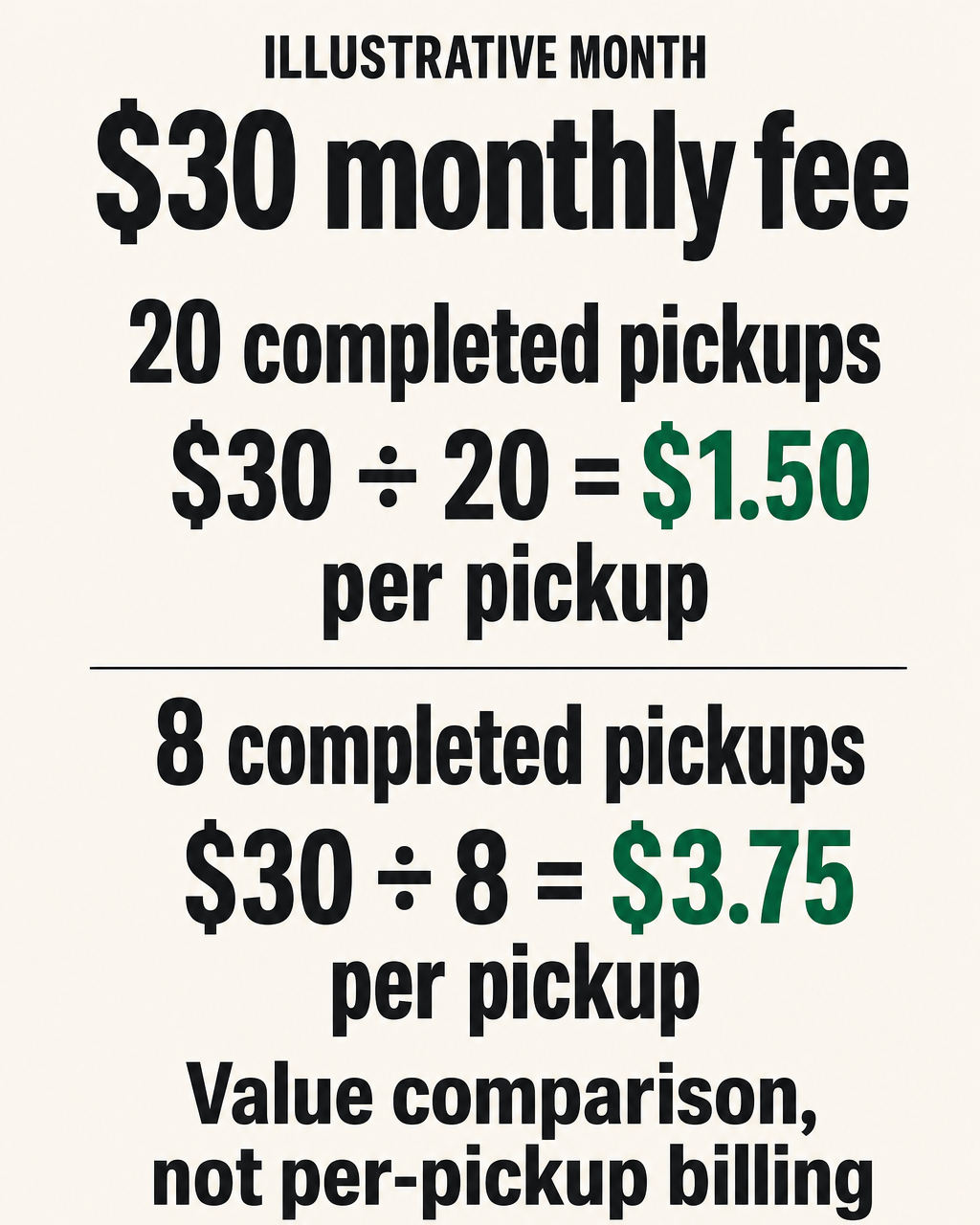
A $30 monthly fee costs the same whether you use the service most nights or twice a week. For an illustrative month:
- At 20 completed pickups, $30 works out to $1.50 per pickup.
- At 8 completed pickups, the same $30 works out to $3.75 per pickup.
- At zero pickups, it is a $30 housing cost with no trips saved.
Divide the monthly fee by the pickups you realistically expect to use. Offered service nights can overstate the value if work, travel, or a small amount of household trash means you rarely participate. This calculation is a way to judge convenience, not a per-pickup billing or refund formula.
The service can be worthwhile when the dumpster is far away, your apartment is up several flights, or carrying bags is difficult. It can be poor value when a chute is nearby, the pickup window conflicts with your schedule, or you still need frequent disposal trips for excluded items. The bin also needs a place inside your home between pickups.
Compare the apartment’s total price
A mandatory valet fee belongs in the apartment comparison even if you dislike the service. Suppose two otherwise comparable apartments have the same other required costs:
| Apartment | Base rent | Required valet fee | Monthly total for these two lines |
|---|---|---|---|
| A | $1,850 | $30 | $1,880 |
| B | $1,875 | $0 | $1,875 |
Apartment A’s lower advertised rent still leaves it $5 more expensive each month. A service you genuinely like may justify that difference. A label on an amenities page cannot make that decision for you.
If you want a lower total, ask about an opt-out, fee waiver, or rent credit before committing. Some communities will decline. Our guide to negotiating rent and terms explains how to make a specific offer without assuming every charge is negotiable.
Questions to ask before signing a lease
Ask for the written valet-trash policy and the charge for your exact unit while you still have other apartments to consider. These questions turn an amenity label into a routine you can evaluate:
- Is the fee required? Is it included in the quoted rent, billed separately, or optional? Does opting out remove the charge?
- What is the full-term cost? What amount will be charged each month, and what do the proposed terms say about changes?
- Which days and hours apply? Get the service nights, set-out window, collection window, bring-in deadline, and holiday notification process.
- What can go in the bin? Get the bag count, size and weight limits, lid rule, extra-bag placement, and pet-waste instructions.
- What else is collected? Ask specifically about recycling and cardboard, including their preparation and pickup days.
- Where does trash go on off-days? Ask to see the resident disposal location, its access hours, and the route from your unit.
- How are misses resolved? Which contact or app receives the report, is a return pickup available, and how are repeated interruptions or credit requests handled?
- Which extra charges are possible? Get the written rules for set-out violations, a lost or damaged container, and returning the bin at move-out.
During a tour, notice whether the container fits inside the apartment and whether the backup disposal route is manageable for you. Our broader apartment viewing questions help carry the same practical approach through the rest of the visit.
The useful question is whether the service fits your hours, your trash volume, and the apartment’s total price. If you’re still hunting, start your rental search with us. Tell us what you need, and we’ll find matches, call leasing offices, and book tours while you stay in control of the choice.