Rent negotiation
Can You Negotiate Rent? Build an Offer a Landlord Can Accept
Learn when rent is negotiable, how to price your offer, what to say before signing or at renewal, and which lease terms can lower your total cost.
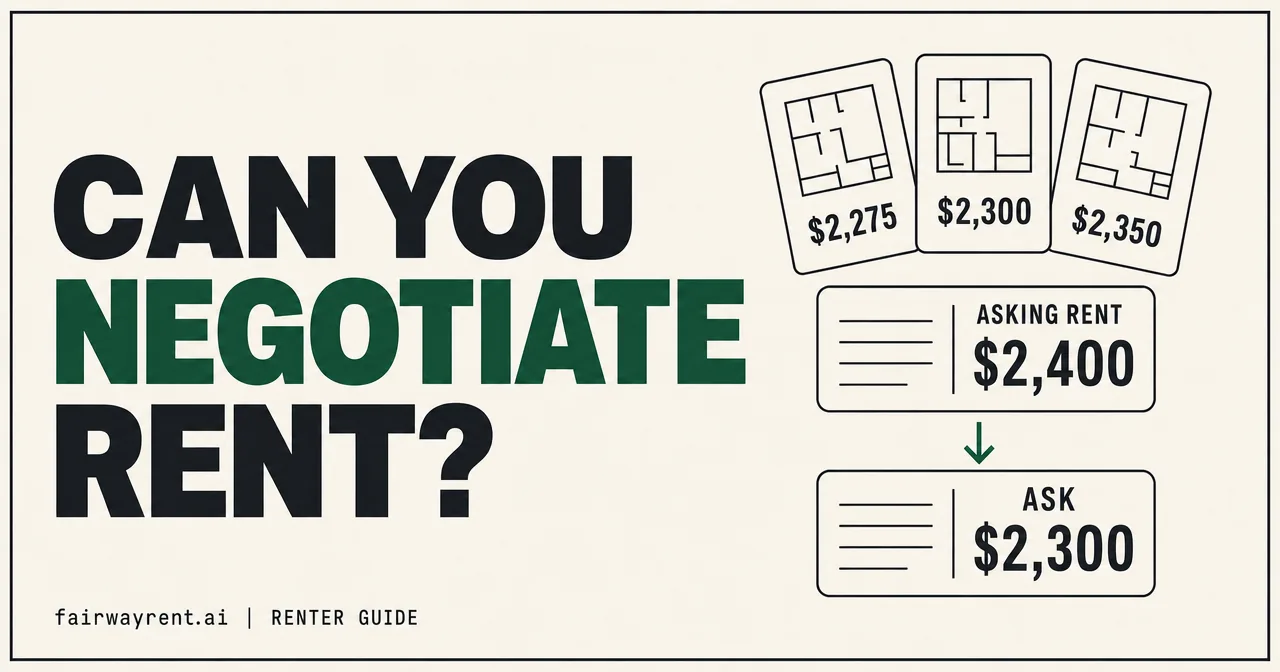
The rent in a listing can look oddly official, right down to the last dollar. Then the fees arrive, the special has conditions, and your renewal quote lands higher than expected. A useful negotiation starts by finding the landlord's reason to make a deal. Here is how to measure your leverage, choose a defensible number, make the ask, and protect the result in the lease.
Yes, you can negotiate rent
You can negotiate rent before signing a new lease and when your current lease comes up for renewal. Under a fixed-term lease, rent generally stays at the amount stated for the term. It may change during the term when the lease itself or applicable law permits it, or when the landlord and tenant agree to modify it. If you and the landlord agree to a change, document it in a signed amendment. The pre-signing and renewal windows are still the cleanest times to negotiate.
An ask is no guarantee. Your odds depend on the exact apartment, local competition, timing, and the landlord's alternatives. In July 2026, 39.8% of rentals on Zillow advertised a concession. That shows how often listings carried marketed incentives, not how often renters negotiated a lower base rent. The national rental vacancy rate was 7.3% in the second quarter of 2026, according to the U.S. Census Bureau. That rate provides broad supply context. It does not prove that a particular landlord has room to deal.
| When you ask | What is open for discussion | Where your leverage comes from |
|---|---|---|
| Before applying or signing | Base rent, move-in credit, fees, parking, lease term, start date, repairs | Comparable apartments, listing age, other vacant units, flexible timing, a complete application |
| At renewal | Proposed increase, renewal term, fees, parking, upgrades, future increase terms | Your payment record, care of the home, comparable listings, the landlord's vacancy and turnover risk |
| During a signed lease | A voluntary lease amendment, transfer, sublet, or early-exit arrangement | A change that also solves a problem for the landlord |
A real backup apartment makes every version of this conversation easier. In the SF Bay Area, our free AI agent for renters can watch listings, surface fees, call landlords, and help book tours. You enter the negotiation with actual alternatives instead of hoping one landlord changes their mind.
Find your leverage before naming a price
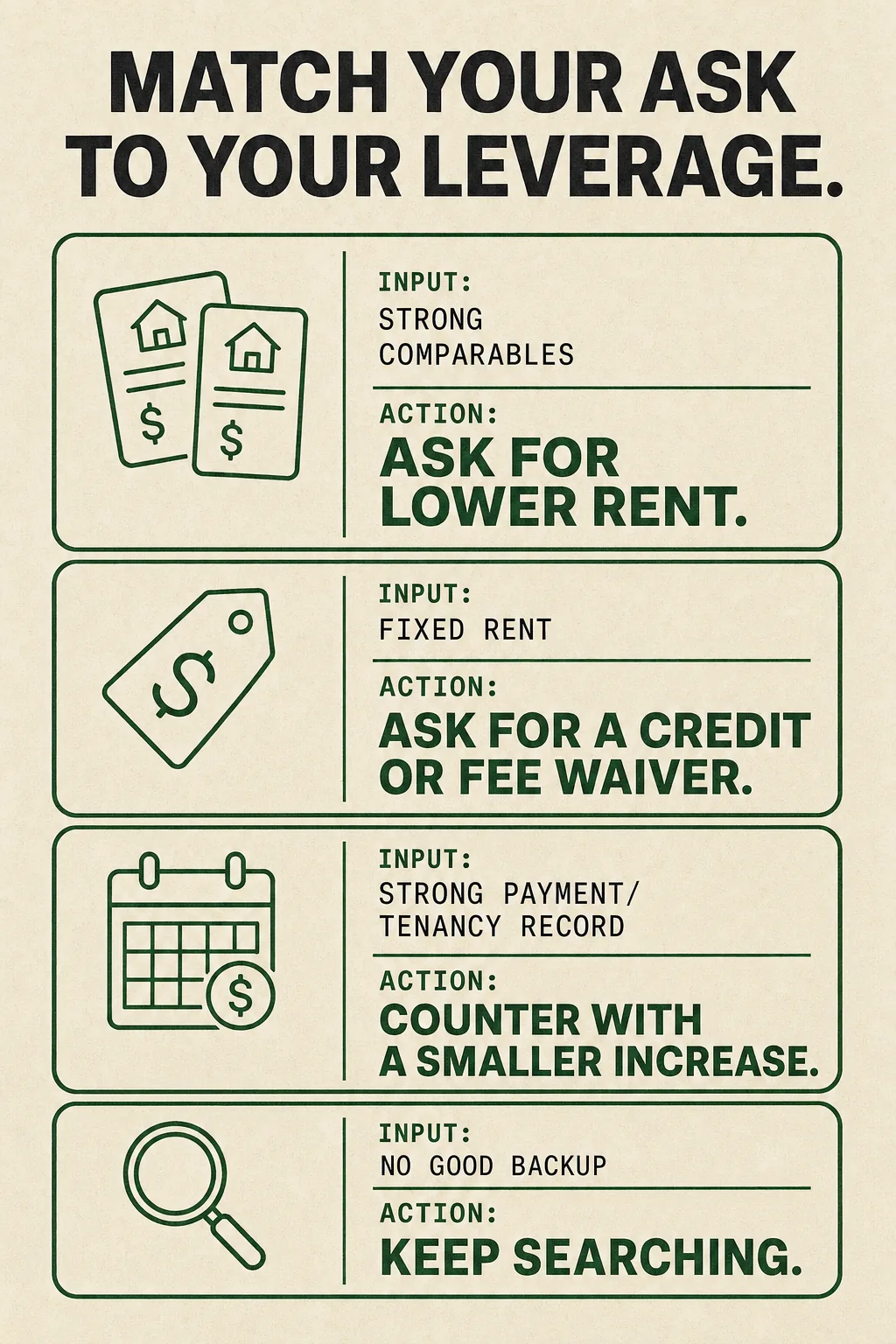
The strongest argument is economic. Show why accepting your offer is better for the landlord than waiting for another renter or replacing you at renewal.
Signs you have room to negotiate
- The apartment has been listed for several weeks, relisted, or reduced in price.
- The property has several similar vacant units or advertises move-in specials.
- Comparable apartments nearby cost less after mandatory fees.
- You can start the lease sooner or choose an end date the landlord prefers.
- You meet the written screening criteria and can submit a complete application promptly.
- You are renewing after paying on time and following the lease.
Signs the landlord has the stronger hand
- Several qualified applicants are ready to pay the asking price.
- The unit is a fresh listing, unusually well priced, or hard to replace in your search.
- Your “comparables” are in a cheaper area, lack similar features, or have different move-in dates.
- You need this one apartment and cannot credibly walk away.
- Local rents are rising quickly and similar homes disappear within days.
One signal rarely settles the question. A unit can sit for 30 days because it is overpriced, under repair, already promised to someone, or simply stale online. Ask whether the exact unit is available, when it can be occupied, and whether other applications are under review.
Build your offer from comparable apartments
“Can you do any better?” is easy to dismiss. An exact offer supported by close comparisons gives the landlord a decision to make.
1. Collect three to five real alternatives
Use apartments you would genuinely consider. Match the neighborhood, bedroom count, property type, condition, parking, pet policy, amenities, and move-in window as closely as possible. A studio six miles away does not establish the price of a one-bedroom next to your office.
Save the address, unit, date, base rent, mandatory monthly fees, concession, lease length, and available date. Take a screenshot because prices and specials change. Active listings show what other landlords are asking. A recent leased price, when available from a reliable local source, is stronger evidence of what a renter actually agreed to pay.
2. Compare the full cost
Ask for an itemized quote before paying an application or holding fee. The FTC has taken action over advertised rents that excluded mandatory monthly charges. Your comparison should include required trash, technology, package, amenity, parking, pet, and utility administration charges where they apply.
Convert free rent into a net effective rent:
Net effective rent = (base rent for the full term - rent credits) / lease months
A $2,400 apartment with one month free on a 12-month lease has a net effective rent of $2,200. You may still owe $2,400 in each paid month, and a renewal may start from the $2,400 base. Our rent concession guide explains how to compare the credit timing, fees, and clawback terms.
3. Decide how much to ask off rent
There is no useful universal percentage. Let close comparables set the range, then choose three numbers before contacting the landlord:
- Your opening offer: a specific amount that your comparable apartments support.
- Your acceptable deal: the highest all-in cost you would choose over your backups.
- Your walk-away point: the price or lease term that makes another apartment the better decision.
Suppose the target unit is $2,400 plus $125 in required monthly fees, or $2,525 all-in. Three close alternatives are $2,275 to $2,350 plus $50 in fees, or $2,325 to $2,400 all-in. A $2,300 base-rent offer would still cost $2,425 after the target unit's fees. That is $25 above the highest comparable, which can make sense if the target has a location, layout, or feature worth the small premium. If it does not, a $2,275 base-rent offer would bring the all-in cost down to $2,400. Either version has a factual basis. “My budget is $2,300” does not explain why the landlord should agree.
At renewal, do the turnover math too. If a landlord proposes $2,550 and you counter at $2,475, the $75 monthly difference is $900 across a year. One vacant month forgoes $2,550 in gross scheduled rent before cleaning, repairs, marketing, or screening. The landlord may still reject the counter, but keeping a reliable renter can be the less expensive option.
How to negotiate rent before signing a lease
Make the ask after you understand the exact unit and full price. Ideally, negotiate before submitting a paid application or holding deposit. Once you have spent money and stopped searching, your leverage shrinks.
Ask the broker or leasing contact who can approve a price or concession. Then keep your message short:
Hi [name], I liked unit [number] and I am ready to move forward. I found three comparable [one-bedroom apartments] nearby with base rents of [$2,275 to $2,350] and required monthly fees of [$50], for all-in costs of [$2,325 to $2,400]. With this unit's [$125] monthly fees, a [$2,300 base rent] would cost [$2,425] all-in. I am willing to pay that small premium for [the location or feature]. Would you consider [$2,300 base rent] for a [12-month lease] starting [date]? I meet the stated screening criteria and can submit a complete application today. Please let me know whether that works or whether the owner has a counteroffer.
The useful parts are simple: real interest, relevant evidence, one number, a clear lease term, and something you can do promptly. Skip the life story. Saying the apartment is unaffordable can raise questions about whether you meet the income standard. Keep the case focused on the market and the value of your offer.
Large apartment communities may use set rates and decline to change base rent. Ask for a quote across available lease lengths and start dates, then ask which current specials apply to the exact unit. A leasing office may have more room on a rent credit, parking, storage, or fees than on the displayed rent.
Do not let a negotiation drag past a real deadline. A good apartment with multiple applications can disappear while you wait to save $50. Decide in advance whether you would accept the asking price if the answer is no.
A landlord may reject your counteroffer and choose an applicant who offers full price. That discretion still has limits. For housing covered by federal fair-housing law, the Fair Housing Act prohibits discrimination in rental terms based on protected characteristics. State or local law may protect additional groups.
How to negotiate a rent increase at renewal
Read your current lease before responding. Note its end date, renewal process, required notice, delivery method, and any month-to-month rate. State and local rules may also control notice periods, rent increases, and renewal rights.
Start when the renewal offer arrives, before your deadline to give notice. Then assemble:
- your on-time payment record
- close listings in your building or neighborhood
- the landlord's advertised price for similar vacant units
- a specific rent and lease term you would accept
- the date by which you need an answer so you can plan a move if needed
Use this script:
Hi [name], I would like to stay in unit [number]. I have paid on time throughout my tenancy and taken good care of the apartment. The renewal offer is [$2,550]. Comparable units at [addresses or building] are currently offered at [$2,400 to $2,475]. Would you renew my lease for [12 months] at [$2,475]? I can sign by [date] if the written renewal reflects that rate.
Stay matter-of-fact. Threatening to leave only works if you are ready to move. If the answer is no, ask whether the landlord will hold your current rate, reduce the increase, or offer an equivalent credit. Then compare that deal with the cost of moving, including movers, overlap, application charges, deposits, and your time.
If your home is rent controlled, rent stabilized, subsidized, or covered by local increase limits, learn the lawful rent before bargaining. A negotiated discount should not require you to give up a protection you already have. HUD maintains a state housing directory that can lead you to local agencies and renter resources.
If you receive a voucher or other rental assistance, contact the housing agency or program administrator before agreeing to any rent, fee, utility, or lease change. Program review or approval may be required. For Housing Choice Vouchers, federal rules require agreed lease changes in writing, require the owner to notify the public housing agency of a rent change at least 60 days before it takes effect, and require agency approval of certain changes before assistance can continue.
If rent is fixed, negotiate the terms that change your cost
A landlord can reject your base-rent offer and still improve the deal. Ask for the item that has the most real value to you.
| Alternative ask | How to value it | Fine print to settle |
|---|---|---|
| Rent credit or free month | Exact dollars credited | Payment date, eligible unit and term, clawback conditions |
| Waived mandatory fee | Fee avoided across the lease | Which fee, amount, and waiver period |
| Free parking, storage, or pet rent | What you would otherwise pay | Space or service included, start and end dates |
| Lower security deposit | Cash you keep at move-in | Whether the replacement charge is refundable or recurring |
| Cosmetic upgrade or appliance | Your value of the completed work | Exact work and completion date before move-in |
| Longer rent lock | Avoided increase during the added term | Rent for every month and the early-exit rules |
| Flexible start or end date | Overlap or temporary housing avoided | Exact possession, rent, and key dates |
Be careful with trades that create a bigger risk than the discount. Prepaying many months can drain your emergency fund, and advance-rent rules vary. Doing repairs yourself can create disputes over workmanship, materials, injury, and responsibility. A longer lease is valuable only if you want to stay and understand the cost of leaving early.
Keep safety, habitability, and legally required work separate from optional upgrades. A landlord's existing repair duty is not a rent concession.
Also separate savings from cash flow. Reducing a normally refundable deposit helps at move-in, but it may save nothing over the full tenancy. Replacing it with a nonrefundable monthly product could cost more.
Put every accepted term in the lease or an amendment
A friendly email saying “we can probably waive parking” is unfinished. For a new tenancy, put each accepted term in the lease or signed addendum. For an agreed change during a tenancy, document it in a signed amendment. Before signing or paying move-in funds, confirm that the document states:
- the exact address and unit
- base rent and every mandatory fee
- lease start and end dates
- each credit or waived charge, including when it applies
- any condition that cancels or claws back a concession
- promised repairs and completion dates
- parking, pet, storage, roommate, sublet, and early-exit terms you negotiated
Read the final version again after any change. A lower rent does not make a new fee, stricter exit clause, or missing concession harmless. Sign the deal you calculated.
Keep a backup moving while you ask
The best negotiating position is calm, specific, and ready to choose another good home. Keep touring until the agreed price and terms are in the signed lease or amendment.
If you are searching in the SF Bay Area, start a Fairway rental search with what you need. Our free AI agent for renters watches listings, Craigslist included, surfaces fees, calls landlords, and helps get tours onto your calendar. Start with better options, then make the offer that fits your budget.