Renter guide
Can I Change My Move-In Date After Signing a Lease?
Need to change your move-in date after signing a lease? Learn about requests, amendments, rent, and keys from Fairway, the AI agent for renters.
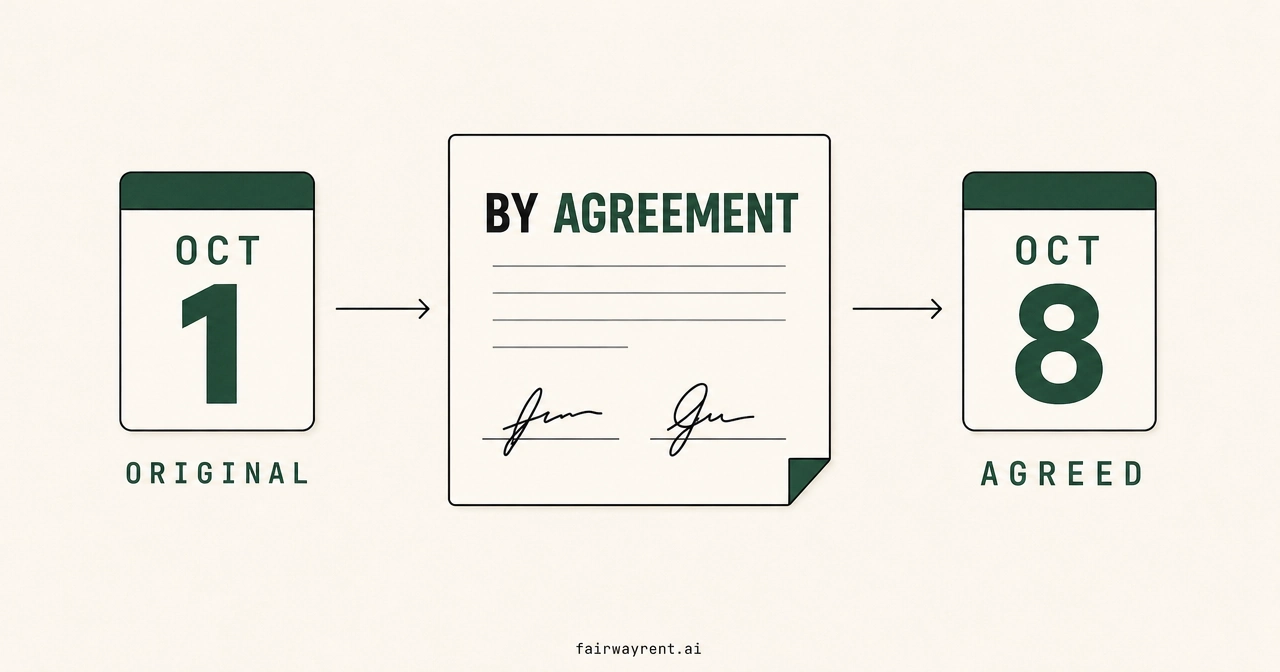
A delayed flight, a new work schedule, or movers who suddenly have other plans can throw off a move. The awkward part is that your lease already has a date on it, and changing your calendar may leave your payment obligations untouched. A clear request starts with separating the day you arrive from the date your rental begins, then getting the agreed dates, costs, and access arrangements into the same written record.
Can you change your move-in date after signing?
You can request a change. Whether it happens depends on your signed lease, the landlord's agreement, and applicable state or local rules. An ordinary scheduling conflict does not give you a universal right to postpone the lease or get money back.
Moving your furniture a week later can be a scheduling change. Starting the lease a week later changes a contract term and potentially the rent. Be clear about which outcome you need before asking.
The New York Attorney General explains that a lease in effect cannot be changed unless both parties agree. A signed amendment is a practical way to record a mutually agreed date change without leaving the rest of the deal uncertain.
For the apartment search, our AI agent for renters is free for renters. You describe what you want, and we find matches, call landlords, and book tours. Changing an existing lease date still needs an agreement with your landlord or authorized property manager.
Decide which date you need to change
A lease can contain several dates that do different jobs. The labels vary, so read the wording around each one.
| Date | What it means for your request |
|---|---|
| Signing date | When you signed the agreement. Signing in advance does not itself give you permission to move in early. |
| Lease commencement or start date | The beginning of the rental term. This is separate from the date you signed. |
| Possession or access date | When the landlord is supposed to make the home available to you under the agreement. Key pickup is part of arranging that access. |
| Physical move-in date | When you bring your belongings or start staying there. It can be later than the agreed start and access dates. |
| Payment due dates | When rent, deposits, or other amounts must be paid. A new arrival date does not automatically move these deadlines. |
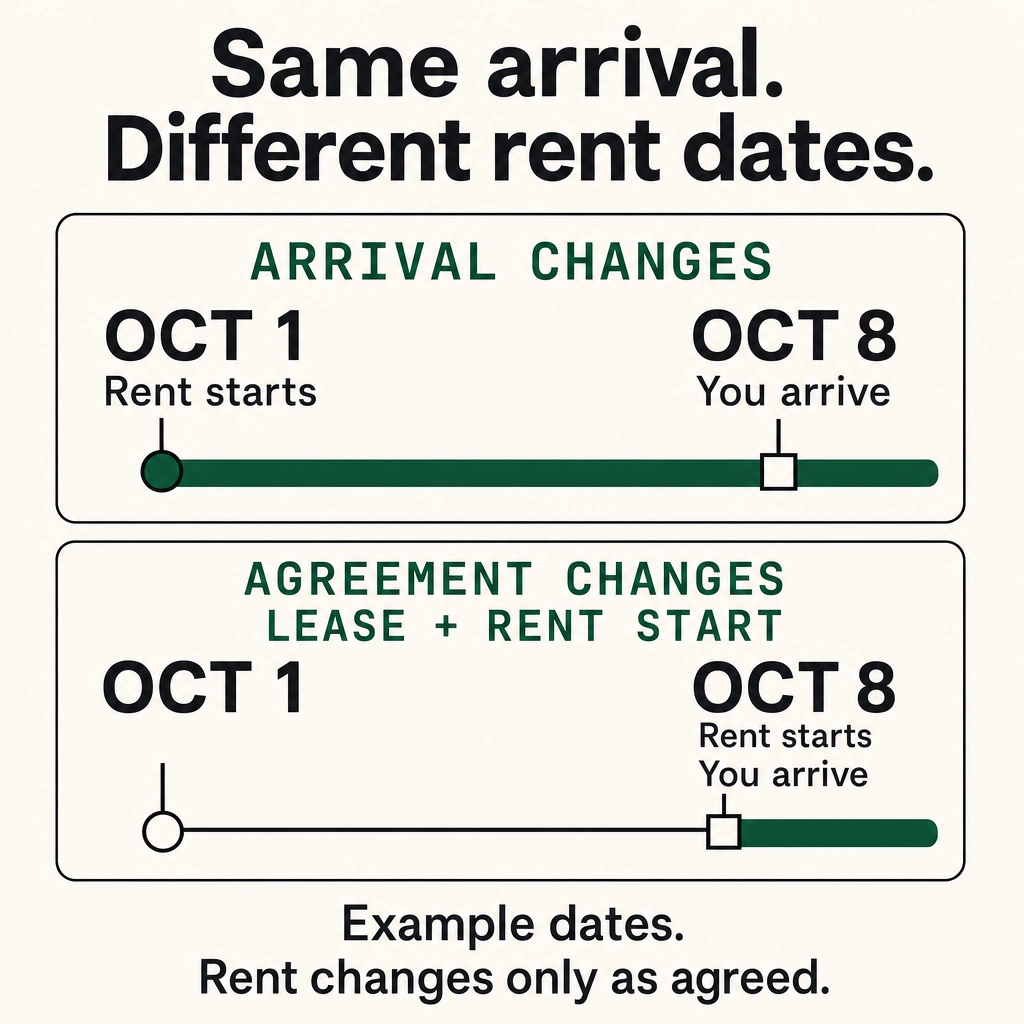
Suppose your lease starts October 1 and the apartment is available that day. Your movers reschedule to October 8. If only your arrival changes, rent can still run from October 1. You might arrange key pickup and the condition inspection earlier, then move your belongings on October 8.
If you want rent and the lease term to begin October 8 instead, say that explicitly. “Can I move in on the eighth?” leaves room for the office to approve the moving truck while keeping the October 1 charges.
An earlier move needs the same clarity. A vacant apartment is not permission to enter. Bringing boxes in before the lease starts also requires an agreed access arrangement, including any rent, insurance, or other conditions for those extra days.
Read the signed lease before making your request
Start with the complete signed lease and its addenda, rather than the date on your application or an earlier email. Pull together these details:
- Start, possession, and end dates. A later start does not tell you whether the original end date will stay or move.
- Rent and payment deadlines. Include the first payment, any partial-month amount, and the regular monthly due date.
- Amendment language. Look for the process for changing terms, required signatures, and the person authorized to approve changes.
- Move-in requirements. These may include insurance, utility accounts, cleared funds, elevator reservations, or limited moving hours.
- Delayed occupancy or failure-to-take-possession clauses. These can affect what happens when a move does not occur as scheduled.
- Deposits and concessions. Note whether a holding deposit was credited toward rent or security, and whether a promotion depends on a particular start date.
Also look for any requirement to notify management about an extended absence. If you will leave the apartment empty after the lease starts, put that fact in your request.
If the signed date differs from what you agreed before signing, explain that as a discrepancy and save the earlier messages. That is a different conversation from asking for a new date because your plans changed.
Ask for a specific change in writing
Send the request as soon as you know the original plan will not work. Email or the property's documented messaging channel gives everyone a record. If you discuss it by phone, follow up with a written summary.
A useful request names the apartment, the original date, the proposed date, and whether you want to change the lease start or only your arrival. A short reason is enough. You do not need a lengthy account of a family or work problem.
Sample request to postpone the lease start
Subject: Request to change lease start date for [address and unit]
Hi [name],
I signed the lease for [address and unit] with a start date of [original date]. Because [brief reason], I would like to request a new lease start and possession date of [proposed date].
Could you let me know whether that change is possible and what the revised first rent payment, payment deadline, and lease end date would be? Please also include any effect on my deposit, fees, or concession.
If we agree, please send a written amendment for the required signatures. I would also like to arrange key pickup and the move-in inspection around the new date.
Thank you, [name]
For an arrival-only change, replace the main request with: “I plan to bring my belongings on [new date], while keeping the lease start date of [original date]. Please confirm the key pickup, inspection deadline, and moving reservation arrangements.”
A workable alternative date may help, especially if the building only allows moves during certain hours. Keep any offer to pay extra or accept a different term separate until the office explains the full cost.
Put the agreement in a signed amendment
A friendly “that should be fine” leaves important questions unanswered. Ask for a written lease amendment or addendum that identifies the original agreement and spells out the changes. Have it signed by the required renters and the landlord or authorized representative, with any other required consent documented.
The document should make these points clear:
- The home and lease being changed. Include the address, unit, names, and original lease date.
- The old and new dates. Specify the lease commencement, possession, and expiration dates separately. Identify any date that stays the same.
- The money. Record rent amounts and deadlines, deposits already paid, any agreed credits or refunds, fees, and concession terms.
- The access arrangement. Include early access or other special conditions if they are part of the agreement.
- The remaining terms. State that the other lease terms remain unchanged, except for the changes specifically listed.
If the office sends a replacement lease instead, read the whole replacement for changes beyond the date. Keep the original, the signed replacement or amendment, and the messages together.
An email or text can be useful evidence. Its legal effect depends on the circumstances, lease language, and local law. A signed amendment gives both sides a clearer record than a message about scheduling alone.
If the office says its software cannot change a payment deadline, the agreed exception can still be stated in the amendment. Ask management to bring the rent balance shown in your account and the payment instructions into line with that agreement. You should not have to guess which of two conflicting dates to use.
Reconfirm rent, deposits, and the total cost
The cost depends on which terms actually change. Later arrival alone does not create a rent discount. A later lease start may reduce a first month's charge if the landlord agrees to that rent change, but there is no automatic credit or refund.
For a simple hypothetical example, suppose monthly rent is $1,800, the agreed calculation uses a 30-day month, and the parties move the rent start from October 1 to October 8. Seven days at $60 a day produces a $420 difference. That calculation only applies if the agreement actually removes those seven days from the rent charge. Different proration methods produce different amounts.
Get the exact revised amount and due date in writing. If you already paid, the agreement should say whether any difference is refunded, credited to a named future payment, or left unchanged. A credit and a refund are different outcomes for your cash flow.
Deposits deserve their own line. Record the amount already held and what it is held for. Do not assume a security deposit becomes rent, or that a postponed move requires a second deposit. Any proposed extra charge needs a clear explanation and must comply with applicable law.
Include the costs outside the lease too: old-apartment overlap, storage, temporary lodging, mover rescheduling, and utility setup. Our apartment budget guide separates ongoing costs from the cash needed for a move.
Reconfirm keys, inspection, and moving rules
Once the written change is agreed, bring the practical arrangements into line with it.
- Keys and entry: Set the pickup date, time, location, and authorized recipient. Include building fobs, gate access, parking access, and the contact for an after-hours problem.
- Condition inspection: Confirm any move-in walkthrough arrangements and condition-report deadline. If you arrive after possession begins, ask how that deadline will be handled rather than assuming it starts when the truck arrives.
- Utilities and insurance: Align the required start dates with the agreed responsibilities and access date. Do not automatically postpone them to the day you unpack.
- Building reservations: Rebook the elevator or loading space, and confirm permitted days and hours, truck parking, and any mover insurance requirements.
- Payments and receipts: Keep the revised instructions and receipts with the lease documents. Resolve any remaining conflict between the amendment and the account balance with management.
Document existing damage with dated photos and your own written condition checklist before your belongings obscure it. The California Department of Real Estate's renter rights guide recommends this move-in documentation and states that landlord participation in its “Condition Upon Arrival” checklist is not required. Keep your own record even if there is no joint walkthrough, and reconfirm any inspection or report deadline when your arrival changes.
Our first apartment checklist covers the wider move-in tasks, from utilities to documenting the home's condition.
If the landlord declines or does not respond
A pending request is not approval. For an ordinary renter-requested scheduling change, continue treating the original lease and payment dates as the plan unless an agreed change or applicable legal right says otherwise.
You may still be able to arrive later while paying from the original start, choose a shorter delay, or negotiate a written release if the rental no longer works. A release is a separate agreement: it needs clear treatment of rent, deposits, fees, and the date your obligations end.
Simply not collecting the keys or never moving in does not automatically cancel a signed lease. Stopping payment can create a dispute or default. If you cannot proceed and agreement is out of reach, local legal aid can help you understand the obligations and options tied to your lease.
If the landlord cannot deliver the apartment on time
A landlord saying “the unit will not be ready” is different from you asking to arrive later. Save the notice, the promised access date, the reason for the delay, and receipts for costs it causes. Ask for a written explanation of when possession will be available and what the landlord proposes for rent and temporary arrangements.
Do not describe a landlord-caused delay as your voluntary postponement. A proposed amendment may also include a release of claims, so understand that language before agreeing.
Remedies depend on the lease and the jurisdiction. For example, New York's possession statute provides a right to cancel the lease and recover money paid for breach of its implied promise to deliver possession. An express lease provision can change that default rule. That is not a nationwide promise of cancellation, hotel reimbursement, or a refund.
For a missed possession date or a demand to keep paying for unavailable housing, get local advice before withholding rent, canceling, or signing away rights. USAGov's tenant help page connects renters with state resources and legal aid.
The useful end point is one clear agreement: when the lease begins, when you have access, what you owe, and when the truck can arrive. If you need a different apartment after resolving the signed lease, start a rental search with us using your actual timing and budget.