Rent payments
Can You Pay Rent With Cash? How to Keep Proof You Paid
Can you pay rent with cash? Learn state rules, receipt essentials, and no-bank-account payment options with Fairway, your free AI agent for renters.
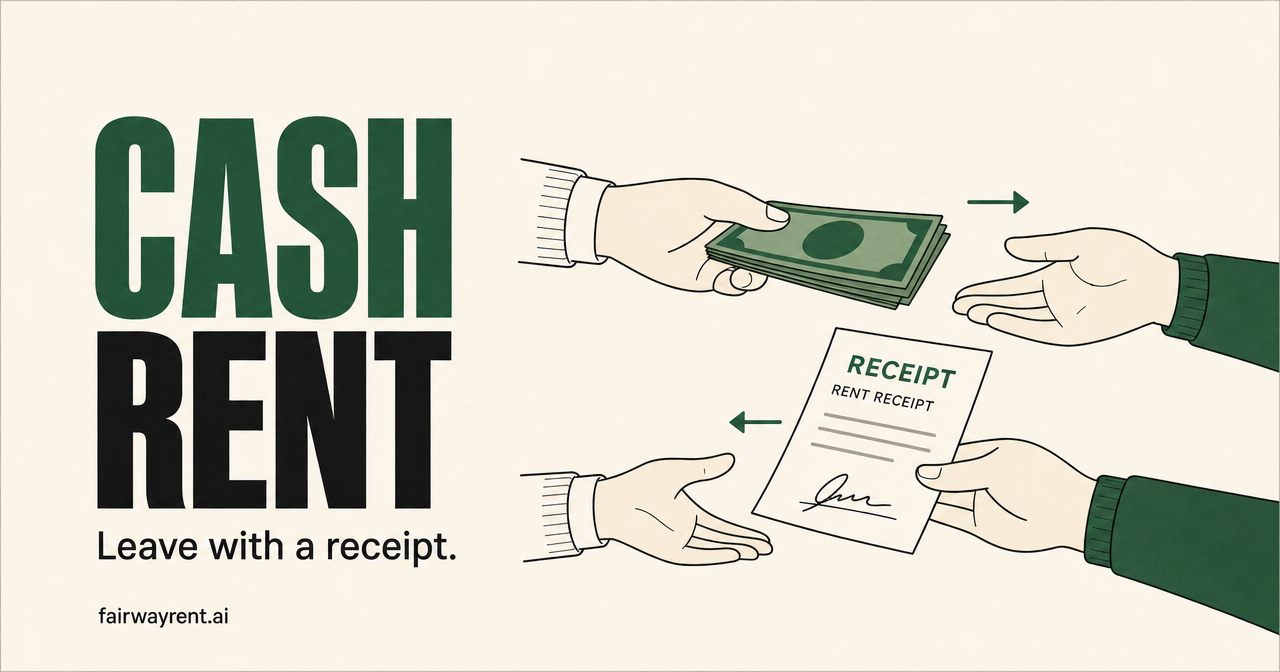
Having the rent money should be the hard part. Paying it can become another project when you earn cash, do not have a bank account, or rent from someone who prefers an envelope to an online portal.
The important questions are whether cash is an accepted payment method and what record you leave behind. A clear payment arrangement and a signed receipt can spare you a stressful argument about money you already handed over.
Yes, you can pay rent with cash when it is accepted
Paying rent in physical cash is generally legal in the United States. You can use it when your rental arrangement permits it or applicable law requires the landlord to accept it. Cash being legal tender does not give every renter an automatic right to pay that way.
Cash also creates no automatic bank record of the handoff. Our recommendation is to use an accepted payment method that documents the recipient, amount, date, and rental period. When that method is cash, get a signed receipt at the handoff.
If you are still apartment hunting, payment requirements belong among your questions before signing. Our AI agent for renters, Fairway, is free for renters. You describe what you want; we find matches, call landlords or leasing offices, and book tours. We can ask properties your payment questions during the search.
Does your landlord have to accept cash?
There is no single nationwide rule requiring every landlord to take cash. The Federal Reserve explains that federal legal-tender law does not require private businesses or people to accept currency for goods or services. State and local rules can add requirements.
The lease's payment clause matters alongside those laws. A rule preserving an offline payment option may allow a money order without requiring acceptance of physical bills.
These state examples show why the distinction matters:
| State | What the rule means for cash rent |
|---|---|
| Texas | A landlord must accept a timely cash rent payment unless a written lease requires payment by check, money order, or another traceable or negotiable instrument. A landlord receiving cash must provide a written receipt and record the payment date and amount. See Texas's cash-payment rule. |
| Washington | A landlord may refuse cash. Landlords must accept personal checks, cashier's checks, or money orders. They may refuse personal checks from a renter whose personal check to the landlord or the landlord's agent was returned for insufficient funds or account closure within the previous nine months. If the landlord accepts cash, a receipt is required. See Washington's payment protections. |
| California | Landlords generally must offer at least one payment form that is neither cash nor electronic funds transfer. Cash-only demands are allowed in limited returned-check or stop-payment circumstances, with written notice and a maximum three-month period. See California's rent-payment guidance. |
A cash-only request therefore raises a different question from a no-cash policy. Neither has the same answer everywhere.
If payment instructions are unclear, ask for the accepted methods, recipient, delivery location, and deadline in writing. A new verbal demand does not settle whether existing lease terms can lawfully change. A local tenant-rights organization can help resolve a conflict before the due date.
Make the cash handoff and receipt one transaction
A practical arrangement is simple: the authorized recipient counts the money while you are there, then gives you a signed receipt before you leave.
Agree on who receives the money
Arrange payment with the landlord or the person the landlord has authorized to collect rent. If someone else suddenly appears to collect it, get written authorization through your established landlord or leasing-office contact before handing it over.
Bring the exact amount. An envelope labeled with your name and unit helps identify it, but the envelope itself does not acknowledge receipt. Avoid leaving physical cash under a door, in a drop box, or on an unattended desk. Those routes separate the money from the person who can acknowledge receiving it.
Get the details into the receipt
A useful cash-rent receipt includes:
- Your name and the rental property's address, including the unit.
- The date the money was received.
- The exact amount and payment method, stated as cash.
- The month or date range the payment covers.
- The recipient's printed name, role, and signature.
- Any remaining rent balance for that period, where relevant.
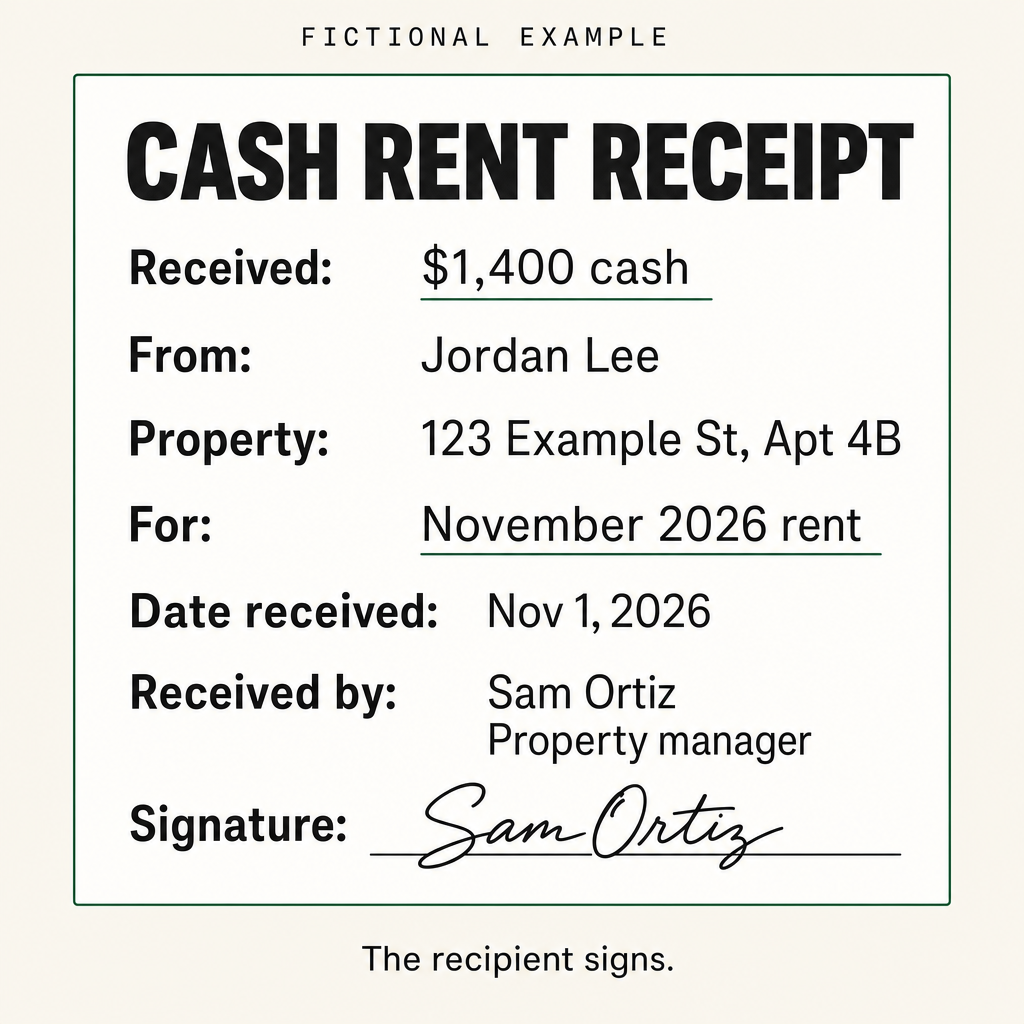
You can bring a prepared receipt for the recipient to complete and sign. A note you write and sign yourself records your account of the payment; it does not give you the recipient's acknowledgment.
If the landlord refuses a receipt, request an accepted traceable alternative in writing. Keep the due date in view and seek local tenant-rights help if no documented payment route is available.
Receipt requirements differ by location. In New York, for example, state receipt law requires a written receipt for cash rent with the date, amount, premises, rental period, and recipient's signature and title. For a payment handed over personally, the receipt must be issued immediately.
Separate rent from deposits and other charges
“Received $2,000” leaves too much unexplained if part was rent and part was a security deposit. Ask for separate line items or separate receipts showing what each amount pays for.
The same applies to partial rent. A receipt for $900 toward $1,400 in November rent should identify the $900 payment and the $500 rent balance. A receipt alone does not create permission to pay the rest late. Any agreed payment schedule belongs in a separate written agreement.
Save a copy outside your phone's camera roll
Photograph the signed receipt while it is legible. Keep the original and a digital copy in a folder organized by rental month, alongside payment instructions and messages. If the property uses a rent ledger, ask for the payment to appear against the correct unit and month.
Know what your payment evidence actually proves
A withdrawal slip, money-order stub, and landlord's receipt document different events. Keeping all available records is useful, but they are not interchangeable.
| Record | What it documents | What it does not establish by itself |
|---|---|---|
| ATM or bank withdrawal | You obtained cash on a particular date. | That the landlord received it. |
| Photo of cash or a labeled envelope | The cash or envelope existed when photographed. | That an authorized recipient accepted it. |
| Money-order purchase receipt | You bought a specific money order. | That you delivered it or it was cashed. |
| Signed rent receipt | The recipient acknowledged receiving the stated payment. | Payment for months or charges the receipt does not identify. |
Allen v. Parkes, an unpublished trial-court decision from New York's Mount Vernon City Court, offers a case-specific illustration. It is not binding appellate precedent.
On the record presented there, the judge declined to admit the renter's self-created receipts as evidence of payment. After considering conflicting testimony, witness credibility, and the landlord's missing legally required receipts and records, the judge found the landlord had not proved that the disputed months were unpaid. Rent the renter admitted she had not paid remained due.
The practical lesson is to get the recipient's acknowledgment. Missing receipts can complicate a dispute, but they do not automatically mean you lose, owe rent twice, or get unpaid rent erased.
You can use cash without handing bills to your landlord
If you do not have a bank account, an accepted money order or property-approved retail payment service may fit better than a monthly cash handoff.
Money orders
A money order converts cash into a prepaid paper payment made out to a named recipient. It gives you an identifying number and a way to trace its status, although you still need a record of delivery.
Postal money orders can be purchased with cash without a bank account. The postal money-order limit is $1,000 per domestic money order, and an issuing fee applies to each one. A $1,400 rent payment therefore needs two postal money orders and two issuing fees.
Make them payable to the landlord's designated payee, add your unit and rental month where the form allows, and photograph the completed orders with their stubs before delivery. Keep the stubs. When handing over a money order in person, ask for a rent receipt too.
A lost money order can take time to resolve. The United States Postal Service says investigating a lost or stolen postal money order may take up to 60 days. Buying it on time does not establish that your rent reached the landlord on time.
Property-approved retail cash payments
Some properties let renters pay cash at participating stores using a payment code or barcode linked to their rental account. The store processes the payment through the property's service and provides a transaction receipt.
This is a real option in some housing programs. The Charleston housing authority offers residents retail cash payments through PayNearMe.
Availability, fees, transaction limits, and posting times depend on the property's arrangement. Get the property's written instructions, including the total charge and when the payment is credited, before using this route. Save both the store receipt and the rental-account confirmation. An unrelated money-transfer service does not become an approved rent-payment channel simply because it accepts cash.
A cash request deserves extra care before move-in
An established landlord accepting cash with a signed receipt is different from a stranger demanding cash to reserve an apartment.
Do not hand over a deposit or first month's rent to an unconfirmed contact who pressures you to pay immediately, will not establish their authority to rent the home, or refuses documentation. A signed piece of paper cannot make a fake landlord legitimate.
The Federal Trade Commission warns that rental listing scams can use copied photos and even self-guided tours of real properties. Seeing the inside of a home does not establish that the person collecting your money controls it. Our guide to avoiding rental scams explains the identity, property, paperwork, and payment warning signs in more detail.
Cash payment alone does not prove a landlord is committing fraud. Pressure, conflicting identities, and refusal to document the transaction are the more useful warning signs.
If you already paid cash and the payment is disputed
Start with a written account of the payment: amount, date, place, recipient, rental period, and anyone who witnessed the handoff. Preserve existing messages, receipts, withdrawal records, and any acknowledgment from the landlord. Ask for the rent ledger and a written explanation of the amount claimed unpaid.
You can write:
I paid $1,400 in cash to [recipient] on [date] for November rent at [address and unit]. Please send the receipt and an updated ledger showing how that payment was applied.
If there is a nonpayment notice or court paperwork, get local housing legal help promptly and keep every response deadline. Do not assume that requesting a receipt pauses an eviction process or authorizes withholding the next payment. USAGov's tenant-rights resources connect renters with state agencies and affordable legal help.
Make payment terms part of your next apartment search
A workable rent-payment arrangement includes the method, total fees, authorized recipient, deadline, and proof you receive. Getting those details before signing is one small part of renting an apartment that can prevent a large monthly headache.
If another apartment search is ahead, start with Fairway. Tell us what you need. We find matches, call properties with your questions, and book tours, free for renters.