Renter guide
Does Breaking a Lease Affect Your Credit? Leave With a Clear Record
Does breaking a lease affect your credit? Learn the debt risks, rental-screening differences, and exit paperwork with Fairway, the AI agent for renters.
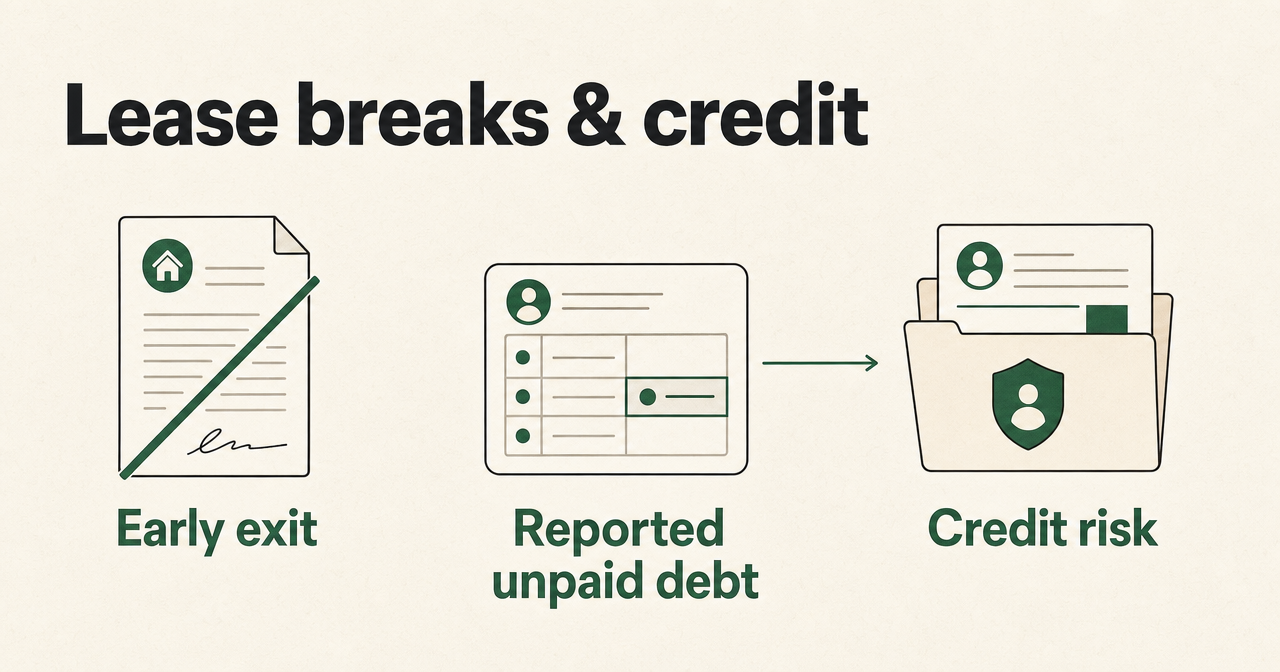
Moving before your lease ends can leave you juggling two worries: what you owe now and what a future landlord might see. A termination fee, a rent balance, and a rental-history record can follow different paths. Understanding those paths helps you avoid an expensive surprise. Here’s how credit damage can happen, what a lease break means for your next application, and the paperwork that makes a clean exit easier to prove.
Breaking a lease does not automatically hurt your credit
Ending a lease early does not, by itself, create a negative credit entry. Unpaid rent or other valid lease charges can hurt your credit if they are reported, including through a collection account. A move-out date alone does not lower your score.
Rent-payment reporting also matters. Some rental-payment information reaches the credit bureaus through reporting programs. An overdue balance can therefore create risk even without a collection agency. The Consumer Financial Protection Bureau (CFPB) explains that the three major bureaus use rental payment information and related collection data, although their treatment varies.
These general U.S. reporting rules do not establish what you personally owe under a lease or guarantee a credit-score result. Contract terms and applicable state and local law determine the lease obligation.
These situations have different consequences:
| What happens | Credit risk | Next-rental concern |
|---|---|---|
| You end the lease under an agreement and resolve all valid charges | The early termination itself does not create a negative credit entry | A future landlord may still ask about the early departure |
| A rent balance is overdue and reported | Reported negative payment information may affect your score | The balance may also appear in rental screening |
| Unpaid rent or fees become a reported collection | The collection can hurt your score | A property may consider the rental debt separately from your score |
| Your landlord files an eviction case | The filing itself is different from a credit collection | Court information may appear in a tenant-screening report |
If you also need another apartment, we help with the search through our AI agent for renters. It’s free for renters: describe what you need, and we find matches, call landlords or leasing offices, and book tours. Closing out your current lease is a separate job.
Your credit file and rental history are different records
A credit report contains information used to calculate credit scores. A tenant-screening report can combine credit information with rental-payment history, housing-court records, and other background information. A landlord may also contact your previous landlord directly.
That distinction answers a common worry: you can have an unchanged credit score and still face questions about a previous lease. A score in a banking app does not tell you everything a property may receive.
An agreed early termination is also different from an eviction. Leaving under a signed agreement does not automatically mean an eviction occurred. If a case was filed, its outcome matters. A dismissed case should not be presented as though the landlord won. The CFPB’s rental screening guidance explains the right to dispute inaccurate or incomplete records.
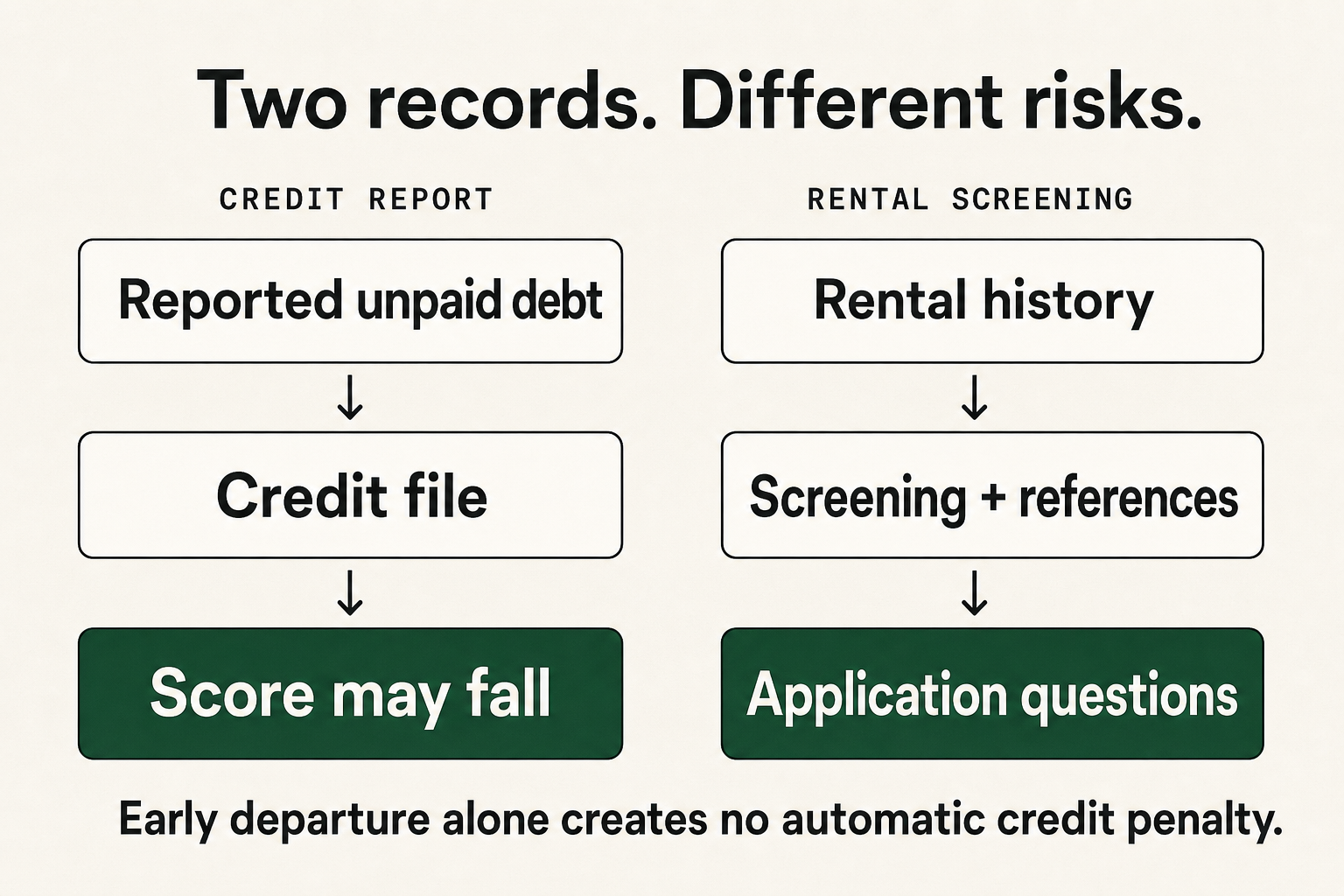
For an application that asks why you left, a short factual explanation and the termination agreement are more useful than the vague label “broken lease.” Our guide to rental history reports explains how specialty screening records differ from ordinary credit reports.
The amount you owe depends on how the lease ends
Before you can close the account, you need a clear end date and a clear explanation of the charges. Different exit arrangements can leave very different balances.
An early-termination agreement
A lease may offer a buyout or early-termination option with a fee, notice period, and other conditions. You may also negotiate a separate agreement with the landlord.
The useful question is: Does this payment end future rent liability, or is it only one charge? A fee called a “reletting fee” may cover finding another renter while leaving you responsible for additional rent. The label alone does not establish a release.
A written agreement should identify the effective termination date, the required payments, and any obligations that remain. “You can move out” leaves too much unsaid.
Moving out while rent liability continues
Without a release or another applicable right to terminate, leaving the apartment may leave you responsible for rent after departure. The amount depends on the lease, applicable law, and what happens when the home is rented again.
State rules can require landlords to reduce their losses. For example, Texas law requires mitigation when a renter abandons a home in violation of the lease. That is a duty to mitigate damages, not an automatic waiver of everything owed. There is no single nationwide formula for “months remaining × rent.”
A replacement renter or sublet
A replacement may help reduce the vacancy, but handing over the apartment does not necessarily release you. A sublet can leave your original lease obligations in place. The written arrangement needs to say whether you remain liable and when any release takes effect.
A legally protected termination
Certain circumstances create termination rights with specific notice, documentation, and timing requirements. The Servicemembers Civil Relief Act provides military lease protections, including for qualifying entry into military service or military orders. A qualifying termination can still leave rent due through its effective date.
Other protections depend on the location and circumstances. A housing problem or safety concern does not establish one universal exit procedure. USAGov’s tenant-rights directory connects renters with state resources and legal help for a disputed obligation.
Resolve the whole move-out balance
A fee receipt proves that payment. It may leave final rent, lawful damage charges, or other agreed amounts unresolved. Your security deposit also needs its own accounting. It is not automatically the last month’s rent or an automatic payment toward a buyout.
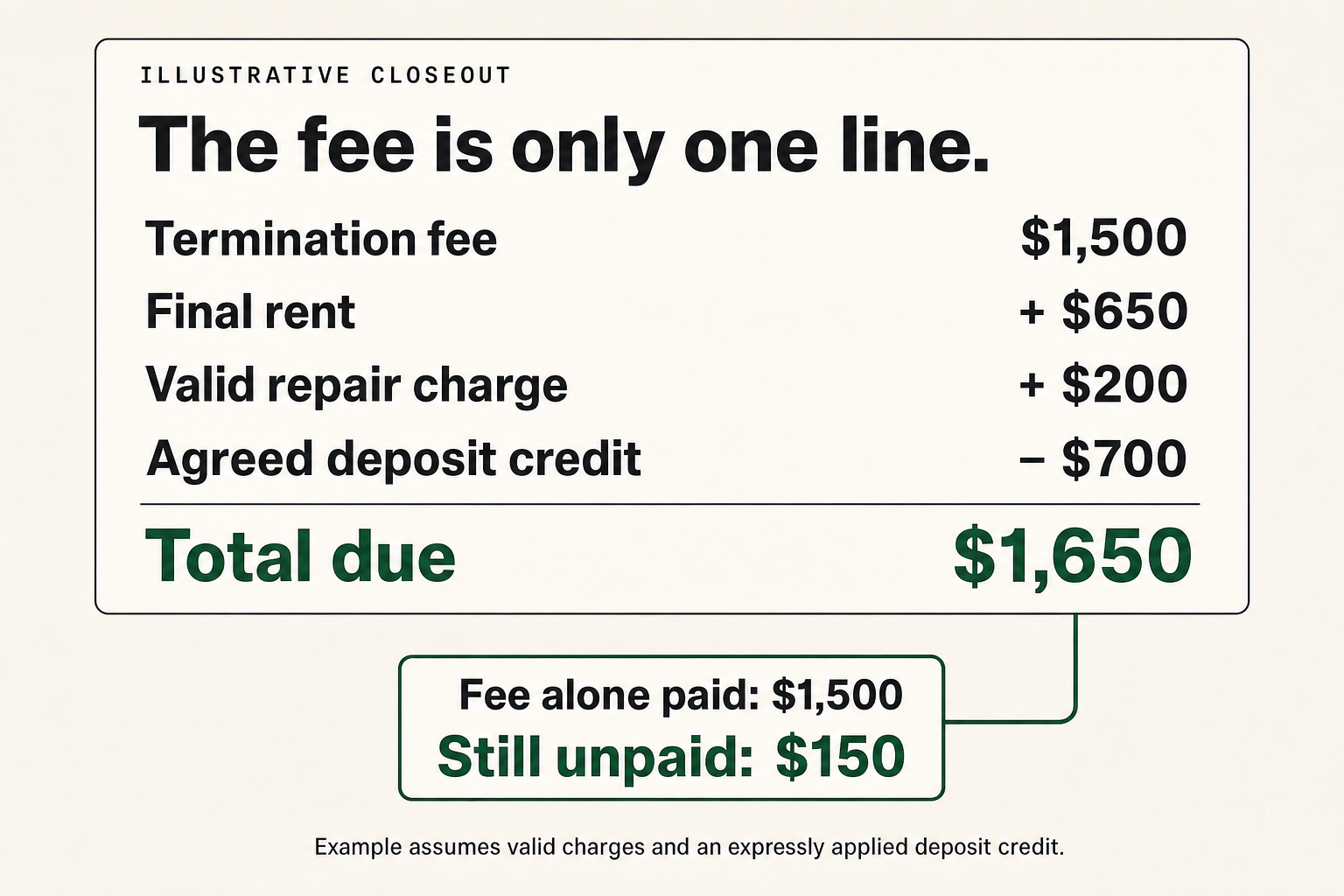
Consider an illustrative closeout with a $1,500 termination fee, $650 in final rent, and a $200 permitted repair charge. Those charges total $2,350. If the written accounting applies a $700 deposit credit, the remaining amount is $1,650. Paying only the $1,500 fee leaves $150 unpaid.
The example assumes the deposit credit is expressly applied and all charges are valid. Your actual deposit deductions and timing depend on the lease and applicable law. Our security deposit guide covers the records that support or challenge deductions.
Build a closeout file with four kinds of proof
- The exit agreement. Save the signed terms, effective end date, notice, delivery record, and any release from future rent.
- The final accounting. Keep an itemized statement showing charges, deposit credits, other credits, payments, and the remaining balance. If charges are still pending, have the statement identify them.
- The payment record. Save receipts and written confirmation that agreed payments were applied. After everything is resolved, request a final statement showing no balance owed.
- The possession and condition record. Keep dated move-out photos, any inspection record, proof of key return, and the forwarding address you provided.
You can start the conversation with a simple request:
Please send the written terms for ending my lease on [date], including when rent liability ends, all required charges, and how my deposit will be handled. Please identify any charges that will be determined after move-out and where the final statement will be sent.
If the amount is correct but unaffordable, a written payment plan may be an option. The agreement should cover amounts, due dates, and how the account will be handled while you pay as agreed. Installments alone do not guarantee that the account stays out of collections or off a credit report.
If a lease balance reaches collections
A collection notice is a reason to respond promptly. It is not proof that every listed charge is correct, and it does not necessarily mean the debt has already appeared on your credit report.
For an old or disputed debt, local legal aid or a consumer attorney may be needed before you make a payment, agree to installments, or acknowledge owing it. The Federal Trade Commission (FTC) explains in its old-debt guidance that a payment or written acknowledgment can restart the lawsuit limitation period in some states. That state-law deadline is separate from the credit-reporting period. A debt disappearing from a report does not, by itself, establish whether a lawsuit is time-barred.
Use the notice’s dispute period
A covered debt collector generally must provide validation information identifying the creditor, the amount, an itemization, and a dispute deadline. Under the CFPB’s debt validation guidance, a written dispute within the 30-day period requires the collector to pause collection of the disputed amount until it adequately responds.
If a paid fee is missing, a deposit credit was omitted, or the debt belongs to someone else, describe the specific error and send copies of supporting records. Keep the originals and proof of delivery. A dispute sent only to your former landlord is different from a timely dispute sent to the collector.
The 30-day dispute period is not a universal credit-reporting grace period. Debt collectors have separate contact-before-reporting rules. There is no safe application window you can count on before a rental debt becomes visible.
Dispute a reporting error separately
The FTC identifies AnnualCreditReport.com as the authorized site for requesting free credit reports from Equifax, Experian, and TransUnion. Online reports are available weekly. If inaccurate information appears, send a dispute to each credit reporting company showing the error and to the landlord, collector, or other business that supplied it. The CFPB’s credit dispute guidance calls for identifying the error and providing supporting copies.
If a tenant-screening report has the error, that screening company needs a dispute too. Resolving a bill and correcting a report are separate steps.
Payment does not guarantee deletion or a score rebound
A rental collection can generally remain on your credit report for about seven years, measured from the original delinquency that led to the collection, rather than your move-out date or the date a collector bought the debt. Payment does not restart that reporting period.
Paying or settling the balance does not automatically erase an accurate collection. Scoring models treat paid collections differently. FICO Score 9 and the FICO Score 10 suite disregard paid third-party collections, while other score versions may still consider them. FICO’s collection guidance also makes clear that paying a collection does not guarantee a particular score increase.
For a valid debt you resolve, keep the written payment or settlement terms and a receipt showing the resulting balance. Those records can help with future rental questions even when the collection remains visible.
Applying for your next apartment after a lease break
Before paying an application fee, ask how the property treats agreed early terminations, outstanding rental debts, and resolved collections. A property with a firm unpaid-rental-debt rule presents a different path from one that accepts a documented explanation and payment proof.
Keep your explanation brief and accurate: when you left, how the lease ended, and whether the balance was resolved. Share the requested termination or payment records through the property’s official application channel. If credit damage is part of the problem, our guide to renting with bad credit covers application options without promising approval.
When report information leads to a denial or less favorable terms, such as a higher deposit, the landlord must provide an adverse-action notice. You can request a free copy from the named reporting company within 60 days. Keep the notice so any inaccurate lease-related record can be challenged with the right company.
Leaving early is easier to explain when the agreement, final accounting, and payment proof tell the same story. When you’re ready for the next-home search, start with Fairway. We’ll handle finding matches, calling properties, and booking tours while you keep control of the move.