Renter protections
Security Deposit for Rent: What It Covers and How to Protect Yours
Learn what a security deposit can cover, how to document your rental from move-in to move-out, and where to check the rules that apply where you live.

A security deposit can turn an affordable apartment into a serious up-front cash problem. It also leaves a large amount of your money tied to lease terms, local law, and evidence you may need months later.
You can make that risk easier to manage. Start by separating the deposit from other move-in charges, get the terms in writing, and build a clear record from the day you pay through the day you return the keys.
What is a security deposit for rent?
A security deposit is a one-time payment that a landlord or property manager holds as security for obligations in a rental agreement. It is separate from recurring rent. Depending on the lease and the law where the home is located, the deposit may be returned after the tenancy ends, minus permitted deductions.
That last part needs a local answer. States and cities can set different rules for deposit limits, receipts, how the money is held, interest, deductions, inspections, itemized statements, return timing, and dispute options. Your lease still has to be read alongside any local protections that apply.
Treat the charge's name as a starting point. A landlord might use terms such as “cleaning deposit,” “pet deposit,” “holding deposit,” or “move-in fee.” The written purpose of the payment and applicable law may matter more than the label.
Security deposit vs. other move-in charges
Move-in totals get confusing because several payments may be due close together. Ask for an itemized list before you commit, then match every amount to a written term.
| Charge | What it is generally for | Could you get it back? | What to get in writing |
|---|---|---|---|
| Security deposit | Security for obligations under the rental agreement | It may be returned after deductions allowed by the lease and applicable rules | Amount, due date, payee, purpose, payment record, and return terms |
| First month's rent | Payment for the first rental period | Usually treated as rent once it is owed; cancellation terms can affect the answer | Rental period covered and what happens if the move-in does not occur |
| Last month's rent or advance rent | Rent paid for a future rental period | It is generally applied to the stated rental period rather than handled as a deposit, subject to local rules | Month covered, whether it changes after a rent increase, and any cancellation terms |
| Application fee | Processing or screening an application | Often nonrefundable, although limits and refund rules vary | Amount, screening purpose, refund conditions, and screening criteria |
| Holding deposit | Taking a home off the market before the lease begins | Refundability and whether it becomes rent or a deposit vary | Deadline, cancellation terms, approval terms, and how the money will be applied |
| Move-in fee | Administrative, building, elevator, or other move-in costs | It may be nonrefundable where allowed | Exact service covered and whether any part is refundable |
| Pet deposit or pet fee | Pet-related risk or costs | A deposit and a fee may receive different treatment | Whether it is refundable, what it covers, and any separate pet rent |
An apartment application fee pays for a different step than a security deposit. If a leasing office groups several amounts under one total, ask it to break out each charge before you pay.
How much is a security deposit?
There is no single national “normal” amount or nationwide cap. The requested deposit can depend on the property, the lease, the screening result, and state or local rules. Some places limit the amount. Other rules may depend on the unit, building, landlord, rental program, or renter's circumstances.
Judge the request with two separate questions:
- Can you cover the full move-in total and still handle your monthly costs? Add the deposit, rent due at signing, application and holding charges, pet charges, utility setup, parking, movers, and basic household needs. Our apartment budget guide helps you build that full cash total.
- Is the request allowed and clearly documented where you rent? Compare the written amount with the current state, county, and city rules that apply to the home. Check whether a special rule applies to the unit or rental program.
Ask these questions before sending the money:
- What is the exact amount, when is it due, and who receives it?
- Is any earlier holding payment credited toward the deposit?
- Which lease section explains deductions and return?
- What payment record, notice, account information, or disclosure will you receive?
If screening led to a larger deposit
A larger security deposit based on a tenant background check can be an adverse action under the Fair Credit Reporting Act. The Federal Trade Commission (FTC) guidance says you have the right to a notice that identifies the screening company and explains how to get a free copy of the report within 60 days and dispute inaccurate information. Local law may add more protections.
Keep the notice, request the report, and compare it with the information you submitted. An error is easier to challenge when you have the property's original criteria and its revised deposit request in writing.
What could be deducted from a security deposit?
Potential deductions often involve unpaid amounts, damage, cleaning, or another lease obligation. The categories and proof required vary. A lease clause alone does not answer whether a particular deduction is allowed under the law that applies to your rental.
Use three layers to evaluate a possible deduction:
- The lease: What did you agree to pay, maintain, clean, remove, or restore?
- The local rule: Which deductions are allowed, and which notices, records, or deadlines apply?
- The evidence: What do the move-in and move-out records show about condition, dates, repairs, payments, and possession?
“Normal wear and tear” is the difficult boundary. It generally refers to deterioration from ordinary use over time, while damage involves a different level or cause of harm. The exact treatment is local and fact-specific. You need the home's starting condition, its age, the lease, and the rule where you live to assess a disputed mark, stain, worn surface, or broken item.
That is why a room-by-room record beats a vague promise to “leave it clean.”
Before you pay: verify the rental and the paper trail
A deposit request creates urgency, especially when someone says another applicant is ready to pay. Slow down long enough to confirm that the home, the person collecting money, and the payment instructions are real.
The strongest deposit file is built at four moments: before payment, at move-in, during the lease, and at move-out.
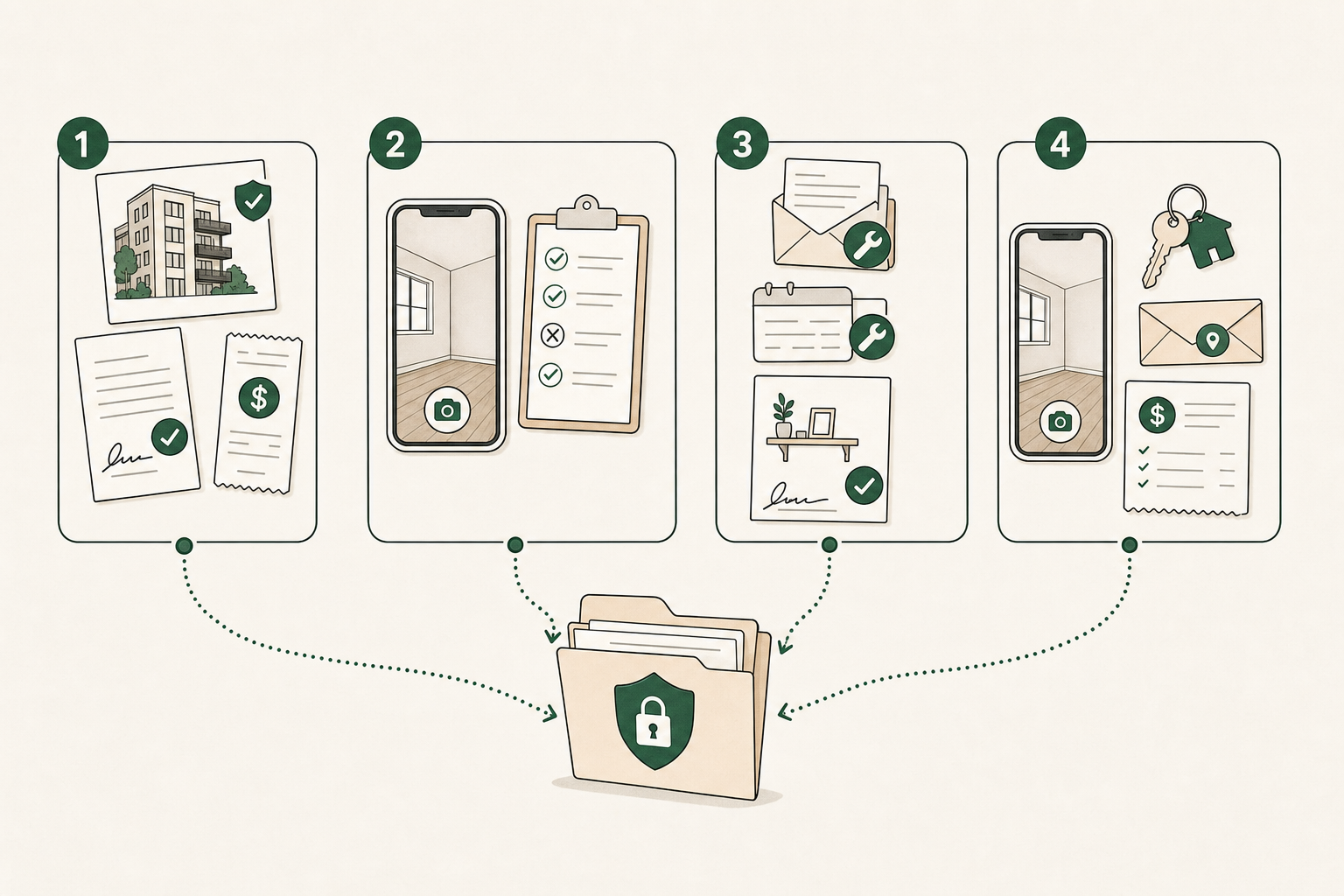
- Verify the listing independently. Find the property manager or owner's contact information through its official website or reliable public records. Call that number rather than relying only on the listing contact.
- See the home. Tour it in person when possible. A live video tour may add context, although it does not prove that the person has authority to rent the home.
- Read the lease or deposit agreement. Confirm the address, unit number, amount, due date, payee, purpose, and cancellation terms.
- Match the payment instructions. Confirm them through a verified contact when the recipient or account changes.
- Use a documented payment route. Save the confirmation, receipt, and any message that explains what the payment covers. Be cautious when someone insists on a method that is difficult to recover.
- Keep the full conversation. Save the listing, fee sheet, screening criteria, lease draft, and payment request.
The FTC warns that scammers copy real listings and seek deposits for homes they do not control. Its rental scam advice recommends verifying the management company, seeing the rental, and watching for demands to pay before a showing or through hard-to-recover methods. Our guide to avoiding rental scams has a fuller verification process.
Move-in checklist: record the starting condition
Your goal is to create a dated, specific picture of the home before everyday life starts moving the furniture around.
- Photograph each empty room from more than one angle.
- Take close-ups of existing marks, stains, holes, chips, water damage, missing parts, and worn surfaces.
- Record a slow video that shows how rooms connect and where each issue is located.
- Test included appliances, fixtures, doors, windows, locks, faucets, drains, lights, and supplied equipment.
- Complete any condition form with specific descriptions. “Scratch on lower-left refrigerator door” is more useful than “kitchen damage.”
- Send the list and supporting photos through the method named in the lease, then save proof that it was delivered.
- Ask whether a joint move-in inspection or signed condition form is available. Availability and legal requirements vary.
- Save the signed lease, addenda, deposit record, inspection documents, and repair requests in one folder.
A short email sent at move-in that identifies the unit, date, room, and issue creates a clearer timeline than photo metadata alone. A first apartment checklist can help you cover the rest of the move without losing this paperwork in a box labeled “misc.”
During the lease: keep the record current
Move-in photos show the starting point. You still need a record of what happened next.
- Report leaks, pests, broken appliances, and other repair needs in writing using the lease's process.
- Keep the request, response, entry notice, work order, and completion message together.
- Get written permission before painting, mounting equipment, changing fixtures, installing shelves, or making another alteration.
- Save payment confirmations and any agreement about credits, reimbursements, or fees.
- Keep renewal documents and records of any additional deposit payment.
- Follow up in writing after an important phone call with the date, issue, and agreed next step.
Use simple filenames such as 2026-10-04-bedroom-window-before.jpg and 2026-10-05-repair-request.pdf. Future you should not need to search three phones and an old group chat for a photo of a cracked window.
Move-out checklist: create the matching end record
Start with the lease and current local rule. Notice dates, inspection options, cleaning terms, forwarding-address requirements, key return, and the event that starts a return period can all vary.
- Review the lease's notice, cleaning, removal, alteration, and key-return terms. Ask how to request any available walkthrough or inspection.
- Address renter-caused issues you are responsible for without hiding damage or making an unapproved repair.
- Remove belongings and trash, then clean according to the lease and applicable rules.
- Take wide photos and detailed video after the home is empty and clean. Cover included appliances, floors, walls, cabinets, bathrooms, windows, outdoor areas, and any disputed spot.
- Return every key, fob, remote, permit, and access device through the agreed process. Keep proof of the handoff.
- Provide a forwarding address if the lease or local rule calls for one, and save proof of delivery. Keep the final payment records, communications, inspection report, and possession handoff.
Do not assume the deposit covers your last month's rent. Pay rent according to the lease unless a written agreement and applicable law clearly allow a different treatment.
If money is withheld or the deposit does not arrive
Avoid starting with a threat or a guess about the deadline. Build a clean comparison first.
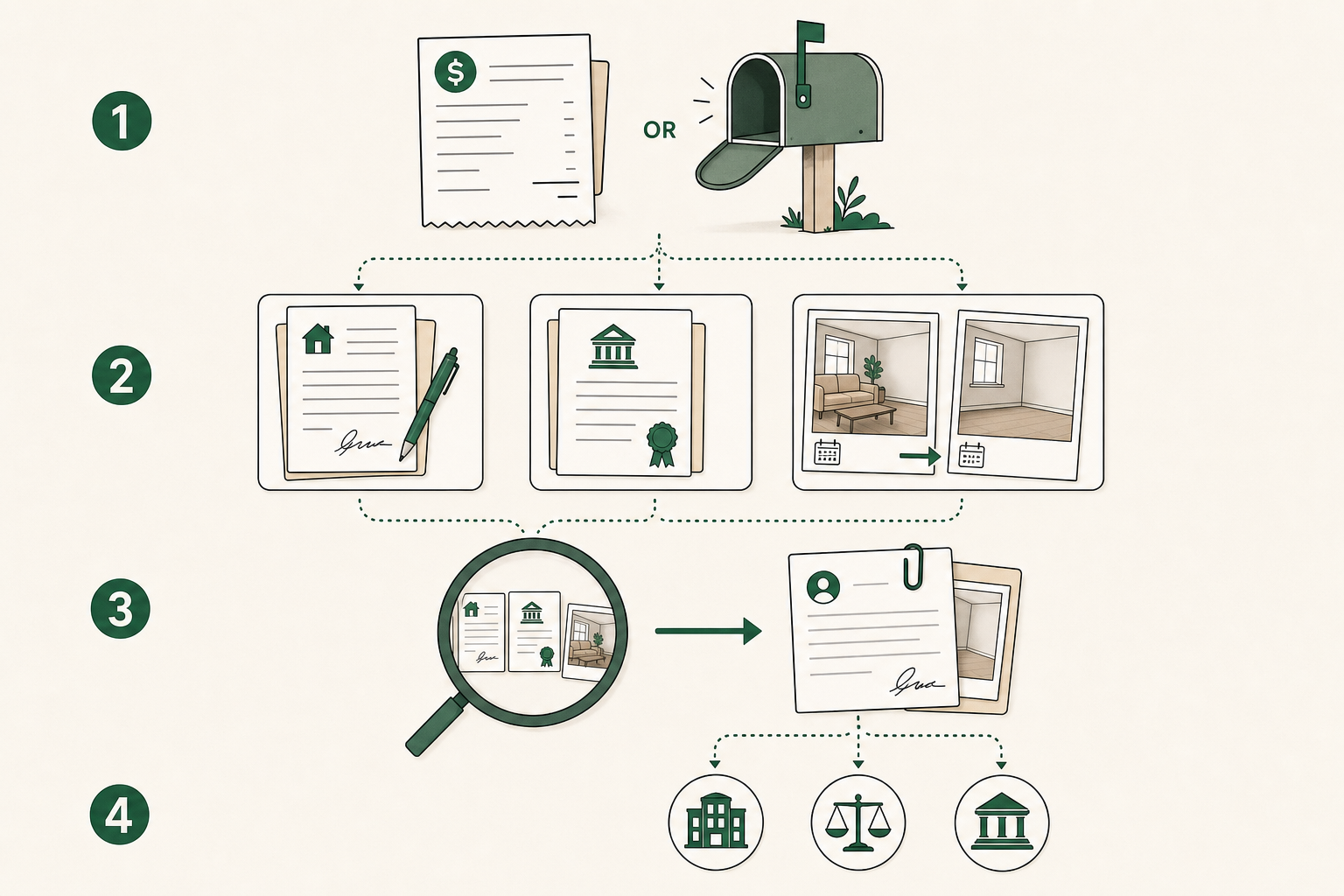
- Identify the applicable rule. Use the home's state and locality, plus the unit type or rental program, to find the correct source.
- Check the triggering event. The local timeline may run from move-out, lease end, key return, possession transfer, receipt of a forwarding address, or another event.
- Assemble the record. Gather the lease, payment proof, condition forms, photos, videos, repair messages, inspection papers, key-return proof, forwarding-address proof, itemized deductions, invoices, and any amount returned.
- Compare each deduction. Match the reason and amount against the lease, local rule, starting condition, ending condition, and relevant communication.
- Make a factual written request. State the property, tenancy dates, deposit paid, amount returned, deduction or missing amount at issue, and the evidence supporting your position. Ask for the specific explanation or amount you seek.
- Use the local escalation path. Depending on the location and housing, that may be a state agency, city or county housing office, tenant resource, legal aid program, housing counselor, or court process.
Keep a copy of what you send and proof of delivery. The right delivery method, deadline, court, claim limit, and possible remedy depend on local law, so a national template can send a renter down the wrong path.
Find the security deposit rule where you rent
Start with the USAGov tenant-rights directory. It routes renters to state agencies, attorneys general, housing agencies, tenant handbooks, and legal-aid options. Then check your city or county housing department, rent board, or tenant-protection office.
Location is only the first filter. Ask whether the rule changes based on rent regulation, subsidized housing, student housing, an owner-occupied property, building size, or another unit category.
Official guidance shows why the local check matters. California Courts, the Connecticut Department of Banking, and the New York City Rent Guidelines Board each describe a different mix of limits, records, inspections, timing, and dispute steps for their jurisdictions.
If you need help reading the rule or sorting out a dispute, agencies participating with the U.S. Department of Housing and Urban Development (HUD) may offer rental counseling on landlord-renter disputes. Use HUD's housing counselor search to find a participating agency.
This guide provides general U.S. renter information, not legal advice.
Security deposit FAQ
Is a security deposit refundable?
It may be returned after the tenancy ends, less deductions permitted by the lease and applicable law. A full return is not automatic. The amount, process, documentation, and deadline vary by location and sometimes by unit type.
Does a security deposit go toward rent?
Do not assume it does. A security deposit and rent serve different purposes, and using the deposit as rent without a clear written agreement can create unpaid-rent and lease issues. Review the lease and the rule where the home is located.
When is a security deposit due?
The landlord may request it during lease signing or before move-in, but the permitted timing and required paperwork can vary. Get the amount, purpose, deadline, payee, unit, refund terms, and cancellation terms in writing before paying.
When you are still looking for the right home, tell Fairway's AI agent what you want. We find matches, call landlords and leasing offices, and book tours, free for renters.