Holding deposit
Holding Deposit for an Apartment: Know What Your Money Reserves
Understand apartment holding deposits, refund and credit terms, deadlines, and safer payments, with help from Fairway, your AI agent for renters.
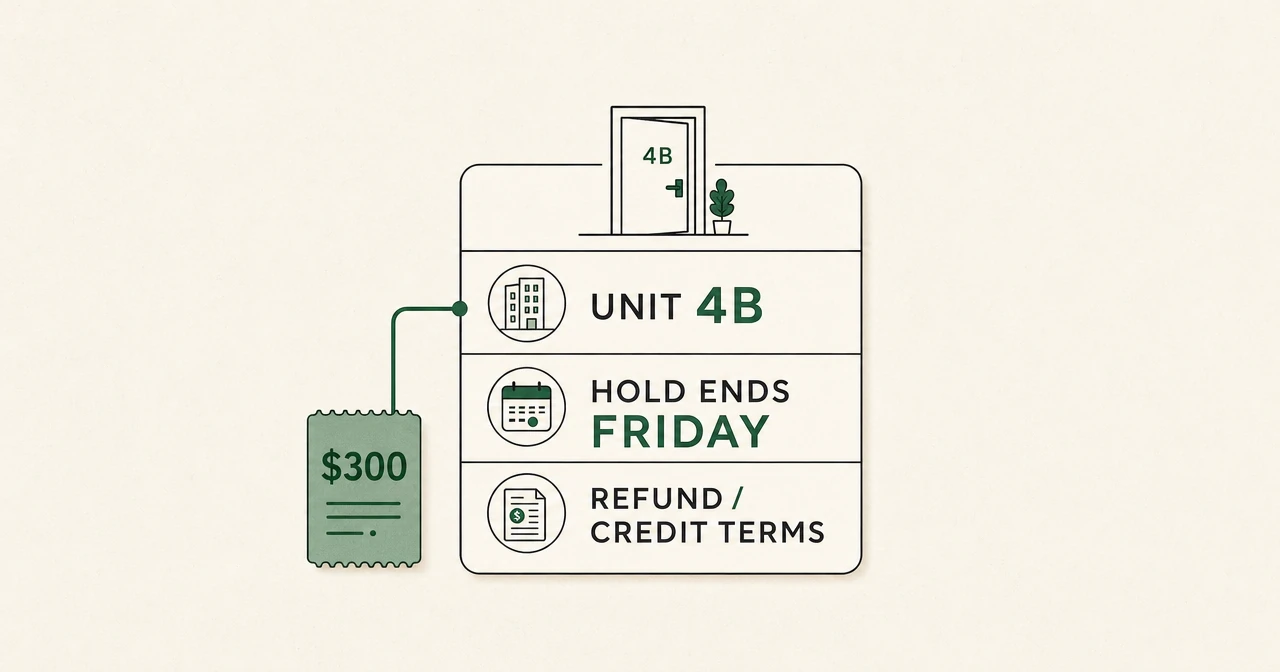
A leasing office asks for $300 to “hold” an apartment. You're still waiting on approval, and the lease hasn't arrived. Now you have to decide whether to send money before you know exactly what you're getting. Understanding the reservation terms helps you sort out the deadline, possible refund or credit, and payment risk without treating a payment request as proof that the apartment is yours.
What is a holding deposit for an apartment?
A holding deposit is a payment intended to reserve a specific apartment for an agreed period while you and the landlord work toward a lease. You might also see “holding fee,” “reservation deposit,” or “good-faith deposit.” The name alone leaves important questions unanswered.
The agreement needs to explain what the landlord promises in exchange. Will the office stop showing the apartment, stop accepting applications, or stop offering it to anyone else? Paying to join an applicant queue gives you a different kind of commitment from reserving Unit 4B exclusively until Friday.
A holding payment, by itself, does not establish that you're approved, that both sides have signed a lease, or that you can move in. Those are separate milestones. State and city rules can also affect whether the charge is allowed and how the money must be handled.
Getting those answers can mean another round of calls while you're already juggling tours and applications. Our AI agent for renters is free. Tell us what you want, and we find matches, call landlords or leasing offices, and book tours.
Holding deposit vs. security deposit vs. application fee
These payments have different jobs. Keep them separate even when a portal collects them together.
| Payment | What it is intended to cover | What needs to be clear |
|---|---|---|
| Holding deposit | A defined reservation of an apartment | The unit, hold period, landlord's commitment, and refund or credit conditions |
| Apartment application fee | Screening reports and application-processing work | What work the fee covers and its own refund terms |
| Security deposit | Security for lease obligations, such as unpaid rent or damage | Whether any holding payment will be credited toward the required deposit |
| Rent or prepaid rent | Payment for an identified rental period | Which dates the payment covers and whether a holding credit reduces the amount due |
Timing alone doesn't settle the distinction. Money collected before signing can have different purposes. Ask for an itemized statement showing each charge, its purpose, and what happens to it next. A promise to credit one payment does not make every other fee refundable.
Get the holding terms in writing before paying
A receipt that says “$300 deposit” records the money changing hands. It leaves the reservation unclear. You want the agreement before paying and the payment receipt afterward, with copies you can keep outside the application portal.
Useful written terms cover:
- The exact apartment. Include the street address and unit number. A floor plan, model apartment, or building name leaves room for a different unit.
- The payment and recipient. State the amount, the landlord or management company's legal name, who receives the money, and the payment route.
- The hold's start and end. Include dates, an expiration time, and the time zone when you're moving from elsewhere. Ask whether the hold starts when you pay or when the office accepts it.
- The landlord's commitment. Spell out what stops during the hold, including whether another applicant can still receive the apartment.
- Your next steps. Identify document, lease-signing, and additional-payment deadlines. Ask when the proposed lease and full move-in cost statement will be available.
- Every money outcome. Cover denial, approval and signing, withdrawal, missed deadlines, and the property being unable to provide the unit. Include any refund timing, credit destination, and proposed retention amount or calculation.
The California Department of Real Estate's holding-deposit guidance also emphasizes written agreements and receipts, including written confirmation of an agreed rent or security-deposit credit. Those are useful paperwork habits wherever you're apartment hunting; the legal rules remain location-specific.
If the office describes the money as “nonrefundable,” ask which events that covers. Does the same policy apply when you withdraw, when you're denied, and when the property can't provide the apartment? That label alone does not resolve your rights under local law.
How long does a holding deposit reserve an apartment?
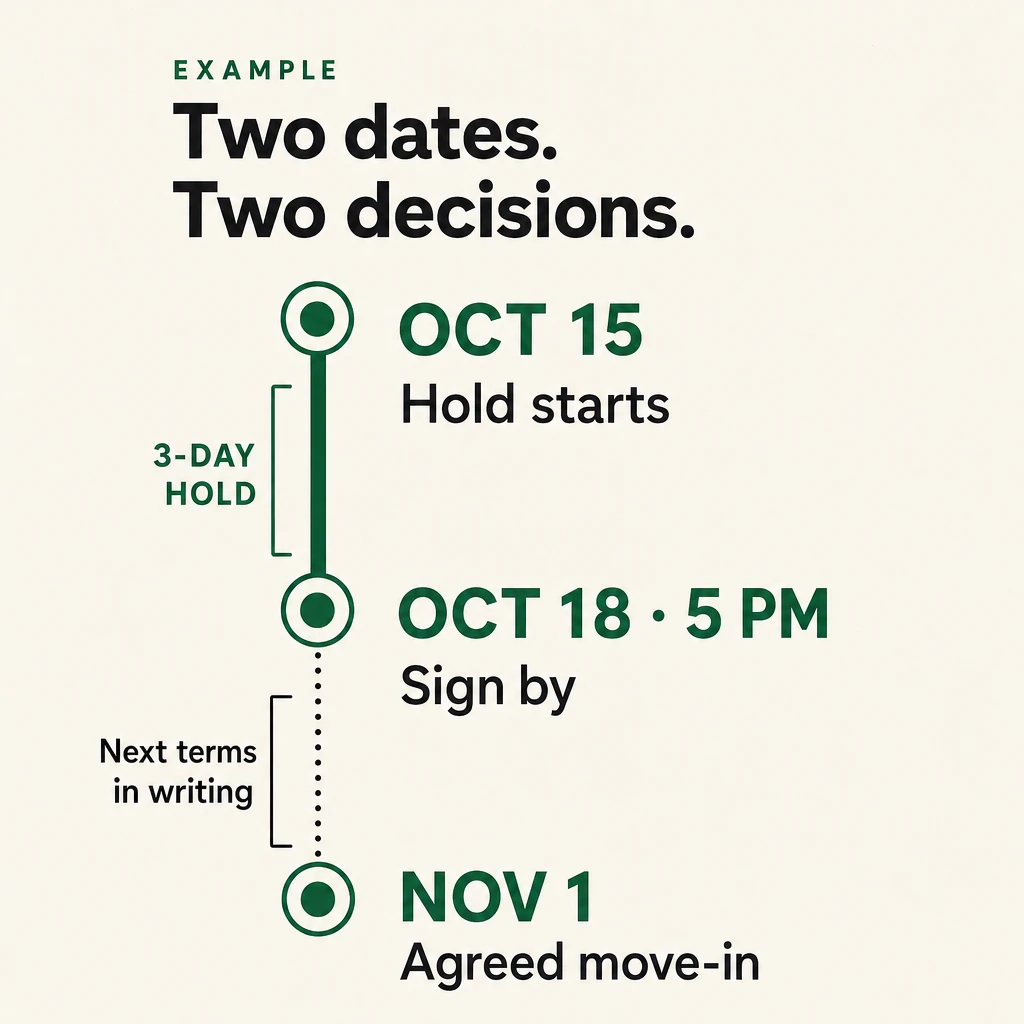
The written terms should give you the reservation's start and expiration. A three-day hold and a move-in date weeks away can exist in the same offer. The short hold may be the window for completing the next leasing step. It does not automatically describe how long the apartment will remain reserved before you move.
For example, an offer could require lease signing by October 18 at 5 p.m. for a November 1 move-in. You need both dates, along with what happens between them, in writing.
If screening is still unfinished as the hold approaches its end, ask the office how it will handle the unit and your money. Request any extension in writing, including the new deadline and whether the refund or credit terms change. Silence is a poor calendar system.
Put the amount in context
No quoted amount, whether $100 or a full month's rent, tells you by itself whether the charge is allowed or worth accepting. Consider how much cash will be tied up, how exclusive the reservation is, and how much could be retained if you cannot proceed.
You can ask for a smaller reservation payment, payment after approval, or a refundable hold while you review the proposed lease. The property may decline. The goal is to understand the commitment before making it, rather than paying first and negotiating the meaning later.
Are holding deposits refundable?
A holding deposit may be refunded, credited toward another payment, or retained in whole or part. The outcome depends on the circumstances, written terms, and applicable state and city rules. A promise in an agreement also cannot make a charge lawful where local rules prohibit it.
Before paying, get a distinct answer for each situation:
| If this happens | What the written terms need to answer |
|---|---|
| Your application is denied | Does denial trigger a full refund? What event starts the return process, and when and how will the money be sent? |
| You're approved and both sides sign | Is the money returned separately or credited? If credited, to which charge and in what amount? |
| You withdraw or miss a deadline | Is any money retained? What deadline or action triggers that result, and how is the amount determined? |
| The property rents to someone else, changes the offered terms, or cannot provide the unit | How does the agreement address the property's failure to honor the hold? What happens to the money and the reservation? |
“Refundable if not approved” leaves other situations open. So does “applied at move-in” without identifying the charge. Clear terms should account for what happens on both sides of the transaction.
If you decide against the apartment, send your withdrawal promptly through the agreed contact route and keep the timestamp. A written record helps establish when you acted; it does not guarantee a particular refund.
A message to send before paying
You can collect missing details in one request:
Hi [leasing office], before I pay the $[amount] holding deposit, please send the written terms for [address and unit]. I'd like the hold's start and expiration, what the office will stop doing during that period, and my deadlines for documents, signing, and other payments. Please include what happens to the money if I'm denied, sign the lease, withdraw, miss a deadline, or the property can't provide the agreed apartment. If the payment is credited, please identify the charge and amount. Please also send the proposed lease, full move-in costs, official payment instructions, and how I'll receive a receipt.
If a phone answer differs from the paperwork, ask for corrected written terms before sending money. Save the final agreement and response together.
Follow the credit into your move-in balance
A credit reduces another amount you owe. A refund sends money back to you. Keep those outcomes separate when planning how much cash you still need.
Suppose the written terms apply your full $300 holding payment toward a $1,200 security deposit. The remaining deposit payment is $900. If first month's rent is $1,800, that rent is still due in full. Your remaining total is $2,700, before any separate charges.
That example assumes a full deposit credit. The balance changes if the agreement applies only part of the hold, directs the credit to rent, or calls for a separate refund.
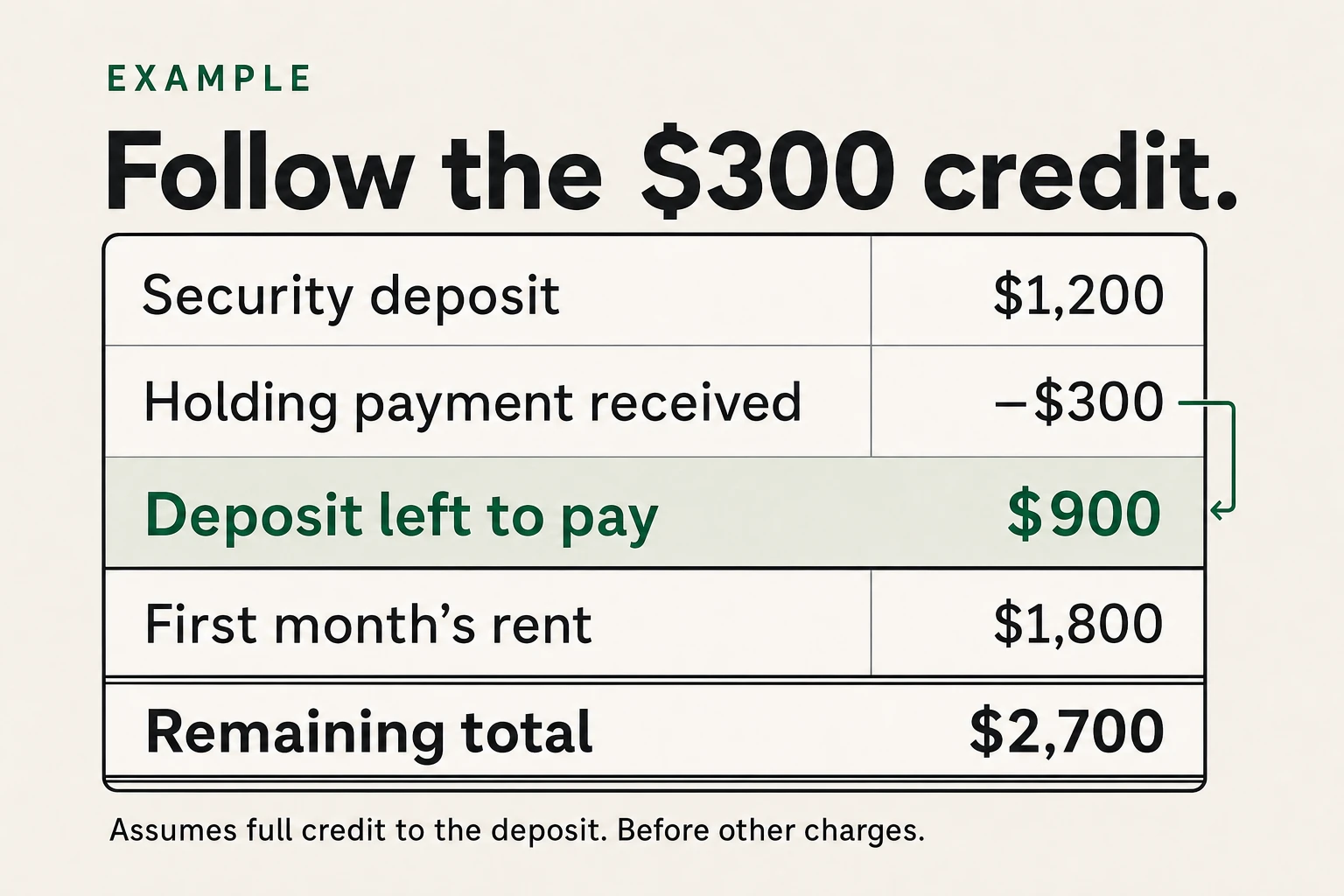
Ask for a move-in statement that shows the original charge, the holding-payment credit, and the remaining balance as separate lines. Keep the earlier receipt with it. A vague “deposit paid” status can make it hard to see whether the money was applied to the right charge or counted twice.
Match the apartment, payee, and payment route
A polished listing and a payment button are not enough to establish who's collecting your money. Before sending a holding payment:
- Contact the office independently. Find the management company's official website and phone number yourself. Use that route to confirm the exact unit, availability, person handling the reservation, recipient, and payment instructions.
- See the actual unit when practical. Visit yourself or have someone you trust go. A model or recorded tour leaves the specific apartment unresolved. Even a self-guided tour does not establish that the person requesting money can rent it to you.
- Pause for mismatched instructions. A new recipient, unfamiliar payment domain, or last-minute account change deserves a fresh conversation through the independently located contact route.
- Walk away from cash-like demands. Pressure to pay immediately, especially only by wire transfer, gift card, or cryptocurrency, is a scam warning.
The Federal Trade Commission's rental-scam guidance explains how scammers copy real listings and tours, and why those cash-like payment demands put your money at risk. No payment method makes an unconfirmed reservation safe or guarantees recovery.
For a fuller property, person, paperwork, and payment process, use our guide to avoiding rental scams.
If the reservation and the promise don't match
Keep the listing, holding agreement, application status, messages, payment receipt, and any promised credit or refund. Write down the relevant dates while they're easy to reconstruct.
Then ask the leasing office for a written explanation tied to the agreement: what happened to the reservation, which term it is relying on, and how it calculated any money it proposes to keep. Include the outcome you're requesting, such as the promised refund or a corrected move-in balance.
If the answer conflicts with the agreement or leaves the legal treatment unclear, a state or city housing agency or local legal-aid organization can help explain the rules for the apartment's location. The USAGov tenant-rights directory provides routes to state agencies and affordable legal help.
You deserve to know what a holding payment reserves, when the promise expires, and where the money goes. If you're still comparing homes, start with Fairway. We'll help with the apartment search, calls, and tours, free for renters.