Roommate removal
How to Evict a Roommate: Start With Who Holds the Lease
How to evict a roommate: understand lease authority, notices, court steps, unpaid rent, and exit options with Fairway, the free AI agent for renters.
Living with someone who misses rent or makes home feel tense can leave you paying more and wondering who can make them leave. Your next step depends on who rents to whom, what the agreements say, and where you live. A clear plan separates the right to seek removal from the money and lease obligations that could follow. If moving becomes the better option, our AI agent for renters can help with your next search, free for renters.
Can you legally evict your roommate?
You generally cannot evict a roommate who rents from the same landlord as you. If your roommate rents from you, you may have a landlord-tenant relationship that allows you to bring an eviction case. For U.S. rentals, state and city law determine the available process.
| Your arrangement | Who may seek removal? | Practical starting point |
|---|---|---|
| Both of you are co-tenants on the landlord's lease | Generally the landlord, not one co-tenant against another | Discuss a voluntary roommate change or lease resolution |
| Each person has an individual bedroom lease | The landlord under that person's lease | Report the issue without trying to terminate their agreement yourself |
| Your roommate rents space from you as a subtenant | You may be able to act as a sublessor, subject to local law | Establish lawful grounds and the required notice and court process |
| Occupant or guest status is unclear, with no written agreement | Authority depends on the actual legal relationship | Resolve status before sending a termination notice |
| You own the home and share it with the occupant | Homeowner-sharing rules may apply | Use an owner-occupied or lodger procedure only if its requirements are met |
Being the person who found the apartment, paid the deposit, or sends the rent each month does not by itself make you the landlord. Start with the lease, any sublease, landlord approvals, and messages about the arrangement.
You both signed the same lease
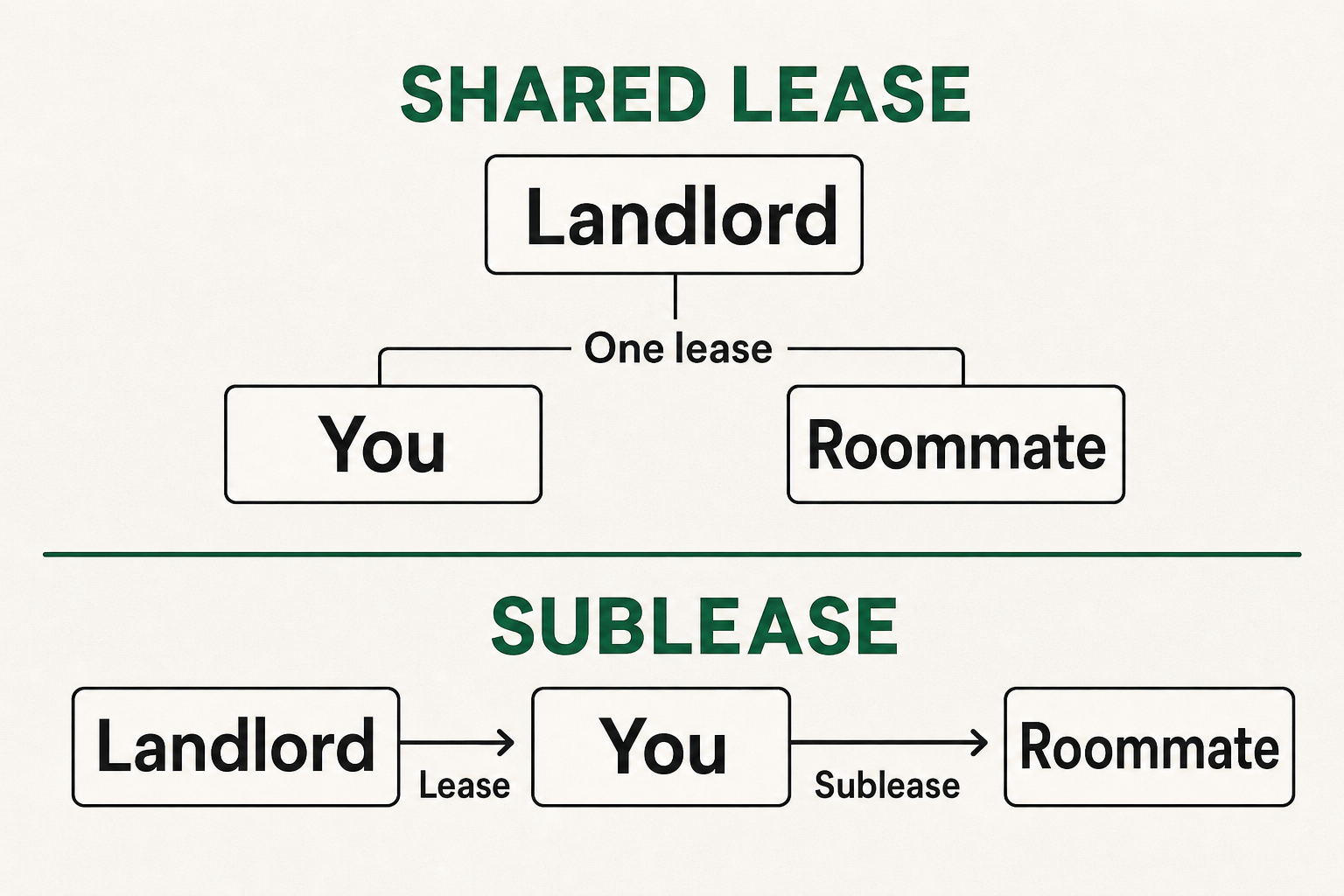
You are usually co-tenants with equal rights to occupy the home. You cannot remove the other person's name, end their tenancy yourself, or lock them out because they stopped paying their share. New York City's roommate court guidance expressly distinguishes co-tenants from roommates who rent from another renter.
Sending one combined rent payment does not change that relationship. A roommate agreement dividing chores and bills does not give one co-tenant authority to evict another.
Your roommate rents a room from you
You may be a sublessor, meaning you rent space to a subtenant while remaining a renter yourself. That can bring landlord duties as well as a possible right to seek eviction. Your original lease still matters, including any required approval for subletting.
Local protections can limit your ability to end that arrangement. In Berkeley, for example, a master tenant must have a legally recognized reason, called just cause, and use the formal eviction process to remove a protected subtenant. The city's subtenant eviction rules also protect replacement roommates in circumstances that do not depend solely on whose name appears on the lease.
You each have an individual bedroom lease
Your roommate's lease is with the landlord. Report the specific issue to the landlord or property manager. You are not the person who can terminate that separate rental agreement. Individual leases can also separate responsibility for rent, unlike a shared lease, as Texas RioGrande Legal Aid explains.
There is no written lease
No signature does not automatically mean no housing rights. An oral rental agreement, permission to live there, payments, and the history of the arrangement can matter. A person you call a guest may have legal protections that require a court process before removal.
New York, for example, protects occupants under oral leases and people who have lawfully lived in a home for at least 30 days from unlawful eviction. Those are New York protections, not a nationwide guest-to-tenant countdown.
If the relationship is unclear, bring the agreements, payment records, move-in date, and permission messages to a local housing lawyer or court self-help center before sending a termination notice. The Legal Services Corporation's legal aid finder locates nearby programs; eligibility and the matters each program handles vary.
Homeowners sharing their own home can fall under different rules. California has a narrow single-lodger exception, with specific residency and access requirements. Renting an apartment yourself does not make that homeowner procedure available to you.
If your roommate is threatening you, prioritize safety
If you are in immediate danger, call 911 and get to a safer place if you can. You do not need to attempt an in-person negotiation or mediation first.
A protective or harassment order may provide a separate route to restrict an abusive roommate's access to the home. The available order and eligibility depend on your location and relationship. Minnesota's roommate safety guidance identifies court orders that can require a threatening or abusive roommate to stay away. Ordinary eviction notice periods are not a reason to delay seeking emergency protection.
If you share a lease, work toward a signed change
When you cannot evict the other person yourself, the useful goal is a workable agreement about who stays, who leaves, and who remains responsible for the rent.
If it is safe, offer a concrete proposal: a voluntary move-out date, an approved replacement roommate, or a joint request to end the lease. A mediator can help with an ordinary dispute when everyone is willing to participate.
Put any agreement with the landlord in writing. A private promise between roommates cannot, on its own, release either of you from the landlord's lease. Our roommate agreement template helps organize household terms, but changing the lease needs its own resolution.
Ask how any action affects your own tenancy
Give the landlord dates, missed payments, relevant lease provisions, and a clear description of the outcome you want. Distinguish an unpaid household rent balance from money one roommate owes another.
A useful message could read:
We share the lease for [address]. Since [date], [brief factual description]. I would like to stay and discuss a voluntary roommate change or another written solution. What options would allow that, and what approvals, payments, and signatures would be needed? Please explain how any proposed action would affect my tenancy.
That message opens a discussion. It does not guarantee the landlord can remove only the other person.
A shared lease can put everyone at risk. Many leases make each signer responsible for the full rent and certain other obligations. Michigan Legal Help explains that a landlord can seek payment from one co-tenant and may pursue eviction of the household for another roommate's lease violation. Its shared-lease guidance also distinguishes a claim against a roommate from a defense to the landlord's eviction case.
If a notice or lawsuit already names you, respond through the court's required process and deadlines. An informal promise that you can stay does not resolve court papers filed against you.
Keep two separate rent balances
A roommate can owe you money even when the landlord has been paid in full. Keeping those amounts separate prevents a confusing landlord conversation and helps document a possible repayment claim.
Suppose the monthly rent is $1,800 and you agreed to pay $900 each. Your roommate pays nothing, so you cover the full $1,800:
- Balance owed to the landlord for that month: $0.
- Your potential reimbursement claim against your roommate: $900.
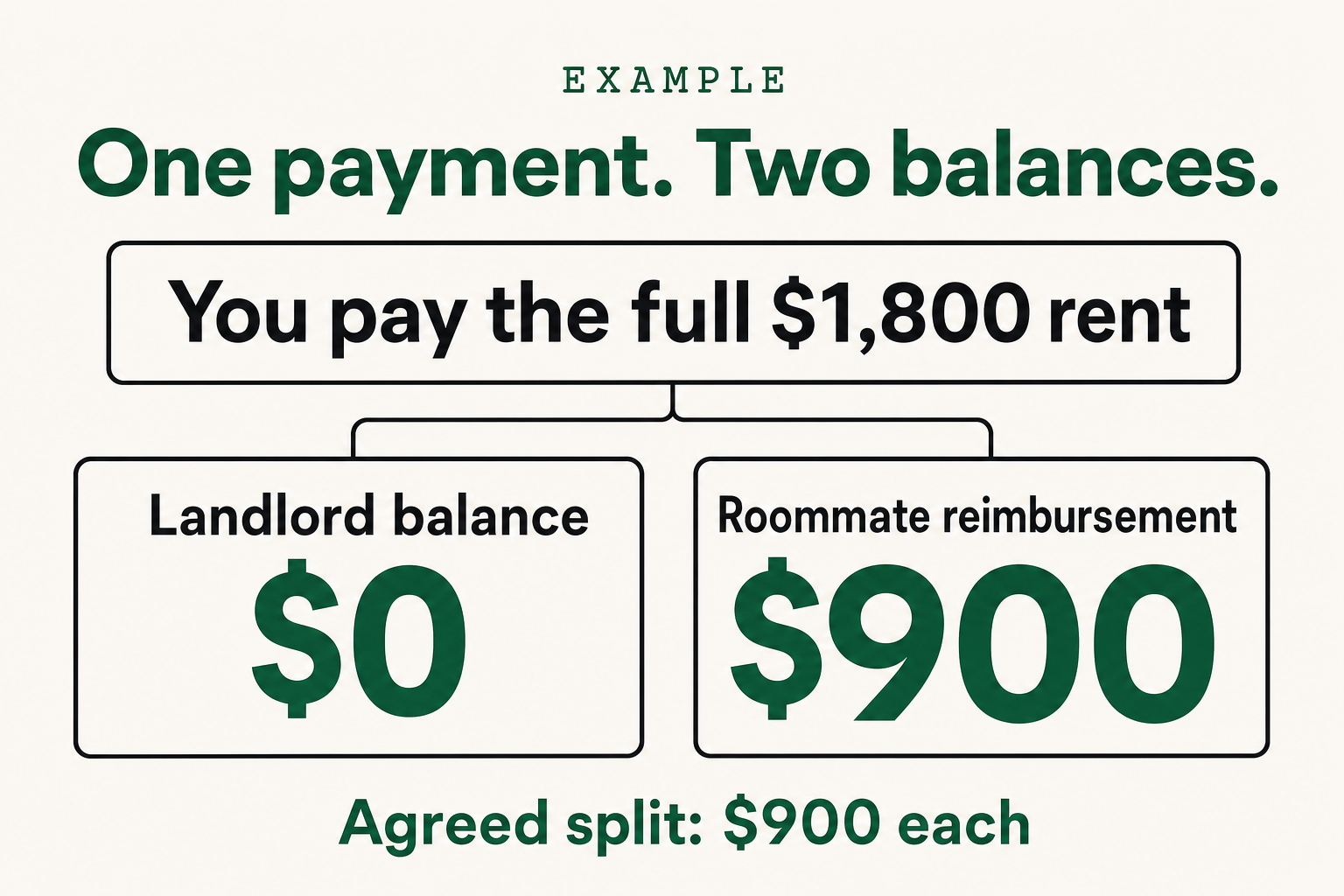
If you pay only your $900 share instead, the landlord still has a $900 unpaid balance. A private 50/50 split may not protect you from that shortfall under a joint lease.
Save the agreement about the split, the landlord's rent ledger, proof of each payment, bills you covered, and messages acknowledging the debt. A small-claims case may be available to recover money owed, subject to local rules and limits. A money claim does not itself give you the right to remove your roommate.
Avoid withholding rent to pressure the landlord into dealing with the roommate. That can create a nonpayment problem for your own tenancy.
If you can bring an eviction case, follow the local sequence
An eviction is a legal process for recovering possession of a home. A demand to leave, a filed case, and an enforceable removal order are different stages. California Courts' eviction process overview illustrates that sequence and prohibits using lockouts, utility shutoffs, or disposal of belongings to make a tenant leave.
1. Establish a lawful reason and the correct case type
Nonpayment, a lease violation, and ending a periodic tenancy can require different procedures. A personality clash does not automatically establish grounds to end a protected tenancy. A fixed-term agreement can also limit when you may terminate it.
For example, New York City's court system distinguishes a paying roommate's holdover case from a licensee holdover for someone allowed to live there rent-free. The right filing depends on the actual relationship, even when both people are casually called roommates.
Prepare a compact record:
- The lease, sublease, addenda, and required landlord approvals.
- A rent ledger showing dates, amounts due, payments, and any balance.
- Dated messages, photographs of relevant damage, and factual incident notes.
- Any notices already sent, with delivery records.
Keep the record focused on the legal issue. A long list of irritating habits is harder to use than a dated account of the missed payment or specific violation.
2. Give the required notice in the required way
The notice may need to demand payment, allow time to correct a violation, or state a lawful termination date. Its contents, timing, and delivery method depend on the jurisdiction and the grounds for the case.
There is no universal rule that every roommate gets 30 days. New York City's termination notice rules, for example, describe different notice periods based on occupancy length and warn that improper delivery can lead to dismissal. They also warn that accepting rent after the termination date can require a new notice.
A text saying “be out Friday” is not a safe substitute for the notice and service requirements. Use the applicable court forms and instructions, with a local housing lawyer's help for disputed status, protected tenancies, or unclear grounds.
3. File and serve the court case when legally permitted
If the required notice period ends without a resolution, the person with legal authority may be able to file the appropriate case. Court papers have their own service rules, separate from the earlier notice.
The roommate has an opportunity to respond and raise defenses. Keep copies of the filed papers and proof of service, and follow the court's hearing instructions. Filing alone does not authorize removal.
4. Obtain the required order and use lawful enforcement
If the court grants possession and the roommate does not leave, follow the court's enforcement process. Depending on the jurisdiction, a sheriff, marshal, or constable carries out the removal. New York Courts' judgment and enforcement guidance explains why a judgment still requires further steps and how a court may stop an eviction.
Do not change locks, block access, shut off essential services, threaten the roommate, or put their belongings outside to force an exit. Winning a case is not permission to improvise the final step.
Put the move-out terms in writing
A voluntary departure can avoid a contested eviction, but the handoff still needs clear terms. The practical details worth recording include:
| Issue | What the written resolution should address |
|---|---|
| Departure | Move-out date, key return, and possession handoff |
| Lease obligations | Who remains a renter and when any departing person's future liability ends |
| Money already owed | Amounts paid, forgiven, disputed, or scheduled for repayment |
| Security deposit | Each person's contribution and how any settlement fits the landlord's deposit handling and applicable law |
| Replacement | Required approval, start date, rent amount, and any new lease or amendment |
| Final bills and belongings | Utility allocation, account transfers, and lawful handling of anything left behind |
A roommate leaving the apartment and a landlord releasing that person from the lease are separate events. A replacement moving in does not automatically settle either the old debt or the departing renter's obligations.
If you decide to leave yourself, our guide to breaking a lease explains the difference between moving out and ending responsibility for future rent. Keep your own exit terms separate from the dispute about what your roommate owes.
Common questions about evicting a roommate
Can the police remove a roommate who will not leave?
Do not rely on a trespassing complaint to bypass a housing dispute involving someone who has a right to live there. Ordinary eviction enforcement follows the applicable legal process. Emergency threats, crimes, protective orders, and narrow exceptions such as California's qualifying lodger procedure involve different rules.
How long does it take to evict a roommate?
There is no reliable nationwide timeline. Notice comes before filing in many cases; service, a response, court scheduling, and enforcement add separate stages. A contested case or defective notice can take longer. Do not promise the room to a replacement based only on the date in a notice.
How much does a roommate eviction cost?
Budget for the applicable filing, service, and enforcement charges, any lawyer's fees, and rent you may need to cover while the matter is pending. Fee waivers may be available under local court rules. A voluntary agreement has its own trade-offs, such as a payment plan or an agreed deposit settlement.
Give your next rental search its own plan
If leaving is the route you choose, deciding where to live adds another round of listings, unanswered calls, and tour scheduling. Tell us your budget, location, and move window. We find matches, call landlords or leasing offices, and book tours, free for renters. Your current lease still needs its own resolution.
Start your rental search with Fairway.