Renter guide
How to Break a Lease Without Leaving the Costs Open-Ended
Understand your lease-exit options, compare fixed and vacancy-based costs, and get the dates, payments, and end of your rent responsibility in writing.
Needing to move before your lease ends is stressful enough. Then come the unfamiliar fees, conflicting answers from the leasing office, and worry about paying for two homes. A clearer exit starts with understanding what can end your obligations, what may still cost money, and which promises belong in writing. The goal is a move you can plan around, with fewer loose ends following you to the next apartment.
1. Separate moving out from being released
To break a lease, you can use an applicable legal termination right, follow an early-exit clause, negotiate a written release, or arrange an approved replacement. Leaving without one of those protections can leave you owing rent or other lawful damages after you move.
For U.S. residential rentals, the lease and state or local law determine the available routes. There is no nationwide rule that 30 days' notice or one month's rent buys you out of a fixed-term lease.
Start with the full lease and its addenda. The useful sections are early termination, notice, reletting, assignment, subletting, concessions, and move-out.
| Exit route | What it does | What can remain unresolved |
|---|---|---|
| Protected legal termination | Ends the tenancy under a qualifying law and its required process | Rent through the effective date and other obligations the law preserves |
| Contractual buyout | Provides an early-exit option when you meet the clause's conditions | Notice-period rent, concession repayment, or separate charges |
| Negotiated release | Ends obligations on the terms you and the landlord sign | Any amounts or claims the agreement expressly leaves open |
| Replacement renter | Can reduce vacancy losses or support a new lease or assignment | Your liability unless the law or signed documents end it |
| Sublet | Lets someone else occupy the home under a separate arrangement | Your responsibility to the landlord under the original lease |
If you are already month to month, ending the tenancy with proper notice is a different process from breaking a fixed term. The notice period and effective date still depend on your agreement and local rules.
Finding your next home adds another round of calls and scheduling. Our AI agent for renters is free for renters: you describe what you want, we find matches, call landlords or leasing offices, and book tours. That help concerns your next rental search; your current lease exit needs its own written resolution.
2. Identify any protected reason to leave
A new job, breakup, home purchase, or tighter budget can be a good reason to move. Those circumstances do not create a universal right to cancel a lease without cost. A specific lease provision or state protection may help; otherwise, they are reasons to negotiate.
Legal termination rights have their own eligibility, documentation, delivery, and timing requirements. A general message saying you need to leave does not necessarily exercise one.
Military service and qualifying orders
The federal Servicemembers Civil Relief Act, or SCRA, allows qualifying residential lease terminations, including when someone signs a lease and later enters military service, or receives qualifying permanent-change-of-station or deployment orders. Deployment orders generally must cover at least 90 days. Retirement or separation orders can also qualify. Written notice and military orders, or an appropriate commanding officer's letter, are required.
For rent paid monthly, termination generally takes effect 30 days after the next rent payment is due, following proper notice. That is different from 30 days after sending the letter. A qualifying termination cannot carry an early-termination fee. The Justice Department also treats required repayment of rent concessions as a prohibited termination fee under the SCRA. Its military housing guidance explains these protections.
Domestic violence, stalking, and other protected circumstances
State laws can give survivors a way to leave without a standard lease-break penalty. The covered circumstances and required evidence differ.
For example, California's survivor protection covers specified acts of domestic violence, sexual assault, stalking, and other crimes. A qualifying written notice requires supporting documentation and must meet the law's timing rules. Rent responsibility is limited to no more than 14 calendar days after notice, or a shorter applicable period, with release from further lease payment obligations without penalty.
That 14-day rule belongs to California. It is not a national notice period, and one protected renter's departure does not necessarily release unrelated co-renters.
Serious housing problems or landlord violations
Unsafe conditions can support an early exit when the applicable law's requirements are met. The condition, repair notices, landlord's opportunity to respond, and your own compliance can all matter. A slow maintenance response or unpleasant neighbor does not automatically cancel a lease.
Texas, for example, provides possible termination remedies for certain health or safety repair failures after the required process. The Texas Attorney General describes rent-current requirements, notice procedures, and a reasonable repair period. Those details are specific to Texas.
A local housing lawyer or legal-aid organization can assess a repair-based exit, repeated unlawful entry, harassment, or a disability-related accommodation request before you rely on it to end rent payments. USAGov's tenant-rights resources connect renters with state agencies and affordable legal help. Keep dated repair requests, photos, inspection records, and responses together. If you are in immediate danger, getting somewhere safe comes first.
3. Compare the total cost of each exit
One expensive misunderstanding is treating a fee as a release. A reletting charge can compensate the landlord for finding another renter while leaving your rent obligation in place.
The Texas Apartment Association's sample lease terms make that distinction explicit: its reletting charge does not release the renter from lease obligations. Its separate early-termination option applies only when selected in the lease details and all required conditions are met.
A useful question for the leasing office is: “Does this payment end my future rent obligation, or will rent continue until another event?”
Request an itemized proposal showing:
- Rent due through the proposed termination date, including any notice period.
- The buyout, termination, or reletting charge and what it covers.
- Any claimed repayment of free rent or other concessions.
- Any rent that can continue afterward, its end condition, and any proposed cap.
- Separate damage, utility, cleaning, or key charges.
- How the security deposit will be accounted for.
These are possible categories, not automatically valid charges. Their enforceability depends on the lease and applicable law. A fixed-sum release and a vacancy-based claim can be different alternatives, rather than costs to add together.
A fixed price versus an uncertain vacancy bill
Suppose your rent is $1,800, four months remain after your planned move-out, and you have two written proposals. This example excludes amounts already due, deposits, damages, and the next apartment's costs.
- Fixed release: $4,000 total, with no additional future rent after the agreed date once you meet the agreement's conditions.
- Vacancy-based exit: $500 in permitted reletting costs plus $1,800 for each full vacant month, ending when an approved new lease starts, with no rent shortfall afterward.
If the home sits vacant for one month, the second route costs $2,300. At two months, it costs $4,100. At three, it costs $5,900. Under those assumptions, the crossover is about 1.94 months, or $3,500 divided by $1,800.
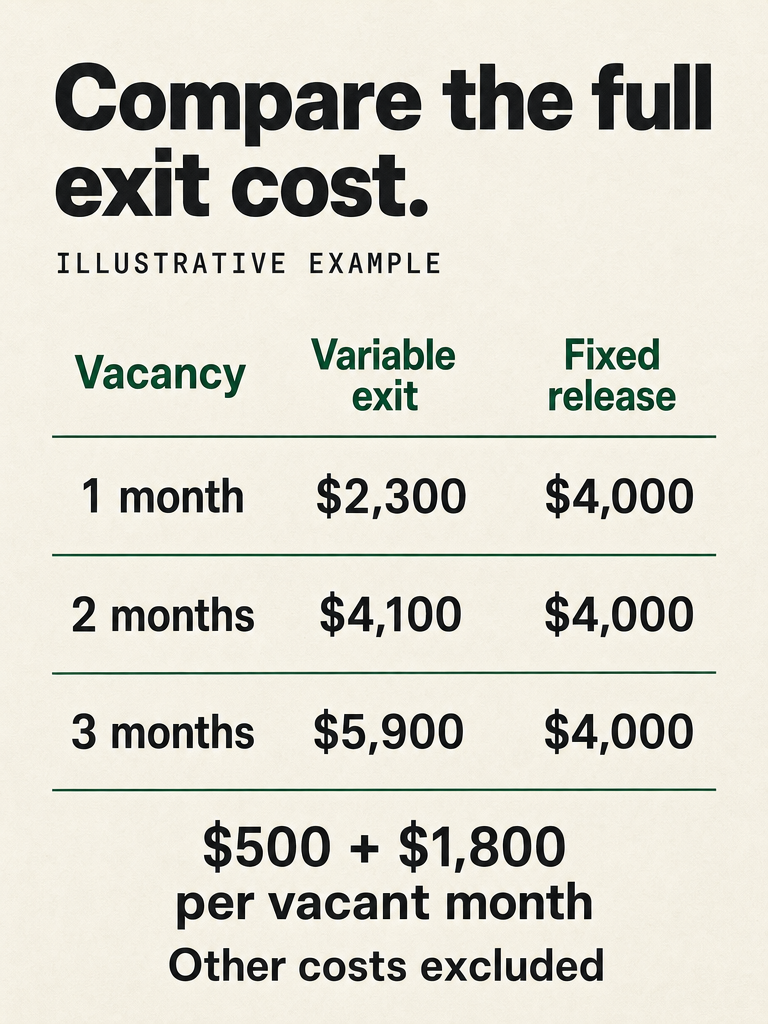
The lower starting fee buys uncertainty. A fixed release can cost more if the home fills quickly and less if it does not. A rental listing is not a signed replacement lease, so a forecast of “probably next week” is still a forecast.
Re-renting can limit what you owe
A landlord's duty to reduce avoidable losses is called mitigation. State rules differ. In New York, the mitigation statute requires reasonable and customary efforts to re-rent a home after a renter leaves in violation of the lease. It also provides that a qualifying new lease, once effective, terminates the previous lease.
Mitigation does not mean every early departure is free or that any proposed replacement must be accepted. Where rent remains tied to re-renting, keep dated listing records, the applicants you referred, responses, and the replacement lease's effective date if provided. Those records help resolve a later claim for vacancy losses.
4. Offer a concrete plan and get the release in writing
A workable proposal gives the landlord something specific to respond to: a departure date, access for lawful showings, an approved replacement process, or a defined settlement amount. You can negotiate the date and payment together rather than accepting a fee with an unknown rent tail.
For an ordinary negotiated exit, this message starts the conversation:
Subject: Request for early lease termination, [address and unit]
Hi [name],
I would like to discuss ending my lease, which currently runs through [lease end date]. My proposed move-out date is [date].
Would you agree to a written early-termination arrangement? I can [offer reasonable showing availability / refer potential replacement renters / propose a settlement amount].
Please send an itemized proposal stating the termination date, each payment and due date, and whether satisfying the agreement releases me from future rent and reletting claims. Please also describe any remaining charges and how the security deposit will be handled.
Thank you, [name and contact information]
This is a request to negotiate. It does not cancel the lease, serve as a universal legal notice, or replace the procedure for a protected termination.
Once you agree, the signed document should name the property, lease, and parties and state:
- The dates: when you surrender possession and when the tenancy and future rent responsibility end.
- The payment terms: exact amounts, deadlines, and every condition required for release.
- The scope of release: which future rent, reletting, concession, or other claims are settled and which remain open.
- The deposit treatment: whether it is applied to an agreed balance or accounted for separately under applicable law.
- The signatures: the landlord or authorized representative and the other parties needed for the agreement.
“You can move out” leaves the money question unanswered. The sentence you need addresses what you still owe after you do.
A replacement renter and a sublet are different
An approved new renter may sign a new lease directly with the landlord. An assignment transfers your lease interest. A sublet creates an arrangement between you and another occupant while your original lease remains in place. New York's subletting and assignment guidance explains the distinction and its state-specific approval rules.
Approval of a person moving in does not, by itself, establish that you are released. The useful outcome is signed paperwork addressing your continuing liability. A sublet can cover costs while leaving you responsible if the subtenant fails to pay or causes damage.
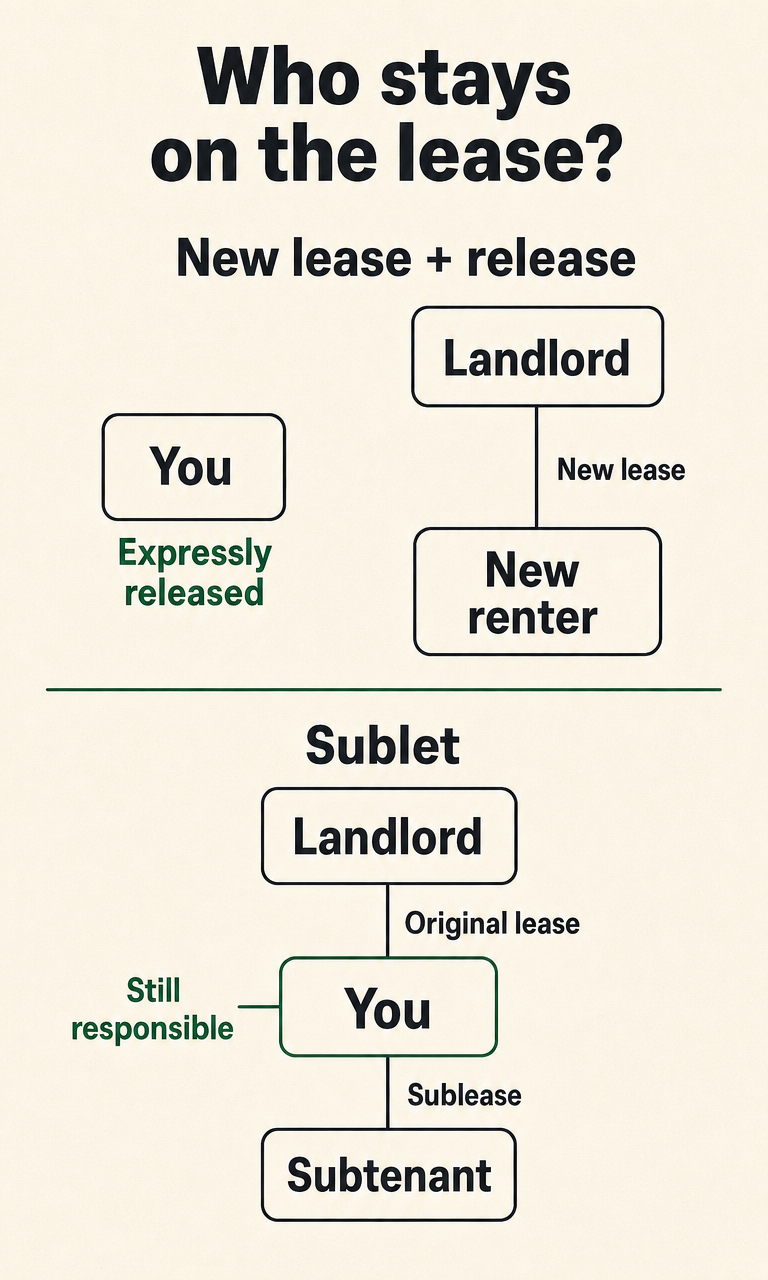
When only one roommate is leaving, a written lease amendment or individual release should address that person's liability, the replacement's obligations, and the deposit share. Under a joint-and-several-liability clause, a departing signer can remain responsible for the full rent, even if roommates privately promise to cover it. Our roommate agreement template helps document the household's arrangement; it does not change the landlord's lease rights.
5. Give the required notice and document the handoff
Notice delivery is part of the exit process. The applicable law, lease, or signed agreement determines the recipient, permitted method, notice period, and required attachments. Emailing a general inbox or telling someone during a tour may not satisfy those terms.
Keep the notice, attachments, delivery evidence, signed agreement, and payment receipts in one folder. A conversation can clarify a proposal; the retained documents show what actually took effect.
At move-out, the useful records are:
- Dated photos or video of the empty home, including existing damage.
- Any walkthrough report and relevant move-in condition records.
- Cleaning receipts and required utility arrangements.
- A written receipt for all keys, fobs, remotes, and parking passes.
- A forwarding address or safe mailing arrangement for account and deposit correspondence.
Treat the key-return date and the release date as separate entries. They may match, but a key receipt alone does not settle every financial obligation.
6. Close the account and plan the next rental
The final statement should separate rent, permitted fees, damage claims, deposit credits, payments, and the remaining balance. Match it to the signed exit terms and any applicable re-renting limit. If a charge is disputed, a written response identifying the amount and supporting records creates a clearer record than another phone call.
A security deposit is not automatically your last rent payment or the maximum you can owe. Deposit deductions, accounting requirements, and return deadlines depend on state law. For example, Texas generally requires a refund, less lawful deductions, within 30 days after you surrender the premises, subject to your providing a written forwarding address. Property Code sections 92.103 and 92.107 establish that timing and address requirement.
For the next home, budget separately for old-lease exit costs, the new deposit and upfront charges, moving, and any overlap. A deposit you expect back later cannot fund a payment due today. Our apartment renting guide helps separate monthly affordability from the cash needed to get the keys.
Keep the release and final receipts after the move. A clean account record is useful if a future landlord asks why the lease ended early.
Common questions about breaking a lease
Does breaking a lease hurt your credit?
An agreed early exit is different from an unpaid rental debt. Late rent and related debt-collection information can appear in credit reports, and rental-payment history can appear in specialty screening reports. The Consumer Financial Protection Bureau explains how those records can affect future applications. Our rental history report guide covers obtaining records and disputing errors.
Can you break a lease before moving in?
Potentially, through a contract provision, applicable legal right, or negotiated release. Signing can create obligations before you collect the keys. The Texas Apartment Association sample lease includes failure to move in as a reletting-charge trigger. Never occupying the home does not itself establish a free cancellation right.
What if the landlord refuses to negotiate?
Refusing a voluntary release does not erase an applicable legal termination right. Without one or a contractual exit option, leaving can expose you to a claim for rent and other lawful damages, subject to applicable limits. Legal aid or a local housing attorney can help with disputed rights, mediation, settlement terms, or a court claim. Keep responding to formal notices; an unresolved bill does not disappear because you moved.
Give your next search a clear move window
A workable exit plan connects three things: the date you leave, the event that ends your rent responsibility, and the total cost you can carry. Once those are clear, you can choose a realistic move-in window without letting the next lease outrun the current one.
When you are ready for the next home, start your rental search. We can handle the listing hunt, property calls, and tour booking while you keep control of the decision.