First apartment
How to Set Up Electricity in an Apartment Before Key Day
Set up apartment electricity with the right provider, start date, deposit details, and activation record. A move-in guide from the AI agent for renters.
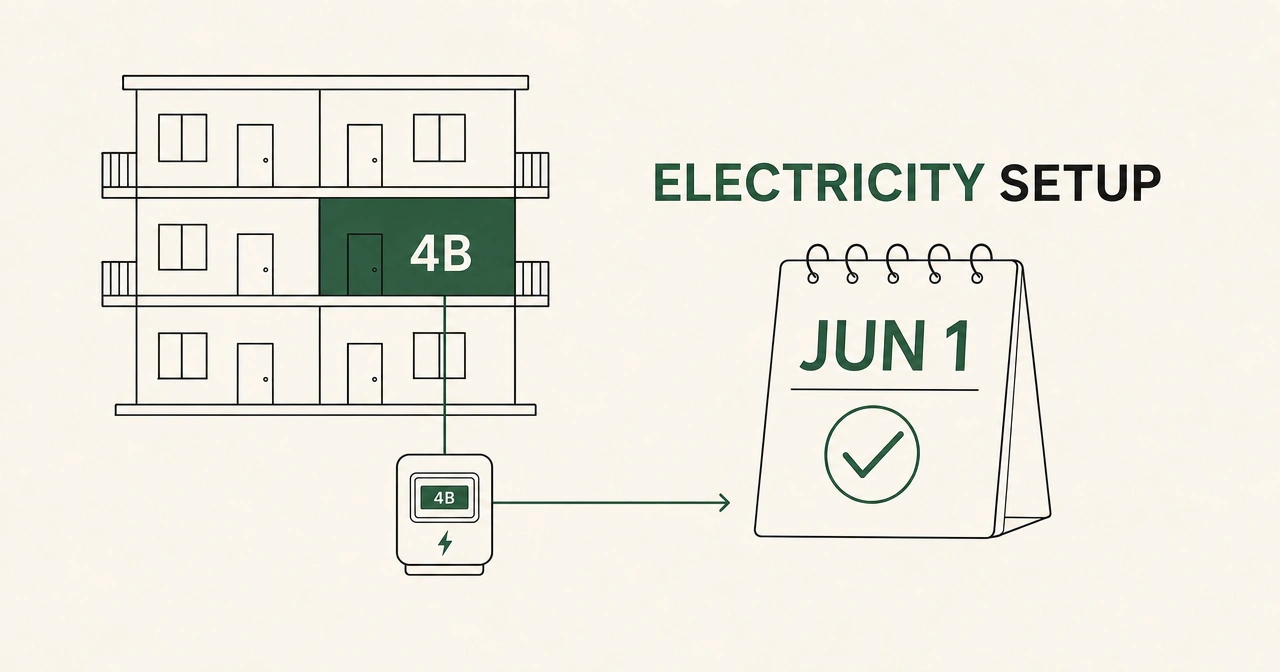
The lease is signed, but the lights still come with their own paperwork. Electricity setup can involve your leasing office, a local utility, and sometimes a separate electricity supplier. Knowing who needs what from you is the confusing part.
A little preparation helps you avoid a dark first night, an account for the wrong unit, or charges starting on the wrong date. Here’s how to get your service arranged and keep a useful record before you pick up the keys.
How to set up electricity in your apartment
Start with the lease’s utilities clause. If electricity must be in your name, identify the provider serving your exact apartment, open or transfer service, and request the date your responsibility begins. Complete any identity or deposit requirements, then save the provider’s start-date confirmation.
We’re Fairway, the AI agent for renters, and we’re free for renters. You describe the home you want. We find matches, call landlords or leasing offices, and book tours. Once you’ve chosen a home, electricity enrollment happens directly with the provider or through the building’s billing arrangement.
1. Find out who bills you for electricity
“Utilities included” can mean different things from one building to the next. The electricity clause, utility addendum, and move-in instructions should establish which setup applies:
| Billing arrangement | Your setup task |
|---|---|
| Electricity is included in rent | Get the included service and any usage cap or extra charge in writing. A separate electric account may be unnecessary. |
| The property or a billing company charges you separately | Get the billing enrollment instructions from management, including how usage or your share is calculated. |
| You pay an electric provider directly | Open or transfer service for your exact apartment and arrange the start date. |
A separate electricity charge does not automatically mean you need a utility account. In a submetered building, for example, the property can receive the main utility bill and bill apartments for their measured usage. Rules for these arrangements vary by location.
A useful message to the leasing office:
For apartment [unit number], do I open my own electricity account or enroll through the property? Which company serves the unit, what is its exact electric service address, and what date must service begin in my name? Do you need an account confirmation before releasing the keys?
Keep the reply with your lease. If management’s instructions conflict with the signed utility terms, ask for the discrepancy to be resolved in writing before enrolling.
2. Find the provider for the exact unit
Use the company name from the leasing office to reach the provider’s official website or customer-service line. Supply the full address, building designation, and apartment number. A company serving your old apartment may not serve the new one, even within the same city.
The delivery utility operates the local wires and brings electricity to the meter. An electricity supplier sells the energy. Depending on the address, these may be the same company or separate companies. Supplier choice is available in some service territories; it is not a nationwide option. The U.S. Energy Information Administration explains how electricity supplier choice works.
Two examples show why the address matters:
- In competitive areas of Texas, you enroll with a retail electric provider. The local delivery utility still handles the wires. The state’s Power to Choose site lists retail plans.
- In Pennsylvania, customers can shop for a supplier while their utility remains the delivery company. Utility default supply is also an option, as the state’s electricity shopping guidance explains.
If your address has no supplier choice, skip the retail-plan shopping. Start with the utility’s residential service application.
If the form cannot find your apartment, stop before selecting a similar unit. Give the provider the address from your lease and ask management for the electric service address and meter or service identifier. A mailing address and a utility’s address record can use different unit formatting. Ask the provider and management to resolve that mismatch before you authorize an account.
3. Gather what the application needs
Keep these details together before starting the online form or call:
- Your legal name and contact information.
- The complete electric service address, including the unit.
- Your requested start date.
- Identification and any identity information the provider requires.
- Your existing account number if you already use that provider.
- A payment method if an upfront charge is required.
- Your signed lease if the provider needs proof of occupancy.
Requirements differ. For example, Con Edison’s application requests a new residential customer’s address, move-in date, and valid identification. Southern California Edison can request additional documents and a review before completing a start-service request.
If an online form requires identification you do not have, ask customer service which identity documents it accepts and how to apply without that document. Keep sensitive documents inside the provider’s official application or secure upload channel.
4. Open new service or move your existing service
If you have never held an electric account, choose the provider’s start service or new customer option.
If you already have an account and the provider serves the new address, use its move or transfer service process. That usually involves a start date at the new apartment and a separate stop date at the old one. If it does not serve your new address, open service with the new provider and arrange the old account’s stop date separately.
Moving your own service is different from taking over someone else’s account. If the apartment still has electricity in the landlord’s or previous renter’s name, apply using your own identity. The lights being on do not establish an account for you.
For example, PG&E’s account-handoff process generally requires one person to stop service and the next to start it, rather than transferring an account between people. Its process allows the stop and start dates to align to avoid a disruption. Let the provider handle the handoff.
5. Match the start date to your responsibility
A useful planning buffer is one to two weeks before your electricity responsibility begins. Start sooner when a technician, building access, or additional paperwork may be needed. This is preparation time, not a universal activation deadline.
Providers have different scheduling windows. PG&E allows residential starts up to 60 days ahead and can complete many requests the same day. Con Edison allows existing customers to schedule a service move within the next 30 days. Neither example makes same-day service a safe assumption for another address.
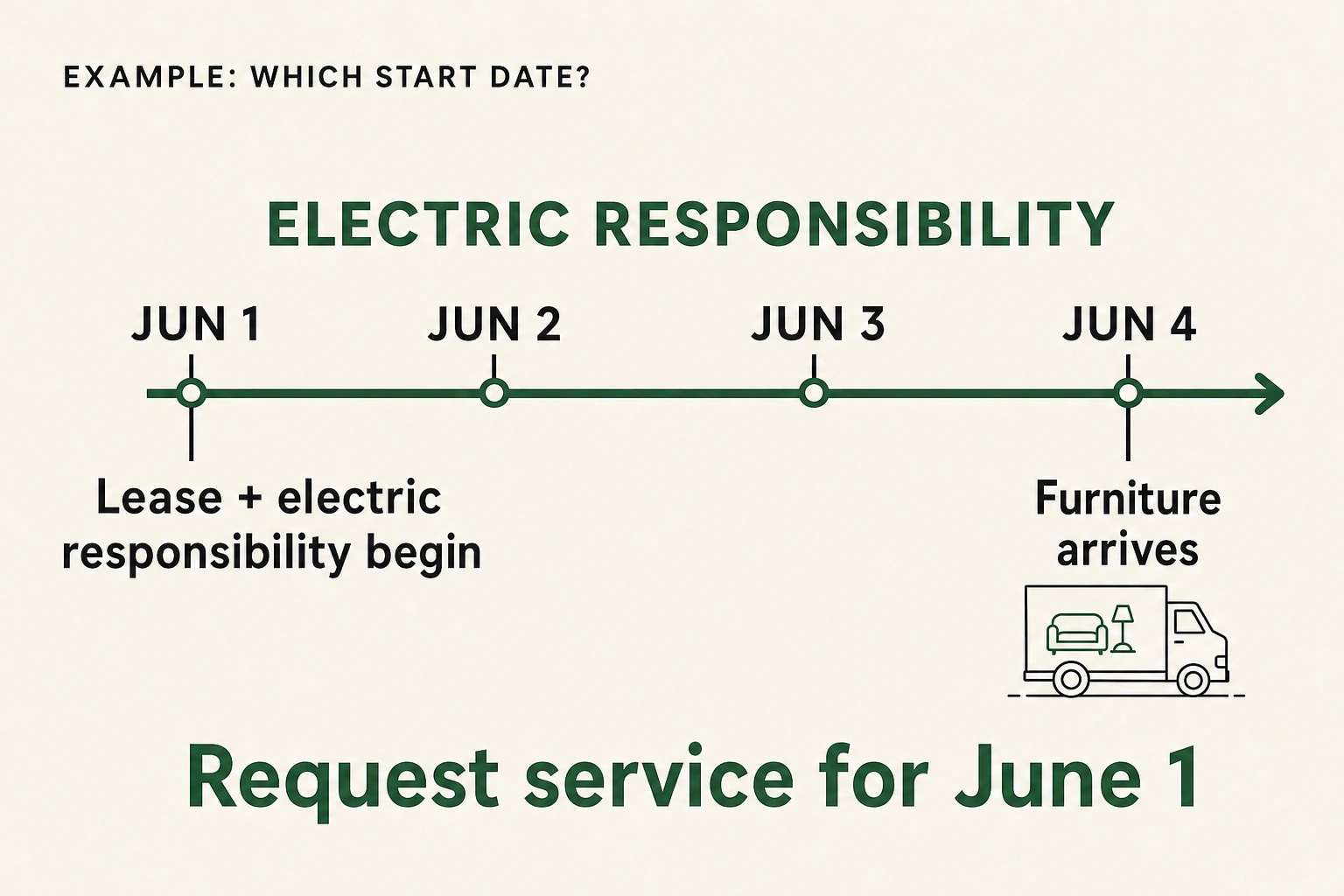
Base the requested date on the lease and written handoff arrangements. Your moving truck may arrive later than the date you become responsible for electricity.
For example: your lease and electric responsibility begin June 1, but your furniture arrives June 4. Requesting June 4 would leave June 1–3 outside your planned account coverage. The relevant date is June 1. If management instead agrees in writing to keep service in its name through June 3, the provider can arrange the corresponding handoff.
When you’re moving between apartments, the two accounts may need to overlap. Starting the new apartment’s service should not automatically end the old apartment’s service before your responsibility there ends.
Ask the provider:
- Is the requested start date accepted, or is the application still pending?
- Are identity documents, payment, or other steps outstanding?
- Does activation require a technician or access to the meter or apartment?
- If access is needed, must an adult be present, and who can unlock the building’s utility room?
Coordinate any appointment with management. An appointment date after key day needs attention before the movers arrive.
6. Separate the deposit, setup fee, and monthly bill
There is no useful national price for “turning on apartment electricity.” Your upfront amount depends on the provider, location, account history, and application.
Some utility companies may use account and payment-history information from specialty consumer reporting companies to decide whether to require a deposit before providing service. The Consumer Financial Protection Bureau explains how these utility payment histories can affect that decision.
Ask for each charge separately:
| Charge | Detail to get in writing |
|---|---|
| Security deposit | Amount, due date, waiver or installment options, and the conditions for a refund or account credit. |
| Connection or activation fee | Amount, whether it is refundable, and whether it is due now or on the first bill. |
| Ongoing service | Rate, recurring fees, billing schedule, and payment due date. |
A deposit waiver, installment plan, or guarantee option depends on the applicable policy. None should be assumed. If an upfront amount would stop you from opening service, ask about available alternatives before paying.
Where you can choose a retail plan, compare the contract length, fixed or variable pricing, recurring charges, usage conditions, and cancellation terms. In competitive Texas markets, the Electricity Facts Label gives standardized plan details, including prices and fees. A low advertised price can depend on how much electricity you use. The regulator’s electricity shopping questions help separate the energy price from delivery and recurring charges. Ask for the total estimated charge at the usage level relevant to your apartment.
Keep monthly budgeting separate from activation cash. Our apartment utility budget explains how to estimate recurring bills for the home you’re renting.
7. Save an activation record before key day
An online login, a submitted application, an accepted service date, and working electricity are different things. Keep enough information to tell which stage you have reached.
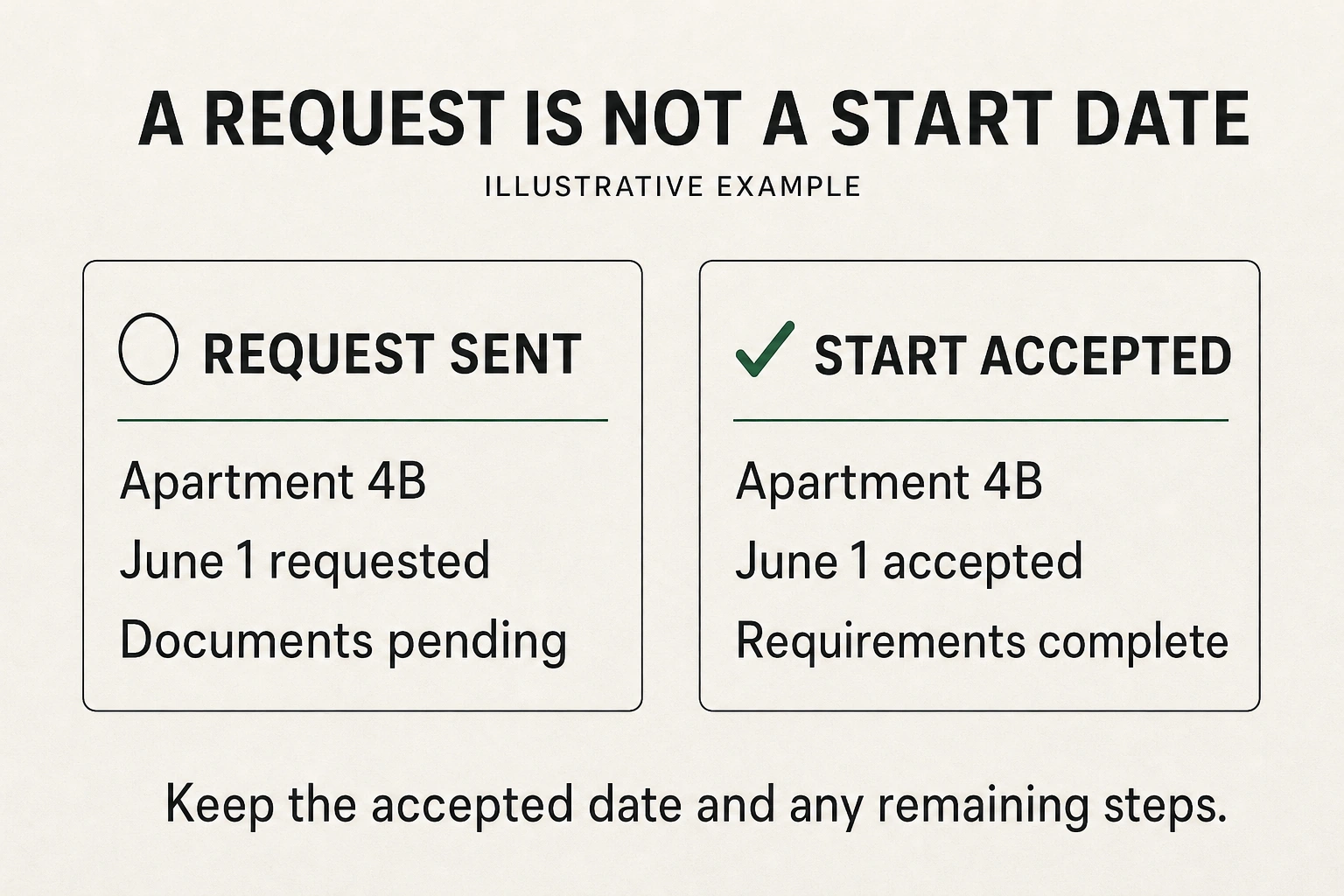
A compact record can live in a note on your phone:
| Field | What to save |
|---|---|
| Provider and account holder | Company name and the name on the account. |
| Service location | Full address, unit, and meter or service identifier if supplied. |
| Start status | Requested date, accepted date, and any remaining requirement. |
| Account and request numbers | Both, if the provider issues separate numbers. |
| Upfront payments | Deposit or fee amount, receipt, and stated refund terms. |
| Access arrangements | Appointment window, adult-presence requirement, and building contact. |
| Key-release proof | Confirmation requested by the leasing office and the date you sent it. |
Share only the confirmation management needs. Your Social Security number, identity documents, payment information, and account password do not belong in a key-release email.
When the first bill arrives, use this record to match the service address, billing start date, agreed rate, and upfront charges. Send any mismatch to the provider with the relevant confirmation or receipt.
If electricity setup gets stuck
A specific question usually helps more than submitting the same application again.
| Problem | Next step |
|---|---|
| The apartment has power, but you have no account confirmation | Ask the provider whether your start request was accepted and what remains outstanding. Existing power may still belong to another account. |
| The address or unit is missing from the form | Ask management for the utility’s service address and identifier, then have the provider match the correct unit. |
| The previous resident or an account hold blocks enrollment | Tell the provider you are a new occupant and ask for its documentation process. Have the signed lease ready. Use your own account credentials. |
| Documents or a deposit were submitted, but the start is still pending | Ask which requirement remains unresolved and whether it changes the accepted activation date. |
| Your account is active, but the apartment has no power | Report it to the delivery utility and the property’s maintenance contact. Ask whether the cause is an outage, an incomplete connection, or a building issue. |
A meter, sealed equipment, or exposed wiring is not a move-in task. Leave electrical work to the utility and qualified building staff.
If service cannot be ready for your planned arrival, get the earliest available date from the provider and contact management about access and move-in arrangements. Keep both conversations in writing. Do not assume a service delay automatically changes your lease dates or payment obligations.
A few first-apartment questions
Can I arrange electricity before I have the keys?
Many providers accept future-start requests before you physically move in, but their scheduling windows and access requirements vary. Use the date your electricity responsibility begins. If activation needs access to a locked meter room or apartment, arrange that access through management rather than assuming you can enter early.
Whose name should the account be in with roommates?
Use the account-holder arrangement the provider accepts. Decide who receives the bill, how roommates reimburse that person, and what happens when someone moves out. Record the split and payment dates in a roommate agreement. Sharing the cost does not automatically make everyone an account holder.
Keep the rest of move-in manageable
Before key day, aim to have the right unit and start date accepted, all provider requirements completed, and any access arrangements settled. Keep that record beside the lease and key instructions. Our first apartment checklist keeps the other move-in tasks in one place.
Still choosing an apartment? Tell us what you need, and we’ll find matches, call landlords or leasing offices, and book tours. Free for renters.