RENTAL CHOICES
Renting a House vs. an Apartment: What You Actually Get
Renting a house vs apartment: compare full costs, privacy, upkeep, and lease terms. Choose a better fit with Fairway, the AI agent for renters.
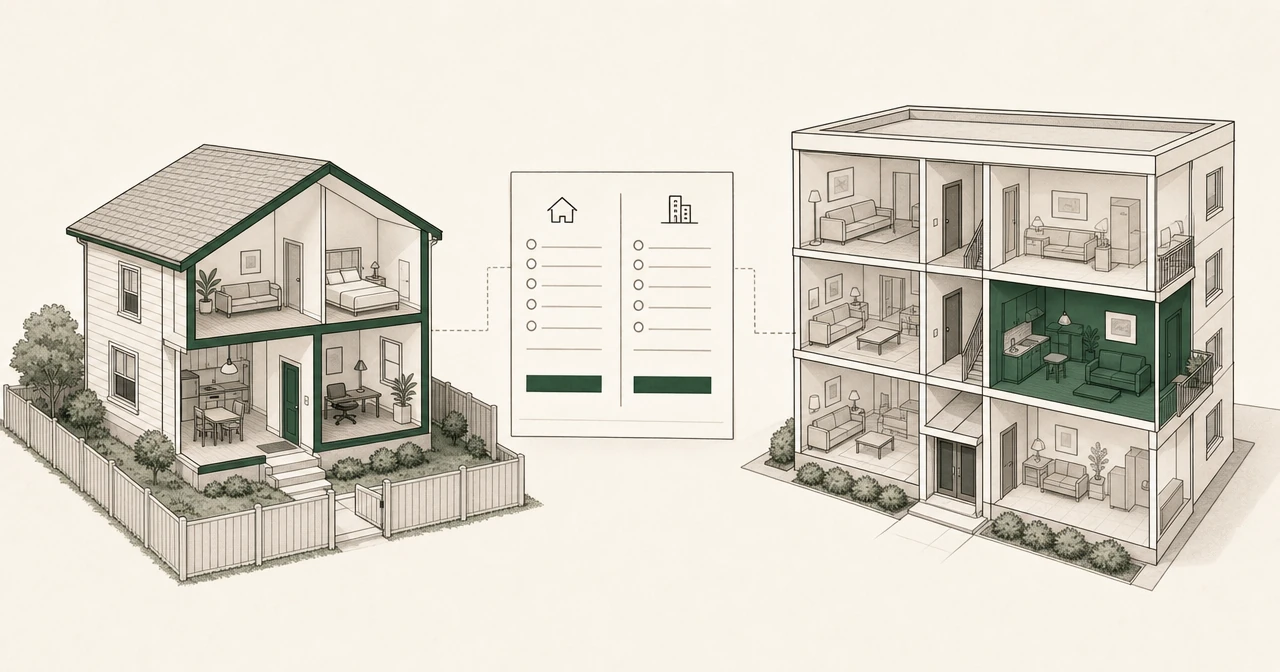
A house with a yard and an apartment near everything can both look like the right move. Listings rarely make them easy to compare. One shows a driveway; the other shows a gym. Neither tells you what an ordinary Tuesday will cost or feel like.
We’ll help you weigh the space, bills, upkeep, and lease behind each option. At Fairway, our AI agent for renters is free for renters and helps with the search, calls, and tour scheduling once your priorities are clear.
The main trade-off: more separation or less upkeep
A detached rental house gives you separation from neighbors, a private entrance, and potentially a yard, garage, or extra rooms. An apartment places your home within a building containing other homes, so walls, floors, entrances, and outdoor areas may be shared. It can also put amenities and maintenance staff closer at hand.
A house is a stronger fit when its private space solves a daily problem. An apartment is a stronger fit when its location and shared upkeep make daily life easier. Neither label guarantees those benefits.
| What matters | Renting a house | Renting an apartment |
|---|---|---|
| Space | May offer extra bedrooms, storage, and outdoor space | Can make a smaller footprint work through a good layout |
| Privacy | A detached house has no shared walls or floors | Depends on construction, floor, and neighboring rooms |
| Monthly cost | More space and outdoor upkeep can add expenses | Parking and mandatory fees can add to the total |
| Maintenance | Yard care and other routine tasks may fall to you | Common-area upkeep usually stays with building management |
| Amenities | May have a garage or access to community facilities | May include a gym, pool, package room, or shared workspace |
| Flexibility | Depends on the lease and owner's plans | Depends on available lease terms and renewal conditions |
A townhouse can share walls even when it is listed as a house. A duplex apartment can have a private entrance and yard. Start with the actual layout and included spaces so those middle options stay on your list.
Compare the full monthly cost
Asking rent is only the starting point. A modest house and an apartment with paid parking and mandatory add-ons can finish surprisingly close. The specific expenses attached to each home decide which costs less.
For each option, add:
Lease rent + required recurring fees + renter-paid utilities + insurance + parking, pets, internet, laundry, storage, and upkeep you will pay for.
Leave out services already included in rent. Keep optional costs separate from mandatory ones. A gym only saves money if you would otherwise pay for a membership and would actually use this one.
The Federal Trade Commission and Colorado alleged that Greystar omitted mandatory monthly fees from advertised rents. A stipulated settlement order was entered December 12, 2025. It requires total-price disclosures and details about fees. A written fee breakdown makes the comparison more useful than a pair of listing prices.
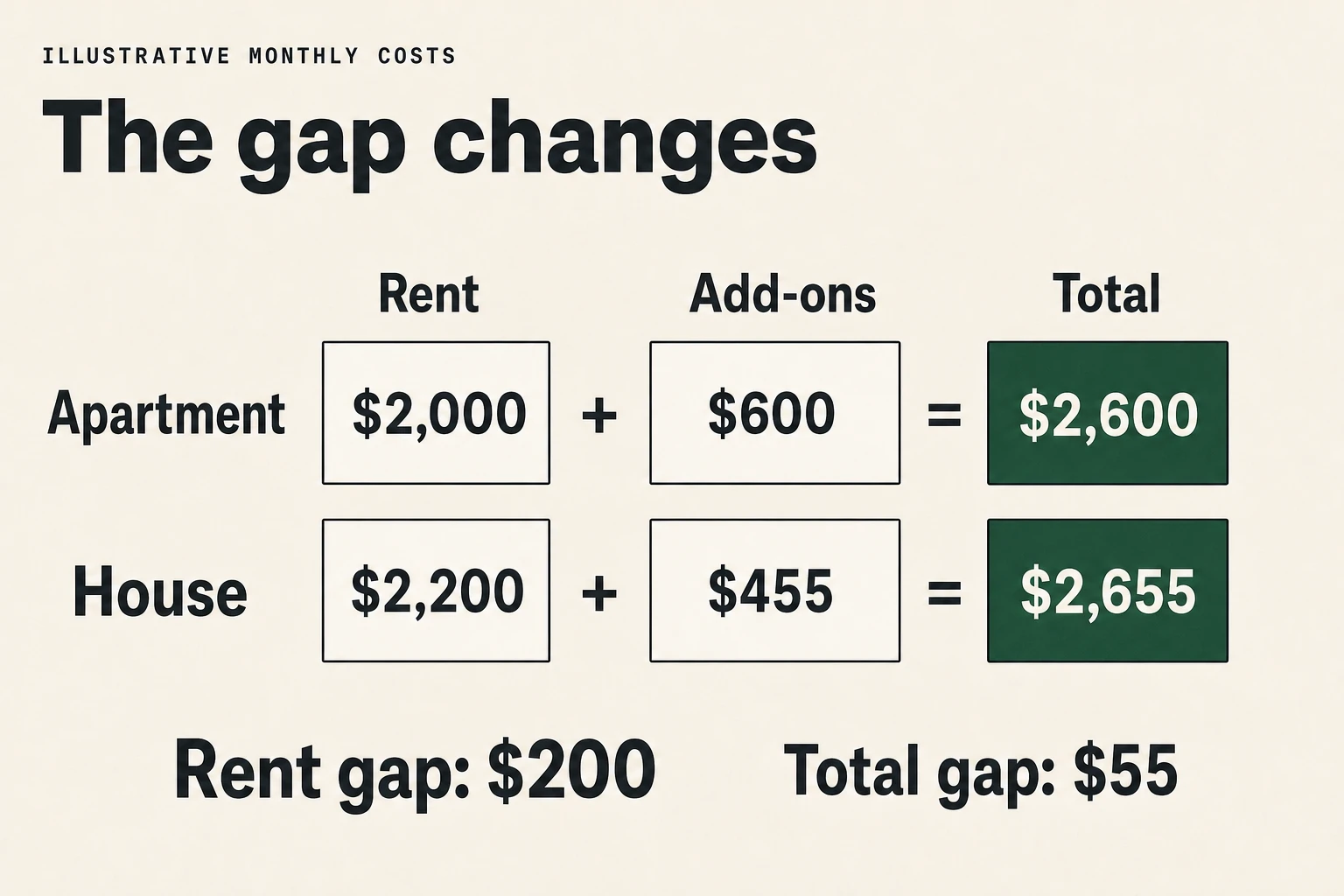
A $200 rent gap can become a $55 decision
Here is an illustrative comparison of two rentals for the same household. These amounts are examples, not local averages or quotes.
| Monthly expense | Apartment | House |
|---|---|---|
| Base rent | $2,000 | $2,200 |
| Electricity, gas, water, sewer, and trash paid separately | $170 | $270 |
| Mandatory property fees, excluding the utilities above | $150 | $30 |
| Parking | $200 | $0, driveway included |
| Yard service required by the house lease | $0 | $75 |
| Renters insurance | $20 | $20 |
| Internet | $60 | $60 |
| Total monthly cost | $2,600 | $2,655 |
The house costs $200 more in rent and $55 more overall. If that $55 monthly difference holds for all 12 months, the annual gap is $660. The apartment's parking and fees offset much of the difference. Another pair could go the other way, especially with expensive heating, irrigation, or pool care.
Then add the change in transportation spending to your household budget. A longer drive can consume a small rent saving through fuel, tolls, and parking. Keep travel time visible too: 20 extra minutes each way, five days a week, is 3 hours and 20 minutes of additional travel.
Our apartment budget guide helps you turn those expenses into a rent ceiling while protecting money for the rest of your month.
Utilities deserve their own line
Larger spaces can use more energy to heat and cool. In the U.S. Energy Information Administration's national 2020 energy survey, rented single-family homes used about twice as much total site energy per household as rented apartments on average. The survey's rented category includes households living in their primary home without paying rent, and its single-family group combines attached and detached homes.
These national averages do not compare otherwise identical homes or predict your utility bill. Climate, size, heating fuel, equipment, and insulation affect energy use. Local rates and the utilities included in rent shape what you pay.
Useful information includes the home's recent seasonal usage, the services included in rent, and how remaining charges are billed. An apartment may have individual meters or a building-wide allocation. A house may add water use for landscaping. Our apartment utility cost guide explains those billing differences.
Keep move-in cash separate
An affordable monthly payment can still leave you short before the keys arrive. Compare application charges, required prepaid rent, deposits, moving costs, utility setup, and any household equipment you need immediately.
A refundable deposit is cash tied up during the tenancy. A nonrefundable fee is an expense. Keep both visible without treating them as the same cost. Deposit amounts and rules depend on the property and applicable law, so a house does not automatically require a larger deposit.
A house may require a lawn mower or washer and dryer. An apartment may add an elevator reservation or a more difficult furniture move. Those details belong in the move-in budget.
Separate routine upkeep from repair responsibility
Renting a house does not turn you into its homeowner. It can give you more chores, but repair obligations still depend on applicable law, the lease, and the cause of the problem.
For example, California's residential renter guidance distinguishes a landlord's responsibility for habitable housing from a renter's responsibility for reasonable care and damage they cause. It also identifies yard-care responsibility as a term to put in the written agreement. Other states have their own rules.
The useful question is: Which tasks would you perform, which services would you pay for, and who would arrange repairs?
| Task or problem | What belongs in the conversation |
|---|---|
| Mowing, leaves, irrigation, or snow removal | Who does the work, how often, and who supplies equipment or pays a service |
| Pool or pest service | Who schedules and pays for it, including any mandatory contract |
| Heating and cooling filters | The required routine care, supplies, and service contact |
| A leak, broken heating system, or electrical fault | The reporting channel, emergency contact, and repair process |
| Damage caused by a renter, guest, or pet | How responsibility is handled under the lease and applicable law |
Avoid treating a broad phrase such as “renter handles maintenance” as a complete agreement. Named tasks and a clear repair contact are much more useful. A leaking roof and a lawn that needs mowing are different problems.
An apartment building may have an on-site team, but that does not promise fast repairs. A house may be managed by a company with an organized service network. Building type and management quality are separate decisions.
Good questions include: “Who responds after hours?” “What happens if the usual contact is away?” and “Which repairs are still outstanding before move-in?” Promised work is easier to track when the agreement names the work and completion date.
Price the privacy you will actually use
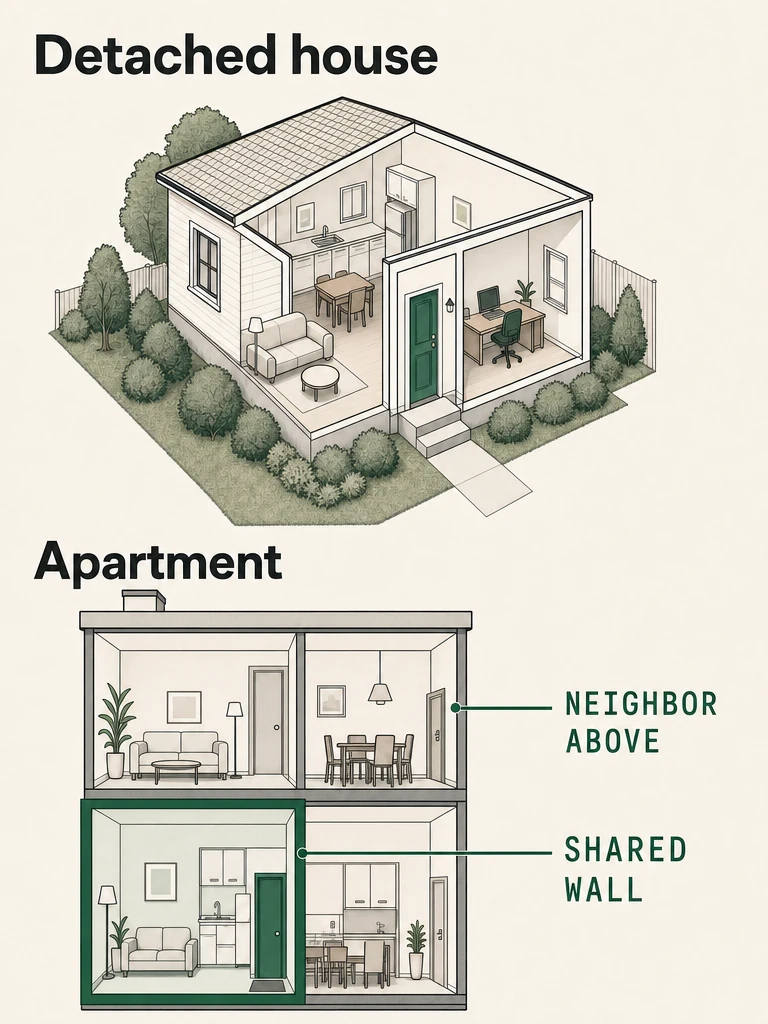
A detached house removes shared-wall and upstairs-neighbor noise. It does not remove traffic, barking dogs, construction, or a neighbor's outdoor speakers. An apartment's sound isolation depends on its construction and the exact unit.
Think about the room where quiet matters most. A bedroom beside an elevator or a workspace against a neighboring living room can affect your day more than the total square footage. A top-floor apartment removes overhead neighbors, though it may introduce stairs or greater heat exposure.
For a household working from home, an enclosed room with a door may matter more than an extra-large living area. With roommates, separate bedrooms, bathroom access, and a route through the home that avoids someone else's room can make a smaller apartment easier to share.
The same property-level approach applies to security. Useful features include functioning locks, lighting, controlled entry, sightlines, and a practical route from parking to your door. A gated apartment and a detached house each have their own exposure; the label alone tells you little.
Make the yard, amenities, and location earn their cost
A private yard can make dog breaks, gardening, and outdoor time easier. The listing needs to mean a yard you can actually use exclusively. A shared yard, unfenced boundary, or restriction on outdoor furniture changes the benefit.
Pet permission is a separate issue. A house with grass can still have restrictions and pet charges. An apartment can accept your pet and have an easier walking route. Permission for the particular pet, outdoor access, and the complete pet costs belong together in the decision.
Qualifying assistance animals are different from pets. The U.S. Department of Housing and Urban Development's May 22, 2026 memorandum focuses its federal enforcement of animal-related housing complaints on animals trained to provide disability-related assistance. It does not change the right to bring a private Fair Housing Act case. Whether a particular rental must allow an animal or waive a fee depends on applicable law and the request.
A garage has value when your vehicle fits, you are allowed to use it, and it solves a parking or storage need. A garage already occupied by the owner's belongings offers less than the listing suggests.
Apartment amenities deserve a realistic place in the budget and routine. Pool hours, gym equipment, package access, and workspace availability matter more than a polished photo. Mandatory amenity fees remain expenses even when you never use the facilities.
Finally, compare addresses rather than assuming every house is suburban and every apartment is walkable. Consider the actual trips: work, school, groceries, care appointments, and visits to people you see often. For someone with mobility needs, the route through the entrance, stairs, doors, and bathroom can outweigh both space and amenities.
Let the lease decide flexibility and stability
A house is not automatically a long-term home, and an apartment is not automatically easy to leave. The lease term, renewal process, notice requirements, and early-exit conditions shape both arrangements.
If your plans may change in six months, the available lease length deserves more weight than a yard you would enjoy occasionally. If you want to stay several years, the owner's stated plans and the renewal process matter. A private owner may eventually want to sell or move into the house; apartment buildings can also be sold or undergo major changes.
These are reasons to understand the arrangement, not predictions about what will happen. Rights around rent increases, nonrenewal, sale, and entry vary by jurisdiction and sometimes by property category. Neither rental type guarantees the same legal coverage everywhere.
With roommates, price the home for the people who can actually live there under the agreement. An extra bedroom does not automatically allow another occupant or a sublet. The roommate agreement template can help settle bill sharing and chores, but a household agreement does not change anyone's obligations to the landlord.
Choose between two homes, not two stereotypes
We suggest narrowing the decision in this order:
- Name the needs that would rule a home out. An accessible entrance, an accepted pet, a workable commute, or a separate sleeping room may be essential.
- Compare the complete monthly price and move-in cash. Keep seasonal utilities, mandatory fees, and transportation in view.
- Put the upkeep arrangement beside the price. Include the time you would spend on chores or the service you would pay for.
- Decide what the remaining difference buys you. A private yard, a quiet office, or a shorter commute should solve something you experience regularly.
In the worked example, the house costs $55 more a month before transportation differences. That could be worth it for someone who needs a private workspace. It could be poor value for someone who travels often and would pay to maintain an unused yard.
You do not need to choose a property type before starting your search. Keep both in the running when they meet your needs. The better rental is the specific home whose price, responsibilities, and daily routine you can comfortably live with.
When you're ready to turn those priorities into a shortlist, start your rental search with us. Tell us what you want, and we find matches, call landlords or leasing offices, and book tours in the metros we cover.