Apartment key fobs
Apartment Key Fobs: Access, Extra Fobs, Fees and Returns
Apartment key fobs explained: doors they open, authorized extras, fees, guests and move-out returns. From Fairway, your free AI agent for renters.
A fob handoff can be oddly vague. You get a small plastic tag and a nod toward the door, then discover you still need a key upstairs or your roommate needs separate access.
We’re Fairway, the free AI agent for renters. We help make the apartment hunt less manual. These are the everyday access details worth getting clear before you move in, request an extra fob, or return the whole set.
How apartment key fobs work
An apartment key fob is a small electronic credential that gives you permission to enter specific doors or areas. You hold it near a reader, usually beside a door or gate. The system recognizes the credential and allows entry if it has permission for that access point at that time.
Many apartment fobs use radio-frequency identification, or RFID. Salto’s access-management documentation describes fobs that open locks the user has permission to enter, with access groups defining locks, floors, and timeframes. The useful distinction is between the device you carry and the access assigned to it. Identical-looking fobs can have different permissions, which management can change or revoke.
A fob may open the building entrance, your apartment, a garage, or shared amenities. It only opens the places included in your building’s setup and your assigned access. A working lobby fob does not automatically open your unit.
Building access and apartment access are separate questions
Think through the route from the sidewalk to your front door. Getting through the first entrance is only one part of getting home.
| Access point | What to ask the leasing office |
|---|---|
| Building entrance | Which resident entrances does my fob open? Is there a separate gate or entrance after office hours? |
| Apartment door | Does this same fob open my unit, or will I receive a separate key, code, or credential? |
| Garage and elevator | Is access included with my parking arrangement? Does the elevator require a credential for my floor? |
| Laundry, gym, pool, or storage | Which spaces are included, and are there access hours or separate enrollment requirements? |
A guest may also need two permissions: a way into the building and a way into your home. A lobby intercom that lets you buzz someone in does not necessarily unlock your apartment door.
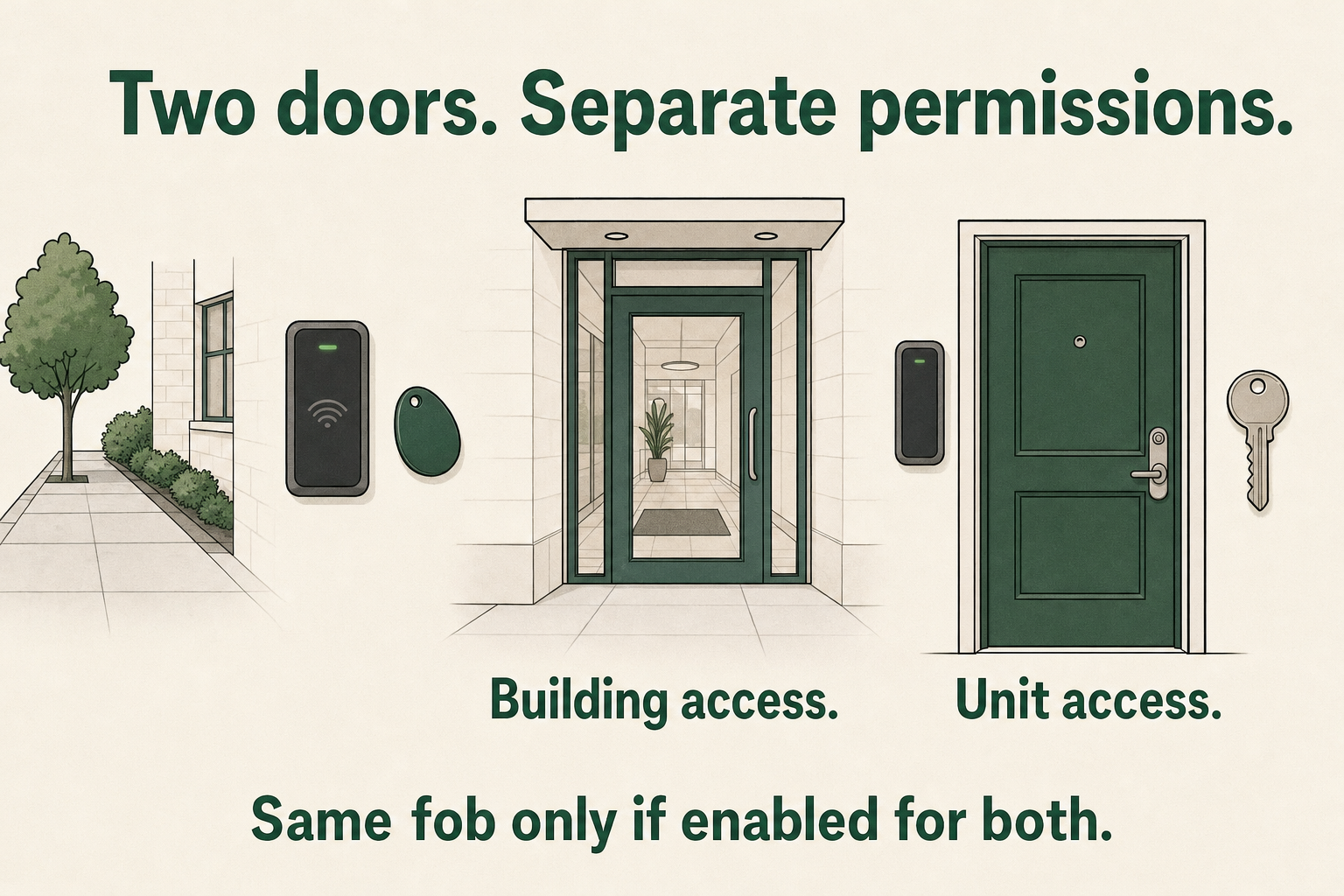
Before move-in, ask for the number of credentials included for your household and when access becomes active. At pickup, ask staff to demonstrate the doors on your normal route using the credentials issued to you. A model-unit demonstration does not establish your own access.
Keep a simple record of what you receive: two building fobs, two unit keys, one garage remote, for example. Add any later extras or replacements to the same record. This belongs with the other handoff details on your first apartment checklist.
Request an authorized extra fob through management
An extra fob request should identify who needs access, where they need it, and for how long. A second leaseholder’s everyday access is a different request from a weekend visitor’s access or a pet sitter’s recurring visits.
Ask the leasing office or property manager to issue or approve the additional credential. The building may require identification, an authorized-occupant record, payment, or pickup by the assigned resident. There is no universal rule that every household receives the same number of fobs.
A useful message is:
Hi, I live in unit [number] and would like an authorized additional fob for [resident or approved purpose]. The access needed is [building, unit, garage, or other area] starting [date]. Please send the approval requirements, total charge, any refundable deposit and its return terms, and the pickup process. Please also confirm which doors and hours this credential will cover and whether it must be returned separately at move-out.
If management declines, ask for the written policy and the approved alternative for that person. Having a spare device does not grant permission for another person to live in the apartment or use every amenity.
For a new roommate, settle the occupancy approval and lease paperwork with management first. A private roommate agreement can organize shared responsibilities, but it does not authorize a new occupant.
When access is disability-related
If you need an exception to an access policy because of a disability, such as access for a caregiver, describe the need in a reasonable-accommodation request. The U.S. Department of Housing and Urban Development and Department of Justice explain that accommodations can include changes to housing rules, and covered housing providers cannot require extra fees or deposits as a condition of granting a reasonable accommodation. The appropriate arrangement depends on the disability-related need and the request. Their reasonable-accommodation guidance explains the requirements and limits.
Separate the fob fee from the fob deposit
There is no single standard apartment key-fob price. More importantly, an extra-fob charge, a replacement charge, and a refundable deposit answer different questions. A receipt that only says “keys” leaves too much open.
Ask for an itemized amount and the written terms before paying.
| Charge described by the property | What you need in writing |
|---|---|
| Initial fob issuance | How many credentials are included, and whether the move-in total includes an access charge |
| Authorized extra fob | The full amount for the extra device, including any separate activation or administrative charge |
| Refundable fob deposit | The amount held, the return conditions, the refund timing, and how the refund will be paid |
| Replacement fob | Whether the charge differs for loss, damage, or an ordinary device failure, and what happens to the old credential |
| Unreturned fob | The charge for each missing device and the required return deadline and method |
Paying for a fob does not automatically mean you can keep it. A property may issue it for use during your occupancy and still require its return. Columbia Residential, for example, requires issued access devices to be returned when occupancy ends and applies replacement charges for missing items. Its rules also prohibit lending or transferring them. Your own building’s written terms matter.
Likewise, returning a fob does not automatically refund a charge described as a fee. Ask whether the payment is refundable and what event starts the refund process. Keep the answer with your receipt.
If an amount is unclear or disputed, request the lease provision, fee schedule, and itemized explanation. State and local rules can affect charges and refundable payments; local renter resources can help with a dispute. Our security deposit guide explains the broader payment and return record.
Give guests their own approved access plan
The simplest arrangement for a short visit may be meeting your guest at the entrance or using the building’s intercom. For someone arriving while you are away, ask about an authorized guest fob, temporary code, or guest invitation if the building supports one.
Make the plan specific:
- Access points: Does the guest permission cover the lobby, elevator, and apartment, or only some of them?
- Timing: When does access start and end? Are recurring visits supported?
- Building rules: Must guests be registered or accompanied in shared amenities?
- Ending access: Who retrieves the guest fob or cancels the credential when visits end?
Use the building’s guest feature rather than sharing your resident-app password. Where temporary access is available, give the visitor only the access and time they need. Remove guest permissions you no longer need, and arrange the return of any approved loaned device.
For shared-entry safety, let the door close securely behind you. Do not prop it open or admit an unfamiliar person simply because they say they live upstairs. Direct them to the intercom or building staff without confronting them.
If a fob is lost or stolen, notify management promptly so it can be deactivated. A replacement in your hand does not, by itself, establish that the missing credential has been disabled. Ask management to confirm both actions.
The New York City Housing Authority’s resident handbook gives its residents similar door-safety advice and calls for immediate reporting of lost fobs so they can be deactivated.
Return fobs with a clear move-out handoff
Plan the return before moving day, especially if the office closes before your final trip. Ask for the exact return location, deadline, approved after-hours method, and access-deactivation time. You still need to get yourself and your last box out.
A useful handoff has four parts:
- Gather the full set. Include the original fobs, authorized extras, guest devices, keys, cards, and remotes assigned to your household. Collect anything held by an approved visitor.
- Match the count to your record. Explain any fob already returned or reported missing. Ask how a previously replaced device should be handled if you still have it.
- Use the approved return method. Avoid leaving devices on a counter or passing them to the next renter unless management has specifically authorized that arrangement in writing.
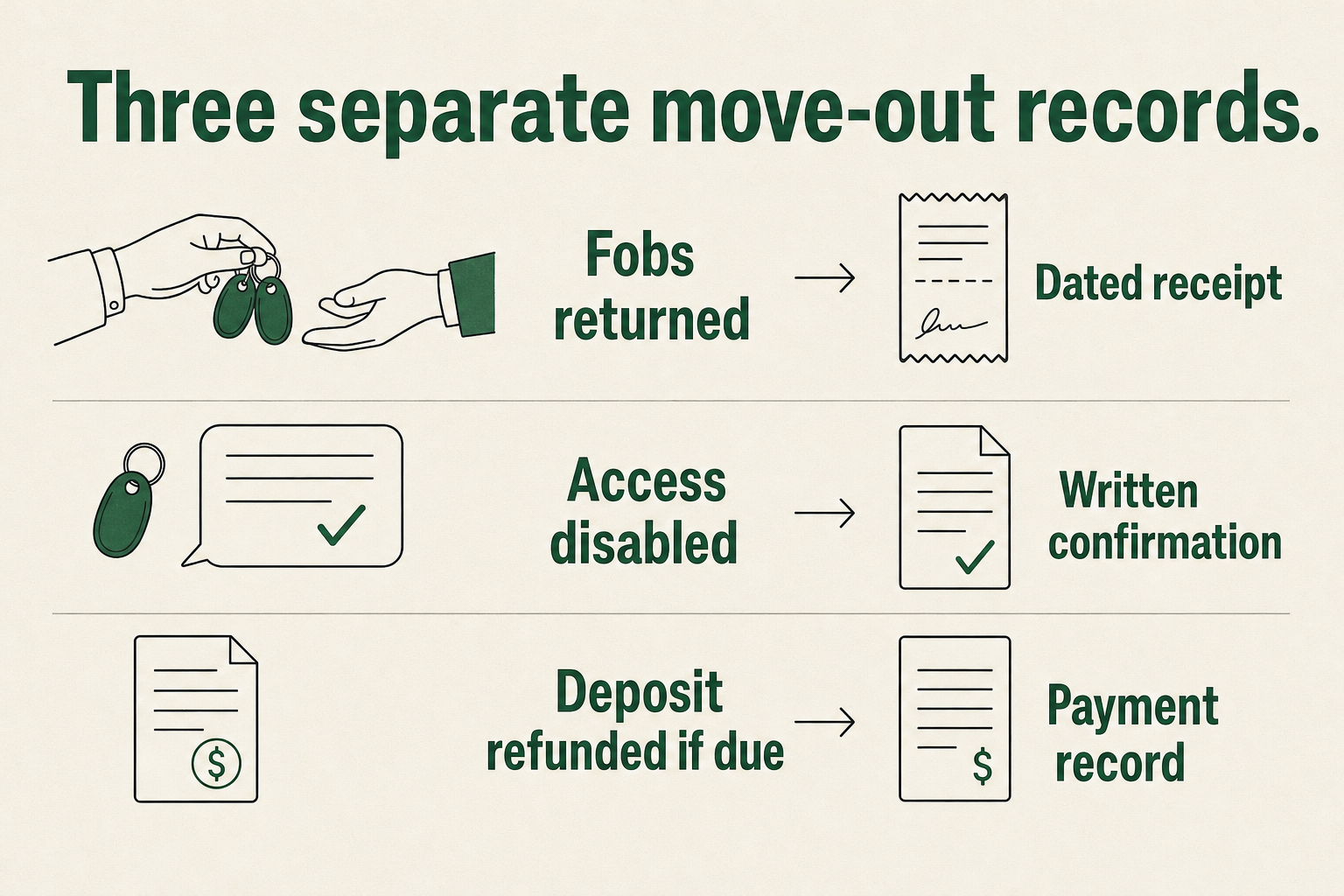
- Keep dated proof. Ask for a receipt or written acknowledgment showing the property, unit, return date, item types, and quantities. For an approved drop box, retain your handoff photos and send a same-day written record.
A photo of fobs in an envelope records what you prepared. A management acknowledgment records what the office received. Keeping both is useful when a missing-fob charge appears later.
Ask management to acknowledge any refundable fob deposit separately from the return count. Return of the devices, removal of access, and repayment of a deposit are three different events. One does not document the others.
If only one roommate is leaving, have management coordinate the credential change with the approved occupancy or lease change. Returning a fob alone does not release someone from the lease.
Can you use your phone instead of a fob?
Only if the building supports and authorizes mobile access for the doors you need. A phone’s contactless-payment capability does not automatically make it an apartment credential.
Ask whether mobile access covers the building, your unit, and any parking or amenities you use. Also ask what approved physical credential or other access route is available when your phone is unavailable. Keep physical fobs in your return inventory even if you normally use an app.
Make access part of choosing the apartment
A clear access setup fits your actual week: the roommate who gets home late, the garage entrance you use daily, and the approved visitor who arrives while you are out. Those are useful apartment viewing questions, alongside rent and move-in costs.
Still looking? Tell us what you want. Our AI agent for renters finds matches, calls landlords and leasing offices, and books tours, free for renters. Start your search with Fairway.