Renter protections
Demand Letter for Security Deposit: Template and Next Steps
Use a demand letter for security deposit with a clear template, evidence tips, and local notice caveats. Fairway is a free AI agent for renters.
You returned the keys, paid for the move, and are still chasing money your landlord is holding. Another unanswered text does little to clarify the dispute. A written demand gives you a specific request and a record you can use if the conversation goes nowhere.
The useful work starts before the letter: separating the amount you want back, the evidence behind it, and the deadlines that apply where you rented.
What a security deposit demand letter does
A demand letter for a security deposit is a written request for your former landlord to return money you believe is owed. It identifies the rental, deposit, relevant dates, disputed deductions, and requested payment date. It can address a completely missing refund or just the portion you disagree with.
The letter gives the landlord an opportunity to resolve the dispute. It does not start a lawsuit, guarantee payment, or establish that every deduction is unlawful. California Courts, for example, places asking for payment before filing in its small claims process.
A missing refund can also squeeze the budget for your next place. Keep it separate from cash already available in your apartment move-in budget. Fairway is our AI agent for renters, free for renters. Tell us what you want, and we find matches, call landlords, and book tours. A dispute over your previous deposit follows its own notice and court process.
Separate the legal deadline from your letter's deadline
There are two dates to keep distinct:
- The landlord's legal deadline: when the refund, deduction statement, or notice of a claim was due under the applicable rules.
- Your requested response date: when you want the landlord to pay or answer your demand.
A date you choose in a letter does not replace a legal deadline. Nor does a universal “pay within 10 days” sentence satisfy every jurisdiction's pre-suit notice rules.
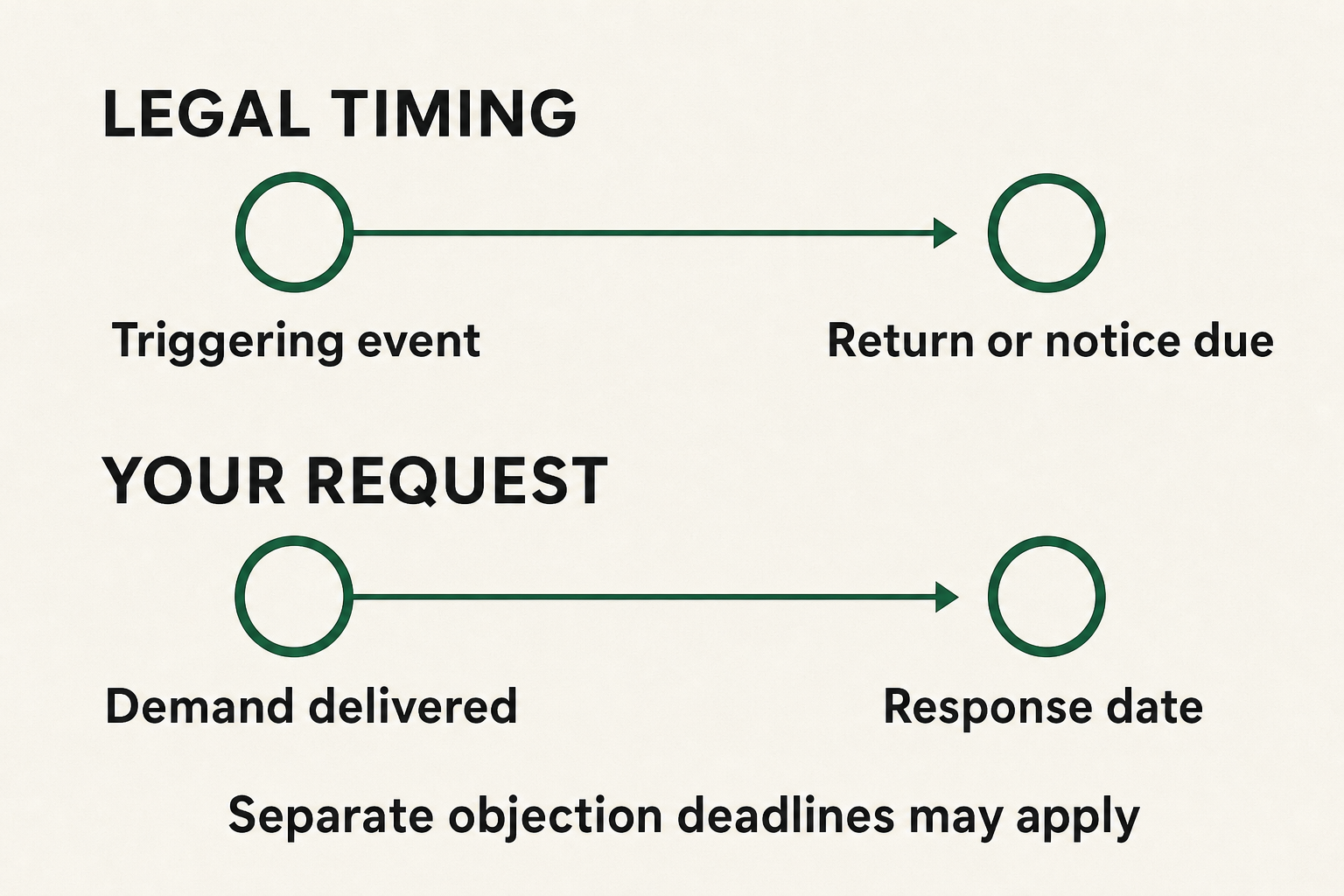
For a missing refund, establish when the landlord's obligation became due. For a deduction dispute, the next action may be a written objection with its own short deadline. These examples show why the distinction matters:
| Location | Rule that affects the request | What belongs in your records |
|---|---|---|
| California | Generally, the landlord has 21 days after move-out to return the deposit or send the remaining balance and itemized deductions. Good-faith repair estimates can be allowed when work cannot reasonably be finished in time. | Move-out date, deduction statement, and any estimate or later accounting. California deposit rules. |
| Texas | The refund is generally due within 30 days after surrender, subject to the written-forwarding-address requirement. The landlord is not obligated to refund or itemize until that address is provided. Failing to supply it does not forfeit your refund right. | Surrender date and the dated written forwarding address. A timely postmark can matter, so retain the refund envelope. Texas deposit rules. |
| Florida | Generally, a landlord with no claim has 15 days after termination to return the deposit. A landlord claiming a deduction has 30 days to give the required notice. You have 15 days after receiving that notice to object in writing. | Termination date, the notice and its envelope or email, and proof of your written objection. Florida deposit rules. |
| Colorado | The statutory action for treble damages, reasonable attorney fees, and court costs has a specific pre-suit demand-and-notice requirement. | The demand, notice of intent to file, and evidence of when the landlord received both. |
These are examples for residential rentals, not a nationwide deadline table. The rental's location, housing program, tenancy terms, and circumstances can change the applicable requirements. Florida, for example, has additional rules for early departure and certain periodic tenancies. Its claim-notice rules also allow email under statutory conditions; ordinary email is not automatically a substitute for every required notice.
Colorado's state deposit statute, §38-12-103(3), requires both a demand for return and notice of intent to file legal proceedings at least seven days before filing that action. Under subsection (3)(c), the action is available only if the landlord fails to return the deposit or withheld portion within seven days after receiving both. Wrongful retention and the other statutory conditions still matter; sending a letter does not guarantee damages.
The Longmont letter template is a city-provided seven-day example with separate wording for disputed charges and a missing accounting. It is a municipal template, not a court form, and does not create a universal seven-day response rule.
Its missing-accounting wording counts 30 days from move-out. Do not copy that timing shorthand without checking the current Colorado statute. Under §38-12-103(1), the return/accounting period is 30 days after lease termination or surrender of the premises, whichever occurs last, unless the lease specifies a longer period capped at 60 days.
For other locations or a complicated tenancy, state housing agencies, court self-help centers, and local legal aid provide jurisdiction-specific notice and filing guidance. Use the rule for the property where you rented, even if you now live elsewhere.
Prepare a small evidence packet
You do not need to mail every photo you have ever taken. Start with the records that explain the amount and the disagreement:
- Lease and deposit proof. Include the deposit provision and a receipt, bank transaction, or landlord acknowledgment identifying the payment as a security deposit. Separate it from prepaid rent and other charges.
- Move-out timeline. Record the notice date, tenancy end, actual departure, key handoff, and forwarding-address delivery. These may be different dates.
- Condition records. Pair relevant move-in and move-out photos with inspection reports, maintenance requests, and cleaning receipts. Keep original files and dates.
- The landlord's explanation. Save deduction statements, invoices, estimates, messages, envelopes, and email headers. An envelope can answer a different question from the letter inside it.
- Your calculation. List the original deposit, refunds already received, deductions you are not disputing, and the remaining amount requested.
For an attachment list, use names such as “A: Deposit payment receipt,” “B: Key-return email,” and “C: Bedroom wall, move-in and move-out photos.” Refer to those labels in the letter. Send copies and retain originals. Redact unrelated bank transactions and account numbers.
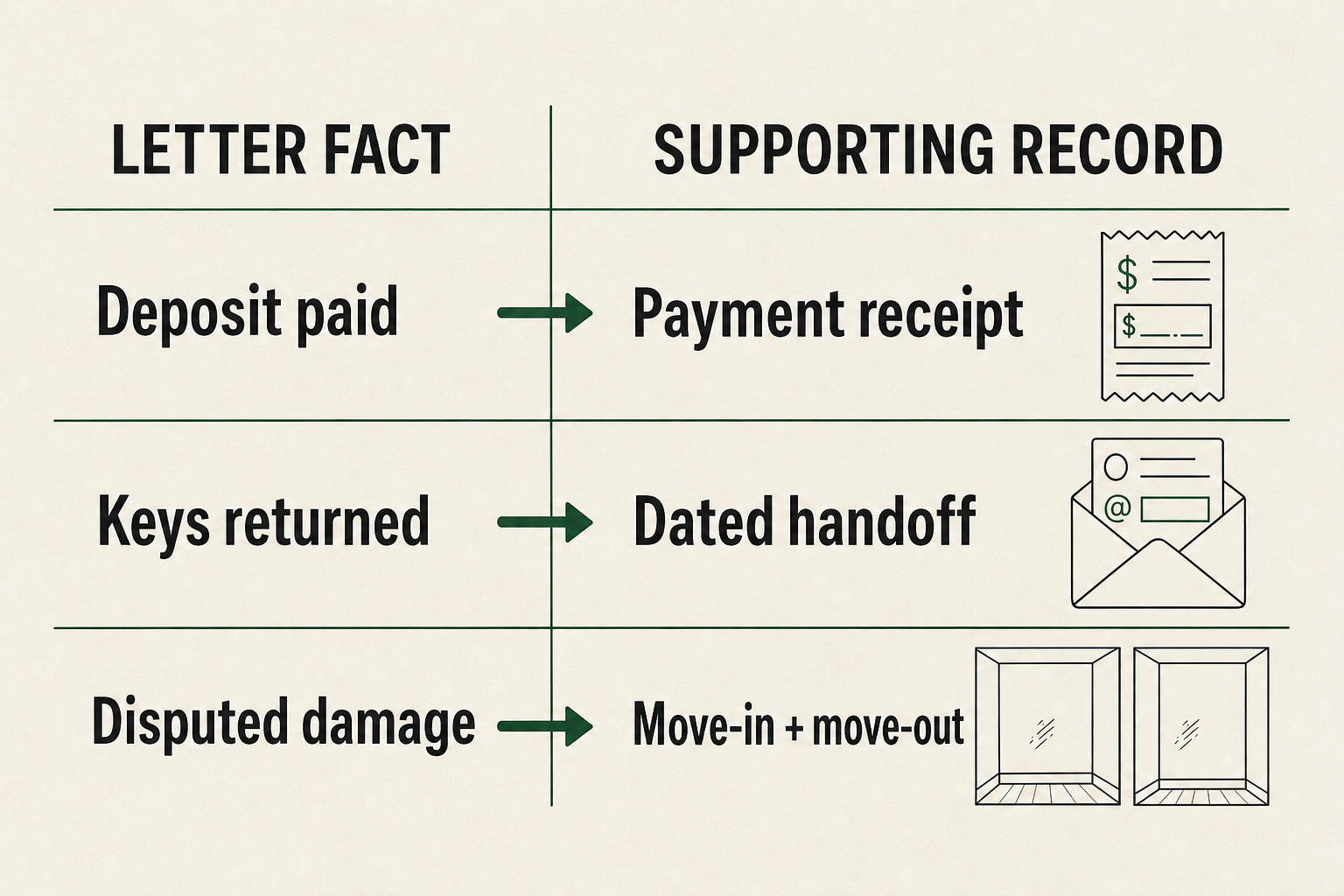
Missing a record? State what you do have. A dated message acknowledging the deposit is useful evidence; an invented payment date is not. Our move-in documentation checklist also helps you build a cleaner baseline for the next rental.
Calculate the amount you are requesting
Start with this working calculation:
Deposit paid − refunds received − deductions you are not disputing = deposit balance requested.
Keep interest, statutory damages, and court costs separate. They depend on the applicable law and facts. Your arithmetic should not quietly turn a $400 deduction dispute into a demand for the entire deposit again.
Example: a partial refund with disputed deductions
Suppose you paid a $1,800 deposit. The landlord returned $1,050 and listed three deductions:
| Deduction | Amount | Your position |
|---|---|---|
| Unpaid final water bill | $150 | Not disputed for this request |
| Bedroom repainting | $400 | Disputed; move-in photos show the same marks |
| Cleaning | $200 | Disputed; move-out photos show the areas named in the charge |
Your request is $1,800 − $1,050 − $150 = $600. The two disputed charges also total $600. Those matching totals make the request easy to follow.
Our security deposit basics guide explains how the lease, local deduction rules, and condition records fit together.
The photos support your position. They do not automatically decide the dispute. Explain what each photo shows and how it relates to the charge. For a wear-and-tear dispute, describe the actual condition and length of use; the phrase alone does not explain your objection. For a replacement charge, request the item's age, prior condition, and the basis for the amount instead of assuming that a brand-new replacement price is always permitted.
If you seek the full remaining deposit because a missed legal requirement changes the landlord's deduction rights, state that as a separate legal basis. It is different from simply disagreeing with a charge.
Copy this security deposit demand letter template
Replace the bracketed fields with true statements and keep only the paragraphs that fit. Choose either the missing-refund paragraph or the disputed-deduction paragraph. Include a forwarding-address statement only if it is true, using the alternative for an address supplied with this letter when needed.
In Texas, the landlord is not obligated to return or itemize until you provide a written forwarding address for the refund. If you have not supplied it, use this letter to provide it and request payment without claiming an already-missed deadline.
The local-rule paragraph is optional; a factual request is better than a borrowed statute from another state.
For a voluntary response date, 14 calendar days after expected delivery can be a practical starting point. This is a suggested negotiation window, not a nationwide legal requirement. Any mandatory notice period or objection deadline takes priority.
[Your name and any co-renters making this request]
[Current mailing address]
[Email or phone]
[Date]
To: [Landlord's legal name or business name]
[Address for notices]
Subject: Request for return of security deposit, [rental address and unit]
Dear [name],
I rented [rental address and unit] from [start date] to [tenancy end date]. I paid a security deposit of $[amount] on [date]. I moved out on [date] and returned possession and keys on [date].
[Optional, only if true: I provided my forwarding address in writing on [date] for return of my security deposit.]
[Alternative, if supplying it now: I am providing my forwarding address in writing with this letter for return of my security deposit: [address].]
[Missing refund: As of [date], I have received neither my deposit refund nor an explanation of deductions. I request return of $[amount] and any accounting required by applicable law.]
[Disputed deductions: I received a refund of $[amount] and a deduction statement dated [date]. I dispute $[amount] for [charge] because [specific reason and attachment reference], and $[amount] for [charge] because [specific reason and attachment reference]. I request payment of the additional $[total].]
[Local rule, only if accurate: Under [state or local law and section], [applicable requirement]. Based on [relevant events, satisfied conditions, and dates], the applicable deadline is or was [date].]
My calculation is: $[deposit paid] minus $[refunds received] minus $[deductions not disputed in this request], leaving $[amount requested].
Please return $[amount requested] by [specific date]. My current mailing address is [address]. [If requesting an electronic refund, state the agreed or legally applicable method without including sensitive account details in this letter.]
If you disagree, please respond in writing with the basis for each disputed charge and supporting records, including relevant invoices, receipts, photographs, or inspection reports. Please also provide any outstanding documentation required by applicable law.
I would prefer to resolve this directly. If the matter remains unresolved, I may pursue available remedies, including a small claims action where appropriate. I am not agreeing to release any remaining disputed claim by making this request.
Sincerely,
[Signature and printed name]
Attachments: [Short list of copies enclosed]
A landlord's reply date belongs on the calendar as an actual date. “As soon as possible” is easy to leave in an inbox forever.
For Colorado's statutory action described above, do not rely on the generic “I may pursue” closing as the required notice of intent to file. Local legal aid can help adapt the wording and delivery to that requirement.
Use specific language for the problem you have
No refund and no accounting
Keep this paragraph factual:
I returned the keys on September 30 and provided my forwarding address in writing that day. As of November 5, I have received neither a refund of my $1,500 deposit nor an explanation of deductions. Please return the $1,500 and provide any accounting required by applicable law.
Those sample dates do not establish lateness everywhere. Add a missed-deadline claim only when the applicable rule and triggering facts support it.
A charge for damage that was already there
Describe the evidence instead of the landlord's motives:
I dispute the $400 bedroom repainting deduction. Attachment C contains the move-in inspection report and dated photos showing the same wall marks at the beginning and end of my tenancy. Please return the $400 and provide the records supporting this charge.
Avoid “fraud,” “theft,” and automatic threats of triple damages. In California, for example, a court may award additional damages of up to twice the deposit for bad-faith retention. That is a conditional remedy, not a guaranteed payment for every late refund. The California Attorney General explains the distinction.
A Florida notice claiming part of the deposit
Make the objection unmistakable:
I object in writing to your claim of $[amount] against my security deposit, described in the notice I received on [date]. I dispute [charge and reason]. Please return the disputed amount and provide the supporting records.
Send the objection to the address identified in the notice within the applicable 15-day window. Waiting for a later refund-demand date can miss that separate step.
Send it with a record of what went where
Address the letter to the landlord or responsible business using the notice address in your lease and any written updates. If a property manager handles deposit accounting, copy that office. A leasing-office brand name may differ from the legal entity on the lease.
Use the delivery method required by applicable notice rules. When no special method governs, certified mail with a return receipt is a practical way to document mailing and delivery. USPS's delivery service details distinguish delivery or attempted delivery from the signature obtained with a return receipt.
Save the signed letter, exact attachments, mailing receipt, tracking number, and delivery record together. A tracking record does not show the contents of the envelope, which is why your copy matters. An email copy can make a response easier, but does not cure a notice sent by the wrong method.
If the letter comes back unclaimed or undeliverable, keep the envelope and tracking history. An attempted delivery is not the same as confirmed receipt. Local notice rules determine the next valid delivery step; a court self-help center or legal aid can help with that issue before a filing deadline passes.
What to do after the demand letter
If the landlord pays the amount requested, record the payment and preserve the correspondence. If they send a new accounting, compare each charge with your evidence and update the balance. A new statement does not automatically erase an earlier notice violation.
If the landlord offers a partial payment, separate the amount from the conditions. A release, “payment in full” notation, or online acceptance screen can affect your remaining claim. For example, Texas payment-in-full rules can discharge a disputed claim when their conditions are met. Get local legal help before accepting settlement terms you do not intend to agree to. Simply writing “rights reserved” does not guarantee that you can undo a settlement.
If there is no resolution, the next options may include mediation, a housing-agency complaint, or a court claim. A complaint and a money judgment serve different purposes. Do not assume informal negotiations suspend your filing deadline.
For a small claims case, organize:
- the correct defendant's legal name and service address;
- the amount requested, with any lawful additional remedies separately explained;
- the local court's monetary limit, filing deadline, fee or fee-waiver process, and required pre-suit notice;
- your lease, payment proof, timeline, condition records, demand, and delivery evidence;
- the required service of the court papers after filing.
Sending a demand letter is different from serving a lawsuit. California Courts' filing instructions show filing and service as separate steps. A court's self-help service can explain procedure; legal aid can advise on disputed rights, deductions, and settlement terms.
Keep the old deposit separate from the next move
A useful demand is calm, specific, and easy to reconcile with your records. Ask for the amount you can explain, keep the delivery evidence, and choose the next step based on the applicable rules and the landlord's response.
If your next search is happening at the same time, we can take the listing calls and tour scheduling off your plate. Start your rental search with Fairway, free for renters.