Renter guide
Notice to Vacate Letter: Templates, Dates, and Delivery
Copy a notice to vacate letter for lease-end or month-to-month moves. Get timing and delivery guidance from Fairway, your free AI agent for renters.
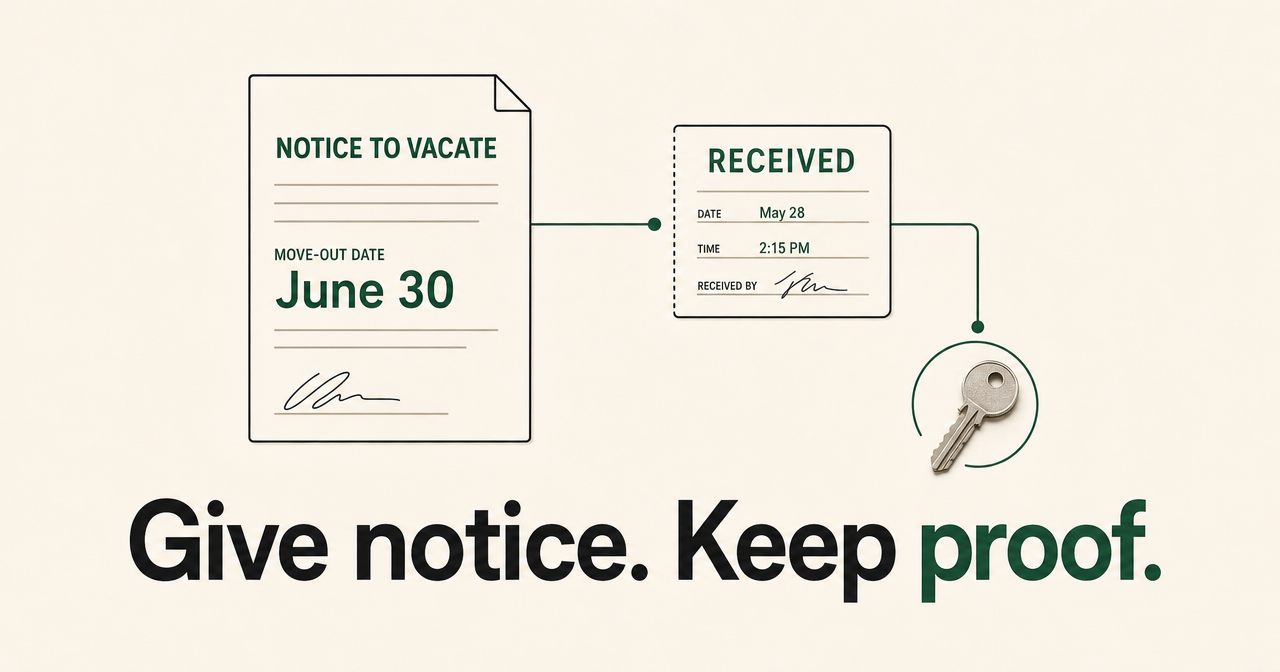
Moving out comes with a small paperwork trap: the day your movers arrive may have little to do with the day your rent responsibility ends. And a friendly conversation with the leasing office can leave you without a written record.
A clear letter helps you put the dates in writing. Here are copyable templates, examples of how notice periods work, and a practical way to keep proof without turning your move into a filing project.
What is a notice to vacate letter?
A notice to vacate letter is written notice to your landlord or property manager that you are ending your tenancy and moving out. Renters commonly use one to give notice of nonrenewal at a lease’s end or to end a month-to-month rental.
A move-out notice does not, by itself, release you from a fixed-term lease early. Leaving before the agreed end date is a separate lease-exit question. Our guide to breaking a lease covers those options and costs.
If you are coordinating the notice with a search for your next home, we can help with that legwork. Fairway is an AI agent for renters, free for renters. You describe what you want; we find matches, call landlords or leasing offices, and book tours. Your move-out notice still needs its own delivery and records.
Notice to vacate letter templates
Choose the wording for your situation. A lease-end nonrenewal and a month-to-month termination can have different deadlines. Use the actual date you sign the letter, and replace every bracketed field before sending it.
These templates cover routine move-outs. A special legal right to end a lease early can require different wording and supporting documents.
Template 1: Moving out at the end of a fixed-term lease
[Date]
From: [Your full name or names]
[Rental street address, unit, city, state, ZIP]
To: [Landlord or authorized property manager’s name]
[Address designated for notices]
Subject: Notice of nonrenewal and intent to vacate, [rental address and unit]
Dear [name],
I am giving written notice that I will not renew my lease for [rental address and unit]. The current lease term ends on [lease-end date]. I will vacate and return possession of the home by that date.
Please acknowledge receipt of this notice in writing. Please also provide move-out instructions, including the inspection process and where and when to return all keys and access devices.
Please send my security deposit refund and any required itemized statement to [forwarding mailing address]. You can reach me at [phone number] or [email address].
Sincerely,
[Signature or signatures]
[Printed name or names]
Template 2: Ending a month-to-month tenancy
Use this version when ending a periodic rental. Fill in the applicable notice period, whether that is 20, 30, 60, or another number of days. A “30-day notice to vacate” is only appropriate when 30 days is the applicable rule.
[Date]
From: [Your full name or names]
[Rental street address, unit, city, state, ZIP]
To: [Landlord or authorized property manager’s name]
[Address designated for notices]
Subject: Notice to end month-to-month tenancy, [rental address and unit]
Dear [name],
I am giving [number]-day written notice to end my month-to-month tenancy at [rental address and unit], effective [tenancy-end date]. I will vacate and return possession of the home by that date.
Please acknowledge receipt of this notice in writing. Please provide the move-out inspection process and instructions for returning all keys and access devices.
Please send my security deposit refund and any required itemized statement to [forwarding mailing address]. You can reach me at [phone number] or [email address].
Sincerely,
[Signature or signatures]
[Printed name or names]
If you do not yet have a forwarding address, replace that sentence with: “I will provide a forwarding mailing address separately before move-out.” A dependable mailing address can be different from the home you are moving into.
Keep the letter focused. A routine nonrenewal rarely benefits from an explanation of your job, relationship, or apartment frustrations. Handle repair disputes and disputed charges separately so the notice remains clear.
How much notice do you need to give?
There is no single U.S. deadline for every renter. The answer depends on the tenancy, applicable law, and lawful lease terms. Landlord notice requirements can also differ from renter notice requirements, even at the same address.
Fixed-term leases: the nonrenewal clause matters
A lease ending on June 30 may require advance notice that you will not renew. An automatic-renewal or month-to-month conversion clause can matter even when you plan to leave on the printed end date.
For example, the Texas State Law Library explains that notice for a written lease that is not month-to-month depends on the agreement’s terms. Its guidance separately describes the statutory rules for month-to-month tenancies.
Have the notice period, renewal clause, and delivery clause together before setting your deadline. A lease clause cannot override a legal protection that makes that clause unenforceable. A local tenant legal-aid service can help resolve a conflict between the lease and the law.
Month-to-month rentals: the end date matters too
Some rules count a number of days. Others also tie the ending date to the rental period. These examples show why copying “30 days” into every letter can go wrong:
| Location | Ordinary month-to-month renter notice rule | What matters for the letter |
|---|---|---|
| California | Generally at least 30 days’ written notice; a shorter agreed period can apply | Notice can run from a date during the month. The state’s moving-out guidance gives examples of rent continuing through the notice period. |
| Arizona | Written notice at least 30 days before the periodic rental date specified in the notice | The Arizona notice statute ties timing to the rental date. Counting 30 days to an arbitrary midmonth date is insufficient. |
| Washington | Written notice of at least 20 days before the end of a monthly or other rental period | The Washington notice statute connects the notice to the period’s end. Twenty days from today may land on the wrong date. |
These are examples for ordinary periodic tenancies, not deadlines for every housing program or special early-termination situation.
Keep three dates separate
A useful move-out plan has three distinct entries:
- Notice-delivery date: The date notice is legally given under the applicable delivery rule. This may be receipt or another legally defined date.
- Tenancy-end date: The date the tenancy ends after the required notice and any rental-period alignment.
- Physical move and key handoff: When you remove your belongings and return possession. This may happen before the tenancy ends.
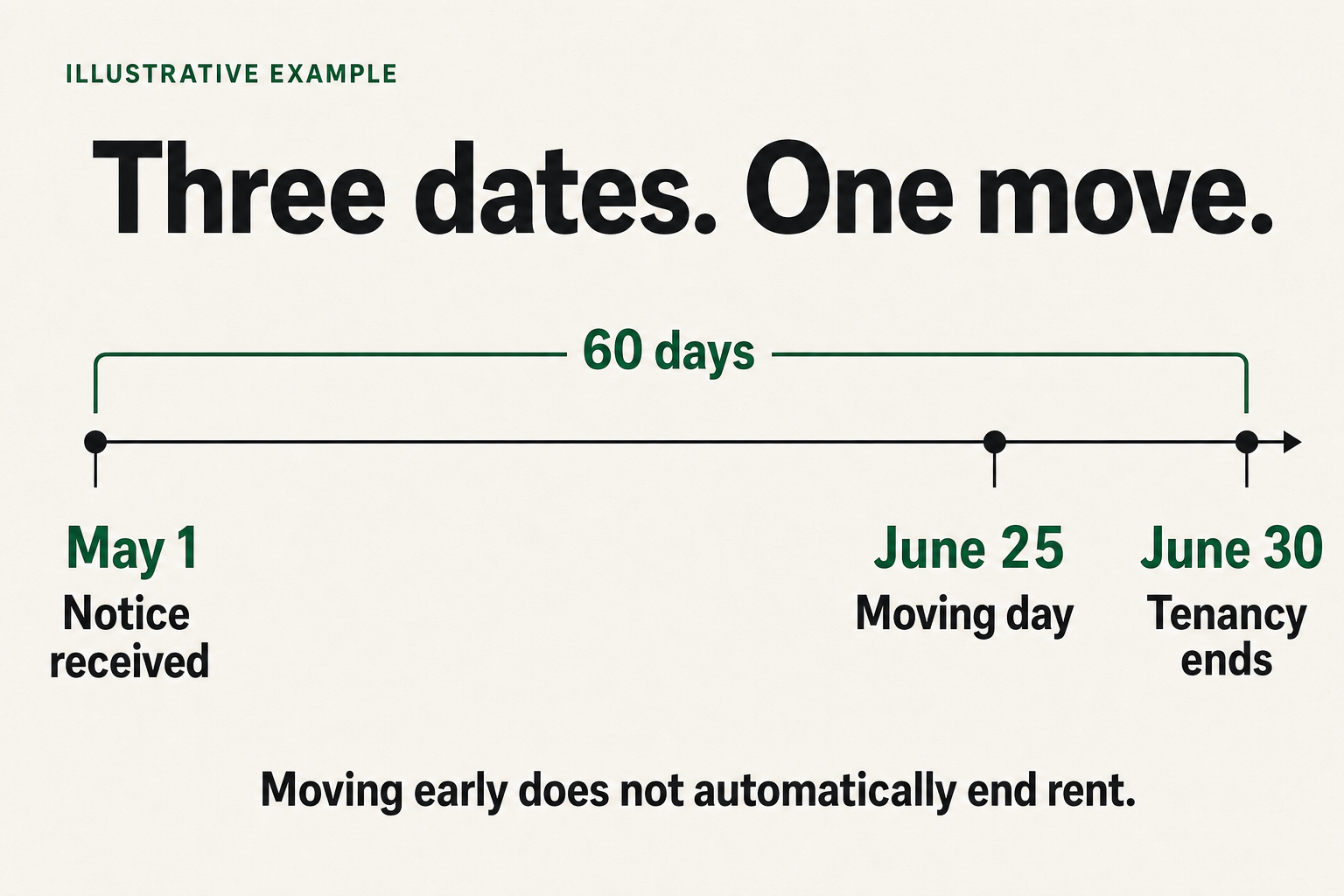
The date at the top of your letter records when you signed it. It does not establish when delivery became effective. Likewise, leaving the apartment early does not automatically shorten the notice period or end rent charges.
A 60-day notice example
Suppose a lawful lease clause requires notice to be received at least 60 calendar days before June 30, with no additional rental-period restriction. Counting backward gives May 1 as the receipt deadline. An April 30 letter that arrives May 4 misses that assumed deadline.
If your movers come June 25, the letter can still say the tenancy ends June 30. Arrange the key handoff separately, and get any agreement reducing rent for those final days in writing.
This example assumes calendar days and receipt-based timing. A rule based on mailing, full rental periods, or a different counting method produces a different calculation. Build delivery time into the schedule rather than aiming for the final possible day.
What should your letter include?
The templates keep the essentials in one place:
- Who is giving notice: Names matching the lease and signatures of the renters giving notice.
- Which home: Full street address and unit number.
- Who receives it: The landlord or authorized recipient and the address designated for notices.
- What is ending: Nonrenewal at the end of a fixed term, or termination of a periodic tenancy.
- The exact ending date: Spell out the month, day, and year.
- How to reach you: A current phone number or email, plus a forwarding mailing address when available.
- Move-out logistics: A request for inspection and key-return instructions.
For a whole household moving out together, listing the renters and gathering their signatures makes the record clearer. If only one person is leaving a shared lease, a whole-tenancy termination letter may be the wrong document.
Avoid broad promises such as “I accept all move-out charges” or “Please deduct anything needed from my deposit.” You can give clear notice without agreeing in advance to unknown fees or damage claims.
How to deliver your notice and keep proof
Use a delivery method permitted by the applicable law and your lawful lease terms. An email address used for maintenance is not automatically the address for formal notices. A conversation at the front desk is not a substitute when written notice is required.
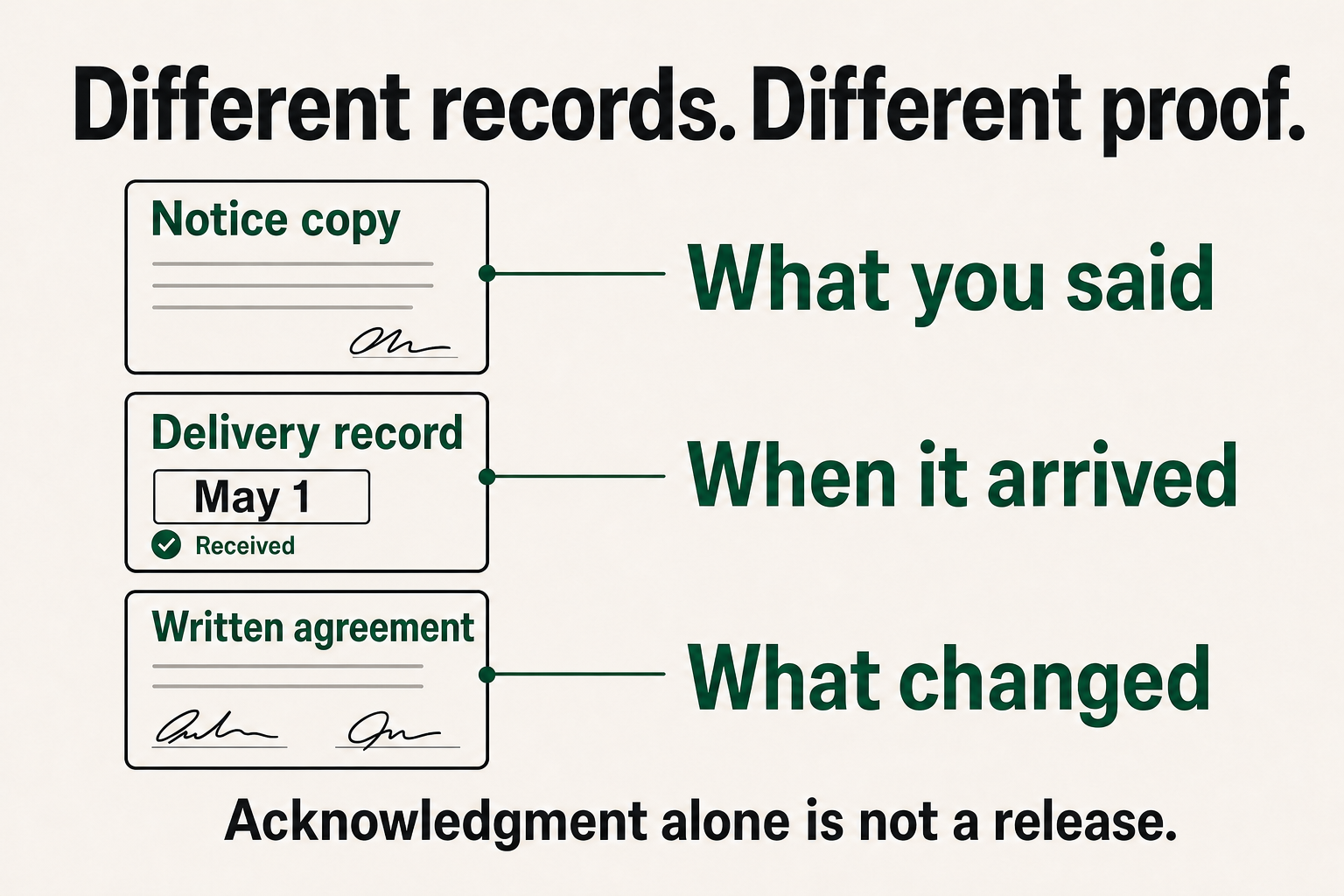
Keep both the exact notice and the evidence of delivery. A mailing receipt alone does not show what was inside the envelope.
| Delivery method, where permitted | Records worth saving |
|---|---|
| Hand delivery to the authorized recipient | A copy of the notice and a dated, signed acknowledgment of receipt |
| The signed notice, mailing receipt, tracking history, and delivery record or returned envelope | |
| The full sent email, attached notice if used, recipient address, timestamp, and any acknowledgment | |
| Resident portal | The submitted notice, submission confirmation, timestamp, and downloadable message history |
Save records outside the resident portal too. A simple move-out folder can hold the lease, notice, delivery evidence, replies, condition photos, and key-return record.
Can you send a notice to vacate by email?
Email can work where the applicable notice rules allow it. It is not universally valid or invalid. For example, Massachusetts tenant guidance describes email as an option for tenants at will and explains that their notice period runs from receipt.
Where email is permitted, use a clear subject line and include the complete notice in the message. Retain any signed attachment as well. A read receipt is useful evidence to keep, but it is not a substitute for a permitted delivery method.
What if the landlord does not respond?
Send a brief follow-up asking for acknowledgment and move-out instructions. If you used a channel that does not meet the notice requirements, deliver through an allowed method promptly; another email may not solve the problem.
Keep two questions separate: Was the notice validly delivered? And did the landlord agree to change your obligations? A reply saying “received” does not mean the landlord waived a notice shortfall, reduced rent, or released you early.
If your notice is late or your plans change
If you have decided to leave, give clear written notice promptly rather than waiting for a renewal offer or move-out form. Then request a written agreement addressing the actual gap.
A useful request is:
I intend to move out on [date]. I am requesting an agreed tenancy-end date of [date]. Please state in writing whether you agree, the final rent amount and period covered, and any charges or continuing obligations. Please identify the basis for any amount you say remains due.
A request is not an agreement. Keep the notice, the request, and the landlord’s answer together. Our prorated rent guide can help with the arithmetic once the period you owe is established. A calculation alone does not create a right to pay less.
If you want to stay longer or withdraw your notice, request written agreement replacing the original date. Treat the original notice as a firm commitment unless an extension or withdrawal is agreed; silence is not a reliable moving plan.
After the notice, close out the move
Arrange the inspection and key handoff early enough to leave room for cleaning or agreed repairs. Photograph the empty home’s condition and keep any inspection paperwork. Get a dated record of returned keys, fobs, parking remotes, and other access devices.
Keep final rent and the security deposit as separate items in your plan. A deposit is not automatically available to cover your last rent payment. Our security deposit guide explains move-out records and deductions in more detail.
The clearest finish is a folder showing what you sent, how it was delivered, when the tenancy ended, and when you returned possession. That is more useful than a long letter full of legal-sounding phrases.
Other notice-to-vacate questions
What if only one roommate is moving out?
Leaving the home and being released from a shared lease are different questions. Request a written roommate-change or release agreement that states who is leaving, who remains responsible, the effective date, and how the deposit will be handled. Get local tenant-law help if the effect of one renter’s notice on the others is disputed.
Is a notice to vacate the same as an eviction?
Your own routine move-out notice is different from a landlord’s demand that you leave. Landlords also use documents called notices to vacate or notices to quit, including notices that precede eviction proceedings.
If the landlord sent the notice, do not reply with a voluntary move-out letter just to acknowledge it. That could communicate a decision you have not made. California Courts explains that landlord notices have different requirements and deadlines. Tenant legal aid or a court self-help center can help you understand the notice and response options promptly.
Keep your next move manageable
Give the current home its own closeout plan: a clear ending date, permitted delivery, and saved records. Keep the next-home search on a separate track so a tour booking does not get mistaken for a confirmed place to move into.
When you are ready to find that next home, start with Fairway. Tell us what you want, and we will handle the listing search, landlord calls, and tour bookings.