Renter guide
Tenants' Rights When a Landlord Sells the Property
Tenants' rights when a landlord sells property: lease terms, notices, deposits, and rent handoffs. Our free AI agent for renters helps if you need to move.
A for-sale sign can turn a settled home into a string of questions. Are you moving? Who gets next month's rent? And why is someone asking to photograph your living room?
For U.S. renters, the useful starting points are your lease, the papers you receive, and the rules for your address. Getting those pieces together helps you protect your housing, keep payments on track, and spot a deadline that needs local legal help.
A sale generally does not cancel an active lease
In an ordinary sale, the buyer generally takes over as landlord under the existing lease. A change of owner alone usually does not erase the remaining term or let the buyer rewrite the rent. The Texas State Law Library explains this principle and its lease-clause and foreclosure exceptions.
The next questions are whether your agreement allows early termination, whether that provision is enforceable, and whether state or local protections limit the landlord's options. A buyer's wish to move in, renovate, or collect higher rent does not establish a move-out date by itself.
Start a sale folder with:
- Your signed lease, renewals, addenda, and written side agreements.
- Rent receipts, your payment history, and any unused rent credit.
- The security-deposit receipt and move-in condition records.
- Every sale, entry, ownership, rent-change, or termination notice, including envelopes.
- A dated record of calls, visits, repair requests, and responses.
Download these records before an old payment portal disappears. Keep copies somewhere you can access without the landlord's account system.
If you want a backup rental search while the housing questions get resolved, our AI agent for renters is free for renters. We can help find your next place; a local housing lawyer or legal-aid organization handles the rights attached to your current home.
Separate your lease end date from the sale date
If you have a fixed-term lease
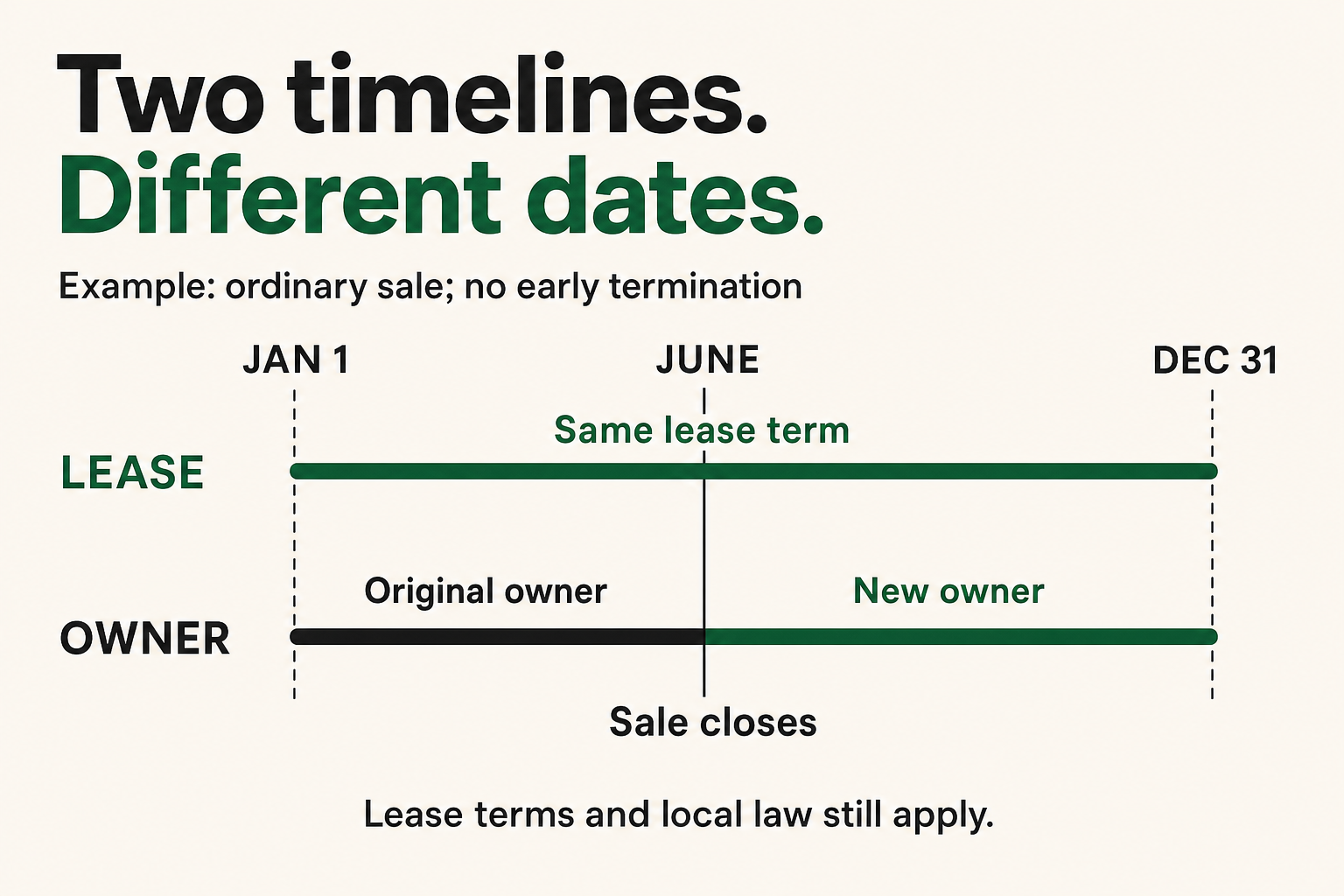
A fixed term runs between stated dates. Suppose your lease runs from January 1 through December 31 and an ordinary sale closes in June. Without a valid early-termination route, the ownership change generally leaves that December end date in place.
The important lease sections are termination upon sale, entry, renewal, notice, and any requirement to sign a lease-confirmation form. A clause allowing termination deserves local legal review before you accept a shortened tenancy. Lease language cannot settle whether a legal protection can be waived.
An ownership handoff also does not automatically require a replacement lease. Compare any proposed agreement with your current one, especially its end date, rent, fees, deposit, parking, utilities, and concessions. A document presented as routine paperwork can ask you to agree to different terms.
If you rent month to month
A month-to-month tenancy can continue through a sale. Ending it is a separate step governed by the applicable notice rules and, in some places, a legally permitted reason. Our month-to-month rental guide explains how rental periods and notice dates fit together.
There is no national rule that a sale gives every renter 30 days to leave:
- New York: The state's nonrenewal notice law uses 30-, 60-, or 90-day periods based on occupancy and lease length. It also addresses required Good Cause Eviction disclosures. Notice length alone does not resolve whether a nonrenewal is lawful.
- Washington: The state's tenancy termination law includes a specific ground for an owner electing to sell a single-family residence, with at least 90 days' advance written notice and conditions on the sale effort. That provision is not a nationwide sale rule or a blanket rule for every Washington building.
Rent control, rent stabilization, and just-cause protections can also affect renewals and rent increases. The building's coverage or exemption matters as much as its city. A lease expiring and a landlord having the right to end your occupancy are separate questions.
Treat each notice as a different document
The listing date, closing date, entry date, rent due date, and proposed termination date serve different purposes. Keeping them separate prevents a sales schedule from becoming your assumed moving deadline.
| Paper or message | What it concerns | What needs a separate answer |
|---|---|---|
| Announcement that the home is for sale | Marketing the property | Whether any tenancy-ending notice has been served |
| Notice of a showing or inspection | Entry at a stated time | Whether the entry purpose, timing, and delivery meet the applicable rules |
| New-owner or payment letter | Who manages the home or collects rent | The sender's authority, effective date, and treatment of money already paid |
| Rent-increase or nonrenewal notice | A proposed change to the tenancy | Coverage, permitted grounds, notice period, service, and effective date |
| Court summons or eviction complaint | A legal proceeding | Your response deadline and required court procedure |
State and local rules may also require notice of an intended sale, a completed transfer, or a new owner's identity. Those requirements are separate from notice to end a tenancy. USAGov's tenant-rights directory connects renters with the relevant state agencies and handbooks; city or county housing departments and rent boards cover additional local rules.
A message saying “the buyer needs it empty by closing” leaves the legal basis unanswered. Ask for the specific lease provision or legal ground, the written notice, and the proposed effective date. Preserve the original message too.
Showings still have entry rules
Selling an occupied home can mean buyer visits, appraisals, inspections, and photography. The landlord's entry rights depend on state law, local rules, and enforceable lease terms. There is no nationwide 24-hour rule, and no nationwide right to refuse every showing.
For example, California permits entry to show a rental to prospective purchasers. Its state renter handbook, pages 48–50, explains reasonable notice and normal-business-hours rules. Twenty-four hours is generally presumed reasonable, with special rules allowing oral notice of buyer showings after a qualifying written sale notice. That is more specific than “the landlord must always give 24 hours in writing.”
A practical written showing plan can address:
- Who will contact you and accompany visitors.
- Proposed time windows and how individual visits will be announced.
- Pets, work calls, accessibility needs, and household schedules.
- Whether photos will include personal belongings or identifying information.
- How keys, lockboxes, and access codes will be handled.
Requested scheduling arrangements and legal entitlements are different. Put agreed arrangements in writing, and keep a log if entries happen outside them. Repeated unannounced visits or pressure to leave during every showing warrant local help. Avoid turning an access dispute into a blanket refusal of lawful entry.
Get a written security-deposit handoff
A sale does not make your deposit disappear. The rules governing transfer, refund, notice, deductions, and responsibility between the old and new owners vary by state.
In New York, for example, the Attorney General's deposit guidance says a selling landlord must transfer deposits to the new owner within five days or return them to renters, and notify renters of the new owner's name and address by registered or certified mail. The guidance also explains that a buyer's responsibility can depend on the building and tenancy. Other states use different rules.
Ask the seller and buyer for a record showing:
- The deposit originally paid, including any separately recorded refundable deposits.
- The amount transferred or refunded and the date.
- Any claimed deductions and the supporting accounting.
- The amount the new landlord acknowledges holding for your tenancy.
Keep the original receipt even after receiving that acknowledgment. If the new owner demands a second deposit because the seller did not pass along the first, take the demand and both owners' records to local legal aid before agreeing to replace it. Our security-deposit guide covers the records that also help at move-out.
Authenticate new rent-payment instructions
A different payee and a different rent amount are two separate changes. An ownership letter may redirect payments without changing the rent owed under your lease.
Before using a new portal or account, obtain a written handoff identifying the owner or authorized property manager, the effective date, the payment destination, and the repair contact. Confirm unexpected instructions through an established contact method, such as the landlord's existing phone number, rather than only replying to the new message.
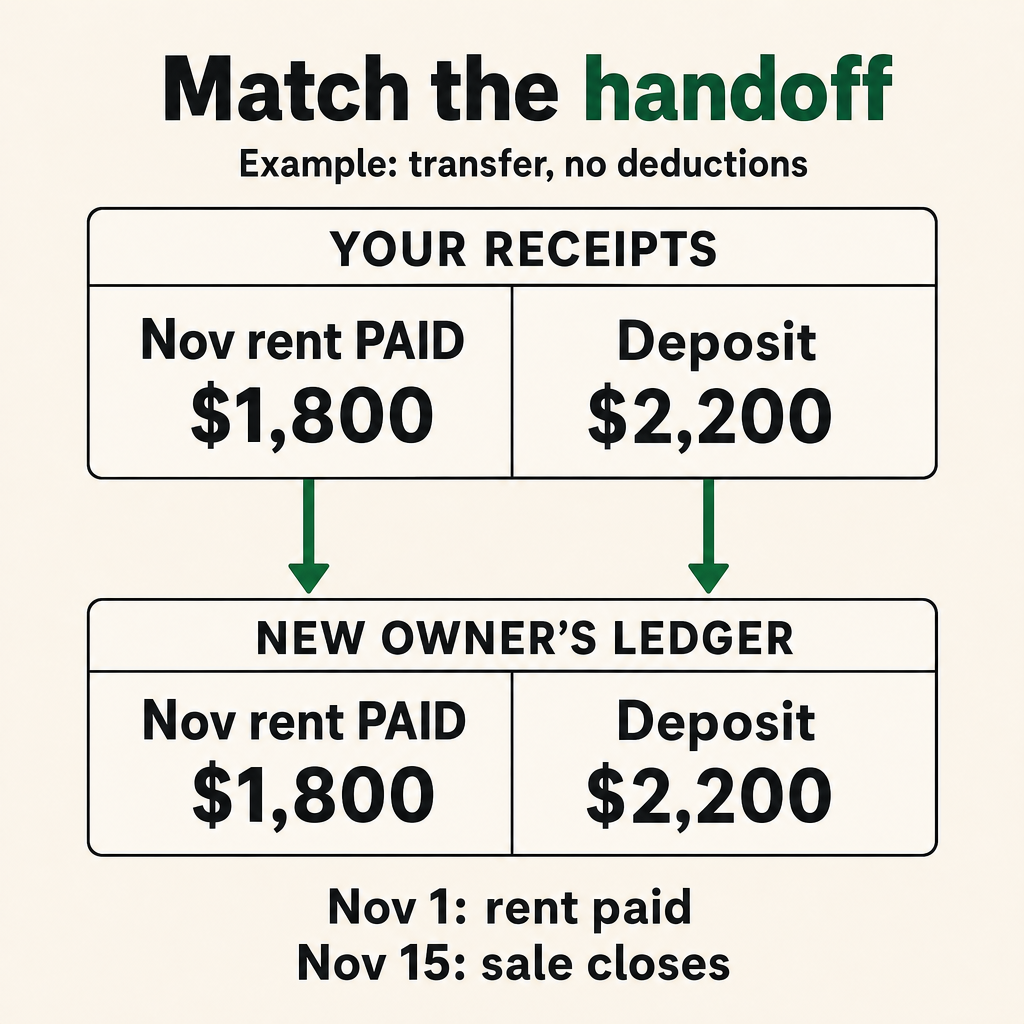
Also request a ledger showing rent already paid, prepaid rent, concessions, and outstanding balances. Suppose you paid $1,800 for November on November 1, the sale closes November 15, and your $2,200 deposit transfers without deductions. The new ledger should reflect that rent payment and deposit balance. Send your receipts if it does not.
Keep paying rent as required by your tenancy. If two parties demand the same payment, the portal closes, or nobody will identify the authorized recipient, get prompt local legal help about how to make and document a timely payment. Silence or a disputed handoff is a poor reason to simply stop paying.
This message keeps the administrative questions together:
Please send written confirmation of the ownership or management change for [address and unit], its effective date, the authorized rent recipient and payment method, and the maintenance contact. Please also confirm my current rent, payments and credits already on the account, and the security-deposit balance transferred or refunded. My records show [payment or deposit details].
That request gathers records. It does not accept a rent increase or agree to end your lease.
Foreclosure follows a different set of protections
An ordinary sale and a foreclosure sale are different events. A foreclosure filing, auction notice, or letter from a lender belongs in your sale folder immediately, even if your landlord says it is being handled.
The federal Protecting Tenants at Foreclosure Act gives qualifying bona fide tenants at least 90 days' notice before the effective date of a notice to vacate from the successor owner. A qualifying lease entered into before title transfers through foreclosure generally continues through its remaining fixed term. There is an exception for a purchaser who will occupy the home as a primary residence, but the 90-day notice protection still applies. State and local law can provide more protection. The U.S. Department of Housing and Urban Development publishes the federal foreclosure protections in section 702.
“Bona fide” has specific conditions. The renter cannot be the borrower or the borrower's spouse, parent, or child; the tenancy must be an arm's-length arrangement; and rent generally cannot be substantially below fair market rent unless reduced through a qualifying subsidy. The timing of the tenancy also matters. The Federal Reserve's explanation outlines these limits.
Bring the lease, rent receipts, foreclosure papers, and any notice to a housing lawyer. The federal protection does not make rent optional or protect every person occupying a foreclosed home. A demand to leave in 90 days also does not prove that a longer lease or stronger local protection has ended.
Subsidized housing needs a program-specific answer
Having a Housing Choice Voucher, living in a project-based assisted apartment, and renting a tax-credit unit are different arrangements. A sale announcement alone does not establish what happens to your assistance.
For Housing Choice Vouchers, federal tenancy rules restrict an owner's termination grounds. During the initial lease term, a sale or the owner's desire to occupy the home cannot serve as “other good cause” for termination. After the initial term, the rule allows business or economic reasons among possible grounds, subject to applicable requirements. The same rule says the family's tenancy cannot be terminated for the public housing agency's failure to pay its contracted share during the lease term.
Send sale and termination papers to your public housing agency or program administrator promptly. Ask it to explain:
- Your program and the rules attached to the unit.
- Any ownership-transfer paperwork affecting assistance payments.
- Your approved rent share and whom to pay.
- Whether a proposed termination is permitted and what notice is required.
- The process and timing if you want or need to move with assistance.
Do not agree to cover the agency's share because a buyer says payments are delayed. Under the voucher program's rent-payment rules, the family is not responsible for the portion covered by the housing assistance payment contract. Keep your own required share current and bring payment disputes to the agency.
Get local help before surrendering rights or missing a deadline
A local housing lawyer can connect your lease and notices to the laws for your exact address. The Legal Services Corporation directory locates legal-aid organizations by address or city. Eligibility and available services vary. Court self-help centers can explain filing procedures, while local rent boards or housing agencies can address coverage and complaint processes.
For a useful first conversation, provide your address, move-in date, tenancy type, assistance program, and any claimed exemption. Send the full lease and every page of the notice. Flag the date and method of delivery, the proposed move-out date, and any court response deadline. Mention rent control, disability-related needs, or alleged retaliation where relevant.
Court papers need prompt attention even when you believe the landlord is wrong. A complaint to a housing agency or an ongoing negotiation does not replace a required court response.
Lock changes intended to force you out, shutoff of landlord-controlled utilities, or withheld necessary repairs call for urgent help. The Consumer Financial Protection Bureau's tenant-rights guidance explains these protections. A sale does not give the landlord permission to bypass them.
If the landlord offers money to leave
A buyout, sometimes called cash for keys, asks you to agree to a departure. It is separate from whether the landlord can legally require one. Local protections add another layer: Berkeley regulates covered buyout agreements, while Portland requires relocation assistance for covered landlord-initiated terminations, with exemptions.
Before signing, have the agreement address the payment amount and timing, moving date, rent through that date, deposit accounting, release of future rent obligations, and any claims you would give up. A housing lawyer can identify mandatory payments or rights that the proposed deal overlooks.
If you want to leave early yourself, the sale alone does not establish a penalty-free exit. Our lease-exit guide explains why a written release matters before you commit to another home.
Keep your next move on your terms
The useful outcome is a clear record: what tenancy continues, which dates apply, who receives rent, and where your deposit sits. A sale can change your landlord without requiring an immediate apartment hunt.
If moving becomes the right choice, give us your budget, location, and move-in window. We find matches, call landlords or leasing offices, and book tours in the metros we cover. Start your rental search while your current tenancy gets its own clear resolution.