Renter guide
Renewing an Apartment Lease: Should You Stay or Start Looking?
Renewing an apartment lease? Compare deadlines, changed terms, and stay-or-move costs with practical help from Fairway, the AI agent for renters.

A renewal offer can make staying feel like the easy option, right up until the new fees arrive or the response deadline leaves you barely any time to think. You already know the apartment's good and bad sides. The harder part is deciding what another term is worth. And you're the one lining up the alternatives.
A useful renewal decision brings the dates, the new agreement, and the cost of moving into one comparison. That gives you room to negotiate, stay with confidence, or reopen the search before the calendar makes the choice for you.
Know what happens when your current lease ends
Renewing an apartment lease means continuing in the same home for another agreed term. The paperwork might be a new lease or a renewal agreement that carries forward parts of the existing lease. Either way, the proposed rent, dates, fees, and attached rules deserve a fresh read.
If you want alternatives while weighing the offer, Fairway is our AI agent for renters, free for renters. Tell us what you need; we find matches, call landlords or leasing offices, and book tours. You can compare real options in the markets we cover without committing to a move.
There are three possible paths to discuss with your landlord:
- Another fixed term: You agree to stay until a new end date, under the renewal's terms.
- A shorter extension or month-to-month arrangement: You gain time or flexibility, with its own price and notice requirements.
- Moving out: You end the tenancy under the applicable notice rules and coordinate the next home.
Doing nothing has its own consequences. Some leases include automatic-renewal provisions, as Los Angeles County explains. Depending on your agreement and applicable law, a lease may renew automatically, continue month to month, or end without giving you permission to stay. California's state renter guidance, for example, distinguishes fixed-term tenancies with just-cause protections, which limit a landlord's reasons for ending a tenancy, from those without them. Silence is a poor moving plan.
Separate the renewal deadline from the move-out deadline
The date your lease ends may be weeks after your actual decision is due. Pull these four dates into one calendar:
| Date | What it controls |
|---|---|
| Current lease end date | When the existing fixed term finishes |
| Renewal response or quoted-rate deadline | How long the landlord says the offered terms remain available |
| Your move-out notice deadline | When and how you must give notice if you leave |
| New term or rent-change effective date | When the new agreement or price would begin |
Where state or local law requires notice of a rent increase or nonrenewal, the landlord's notice runs on a separate clock. It does not automatically tell you how much notice you owe before leaving.
There is no nationwide “renew 30 days before move-out” rule. In New York City rent-stabilized apartments, for example, owners generally offer renewals 90 to 150 days before the lease expires, and renters have 60 days after the offer to choose a term, sign, and return it. Those rent-stabilized renewal rules apply to that housing category, rather than every apartment in New York or the country.
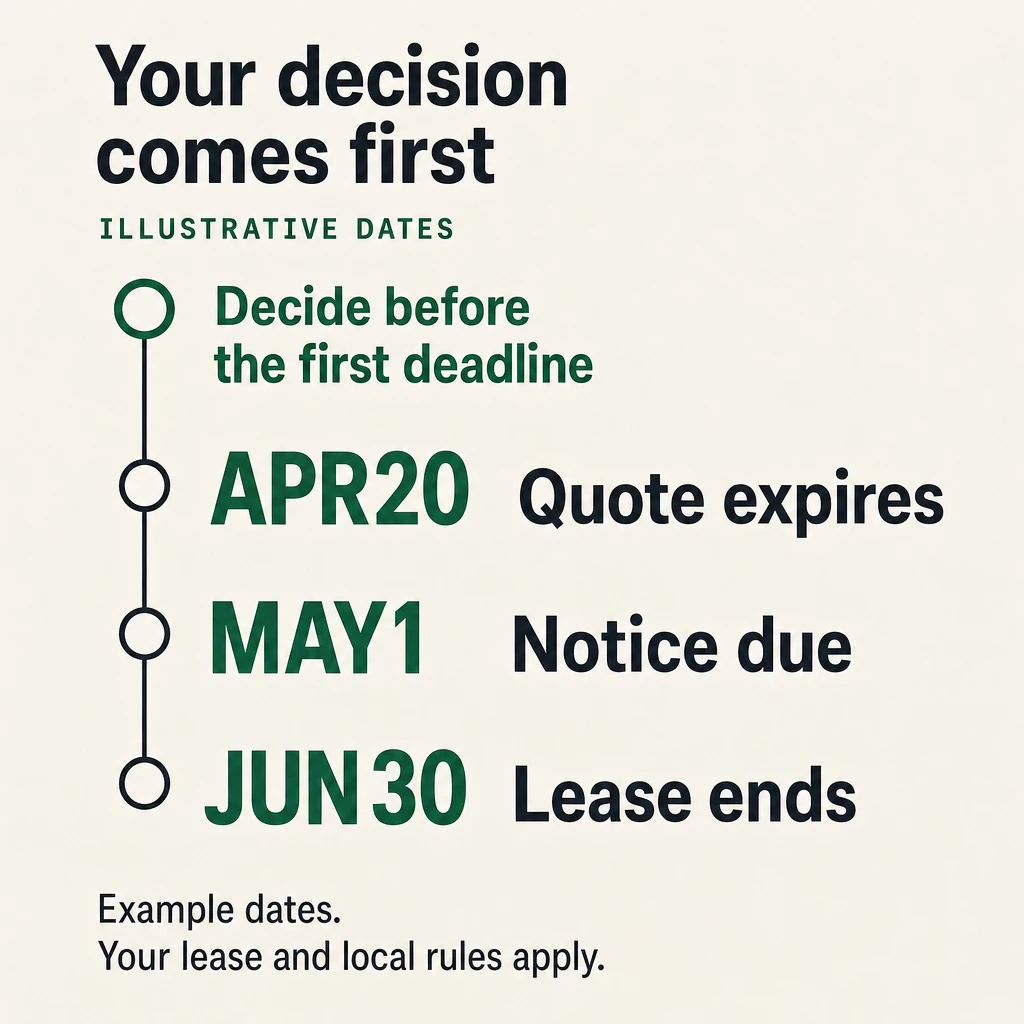
For planning, consider a hypothetical lease ending June 30. Your agreement requires move-out notice by May 1, while the renewal quote expires April 20. Your first decision target belongs before April 20. Waiting until June to compare apartments leaves both earlier dates behind you.
If the renewal offer has not arrived
Request the complete offer before your earliest decision deadline. Ask for the proposed rent, all recurring charges, available term lengths, attached agreements, response deadline, and what happens if you do not sign a fixed-term renewal.
If you need more time, request a written extension that names each affected deadline. An extension of the quoted price does not necessarily extend a contractual move-out notice deadline. A conversation about negotiating does not establish either extension.
For formal notices, use the delivery method required by your agreement and applicable law. Keep the notice, delivery record, and written response together. A portal message or casual email may serve a different purpose from formal notice.
If the landlord's dates conflict with your lease or renter protections, get help from a tenant-rights agency or legal aid before treating the demand as settled. A deadline in an email does not resolve whether the demand is lawful.
Compare the entire renewal, including the attachments
Open the current lease and proposed renewal side by side. Renewal terms can change rent, lease length, fees, and building rules, as Fannie Mae explains. A familiar address does not mean familiar obligations.
Focus on the changes that affect your budget or ability to live there:
- Rent and concessions: Separate base rent from a temporary credit. Record when each credit ends and whether any repayment conditions apply.
- Recurring charges: Include parking, pet rent, amenity packages, trash, internet, billing charges, and any other required monthly payment. Identify which services are optional.
- Utilities: Note who pays, which utilities are included, and whether the allocation or billing method changes. Your own bills are a useful starting point for the renewal budget.
- Term and exit rules: Compare the start and end dates, next notice requirement, automatic-renewal language, transfer options, and early-exit costs.
- Household and use rules: Look for changes involving roommates, occupants, guests, pets, smoking, insurance, or access to spaces you use.
- One-time payments: Identify any renewal fee, deposit increase, or other charge, along with its stated basis. Its appearance on the offer does not establish that it is permitted locally.
A concession can hide a bigger change than the headline increase suggests. Suppose your first lease charged $2,200 per month with one free month over 12 months. The rent averaged about $2,017 per month. A renewal at the same $2,200 base rent without the credit costs $2,200 more over the year, even though the base rent did not rise. Our rent concession guide explains how credits and advertised net-effective rents differ.
If a roommate is leaving, settle the household paperwork early. Ask who will be named on the renewal, what approval a replacement needs, how the deposit will be handled, and what written release the departing renter will receive. Budgeting around a replacement who has not been approved leaves a gap someone still has to cover.
Renewal rights also depend on the home. In New York's rent-stabilized system, renewal leases generally retain the expiring lease's terms and conditions. A market-rate landlord's proposed rewrite is not a universal model for a protected tenancy.
Compare staying and moving over the same period
A $150 difference in advertised rent is only the start. Compare apartments you would actually take, with similar space, condition, commute, parking, pet arrangements, and available dates.
Use the same number of months on both sides. If you are weighing a 12-month renewal against a 12-month new lease:
Total cost = rent + recurring fees + utilities and other housing costs + one-time costs − credits.
Count a credit once. If an advertised net-effective rent already includes free rent, subtracting that concession again makes the alternative look cheaper than it is.
Include changes in insurance and transportation costs. Equal costs can be left out of both sides.
Here is a hypothetical comparison. Utilities are estimates; insurance and transportation costs are assumed equal and omitted from both sides.
| Cost over 12 months | Renew here | Move to another apartment |
|---|---|---|
| Base rent | $2,200 × 12 = $26,400 | $2,050 × 12 = $24,600 |
| Monthly fees for required services and features you need | $100 × 12 = $1,200 | $175 × 12 = $2,100 |
| Estimated utilities | $150 × 12 = $1,800 | $175 × 12 = $2,100 |
| Moving truck or movers | $0 | $1,200 |
| Application and setup charges | $0 | $150 |
| Extra rent for overlapping move dates | $0 | $600 |
| Total | $29,400 | $30,750 |
The alternative's base rent is $150 lower. Its ongoing housing cost is only $50 lower per month after fees and utilities: $2,400 versus $2,450. With $1,950 in one-time moving costs, moving costs $1,350 more over the first year.
At those monthly costs, recovering the $1,950 through $50 monthly savings would take 39 months. A 12-month quote does not establish what either home will cost for the following 27 months. That makes the first-year comparison more useful than assuming future savings will eventually fix the math.
If the offers have different term lengths, keep the unknown months visible. A nine-month rate cannot establish a 12-month total without a price for the remaining three months. Our apartment budget guide can help you fill in the spending categories beyond rent.
Keep move-in cash separate from total cost
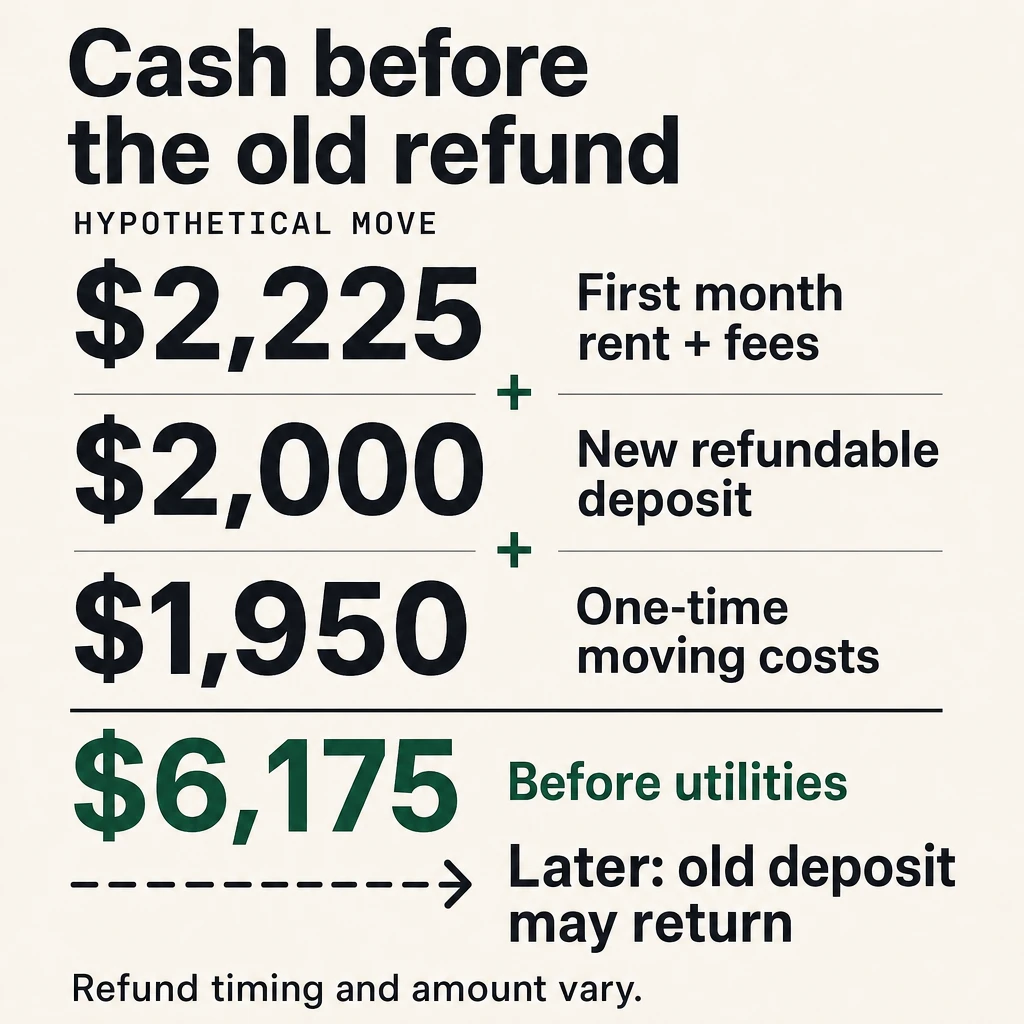
A refundable deposit is money you need available, even though it is not automatically a permanent expense. Your old deposit may still be held when the new one is due.
In the example, a new $2,000 refundable deposit, $2,225 for the first month's rent and fees, and $1,950 in one-time costs would require $6,175 before utilities, if all fall due before the old deposit comes back. The first month's rent is already included in the annual total. Do not add it again as another annual expense.
Map the payment dates as well as the amounts. A move can fit your yearly budget and still create a cash shortage before you get the keys.
Make one specific renewal request
Once you have comparable offers and a total you can afford, choose the change that would make staying worthwhile. That might be lower base rent, a parking discount, a credit, a different term, or a written repair commitment with a completion date.
A short request gives the landlord something concrete to answer:
I'd like to stay for another 12 months. The proposed rent is $2,200 plus $100 in monthly fees. Similar apartments I'm considering are $2,200 to $2,250 including required monthly fees, before utilities. Would you offer a 12-month renewal at $2,150 with the current fees unchanged? Please send the complete revised terms in writing by [date], ahead of my decision deadline.
Use actual comparables and your own numbers. A strong payment record can support the request, but it does not guarantee a discount. Avoid threatening to move unless moving is a workable option.
If base rent is firm, compare any alternative offer in dollars. A $300 one-time credit equals $25 per month across a 12-month term. A recurring $25 fee waiver has the same first-year value, though the conditions may differ. Our rent negotiation guide covers how to frame the offer.
Restart the apartment search before staying becomes the default
You do not need to reject a renewal to explore alternatives. Begin a focused comparison while you still have time to request prices, tour, apply, and coordinate a move.
A wider search earns the effort when:
- The renewal exceeds your workable monthly budget. A landlord accepting a small counteroffer still may not solve the shortfall.
- Comparable homes offer meaningful savings after moving costs. Use the full period you are committing to, including mandatory fees and concession conditions.
- The apartment no longer fits daily life. A changed commute, inaccessible layout, lost roommate, or need for more space can outweigh a modest price advantage.
- Problems are carrying into another term. Repeated leaks, poor sleep, unresolved repairs, or unresponsive management have a cost even when it is hard to put in a table.
- The proposed term creates a foreseeable exit problem. If you expect to relocate in six months, a cheaper 12-month renewal may expose you to costs that a shorter arrangement avoids.
Set a maximum monthly cost and identify the changes that would make you leave before negotiating. That makes it easier to recognize an acceptable offer instead of accepting the last offer because you are tired.
If a short bridge would help, compare the premium and notice terms of month-to-month rentals against a fixed extension. Availability of either arrangement depends on the landlord and applicable protections. Leaving without another home and assuming you can later retract your notice is a risky way to create extra time.
Finish with a clear agreement or a clear move-out plan
If you stay, get the accepted rent, dates, fees, credits, household changes, and repair commitments into the final paperwork. Keep the version signed by all required parties, including every incorporated attachment. Update any scheduled rent payment for the correct effective date.
If you leave, deliver the required notice, retain the delivery record, and get the rent-responsibility end date and move-out arrangements documented. Plan the key return, condition photos, inspection arrangements, and forwarding address alongside the next move-in date.
Renewing makes sense when the home still fits, the complete terms work, and staying compares well with realistic alternatives. Moving earns a closer look when price, fit, or flexibility no longer holds up.
If you need those alternatives, start your apartment search with Fairway. Tell us your budget, move date, and must-haves. We'll find matches, make the calls, and book tours while you decide whether staying is still your best option.